

"Humanity, created by God in all its grandeur, is today facing a pivotal choice." -- Pope Leo XIV
Stop right there.
Before the pope talks about artificial intelligence, before he talks about dangers or policies or the future of work, he starts with one word about you. Grandeur.
You were created in grandeur.
That was important to Pope Leo XIV, and so it is the foundation of everything that follows.
On May 25, 2026, the first American pope released "Magnifica Humanitas." The Latin can be rendered either "Humanity in Its Grandeur" or "Magnificent Humanity."
We use the former throughout this breakdown because it captures the document's central claim: that the grandeur belongs not to us but to God, who bestowed it.
The full title is "On Safeguarding the Human Person in the Time of Artificial Intelligence." And the document's core argument is not that AI is scary. It is that you are magnificent, because God made you so, and that magnificence must be safeguarded.
Pope Leo quotes the Second Vatican Council's great Christological claim, that "only in the mystery of the Word made flesh" does the mystery of humanity truly become clear (No. 1). Everything in this encyclical flows from that one conviction: if you want to understand what a human being really is, look at Jesus Christ. No algorithm will show you. No data set will tell you.
Only the face of the Incarnate God reveals the full truth of who you are.
We are going to walk through every major section, pull out the most important ideas, and help you understand what this document is really asking of you, your parish, and your family.
You can (and should) read the full encyclical on Vatican.va.
A Note Before We Begin: What Is an Encyclical?
An encyclical is one of thee most authoritative forms of papal teaching. Only bested by an actual infallible decree made "ex-cathedra" or from the seat of Peter.
The word comes from the Greek for "circular letter," and it means the pope is writing to the entire Church and, in this case, to all people of goodwill.
Catholics are called to receive an encyclical with what the Catechism calls "religious submission of mind and will" (CCC 892). This is not just an opinion piece. It is not a blog post from the Vatican. It is the Holy Father exercising his teaching office on a matter he considers urgent for the life of the Church and the world.
You do not have to agree with every practical suggestion, but you are called to take the teaching seriously, pray with it, and let it form your conscience.
Pope Leo XIV signed Magnifica Humanitas on May 15, 2026, the exact 135th anniversary of Pope Leo XIII's "Rerum Novarum," the foundational document of modern Catholic social teaching.
That timing was deliberate.
He is drawing a straight line from the first industrial revolution to this one and saying: the Church has something to say about the machines of our age, too.
The Heart of It: You Are More Than a Machine
Before we walk through the chapters, you need to know the beating heart of this document.
It is not a warning.
It is a love letter.
Pope Leo writes that when human dignity is threatened by new forms of dehumanization, "ours is the pressing duty to remain profoundly human" and to "lovingly safeguard the grandeur of humanity" revealed in Christ, "the splendor of which no machine can ever replace" (No. 15).
That is the thesis.
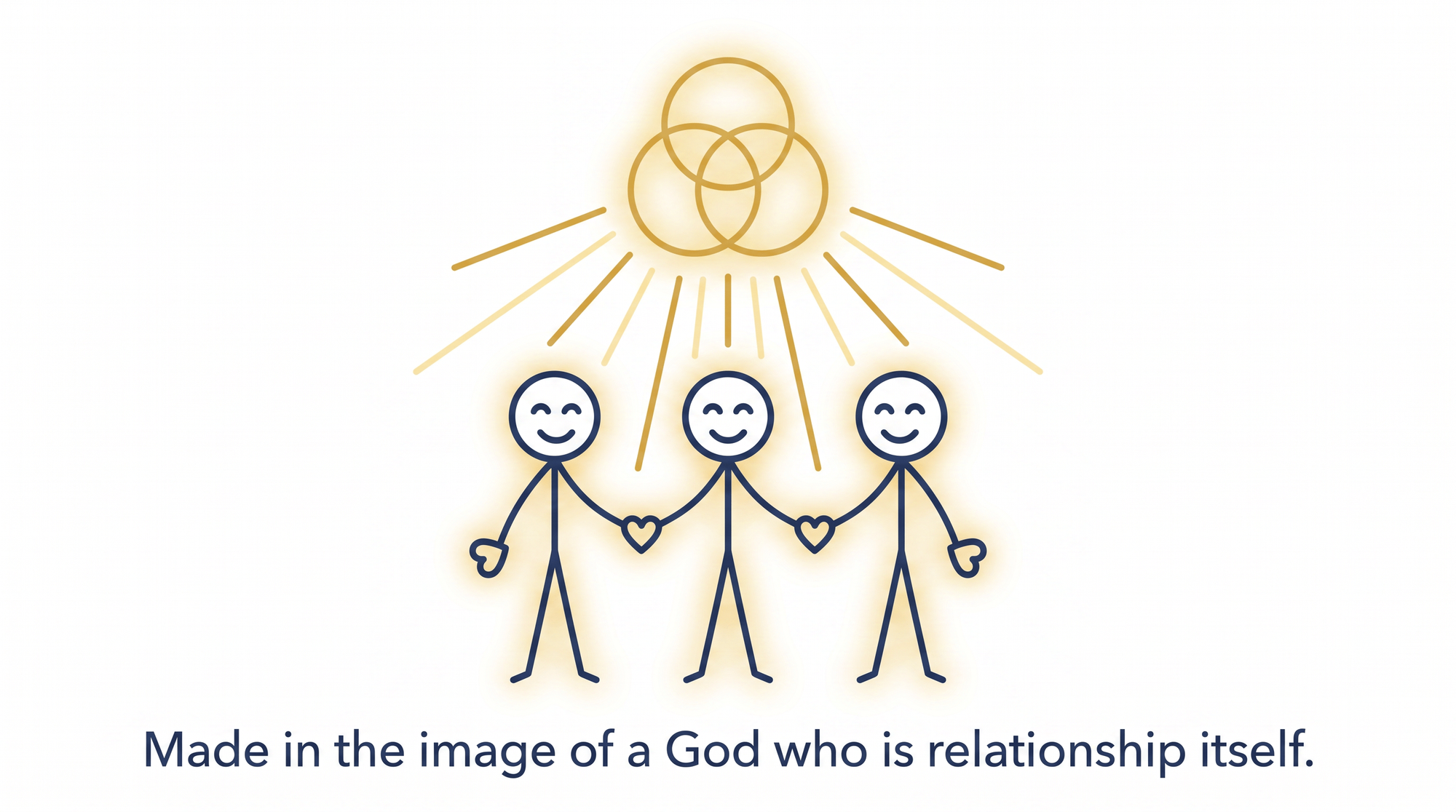
Everything else, the chapters on work, truth, war, technology, is in service to this one claim: you are made in the image of the Triune God, you are called into communion with Him and with one another, and that calling is more real, more lasting, and more magnificent than anything silicon and code will ever produce. Period.
The encyclical roots every principle, not in bureaucratic efficiency, but in who God is and who we are in Him.
When the pope talks about subsidiarity, he is not giving an administrative tip. He is saying that because every person is made in the image of a God who is a communion of persons, social structures must respect that dignity from the ground up.
When he talks about solidarity, he is not making a political argument. He is saying that because we are one Body in Christ, the future of each person is bound to the future of all.
The theological spine of this document is Trinitarian. The Father creates us in grandeur. The Son reveals what that grandeur looks like in the flesh. The Spirit sustains our capacity to build together rather than to dominate.
Everything practical in Magnifica Humanitas hangs on that frame.
Chapter by Chapter: What Pope Leo Actually Says
Babel or Jerusalem? (Introduction)
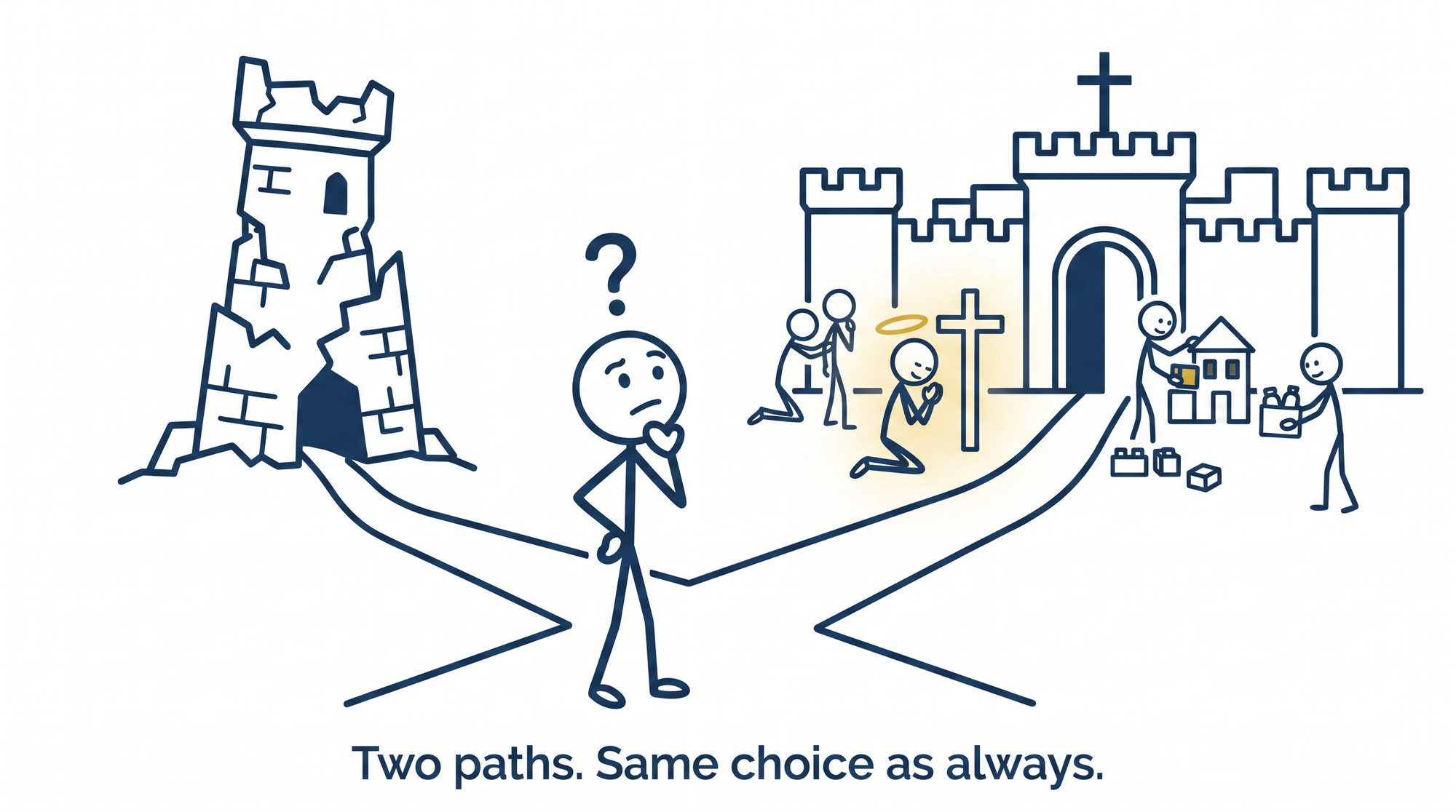
Pope Leo opens with a choice: humanity can build another Tower of Babel, or it can rebuild the walls of Jerusalem like Nehemiah did.
The Babel temptation is what he calls the "Babel syndrome," the idolatry of profit that sacrifices the weak, the pretense that a single language, even a digital one, can translate everything, "including the mystery of the person, into data and performance" (No. 10).
But Babel is only half the story.
The pope spends just as much time on Nehemiah, the Old Testament leader who organized the rebuilding of Jerusalem's walls. Nehemiah did not impose a solution from above. He listened. He assigned each family a section of the wall. He prayed. He built community.
The city was reborn "not through the initiative of one man, but through the shared responsibility of all" (No. 8).
This is the model for Christians approaching AI: prayerfully, together, with room for everyone to contribute.
And the pope draws out four principles from Nehemiah's example.
First, building for the common good means building on a firm relationship with God, recognizing that our hearts were made for Him and will remain restless until they rest in Him (No. 11).
Second, it means accepting the limits and weakness of humanity "without considering them an error to be corrected" (No. 12).
Third, it requires shared responsibility and courage, because "no one is so weak that they cannot play their part," for as St. Paul wrote, "power is made perfect in weakness" (2 Cor 12:9, No. 13). Every person is given their own section of the wall: scientists, workers, educators, artists, parents, grandparents, children.
Finally, it requires what the pope calls "an evangelical language," words that shed light rather than humiliate, frankness that opens new possibilities rather than fueling fear (No. 14).
The pope closes his introduction with an image that should stop you in your tracks. He says the "rejected stones," the poor, the sick, the migrants, the least among us, "will become the cornerstone" of the common home we are building (No. 16).
And then he invites us to abandon the Babel project and "join forces in building up the common good."
The Tradition Behind the Teaching (Chapters 1-2)
These chapters are dense, but they are the foundation. If you have read our Lumen Gentium breakdown, you know how Vatican II reshaped the Church's self-understanding.
Pope Leo walks through what each modern pope has taught about social issues. He quotes St. John Paul II extensively, draws on Pope Benedict XVI's insight that modern man is wrongly convinced he is the sole author of himself, and builds on Pope Francis' critiques of the throwaway culture (see our Fratelli Tutti breakdown for more on that tradition).
The key move is theological, not administrative. Every principle the pope highlights is rooted in the mystery of God as Trinity.
The common good is not a political slogan.
It is the social expression of the dignity that belongs to every person because God willed them into being.
Subsidiarity is not just about keeping decisions local. It flows from the truth that each person is created for relationship and responsible participation.
Solidarity is not mere interdependence. It is "the concrete recognition that the future of each individual is connected to the future of all" (No. 73), because we are members of one another in Christ.
Pope Leo then turns the mirror on the Church herself.
He calls the social doctrine "an examination of conscience for the Church" (No. 86), insisting that the principles must be applied within ecclesial structures too. He calls for transparency, accountability, and genuine participation by the baptized. And he asks forgiveness for the wounds caused by abuses of power within the Church (No. 89).
The Grandeur of the Human Person (Chapter 3)
This is where the encyclical gets sharp.
But it starts with beauty.
Before addressing any specific technology, Pope Leo confronts the philosophy driving the most ambitious claims about AI. Transhumanism and posthumanism, he explains, form "an archipelago of conceptual islands" connected by one common assumption--that human limitations are problems to be solved through technology (No. 116).
Transhumanism envisions enhancing human beings through biomedicine and engineering to extend life, sharpen cognition, and reduce suffering.
Posthumanism goes further, imagining a future where the boundary between human and machine dissolves entirely.
The pope does not dismiss these movements with a wave of the hand.
He takes them seriously enough to name what is dangerous about them. If the human being is treated as something to be perfected or surpassed, "it becomes easier to accept that some lives are less useful, less desirable or less worthy" (No. 117). In the name of progress, "necessary sacrifices" may begin to be justified. Often then the burden falls on the most vulnerable.
But here is where the encyclical does something remarkable. The pope's answer to transhumanism is not a defensive "no." It is a better "yes."
He begins with limitation itself. Everything that appears as a limit, the pope writes, incapacity, illness, old age, suffering, vulnerability, "tends to be seen primarily as a defect to be corrected" rather than as a reality through which our humanity matures (No. 118).
Yet we flourish "not despite limitations, but often through them."
Stop and think about that.
It runs directly counter to every message our culture sends about optimization and self-improvement. It is, if you think about it, the logic of the Cross.
The pope presses further.
It is precisely within our limitations that the deepest human capacities find their place: compassion, generosity that emerges even in darkness, spiritual experience, the worship of God (No. 119).
When we face rejection, when we suffer the illness or loss of someone we love, when we encounter our own weakness, "it is precisely in such moments" that we discover resources we did not know we had.
And then comes a line that will stay with you.
To eliminate suffering entirely, the pope writes, would mean "extinguishing love and desire as well" (No. 120).
Those who love cannot avoid passing through trial. Over the years, we carry within us lessons that leave their mark like scars, a journey shaped by freedom and failure, dreams and disappointments.
This is not a defect.
This is what it means to be human.
Pope Leo then shows what this looks like in real lives. He points to the founding of the Red Cross, the abolition of slavery, the Universal Declaration of Human Rights, the creation of institutions that protect our shared life (No. 123).
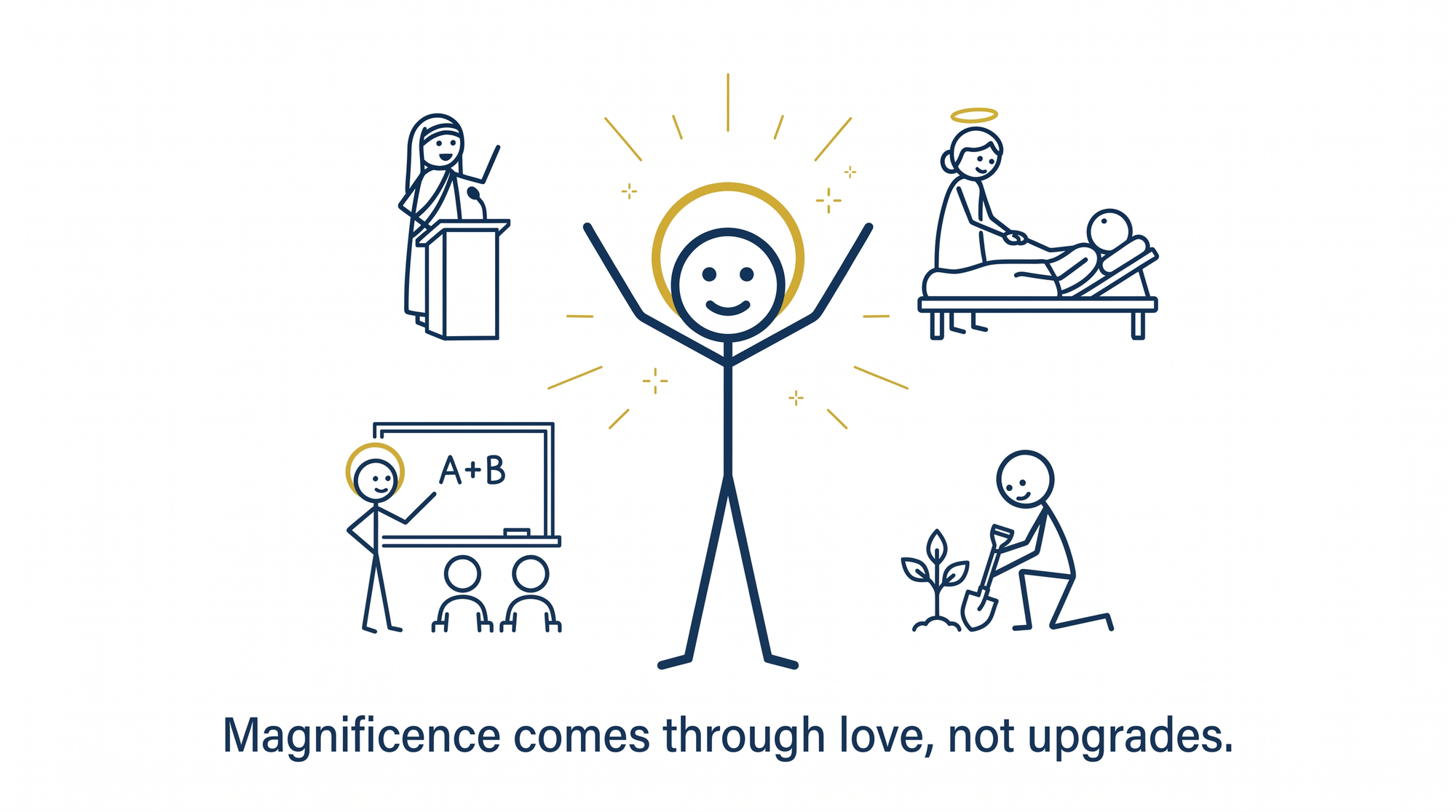
He lifts up the civil rights movement and Martin Luther King Jr., the end of apartheid through Nelson Mandela's refusal "not to surrender the future to hatred" (No. 124). And he names courageous women: St. Laura Montoya, St. Teresa of Calcutta, Dorothy Day, Marie Curie, Maria Montessori, Elisabeth Elliot, Wangari Maathai, "and countless others from every continent."
These are not people who transcended their humanity through technology.
They are people whose humanity became radiant through love, through suffering, through encounter with the God who entered into limitation Himself.
And this leads the pope to his most audacious claim.
The expression "more than human" is not the exclusive domain of technology (No. 127). For centuries, the Christian tradition has taught that human beings are called to self-transcendence, not through escape from their limits, but through their fulfillment in love.
As Pope Francis put it, "We become fully human when we become more than human" by letting God bring us beyond ourselves (No. 128).
This is the radical departure from the transhumanist dream.
What saves humanity is not enhanced self-sufficiency. It is "a relationship that liberates, a communion that transforms."
Algorithms treat errors as flaws to correct.
But for a person, "an error can be a catalyst for profound change." A person's future is not calculable. It depends on freedom, elevated by grace.
Pope Leo also addresses AI directly. He insists it is not equivalent to human intelligence. AI systems have no body, no experience of joy or pain, no relationships. They "do not know from within what love, work, friendship or responsibility mean." Nor do they have a moral conscience.
In a remarkable paragraph, the pope applies each social principle specifically to AI (No. 109). The common good means "exposing this new form of epistemic, economic and political asymmetry."
The universal destination of goods means ensuring universal access to both the technologies and the education to use them.
Subsidiarity means "protecting the ability of communities to make choices and corrections."
Solidarity means recognizing "the hidden, often exploited workers" who sustain algorithmic systems.
Justice means questioning who has the power to build these models and who is merely subjected to them.
The chapter closes with a vision of "two cities and two loves," (No. 129).
Christian humanism does not reject science or technology. It embraces them with gratitude and grounds them within a higher calling. The true choice is not between enthusiasm and fear. It is between two paths: a progress that serves people and the common good, or a progress that concentrates power and discards whoever falls behind.
Truth, Work, Education, and Freedom (Chapter 4)
If Chapter 3 was about who we are, Chapter 4 is about how we live.
On Truth: Pope Leo calls truth a common good, not the property of those with power or influence. He argues that "the search for truth is an essential element of democracy" (No. 134), and that indifference to truth leads slowly but surely toward totalitarianism.
He cites the philosopher Hannah Arendt, whose warning cuts to the bone: the ideal subjects of authoritarian regimes are not the ideologically convinced, but people for whom the distinction between true and false simply no longer exists.
This matters because the problem is no longer just misinformation. It is the erosion of the very idea that truth is worth pursuing.
When questions about what is true lose their appeal, Pope Leo writes, a pragmatism takes hold that is content with "what appears useful or effective" rather than what is right (No. 134). The pope warns that those who command powerful technological and economic resources "possess significant capabilities for influencing cultural change" and can shape how millions of people perceive the world (No. 133).
His response is not censorship. It is what he calls an "ecology of communication," a cultural ecosystem with transparent algorithms, protection of personal data, stronger journalism, and formation in digital literacy for families and schools.
Communication, he reminds us, "is not only the transmission of information, but it is also the creation of a culture" (No. 135).
On Education: Before turning to work, the pope pauses on something every parent needs to hear. Psychological and psychiatric research has documented how early and unsupervised exposure to digital devices can negatively impact sleep, attention, emotional regulation, and relationships in children (No. 141).
It is difficult for parents to resist business models that monetize attention. The pope calls for an alliance among policymakers, educators, and families that can protect young people (No. 142).
School, he writes, is the place where new generations learn to "seek and love the truth" and to recognize the dignity of every person (No. 143).
He calls for "education in digital sobriety," honest evaluation of screen time, and the cultivation of hearts that love truth and pursue wisdom over immediate results.
Families, schools, parishes, and public institutions must forge "a renewed educational alliance" for the digital age.
On Work: The pope says mass unemployment from AI adoption would be a "grave evil" and a "social calamity," echoing St. John Paul II (No. 151).
He insists that the pursuit of greater profits cannot justify choices that systematically sacrifice jobs. The human person is always the end, never the means.
He notes a painful irony: AI promises efficiency, but current approaches often "de-skill workers, subject them to automated surveillance, and relegate them to rigid and repetitive tasks" (No. 150).
The "new ways" of working are not necessarily better. He proposes that every introduction of automation should come with "verifiable measures to protect the employment" and retraining of workers (No. 156). And he insists that politics, not the invisible hand of the market, must orient economies and technologies toward the common good and dignified work (No. 163).
On Modern Slavery: In one of the encyclical's most striking passages, Pope Leo turns the Church's social teaching on herself. He acknowledges that it took the Church eighteen centuries to explicitly recognize the incompatibility of slavery with human dignity.
Past events cannot be judged anachronistically, he writes, as though the moral criteria that matured over time had always been available. But neither can we deny the delay with which both society and the Church came to denounce this scourge (No. 176).
And then he says something a pope rarely says:
"For this, in the name of the Church, I sincerely ask for pardon" (No. 176).
He does not leave this as a historical footnote. The memory of past complicity becomes "a call to vigilance" in the present (No. 177). To prevent the need for repeated apologies, the pope urges us to take immediate action against the modern forms of exploitation prevalent in the digital economy.
This includes the poorly compensated content moderators who sift through disturbing material, the workers who extract rare earth minerals in hazardous conditions, and the individuals who are trafficked and exploited behind the scenes of our digital convenience.
On Freedom: Pope Leo warns about subtler forms of control through data collection and algorithmic systems.
The same technologies that connect us can also "support models that exploit the most vulnerable" and create new dependencies. He calls for spiritual discernment in every technical decision, asking whether the advances we celebrate truly "correspond to the cry of the earth and the cry of the poor."
AI and War (Chapter 5)
The final chapter addresses the normalization of war through technology, and it pulls no punches.
Pope Leo argues that we are witnessing a real paradigm shift in public discourse about war, "a troubling revival of war as an instrument of international politics" (No. 190).
The ethical principles that once limited the use of force are being eroded.
Regional conflicts multiply. Alongside conventional warfare, there are now hybrid forms: cyberattacks, information manipulation, campaigns of influence, and the automation of strategic decisions (No. 183).
AI acts as an accelerating factor in all of these.
At the core of these issues, the pope writes, is a "false realism" rooted in the belief that war is an inevitable part of human nature (No. 205).
It is said that things have always been this way and always will be.
As a result, the concern is no longer the search for peace but rather how and when to take military action. Peace has been "lost as a point of reference on the international stage."
Against this, the pope lays down non-negotiable requirements.
He states that "no algorithm can make war morally acceptable" (No. 198). All systems used in warfare must guarantee the ability to retrace decision-making processes, so that accountability is not collapsed into "the machine" (No. 200).
The decision to use lethal force must remain with a human being, not a system.
But the pope does not leave us in despair.
He names the construction of a world in perpetual conflict for what it is: an evil (No. 210). And then he reminds us that the Christian perspective is never limited to denouncing evil. We view history "in the light of the crucified and risen Lord" and do not consider the present as a predetermined fate, but as an opportunity for conversion.
He pushes back against the common objection that no individual can make a meaningful difference. And here, he reaches for a surprising ally: J.R.R. Tolkien.
Pope Leo quotes Gandalf's rallying cry from "The Return of the King," the speech where Gandalf tells his companions that their part is not to master all the tides of the world but "to do what is in us" for the age in which we live, uprooting evil in the fields we know so that future generations may have clean earth to till (No. 213).
Yes, the pope quotes Tolkien. And it works beautifully, because Tolkien was a devout Catholic, and Gandalf's speech is really about the kind of hope that does not depend on guaranteed outcomes.
It depends on faithfulness.
All of us, at every level, can contribute to building the foundation of peace, which is justice (No. 215).
The Song of Hope (Conclusion)
This is where the encyclical lifts your eyes.
And it is the part you most need to read.
Pope Leo does not end with policy recommendations. He ends with Christ.
He begins the conclusion with St. Paul's counsel to the Corinthians: "Let each builder choose with care how to build" (1 Cor 3:10, No. 229). We have reflected on the world we are building.
Now the pope asks:
what kind of builders will we be?
Our world, he writes, is filled with attempts to seize control of markets and spheres of influence, "often shrouded in reassuring rhetoric and seductive ideologies" (No. 230).
Yet our hearts yearn for something wiser and more benevolent.
Something like what Mary praises in her Magnificat: God's mercy extending in every generation to those who fear Him. This plan of mercy continues to unfold even "amid the rapid and unsettling changes brought by algorithms and global networks."
Against the promises of transhumanism and posthumanism, which seek an enhanced and almost disembodied humanity, the pope presents the mystery of the Incarnation (No. 232).
Old and new ideologies alike dream of transcending our nature. But the Word became flesh. And in so doing, God did not bypass our limitations. He entered into them. He sanctified them. He invites everyone to contemplate, in the face of the Son of God, "the grandeur of humanity" that shines a light on every era, including the era of AI (No. 233).
Then the pope turns to the Eucharist.
He calls for "a Eucharistic spirituality, that is, a spirituality of ecclesial unity in love" (No. 234). The Incarnation and the Paschal Mystery reveal God entering our human condition and transforming it through the gift of Himself.
That gift remains present and active in the Eucharist, in which the Lord gives Himself and gathers the Church into one body.
The Eucharist, the pope writes, "opens us to justice and sharing" with a preferential concern for the poor and marginalized (No. 235).
This is the Church's alternative to the technocratic paradigm.
Not a competing system.
A different kind of life altogether. A life where you receive the Body and Blood of Christ and then go out to become what you have received. (If you want to see the evidence for the Real Presence, start with our deep dive on Eucharistic miracles.)
What follows is a series of exhortations that read almost like a litany.
- Let us remain faithful to the truth (No. 237).
- Let us invest in education, beginning with ourselves (No. 238).
- Let us cultivate relationships, because "the human heart retains an irrevocable need" for genuine encounter (No. 239).
- Let us love justice and peace (No. 240).
Each one is both a prayer and a command.
The pope returns one final time to Nehemiah, calling him "a striking parable of our own vocation" in the digital age (No. 241).
Nehemiah heard the cry of a devastated city. He brought that pain to prayer. He discerned before God. He asked for help. He organized the work. He confronted resistance. And he rebuilt the walls "with the assistance of the people, brick by brick."
And from Nehemiah, the pope lifts the reader's eyes to the New Jerusalem. In the Book of Revelation, the holy city descends as a gift, "prepared as a bride adorned for her husband" (Rev 21:2, No. 242).
The walls are no longer defensive fortifications but adornments of the Bride of the Lamb. The gates remain permanently open to all nations. God's presence offers light and life to all. The city is a new Eden, with living water offered to the thirsty.
This is the destination.
Not Babel. Not a digital utopia.
Our aim is the city where God and humanity dwell together.
And then the Magnificat. Mary's song accompanies our commitment (No. 243).
Before Elizabeth, who announces to her that she has become the mother of the Lord, Mary does not speak of herself.
She sings of what God has done.
"He has shown the strength of his arm, he has scattered the proud in their conceit. He has cast down the mighty from their thrones, and has lifted up the lowly." (Luke 1:51-52)
The Blessed Virgin Mary teaches us to recognize God's invisible work and directs our gaze "to the points at which humanity is broken and the world becomes distorted" (No. 244): the contrast between the humble and the powerful, the poor and the rich, the satiated and the hungry.
Pope Leo's final words reflect that "in the humble fidelity of daily life" the era of AI can become a time in which the Holy Spirit brings about the civilization of love (No. 245).
The encyclical does not end in Babel. It ends in song.
What This Means for Catholics Today
So what do you actually do with a papal encyclical on AI?
Pope Leo does not want you to throw away your phone. He is not against technology. What he is calling for is discernment, intentionality, and a refusal to be passive spectators.
For families: Take an honest look at screen time. Not just your kids' screen time. Yours too. The pope calls for "education in digital sobriety." Ask whether the technology in your home is helping your family grow closer to each other and to God, or whether it is pulling you apart. And then gather for the Eucharist together. That is the antidote.
For parishes: This encyclical is asking to be studied in small groups. The principles of Catholic social teaching it lays out are not abstract theory. They are practical guides for how your community engages with AI in education, communication, and ministry. Consider a parish reading group this summer.
For workers: If AI is changing your job or your industry, know that the Church sees you. The pope explicitly teaches that your dignity does not come from your productivity. Your work matters because you matter, not the other way around.
For anyone who cares about truth: Commit to being someone who verifies before sharing. Who reads before reacting. Who values accuracy over virality. The pope calls this participating in the promotion of justice and peace through honest communication.
For all Christians: Do not be a passive spectator. Do not be a mere commentator on what is crumbling. Be a builder. Like Nehemiah. Cultivate real relationships. Spend time with the lonely and the poor. Defend objective truth. And lift your eyes to the Incarnate Word, in whom the mystery of your own humanity becomes clear.
Discussion Questions
These questions are designed for small groups, Bible studies, RCIA classes, or family dinner conversations.
-
Pope Leo opens with a claim: you were created in grandeur. How does that change the way you think about yourself, your family, and the people around you? Where do you see that grandeur being diminished?
-
The encyclical says AI is not morally neutral because it embeds the values of those who design it. How does this change the way you think about the apps and platforms you use every day?
-
Pope Leo teaches that we flourish "not despite limitations, but often through them." Can you think of a time when your own weakness or vulnerability led to genuine growth, deeper relationships, or a closer encounter with God?
-
The pope calls unemployment from AI a "grave evil." How should your parish or community prepare for the economic changes AI may bring? What does solidarity look like in practice here?
-
The conclusion ends with the Magnificat, Mary's song of praise. Why do you think the pope chose to end an encyclical about artificial intelligence with the words of a young woman from Nazareth? What is he trying to tell us about where real power comes from?
-
Pope Leo quotes Tolkien about doing what we can in the years we are given. What small, faithful action could you commit to this week in response to this encyclical?
Frequently Asked Questions
What is Magnifica Humanitas?
Magnifica Humanitas (Latin for "Humanity in Its Grandeur") is the first encyclical of Pope Leo XIV, signed on May 15, 2026 and formally released on May 25, 2026. Its full title is "On Safeguarding the Human Person in the Time of Artificial Intelligence." It spans more than 240 paragraphs and addresses how Catholics and all people of goodwill should think about AI, human dignity, work, truth, education, data privacy, and warfare in the age of artificial intelligence.
What is an encyclical and how should Catholics receive it?
An encyclical is a formal letter from the pope to the universal Church, and it represents one of the highest forms of ordinary papal teaching. Catholics are called to receive it with "religious submission of mind and will" (Catechism of the Catholic Church, 892). This means taking the teaching seriously, studying it prayerfully, and allowing it to form your conscience, even if you may hold questions about particular practical applications. It is not optional reading. It is a shepherd speaking to his flock about something he considers urgent.
Is Pope Leo XIV against artificial intelligence?
No. The encyclical does not condemn AI. Pope Leo acknowledges that technology "has the power to heal, connect, educate and protect" (No. 9). But he insists it must be ordered toward human dignity and the common good. The danger is not AI itself but allowing AI to reshape our understanding of what it means to be human. The danger is letting AI or any tech, rule our day, time, mind, body, or heart. That alone is for God and God alone.
What does the encyclical say about jobs and unemployment?
Pope Leo calls mass unemployment caused by AI a "grave evil." He teaches that the pursuit of profits cannot justify systematically sacrificing jobs, and that governments have a special responsibility to protect workers during this transition. He proposes that every introduction of automation should be accompanied by verifiable measures to protect employment and retraining.
What should Catholic families do in response?
The pope calls for "education in digital sobriety," honest evaluation of screen time, and intentional cultivation of in-person relationships. He wants families and schools to develop wisdom in using digital tools, with hearts that love truth and pursue what is right, not merely what is engaging.
Why did Pope Leo sign it on May 15?
Pope Leo signed Magnifica Humanitas on May 15, 2026, the 135th anniversary of Pope Leo XIII's "Rerum Novarum," the foundational encyclical of modern Catholic social teaching. This deliberate timing draws a direct connection between the Church's response to the first Industrial Revolution and its response to the AI revolution. It was then formally released on May 25, the feast of Mary, Mother of the Church.
Does Magnifica Humanitas address AI in warfare?
Yes. Chapter 5 is dedicated to AI in warfare, autonomous weapons systems, and the arms race. Pope Leo insists that "no algorithm can make war morally acceptable" and calls for rigorous ethical constraints and proactive peacebuilding.
Who is Magnifica Humanitas addressed to?
The encyclical is addressed "to all the Catholic faithful, to all Christians and to all men and women of goodwill" (No. 16). It is meant for everyone, not just Catholics or theologians.