

A cardiologist at Columbia University receives a tissue sample.
He is not told where it came from.
He runs the standard battery of forensic tests. Under the microscope, he identifies it immediately: heart muscle from the left ventricle. Living white blood cells are present. The tissue shows signs of trauma, as if from a person under severe stress.
Then someone tells him the sample came from a consecrated communion wafer.
Dr. Frederic Zugibe, a renowned forensic pathologist, was speechless.
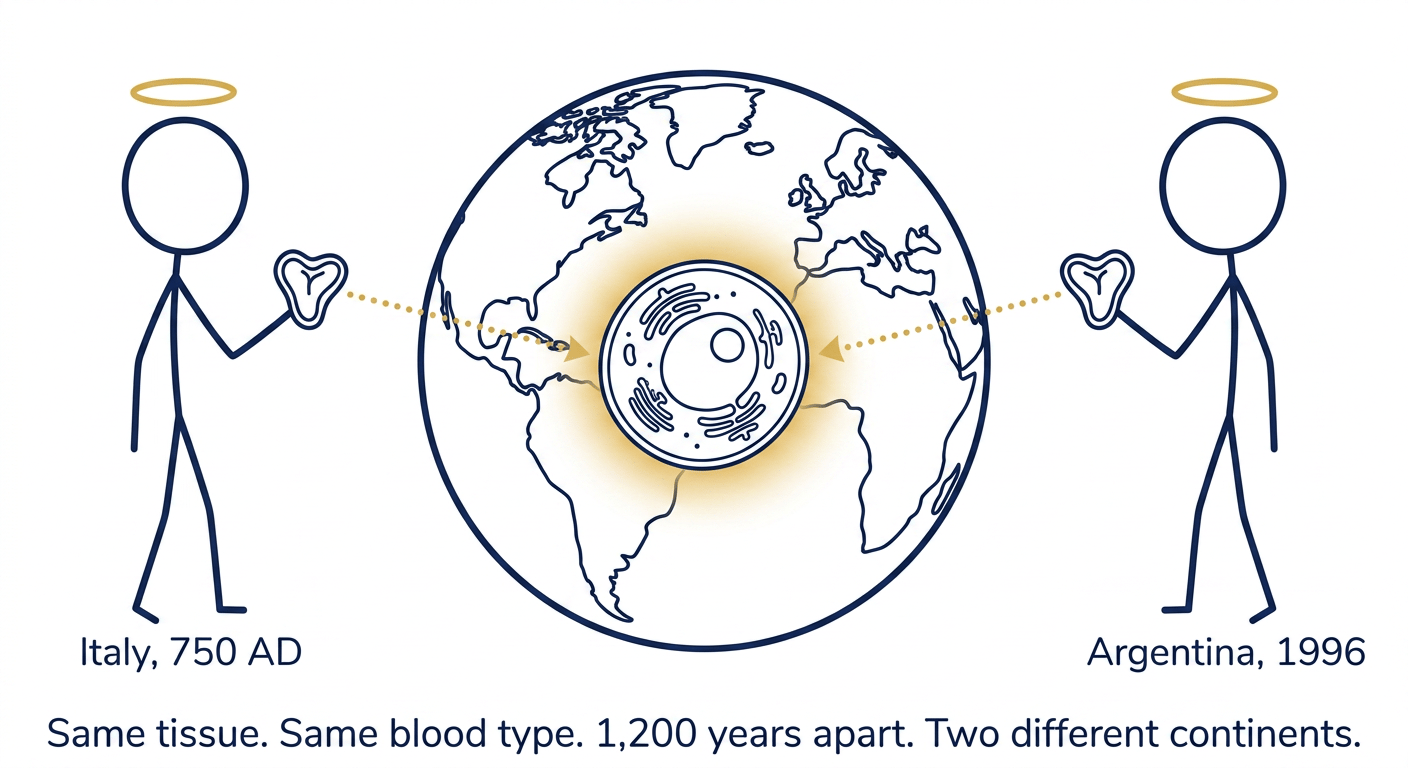
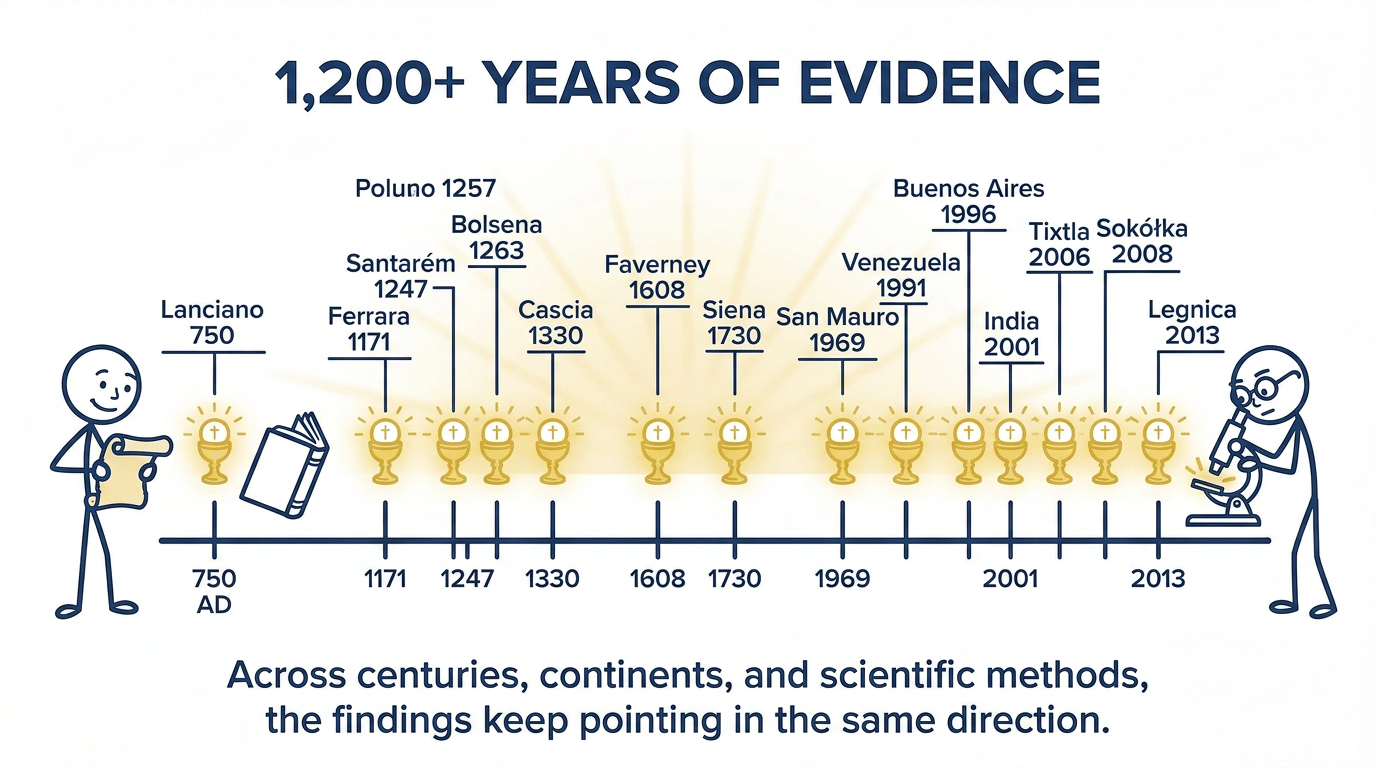
This is not a medieval legend. This happened in the 1990s in Buenos Aires, Argentina. And the results matched what scientists found when they examined a similar sample in Lanciano, Italy, a sample that had been sitting in a church since the year 750 AD.
Same tissue type. Same blood type. Same impossible preservation. Separated by 1,200 years and an ocean.
Welcome to the world of Eucharistic miracles, where science walks into a church and finds out Jesus wasn't joking around in John 6:53-56...
What Is a Eucharistic Miracle?
The Eucharist is the center of the Mass. Bread and wine are consecrated by a priest, and the Church teaches that they become the actual body and blood of Jesus Christ. Not symbolically. Not metaphorically. Actually.
This teaching is called transubstantiation. The outward appearance of bread and wine remains, but the substance, what the thing truly is, changes entirely. The Catechism puts it this way:
"By the consecration the transubstantiation of the bread and wine into the Body and Blood of Christ is brought about. Under the consecrated species of bread and wine Christ himself, living and glorious, is present in a true, real, and substantial manner: his Body and his Blood, with his soul and his divinity." (CCC 1413)
Most of the time, nothing visibly changes. The bread still looks like bread. The wine still looks like wine. Believers accept this on faith.
But on rare occasions, something does change visibly. The bread transforms into flesh. The wine transforms into blood. These events are called Eucharistic miracles, and they have been documented for over 1,200 years.
Here is the part that skeptics struggle with: these are not just pious stories. Many of them have been subjected to rigorous medical and scientific testing. And the results are stunning.
A Teenage Saint and His Catalogue of the Impossible
Before we examine the science, we need to talk about the person who brought these miracles to the world's attention in the modern age.
Carlo Acutis was a teenager from Milan, Italy, who loved video games, soccer, and the Eucharist. That combination might sound strange, but Carlo was a strange kid in the best possible way. He taught himself to code, he made websites for fun, and he had an almost magnetic pull toward the Blessed Sacrament.
At age eleven, Carlo began cataloguing every known Eucharistic miracle in history. He traveled with his family, gathered documentation, photographed evidence, and built an entire digital exhibit. The result was a website and a traveling exhibition that has since visited parishes, schools, and churches in every corner of the world.
Carlo died of leukemia in 2006 at the age of fifteen. He was canonized as a saint in 2025, making him the first millennial saint in the history of the Church.
His Eucharistic Miracles exhibition remains one of the most comprehensive catalogues of these events ever assembled.
It documents miracles spanning from the 3rd century to the present, organized by country, with photographs, historical context, and scientific findings. Much of the research in this article traces back to the work this teenager started in his bedroom.

The Vatican's Brutal Vetting Process
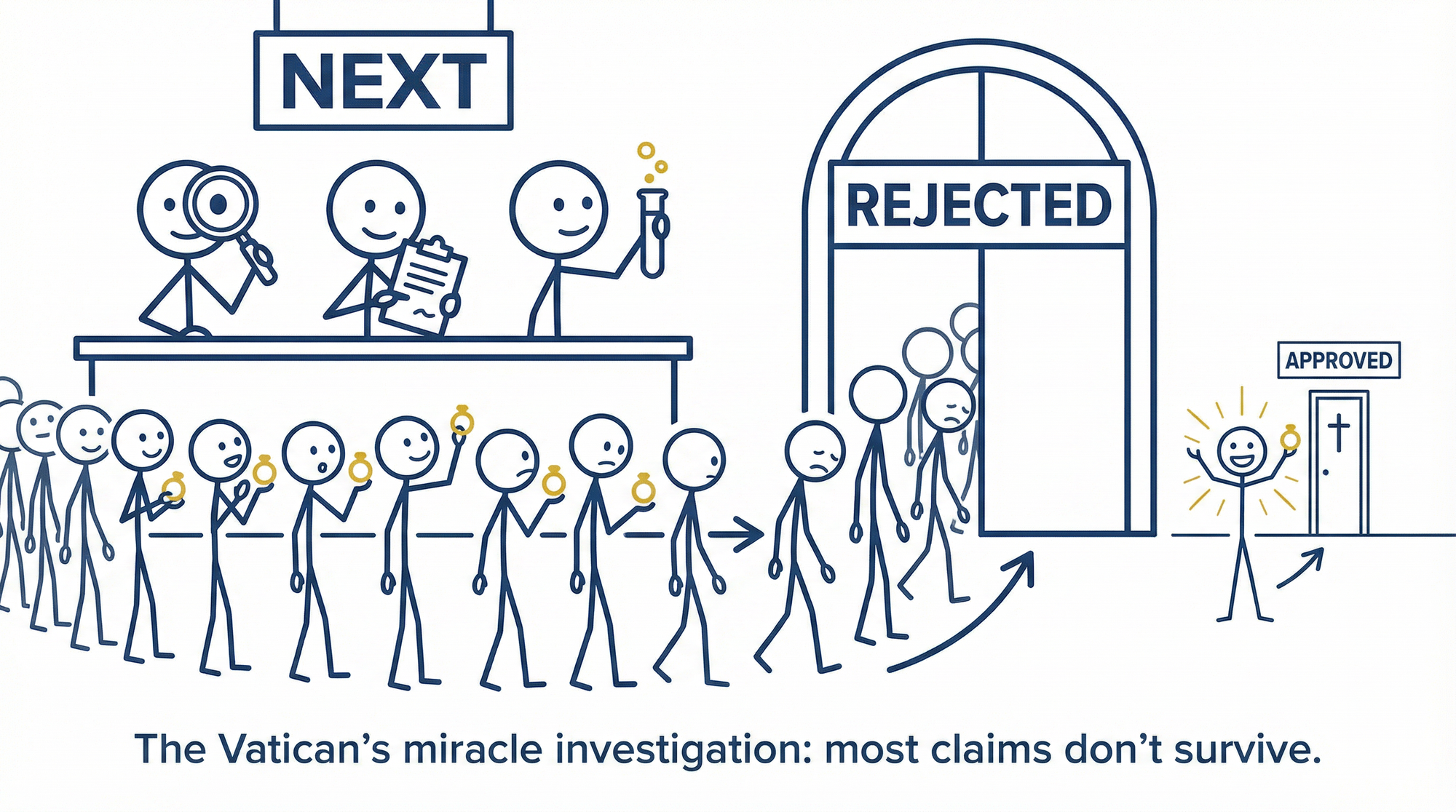
Here is something that surprises most people: the Church doesn't try to declare miracles. The Vatican's investigation process is designed to eliminate claims, not confirm them.
Getting a Vatican approved miracle status is one of the most medically rigorous processes in the world, and can take years.
When a potential Eucharistic miracle is reported, the local bishop initiates an investigation. Independent scientists are brought in. They are often not told what they are examining or where the sample came from. This is intentional. It removes bias from the analysis.
The Church has rejected far more miracle claims than it has accepted.
In 2006, the Roman Catholic Diocese of Dallas investigated a Host that had turned red. The conclusion? Natural bacterial contamination. Case closed. No miracle.
A church custodian once faked a bleeding statue. DNA testing matched the blood to him. Exposed. No miracle.
They built their process to expose any lies.
These rejections are not embarrassing for the Church. They are the whole point. The investigation process starts from skepticism. It demands natural explanations first, second, and third.
Only when every natural explanation has been exhausted, only when the science itself says "we cannot explain this," does the Church even begin to consider the possibility of something supernatural.
Out of hundreds of reported cases throughout history, only about 23 have survived this level of scrutiny to receive official recognition.
Those 23 are the ones we are going to examine.
The Science: What the Labs Actually Found
Let's walk through the most extensively documented cases. These are the ones where credentialed scientists, using standard medical methodology, examined the evidence and published their findings.
Lanciano, Italy (750 AD)
This is the oldest case with modern scientific verification.
According to historical accounts, a priest in the 8th century was experiencing doubt during Mass. As he spoke the words of consecration, the bread visibly transformed into flesh and the wine into blood. The relics have been preserved in the Church of San Francesco in Lanciano ever since.
In 1970, Dr. Edward Linoli, a professor of anatomy, histology, chemistry, and clinical microscopy, conducted a thorough scientific examination. His findings:
The flesh was identified as heart muscle, specifically myocardium from the left ventricle. The blood was type AB. The tissue responded to clinical reactions as living tissue would. No preservatives or artificial substances were detected.
That last point deserves emphasis. This sample was over 1,200 years old at the time of testing. Heart tissue left on a shelf for a week would decompose beyond recognition. This tissue, exposed to the elements for twelve centuries, was still responding to clinical tests as if it were fresh.
Buenos Aires, Argentina (1992, 1994, 1996)
Three separate incidents occurred at the parish of St. Mary in Buenos Aires. The most thoroughly investigated case, from 1996, involved a consecrated Host that was found in a candle holder, placed in water to dissolve, and subsequently developed blood stains.
The local bishop at the time? Jorge Mario Bergoglio. You know him now as Pope Francis.
Scientific investigation led by Ricardo Castañon Gómez involved eight scientists from four continents. A sample was sent to Dr. Frederic Zugibe at Columbia University. He was not told the source.
His findings: heart muscle from the left ventricle. Living white blood cells were present, meaning the tissue was alive at the time of examination. The heart showed signs of trauma, consistent with a person under severe stress. Blood type: AB.
When Dr. Zugibe was told the sample came from a consecrated Host, he reportedly could not explain how a thin piece of unleavened bread could contain living human heart tissue.
Sokółka, Poland (2008)
A consecrated Host fell to the ground during Communion. Following standard procedure, it was placed in water to dissolve. A week later, a red substance had appeared on the undissolved portion.
Professors Maria Sobaniec-Łotowska and Stanisław Sulkowski from the Medical University of Białystok examined the sample and published their findings. The tissue was human heart muscle with specific pathomorphological changes. But here was the truly inexplicable detail: the Host and the heart tissue were "tightly interconnected with the fibers of human tissue, penetrating each other inseparably."
The professors stated that even with the most advanced technology available, including what NASA could bring to bear, no one could artificially recreate such a phenomenon. Bread and cardiac muscle tissue do not fuse together at the cellular level. There is no known natural process that produces this result.
Tixtla, Mexico (2006)
During a retreat at St. Martin of Tours parish, a nun distributing Communion noticed a Host beginning to bleed and transform. Scientific research conducted between 2009 and 2012 confirmed: the reddish substance was human blood containing hemoglobin and DNA. The blood originated from the interior of the Host. Blood type: AB. The exterior of the blood had coagulated while the interior remained fresh, as if the blood was actively being produced from within.
The Pattern That Cannot Be Coincidence
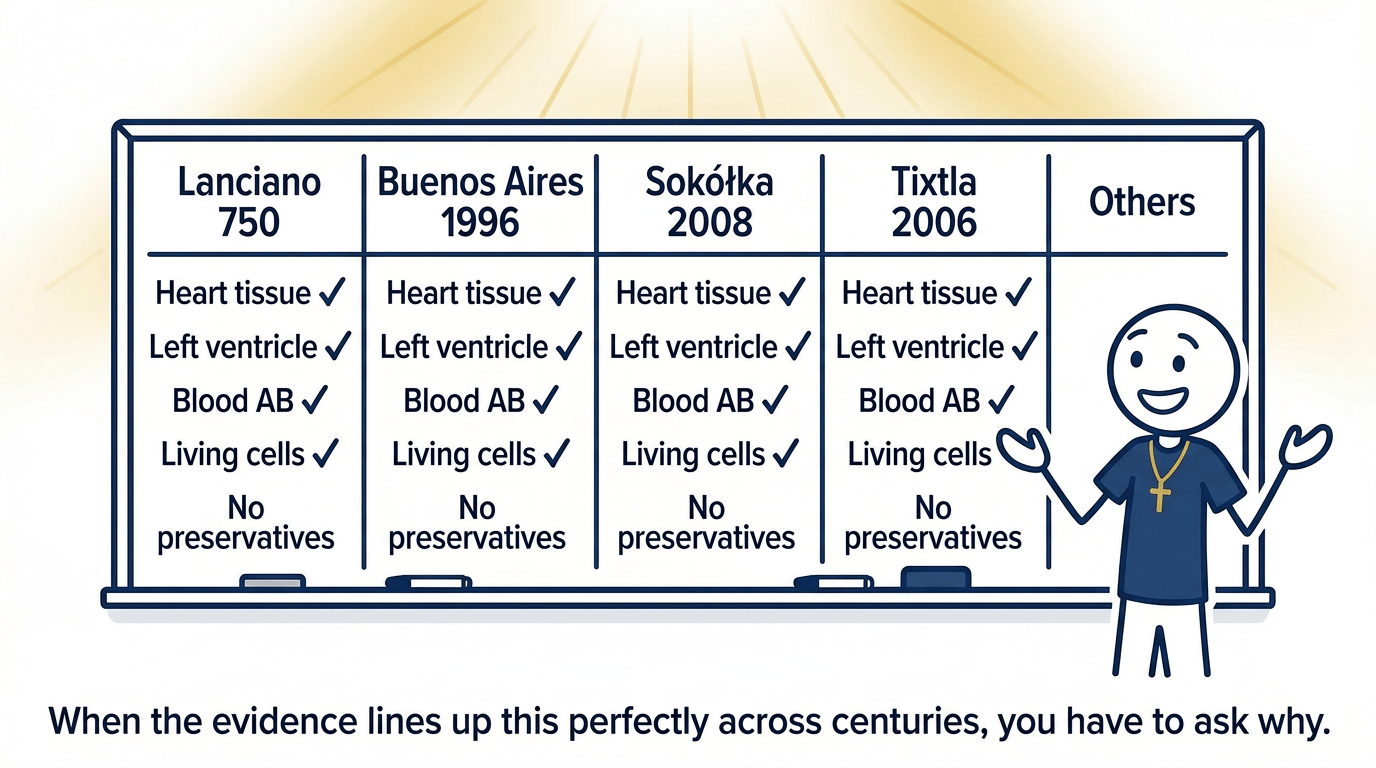
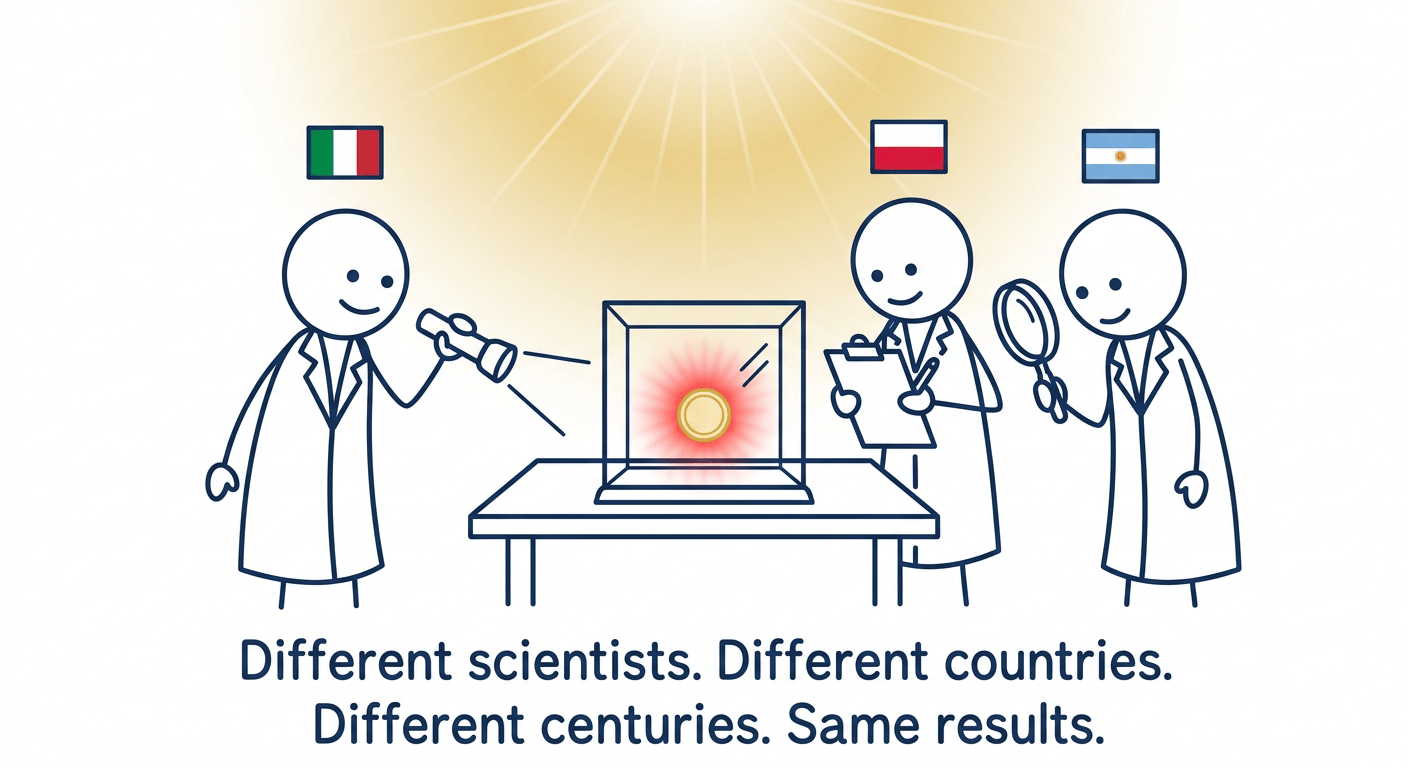
Step back from the individual cases and look at the pattern across all scientifically investigated Eucharistic miracles. Different countries. Different centuries. Different scientists. Different laboratories. And the findings are remarkably, almost impossibly, consistent.
- Heart muscle from the left ventricle. Not generic tissue. Not skin cells or bone fragments. The left ventricle, the chamber of the heart that pumps blood to the entire body.
- Blood type AB. This blood type is found in only about 4% of the global population. Yet it appears in case after case across different continents and centuries.
- Living tissue characteristics. Samples responding to clinical tests as if they were fresh, even when the relics were centuries old.
- No preservatives. No artificial substances. No evidence of human intervention to prevent decay.
- Evidence of trauma. The heart tissue shows signs of stress and suffering, consistent with a person under extreme duress.
Five different scientific investigations, conducted on different continents, over a span of more than 40 years, by scientists who did not know each other and were often unaware of what they were examining, all found human heart tissue under the microscope.
That is not a coincidence. That is a data set.
But wait, there's more...
Those four cases are the headliners because they have the most detailed lab work.
But they are not the whole story.
Across history, over 100 reported Eucharistic miracles have been subjected to some form of scientific or medical investigation. Most were rejected. The ones that survived fall into three categories based on the rigor of the evidence.
Modern Laboratory Analysis (Tissue and Blood Confirmed)
Beyond the four cases above, one more recent miracle has undergone the same caliber of modern laboratory testing.
Legnica, Poland (2013). On Christmas Day, a consecrated Host fell to the ground at the Church of St. Hyacinth. It was placed in water to dissolve, per standard protocol. Instead of dissolving, red stains appeared. Samples were sent to forensic medicine departments at the universities of Wrocław and Szczecin. The findings: "fragmented parts of cross-striated muscle, most similar to cardiac muscle with changes that often accompany agony." Human DNA was confirmed. In April 2016, Bishop Zbigniew Kiernikowski approved the relic for public veneration, and the results were presented to the Vatican's Congregation for the Doctrine of the Faith.
That brings the total of cases with modern histological and DNA analysis to five: Lanciano, Buenos Aires, Sokółka, Tixtla, and Legnica. Dr. Franco Serafini, a cardiologist who examined all five in his book A Cardiologist Examines Jesus, reached the same conclusion across every case: heart tissue, AB blood type, signs of severe suffering.
Blood and Tissue Confirmed Through Earlier Scientific Methods
Several older miracles have been examined with scientific methods available at the time, and their findings align with the modern cases.
Santarém, Portugal (1247). A woman removed a consecrated Host from her mouth. It began to bleed. The blood-stained Host has been preserved in a reliquary for nearly 800 years. In 1997, scientific tests confirmed the contents as human flesh and blood. Blood type: AB positive. The proteins in the blood were found in the same proportions as normal fresh blood, despite being centuries old.
Betania (Los Teques), Venezuela (1991). During Midnight Mass on December 8 at the Marian Shrine of Finca Betania, Father Otty Ossa Aristizábal noticed a red spot on a Host from which blood appeared to flow. The bleeding continued the following morning. By order of Bishop Pío Bello Ricardo of Los Teques, the Host was scientifically examined. The result: real human blood, type AB positive. The same blood type as Lanciano. The same blood type as the Shroud of Turin.
Bolsena-Orvieto, Italy (1263). A priest doubting the Real Presence saw the Host bleed onto the corporal, the altar cloth, during Mass. This miracle was so significant that Pope Urban IV used it as the occasion to institute the Feast of Corpus Christi, one of the most important celebrations in the liturgical calendar. In 2015, advanced UV light analysis confirmed biological deposits on the cloth consisting of blood, split into plasma and serum. Earlier speculation that the stains were from bacteria was contradicted by these findings.
Scientifically Verified Preservation
Some Eucharistic miracles are not about flesh and blood. They are about bread that refuses to decay, in defiance of every known law of organic chemistry.
Siena, Italy (1730). On August 14, thieves stole 351 consecrated Hosts from the Basilica of San Francesco. They were found three days later in an alms box. Normally, unleavened bread deteriorates within a few months. These Hosts did not. In 1914, Pope St. Pius X authorized a scientific examination by Professor Siro Grimaldi of the University of Siena. Additional investigations followed in subsequent decades, most recently in 2014 using digital microscopes and culture tests. The conclusion, confirmed again and again over a century of testing: the Hosts remain completely fresh and intact after nearly 300 years. 223 of the original 351 survive today. No natural explanation has been found.
San Mauro La Bruca, Italy (1969). Thieves stole and later discarded 63 consecrated Hosts. They were recovered and, 25 years later, had not decayed at all. A 1994 scientific evaluation ordered by Bishop Biagio D'Agostino of Vallo della Lucania confirmed miraculous incorruption.
Faverney, France (1608). A fire destroyed the altar and all furnishings during Exposition, but the monstrance containing the Blessed Sacrament remained suspended in the air for 33 hours, completely untouched by the flames. Fifty-four sworn depositions were collected from monks, priests, and villagers who witnessed the event. The surviving Host fragment is preserved as a relic.
Historical Miracles with Preserved Relics
Several additional Eucharistic miracles stretch back centuries, their relics preserved in churches across Europe. Each has been investigated through formal ecclesiastical commissions, though none have undergone the kind of modern laboratory analysis applied to cases like Lanciano or Buenos Aires.
Ferrara, Italy (1171). Blood spouted from the Host during consecration on Easter Sunday. The blood stains on the ceiling vault remain visible after more than 850 years. Approved by multiple popes.
Cascia, Italy (1330). A Host bled onto the pages of a priest's breviary. Pope Boniface IX confirmed its authenticity in 1389. The blood-stained pages are still preserved.
Chirattakonam, India (2001). Three red dots appeared on a Host during Eucharistic Adoration. A week later, they developed into an image resembling a human face. A commission of theologians, medical doctors, and photography experts found no evidence of tampering or manipulation.
Morne-Rouge, Martinique (1902). During the catastrophic eruption of Mount Pelée, marks appeared on a corporal near the Blessed Sacrament. In 1958, chemical analysis at the University of Florence confirmed the marks were of a "hematic nature," meaning blood-related.
The Cases That Were Rejected
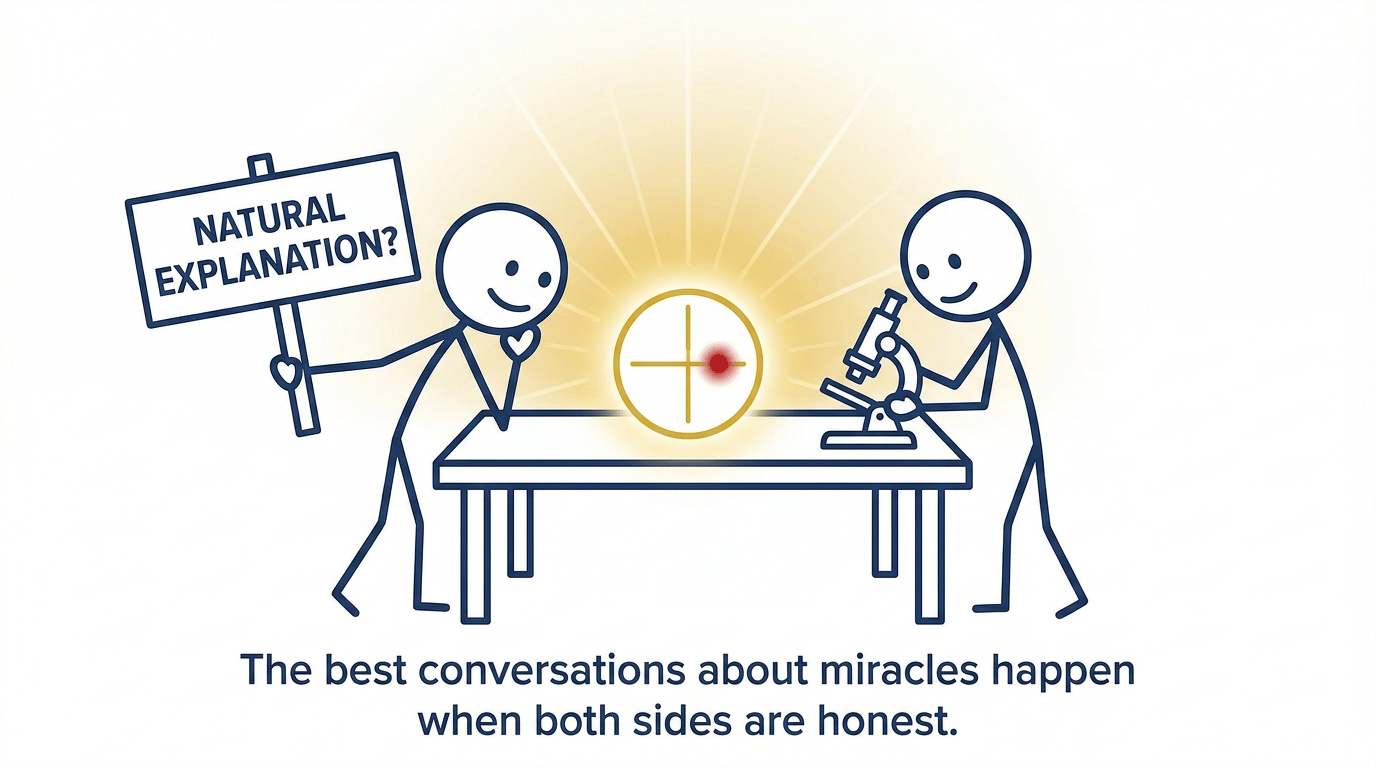
Honesty requires mentioning the other side of the ledger. The Church and independent scientists have examined many additional reported miracles and found natural explanations.
Dallas, USA (2006). A Host turned red. Two University of Dallas biology professors examined it and found a combination of fungal mycelia and bacterial colonies. No miracle.
Schwaz, Austria (2016). A reported "bleeding Host" at the Franciscan Church of Schwaz underwent histopathological examination. Researchers found gram-positive rods, bacterial flora, and fungal spores. No mammalian tissue. This case was one of only two Eucharistic miracle investigations published in peer-reviewed scientific literature, and it concluded bacterial and fungal contamination was the cause.
Aalst, Belgium (2016). Another reported bleeding Host. Examination suggested Serratia marcescens bacteria or fungal organisms. Not declared miraculous.
These rejections show the system works. The Church is not rubber-stamping every claim. It is testing them, and when the science says "bacteria," the Church says "bacteria." The cases that survive this process are the ones where the science says something the scientists themselves cannot explain.
The Skeptics Speak (And They Deserve to Be Heard)
Good science demands that we take criticism seriously. Several legitimate objections have been raised, and they are worth examining honestly.
Bacterial contamination. Dr. Kelly Kearse, a Catholic immunologist who trained at Johns Hopkins, conducted control experiments with unconsecrated communion wafers. When left in water under similar conditions as reported Eucharistic miracles, approximately 15% of the control wafers formed a gelatinous red substance on the surface. The bacterium Serratia marcescens has been known since 1817 to produce red spots on bread that can resemble blood.
This is a real criticism and it explains some reported cases. It is one of the reasons the Vatican has rejected many claims. But bacterial contamination does not produce human heart muscle tissue fused inseparably with bread at the cellular level. Bacteria do not generate living white blood cells. Contamination does not explain tissue that responds to clinical tests as fresh myocardium twelve centuries after it first appeared.
Methodological concerns. Some investigations lacked proper control samples or blind testing protocols. In the Buenos Aires case, the primary experts consulted were pathologists and cardiologists, which critics argue created a presumption toward identifying cardiac tissue. Including microbiologists and mycologists would have strengthened the investigation.
This is fair criticism. The Church should welcome it. Better methodology means more credible results.
Blood type testing questions. Critics note that bacteria can carry A and B antigens on their surfaces, meaning contaminated samples could test positive for AB blood type without any human blood present. The older testing methods used in the Lanciano study relied on polyclonal antibodies that could potentially cross-react with non-human sources.
However, defenders point out that more sophisticated modern techniques can distinguish between bacterial and human AB antigens, and that the newer cases (Buenos Aires, Sokółka, Tixtla) used updated testing methods.
The honest answer is this: the skeptics raise real points. Some miracle claims are bacterial contamination, and the Church has said so itself. But the strongest cases, the ones involving verified human cardiac tissue, living white blood cells, and bread-flesh fusion at the cellular level, have not been adequately explained by any natural mechanism.
The Denominational Question No One Wants to Ask
Here is the detail that makes this conversation uncomfortable for some Christians.
Of all medically documented Eucharistic miracles throughout history, 95.2% are associated with the Roman Catholic Church. Another 4.8% occurred within Orthodox churches. The number documented within Protestant denominations? Zero.
This is not a statement of superiority. It is a statistical observation that demands an explanation.
The Church teaches transubstantiation: the bread and wine truly, actually, physically become the body and blood of Christ. The Orthodox churches affirm the same reality, though they have historically declined to define the precise philosophical mechanism. These are the two traditions that affirm the Real Presence most strongly.
And they are the only two traditions where these scientifically verified miracles occur.
Protestant traditions hold a range of views. Martin Luther himself taught consubstantiation, the belief that Christ is truly present "in, with, and under" the bread and wine. Many other Protestant denominations view Communion as purely symbolic, a memorial meal, an act of remembrance.
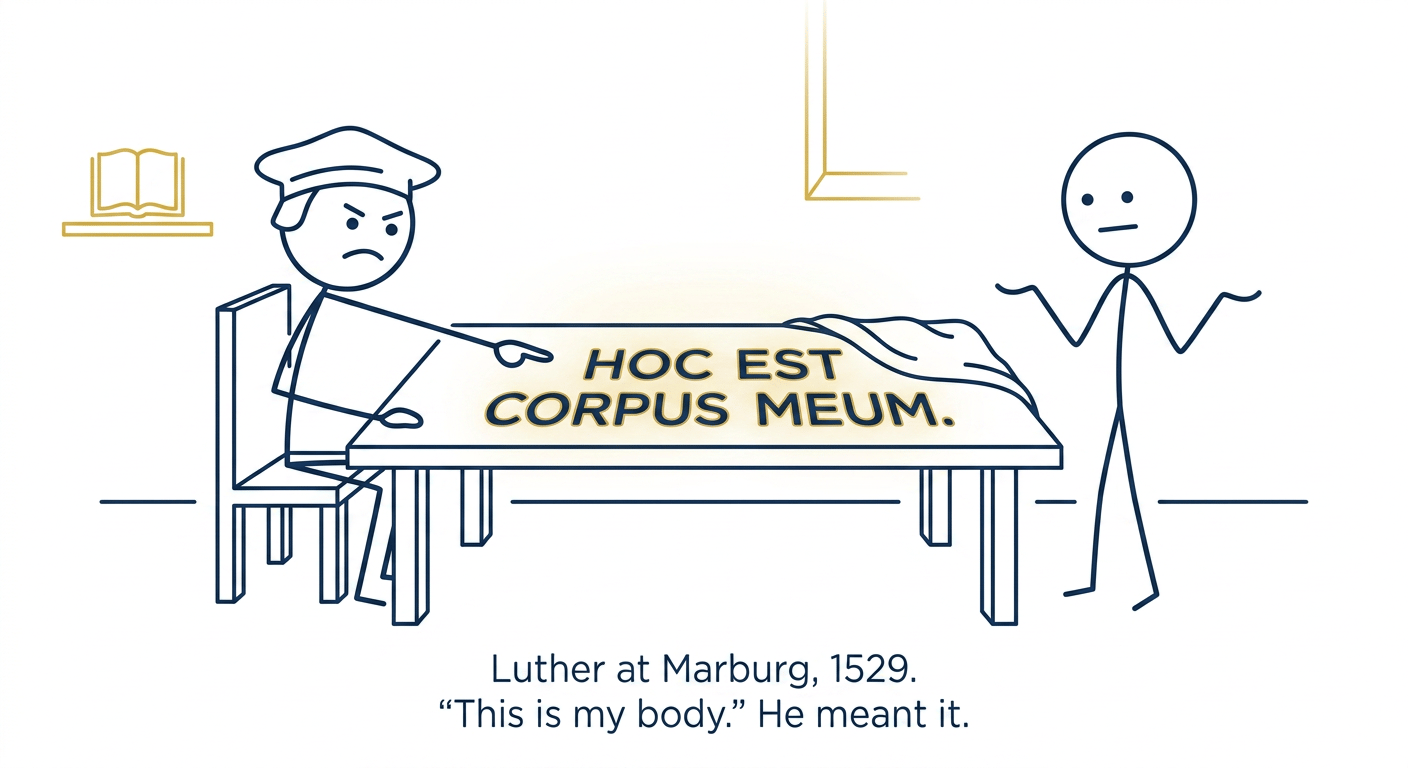
It is worth noting that Luther himself, the man who launched the Reformation, was emphatic about the Real Presence. At the Marburg Colloquy in 1529, Luther debated Ulrich Zwingli, who argued that Communion was purely symbolic. Before the debate began, Luther took a piece of chalk and wrote on the wooden table: "Hoc est corpus meum", Latin for "This is my body," from the words of Christ at the Last Supper. He covered the inscription with a velvet cloth.
As the debate wore on and Zwingli pressed his symbolic interpretation, Luther pulled back the velvet and pointed to the words.
"Hoc est corpus meum (This is my body)."
No metaphor. No symbolism. Christ said what He meant. Even the founder of Protestantism would not budge on this point.
The Marburg Colloquy ended in disagreement. Luther refused to acknowledge Zwingli as a brother in Christ over this issue. The two branches of Protestantism, Lutheran and Reformed, split over the Eucharist and have never reunited.
That historical fracture raises a haunting question...
If the Eucharist is merely symbolic, why do these verified miracles only occur in the churches that say otherwise?
What This Means for You
Maybe you have never thought much about what happens during Communion. Maybe you have received it hundreds of times without considering whether anything actually changes. Maybe you are not even sure you believe it.
That is okay. Doubt is not the enemy of faith. The priest in Lanciano was doubting too, right at the moment of consecration. And that is when the miracle happened.
But consider this: we now have a body of evidence spanning 1,200 years, examined by credentialed scientists using standard medical methodology, producing consistent results that no natural explanation can fully account for. Heart muscle. Left ventricle. Blood type AB. Living tissue. No preservatives. Signs of suffering.
Every detail points to the same conclusion: the body of someone who suffered and died, whose heart was broken by trauma, whose blood type matches the rarest category.
The Church does not need miracles to confirm its teaching. The teaching stands on Scripture, Tradition, and the testimony of the apostles. But when bread turns to flesh under a microscope and the greatest scientific minds in the room cannot explain how, it is worth paying attention.
Saint Carlo Acutis spent his short life collecting this evidence because he wanted people to see what he saw. Not a theological argument. Not a philosophical proof. Just the data, laid out for anyone willing to look.
He called the Eucharist his highway to heaven:
"The Eucharist is my highway to heaven."
Let's be like Carlo!
🙏❤️🔥
Frequently Asked Questions
How many Eucharistic miracles have been scientifically verified?
Approximately 23 Eucharistic miracles have passed rigorous medical and scientific scrutiny to receive official recognition. Hundreds of other claims have been investigated and rejected by the Church itself, which starts every investigation from a position of skepticism and demands that natural explanations be exhausted first.
What did scientists find when they tested Eucharistic miracles?
Across multiple independently conducted investigations spanning different centuries and continents, scientists consistently identified human heart muscle tissue from the left ventricle, blood type AB (found in only 4% of the global population), living white blood cells, no preservatives or artificial substances, and signs of trauma consistent with severe stress. These findings have been remarkably consistent across all major scientifically examined cases.
Why do Eucharistic miracles only happen in Catholic and Orthodox churches?
Of all medically documented Eucharistic miracles, 95.2% are associated with the Roman Catholic Church and 4.8% with Orthodox churches. No scientifically documented cases exist within Protestant denominations. Both the Catholic and Orthodox traditions affirm the Real Presence of Christ in the Eucharist, teaching that the bread and wine truly become the body and blood of Christ. What about Martin Luther? Even Martin Luther, the founder of Protestantism, insisted on the Real Presence during his famous debate with Zwingli at the Marburg Colloquy in 1529. The problem then lies with authority. Only the Catholic and Orthodox churches have the apostolic authority going all the way back to Jesus in an unbroken chain of succession.
Who was Carlo Acutis and what did he do with Eucharistic miracles?
Carlo Acutis was an Italian teenager who taught himself to code and, beginning at age eleven, catalogued every known Eucharistic miracle in history. He created a digital exhibition with photographs, historical context, and scientific findings that has traveled to churches and parishes worldwide. Carlo died of leukemia in 2006 at age fifteen and was canonized as a saint in 2025, becoming the first millennial saint. His exhibition is available online at miracolieucaristici.org.
Can bacterial contamination explain Eucharistic miracles?
Bacterial contamination, particularly from Serratia marcescens, can produce red spots on bread that visually resemble blood. The Church itself has used this explanation to reject some miracle claims, including a 2006 case in Dallas. However, bacterial contamination cannot produce human heart muscle tissue, living white blood cells, or bread-and-flesh fusion at the cellular level. The strongest scientifically verified cases involve findings that go far beyond what any known natural process can explain. Scientists know the difference between real blood and red bacteria. It's a bad argument.