

You have probably heard some version of this story.
A medieval monk walks into a town square, sets up a money chest, and starts shouting that your dead grandmother can fly straight out of purgatory if you just drop in a few coins. It sounds like a spiritual scam.
And honestly?
The people who did it were wrong.
The Church said so itself. Loudly.
But here is the part of the story that almost never gets told. The abuse of indulgences is not the whole story. It is not even most of the story. It is one ugly chapter in a much longer, much more beautiful book about mercy, prayer, community, and what happens when love reaches past the grave.
So what are indulgences, really? What is purgatory? What went wrong in the Middle Ages, and what did the Church do about it? And what do Catholics actually believe today?
Let's walk through the whole thing.
No spin.
No shortcuts.
What Is Purgatory, and Where Does It Come From?
Before we can talk about indulgences, we need to talk about purgatory. Because indulgences only make sense if purgatory is real.
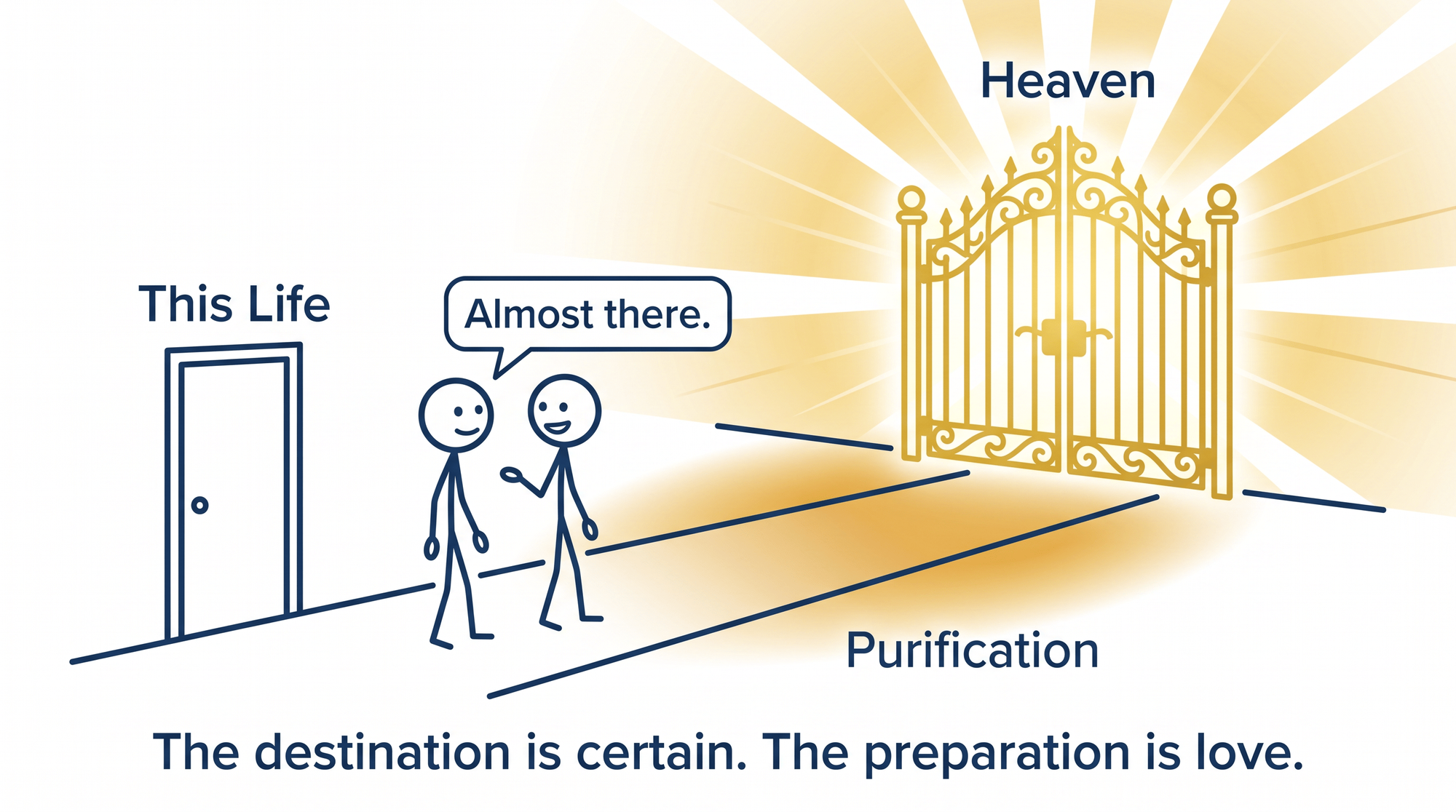
Here is the basic idea. When someone dies in friendship with God, their eternal destination is settled. They are going to heaven. But what if they are not quite ready? Not because God is stingy with His mercy, but because they still carry the residue of sin. The selfishness that was never fully surrendered. The bad habits that were forgiven but never fully healed.
The Catechism puts it simply:
"All who die in God's grace and friendship, but still imperfectly purified, are indeed assured of their eternal salvation; but after death they undergo purification, so as to achieve the holiness necessary to enter the joy of heaven." (CCC 1030)
Think of it this way. Imagine you spent years smoking. One day you quit for good. The decision is made, your direction has changed. But your lungs are still damaged. They need time to heal. Purgatory is the healing. Not the punishment. The destination was never in doubt. Heaven is certain. But the person needs to be made ready for it.
This is not some invention of the Middle Ages. The roots go deep.
The Scriptural Groundwork
The clearest Old Testament passage comes from 2 Maccabees. After a battle, Judas Maccabeus discovered that some of his fallen soldiers had been wearing pagan amulets, a violation of the Law. He did not shrug and move on. He took up a collection and sent it to Jerusalem as a sin offering for the dead.
"In doing this he acted very well and honorably, taking account of the resurrection. For if he were not expecting that those who had fallen would rise again, it would have been superfluous and foolish to pray for the dead. But if he was looking to the splendid reward that is laid up for those who fall asleep in godliness, it was a holy and pious thought. Therefore he made atonement for the dead, that they might be delivered from their sin." (2 Maccabees 12:43-46)
This passage only makes sense if there is a state after death where prayer can still help. If the dead soldiers were in heaven, they would not need prayer. If they were in hell, prayer could not reach them. There must be something in between.
In the New Testament, Paul paints a vivid picture in his first letter to the Corinthians:
"Each one's work will become manifest, for the Day will disclose it, because it will be revealed by fire, and the fire will test what sort of work each one has done. If the work that anyone has built on the foundation survives, he will receive a reward. If anyone's work is burned up, he will suffer loss, though he himself will be saved, but only as through fire." (1 Corinthians 3:13-15)
Saved, but only as through fire. That is a person whose destination is secure but who still must pass through something. A purification.
And then there is a fascinating line from Jesus himself:
"Whoever speaks a word against the Son of Man will be forgiven, but whoever speaks against the Holy Spirit will not be forgiven, either in this age or in the age to come." (Matthew 12:32)
Why mention "the age to come" at all unless some sins can be forgiven after death? If the only options after death were immediate heaven or immediate hell, the phrase would be meaningless.
So What Are Indulgences?
Now we can talk about indulgences. And the first thing to know is what they are not.
An indulgence is not a permission slip to sin. It is not a ticket out of hell. It is not forgiveness. Forgiveness comes through repentance and the sacrament of confession. An indulgence deals with something different.
Here is the distinction. When you sin, two things happen. First, there is the guilt of the sin itself, which separates you from God. That guilt is removed through repentance and absolution. But second, there is what theology calls "temporal punishment," the lingering consequences and damage that sin leaves behind even after you have been forgiven.
The Catechism defines it clearly:
"An indulgence is a remission before God of the temporal punishment due to sins whose guilt has already been forgiven, which the faithful Christian who is duly disposed gains under certain prescribed conditions through the action of the Church which, as the minister of redemption, dispenses and applies with authority the treasury of the satisfactions of Christ and the saints." (CCC 1471)
Think of it like this. Your teenager throws a baseball through the neighbor's window. You forgive him immediately. The guilt is dealt with. But the window is still broken. Someone has to pay for the repair. The "temporal punishment" is the broken window. The forgiveness is real and complete, but there are still consequences to work through.
Indulgences help with those consequences. And they are not magic. They require genuine repentance, confession, prayer, and a real turning of the heart.
There are two types. A partial indulgence removes some of the temporal punishment. A plenary indulgence removes all of it. To gain a plenary indulgence, a person must go to confession, receive communion, pray for the pope's intentions, and be completely detached from all sin, even venial sin. That last condition alone tells you this is not a casual transaction. It requires a total surrender of the heart.
The Raccolta: A Library of Grace
For centuries, the Church maintained a collection of prayers, devotions, and acts of piety to which indulgences were attached. The most well-known of these collections was called the Raccolta.
First published in 1807 and updated through numerous editions until 1952, the Raccolta was essentially a manual. It gathered all the prayers and good works that popes had granted indulgences to over the centuries. A prayer to the Holy Spirit before study. A visit to a particular church. Praying the Stations of the Cross. Acts of charity for the poor.
Each entry would list the prayer, the conditions, and the type of indulgence granted. In the older system, indulgences were described in terms of "days" or "years." An indulgence of "300 days" did not mean 300 days off your purgatory sentence, as many people mistakenly believed. It meant the indulgence was equivalent to 300 days of the rigorous public penance that early Christians used to perform, things like fasting on bread and water, wearing sackcloth, or being excluded from communion for a period.
But this measurement system was confusing. Deeply confusing. It invited exactly the kind of misunderstanding that turned indulgences into a target for criticism. And the Church eventually recognized this and changed it entirely.
The Raccolta contained prayers exclusively from the Latin Rite tradition. Over time, as the collection grew through centuries of papal grants, it became enormous. Various religious orders, confraternities, and groups had lobbied for indulgences to be attached to their specific prayers and devotions, and the collection expanded far beyond what anyone could reasonably use.
What Went Wrong: The Medieval Abuse
Now for the ugly part. And it is important that we tell it honestly, because the Church itself has been honest about it.
In the late Middle Ages, the practice of indulgences became tangled up with money. The theology was sound. The application was not. What happened was a corruption of practice, not a corruption of doctrine.
Here is the backdrop. In the early 1500s, Pope Leo X authorized a special indulgence to raise funds for the construction of St. Peter's Basilica in Rome. The indulgence itself was legitimate. The faithful could receive spiritual benefits by contributing to a great work of the Church. But in Germany, the way it was marketed went terribly wrong.
A Dominican friar named Johann Tetzel became the face of the fundraising campaign. Tetzel was, to put it charitably, an aggressive salesman. He was known for a jingle that went something like this: "When a coin in the coffer rings, a soul from purgatory springs."
This was not what the Church taught.
It was a gross exaggeration.
The idea that you could simply buy your dead relatives out of purgatory with a cash payment was a distortion of the theology. But Tetzel said it anyway. And people believed him because he came with the authority of the Church behind him (though was not an infallable decree made from the seat of Peter).
This matters because the abuse was real. People were being manipulated. The poor were giving money they could not afford because they were told it was the only way to help their deceased loved ones. Genuine pastoral concern for the dead was being exploited for revenue.
And here is what many people never hear from Protestant's making this argument... the Catholic Church condemned this.
Not reluctantly. Not quietly. They condemned it forcefully.
How the Church Responded
The response came in stages, and each one was more decisive than the last.
The Council of Trent (1545-1563)
The Council of Trent, convened partly in response to the Protestant Reformation, addressed the indulgence scandal directly. In its final session on December 4, 1563, the Council issued a decree on indulgences that did two things simultaneously.
First, it reaffirmed the doctrine. Indulgences are real, scriptural, and part of the Church's God-given authority to bind and loose. The Council declared that the power of granting indulgences was given to the Church by Christ and that their use is beneficial for the faithful.
But second, it dropped the hammer on the abuses.
The Council decreed that all "evil gains" connected with indulgences be "entirely abolished." It ordered bishops to investigate and correct any irregularities in their dioceses. It specifically condemned the kind of commercial exploitation that Tetzel and others had engaged in. The message was clear: the doctrine is true, the abuse was unacceptable, and it stops now.
This is a pattern you see throughout Church history. When corruption creeps in, the Church does not abandon the truth. It cleans house.
The Continued Evolution: The Raccolta Era
After Trent, indulgences continued to be practiced, but with greater oversight. The Raccolta became the official reference, carefully maintained by the Sacred Congregation of Indulgences in Rome. Each prayer and devotion in the collection had been individually approved by a pope, and the conditions were clearly spelled out.
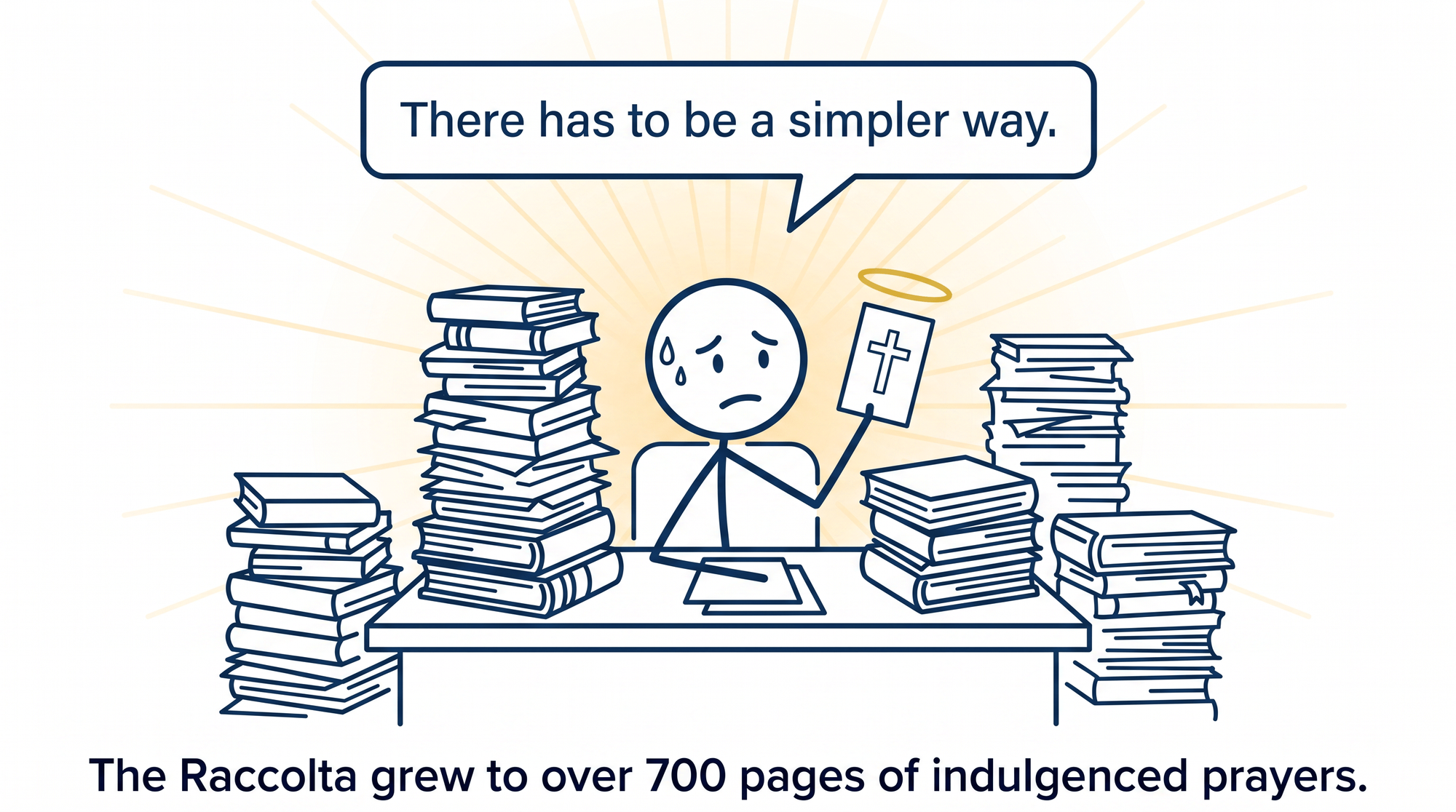
But over the centuries, the collection grew unwieldy. The system of "days" and "years" continued to cause confusion. And the sheer volume of indulgenced prayers, over 700 pages in later editions, made the practice feel more like a spiritual ledger than an encounter with God's mercy.
Pope St. Paul VI and Indulgentiarum Doctrina (1967)
The most sweeping reform came from Pope St. Paul VI. On January 1, 1967, he issued the apostolic constitution Indulgentiarum Doctrina ("The Doctrine of Indulgences"). This was not a casual update. It was a comprehensive rethinking of how indulgences work in practice, ordered in response to recommendations from the Second Vatican Council.
Here is what Paul VI changed:
The confusing "days and years" system was abolished. No more "300 days" or "7 years." From that point forward, indulgences were simply classified as either "partial" or "plenary." Partial removes some temporal punishment. Plenary removes all of it. Clean, simple, and far less prone to misunderstanding.
The massive Raccolta was replaced. Paul VI ordered that the official list be revised "with a view to attaching indulgences only to the most important prayers and works of piety, charity and penance." The new collection, called the Enchiridion Indulgentiarum, was published in 1968. It was roughly one-sixth the size of the last edition of the Raccolta.
But in a beautiful paradox, the reform actually expanded the reach of indulgences. The new Enchiridion included general grants that applied to broad categories of faithful action, things like raising your mind to God while performing daily duties, bearing life's difficulties with trust, or giving of yourself to serve those in need. Under the old system, you had to match a specific prayer to a specific grant. Under the new system, the entire Christian life could become a source of grace.
The old categories of "personal," "real," and "local" indulgences were eliminated. This made it clearer that indulgences are about what a person does, not about objects or locations.
Eastern Catholic traditions were included for the first time. The Raccolta had been exclusively Latin Rite. The Enchiridion embraced the richness of the whole Church, including prayers from the Byzantine, Armenian, Chaldean, Coptic, Ethiopian, Maronite, and Syrian traditions.
The number of plenary indulgences was reduced. Paul VI wanted the faithful to hold plenary indulgences in greater esteem, and reducing the number was a way to restore their significance.
What Catholics Believe Today
So where does all of this leave us?
The teaching is clear, consistent, and deeply scriptural. Here it is in plain language.
Every sin has two dimensions.
- There is the guilt, which is forgiven through repentance and the sacrament of reconciliation.
- And there is the temporal punishment, the damage that sin does to us and to others, which must be repaired either in this life or in the purification after death.
Purgatory is that purification. It is NOT a second chance at salvation. It is NOT a place of doubt or uncertainty. Every soul in purgatory is going to heaven.
Purgatory is the mercy of God finishing what grace began. It is the final healing before a person enters perfect joy. It is still God's grace and mercy, not YOUR own works.
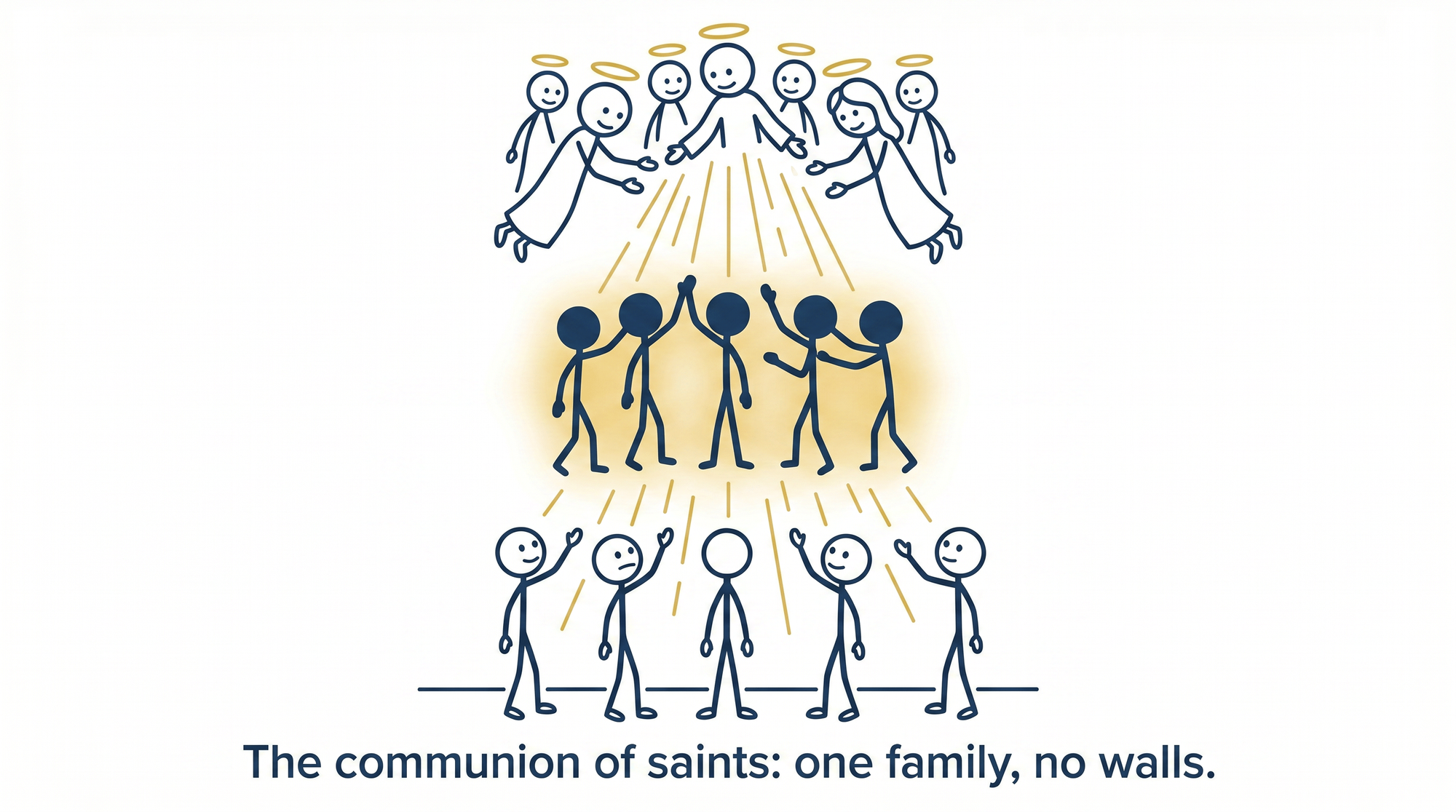
Indulgences are the Church's way of applying the infinite merits of Christ, and the prayers and sacrifices of the saints, to help with that healing. They are rooted in the communion of saints, the beautiful reality that the Church is one body across time. The living can pray for the dead. The saints in heaven intercede for us. We are all connected.
To obtain an indulgence today, a person must:
For a partial indulgence: perform the prescribed action with a contrite heart.
For a plenary indulgence: go to sacramental confession, receive the Eucharist, pray for the intentions of the pope (typically an Our Father, a Hail Mary, and a Glory Be), and perform the prescribed work with complete detachment from sin, even venial sin.
That last requirement alone should dispel any notion that this is a casual or mechanical process. Complete detachment from sin is the work of a lifetime. It requires total surrender to God.
This is the heart of it. Indulgences are an act of love. Love for God, love for the dead who are being made ready for heaven, and love for one another as members of one Body.
Why This Matters for You
Maybe you grew up hearing that indulgences were one of the great scandals of Christianity. That they show the Church was corrupt to the core. That they were some medieval get-out-of-jail-free card for rich people.
Now you know the rest of the story.
Yes, there was abuse. The Church admits it freely. It condemned the abuse at the Council of Trent. It reformed the entire system under Paul VI. It continues to refine the practice today.
But the doctrine behind indulgences is not about money or manipulation. It is about a God who takes sin seriously, forgives generously, and does not leave us half-healed.
It is about a Church that believes death does not end our ability to love one another. It is about the radical claim that when you pray for your grandmother who has died, those prayers actually do something. They reach her. They help her. Because in Christ, love is stronger than the grave.
The next time someone brings up indulgences as evidence that the Church is corrupt, you can tell them... Actually the Church told that story first and then it fixed it. Those people were excommunicated and the practices were condemned.
The Catholic Church takes these seriously. It does not run from its mistakes. It confronts them, corrects them, and keeps going. Because the mission, getting souls to heaven, is too important to abandon over the failures of any one generation.
Where to Go From Here
If this topic has sparked something in you, here are some ways to go deeper:
Read the source documents. Indulgentiarum Doctrina is available in full on the Vatican website. It is surprisingly readable and gives you the reform in Paul VI's own words.
Explore the Catechism. Paragraphs 1030-1032 cover purgatory. Paragraphs 1471-1479 cover indulgences, read the online version here. Both sections are short and clear.
Pray for the dead. You do not need to understand every detail of indulgence theology to pray for those who have died. Start there. Visit a church and offer a prayer for the souls in purgatory. Light a candle. Attend Mass and offer it for someone you have lost.
Look into gaining a plenary indulgence. The conditions are straightforward: confession, communion, prayer for the pope, and the prescribed work. Many parishes offer opportunities during special seasons like Lent, All Souls Day, and jubilee years.
Frequently Asked Questions
Did the Catholic Church really sell indulgences?
Some individuals within the Church did sell indulgences in the late Middle Ages, most notoriously Johann Tetzel in early 16th-century Germany. However, the practice was a corruption, not a teaching. The Church condemned the sale of indulgences at the Council of Trent in 1563, ordering that "all evil gains" connected to indulgences be "entirely abolished." The doctrine of indulgences itself was never about buying spiritual favors.
What is the difference between an indulgence and forgiveness?
Forgiveness removes the guilt of sin and restores your relationship with God. It comes through repentance and the sacrament of reconciliation. An indulgence addresses the temporal punishment that remains even after forgiveness, the lingering damage and consequences of sin that must be repaired. Think of it like a broken window: forgiveness means you are no longer blamed, but the window still needs fixing.
Is purgatory mentioned in the Bible?
The word "purgatory" does not appear in Scripture, but the concept is supported by several passages. 2 Maccabees 12:43-46 describes prayers and offerings made for the dead. 1 Corinthians 3:13-15 describes being "saved, but only as through fire." Matthew 12:32 speaks of sins forgiven "in the age to come," implying a state after death where purification occurs.
What is the Enchiridion Indulgentiarum?
The Enchiridion Indulgentiarum is the official collection of indulgenced prayers and works currently used by the Church. It replaced the older Raccolta in 1968 after Pope St. Paul VI reformed the indulgence system through his apostolic constitution Indulgentiarum Doctrina. The Enchiridion is much shorter than the Raccolta but actually covers a broader range of faithful actions through general grants.
How do you obtain a plenary indulgence today?
To gain a plenary indulgence, a person must fulfill four conditions: go to sacramental confession (within about 20 days of the indulgenced work), receive Holy Communion, pray for the intentions of the pope, and perform the prescribed indulgenced work with complete detachment from all sin, including venial sin. The interior disposition of the heart is essential. This is not a mechanical process but a genuine turning toward God.