

Papal encyclicals have a reputation problem.
They are some of the most important documents written in any generation, and almost nobody reads them. They sit on the Vatican website like treasure chests that nobody opens because the lock looks too complicated.
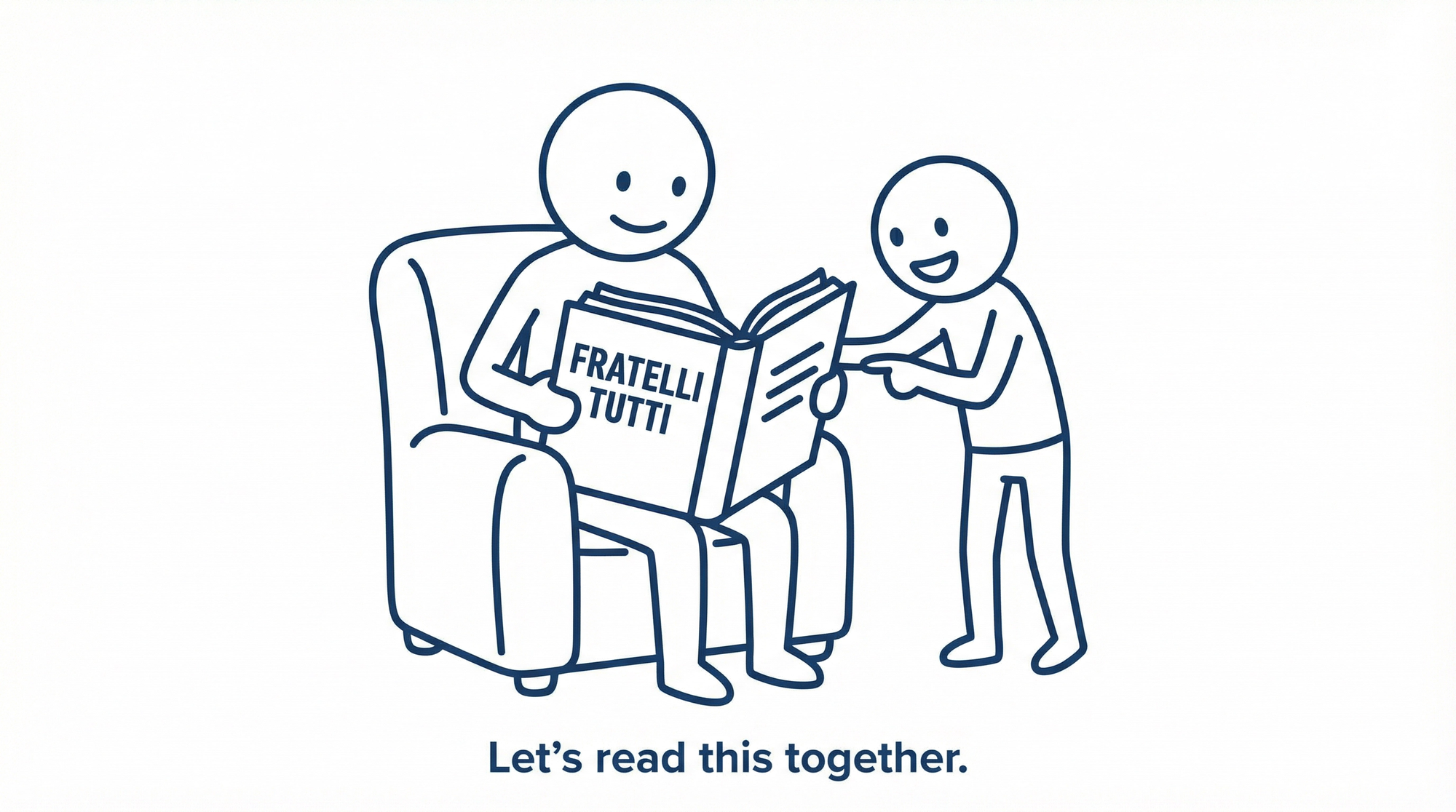
Fratelli Tutti ("Brothers All"), published by Pope Francis on October 3, 2020, is an encyclical on fraternity and social friendship. It asks a simple question with an enormously complex answer: what would it look like if human beings actually treated each other as brothers and sisters?
Chapter 1 is the diagnosis. Before Pope Francis offers his vision for healing (that comes in later chapters), he takes an honest, unflinching look at what is broken. The chapter is titled "Dark Clouds Over a Closed World," and it covers paragraphs 9 through 55 of the encyclical.
What follows is a guided reading. We will walk through the chapter section by section, reading the Pope's own words and then talking about what they mean and why they matter. By the end, you should feel like you have actually read the chapter, because in a real sense, you will have.
Let us begin.
Opening: What This Chapter Sets Out to Do (Paragraph 9)
Pope Francis begins by setting expectations. He is not trying to be exhaustive. He is trying to name the patterns:
"Without claiming to carry out an exhaustive analysis or to study every aspect of our present-day experience, I intend simply to consider certain trends in our world that hinder the development of universal fraternity." (9)
This is important framing. He is not writing a sociology textbook. He is a pastor looking at the world and pointing to the things that are preventing people from treating each other like family. He names them not to despair but to diagnose, the way a doctor names an illness not to scare you but to begin treating it.
Shattered Dreams (Paragraphs 10-14)
The chapter opens with a admission that sounds almost mournful. There was a dream, and it has not come true:
"For decades, it seemed that the world had learned a lesson from its many wars and disasters, and was slowly moving towards various forms of integration." (10)
He cites the dream of a united Europe, the hope that globalization would bring people together, the belief that expanding trade and communication would naturally produce peace. The assumption was that connection equals communion. That proximity produces brotherhood.
It did not.
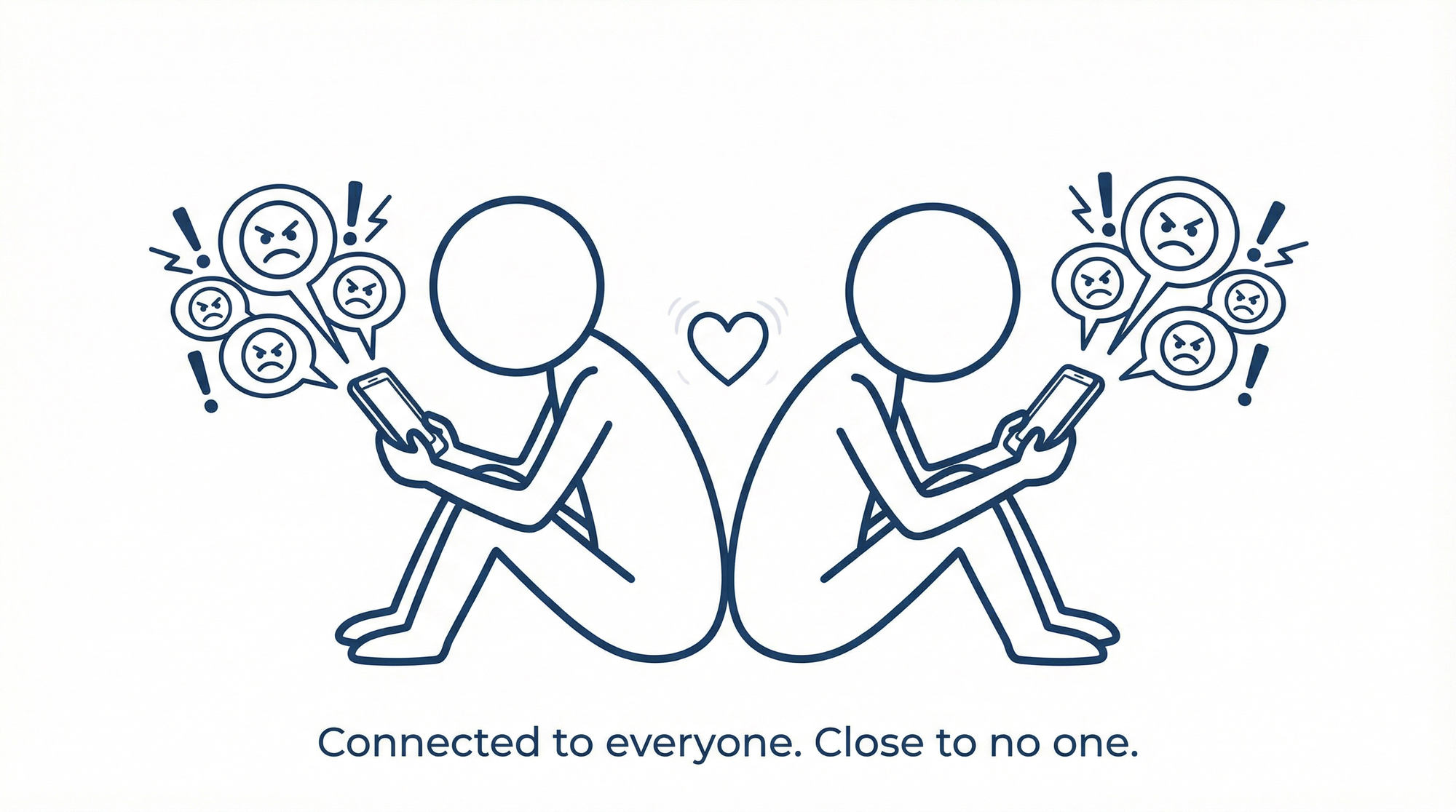
"As society becomes ever more globalized, it makes us neighbours, but does not make us brothers." (12)
Read that line again. It is one of the most quoted sentences in the entire encyclical, and for good reason. It captures something you already feel but may not have had words for. You can have seven hundred friends on social media and feel utterly alone. You can live in a globally connected world and feel no real connection to anyone in it.
"We are more alone than ever in an increasingly massified world that promotes individual interests and weakens the communitarian dimension of life." (12)
Then Pope Francis turns to something unexpected. He talks about the loss of historical consciousness:
"A kind of 'deconstructionism', whereby human freedom claims to create everything starting from zero, is making headway in today's culture." (13)
This is a dense sentence, so let us unpack it. He is describing a cultural tendency to tear down inherited traditions, stories, and institutions without replacing them with anything. Freedom becomes the freedom to destroy, not to build. And when you lose connection to the past, you lose the tools your ancestors developed for navigating the present.
For a young person, this means something concrete. If you have never read Augustine, you do not know that a fifth-century bishop wrestled with the same questions about identity and loneliness that you are wrestling with right now. If you have never heard of Dorothy Day, you do not know that radical social justice and deep Catholic faith lived together in one person. History is not a museum. It is a toolbox. And Pope Francis is warning that we are throwing the tools away.
The Throwaway World (Paragraphs 15-21)
This section hits hard. Pope Francis has been using the phrase "throwaway culture" since early in his pontificate, and here he lays out what it means:
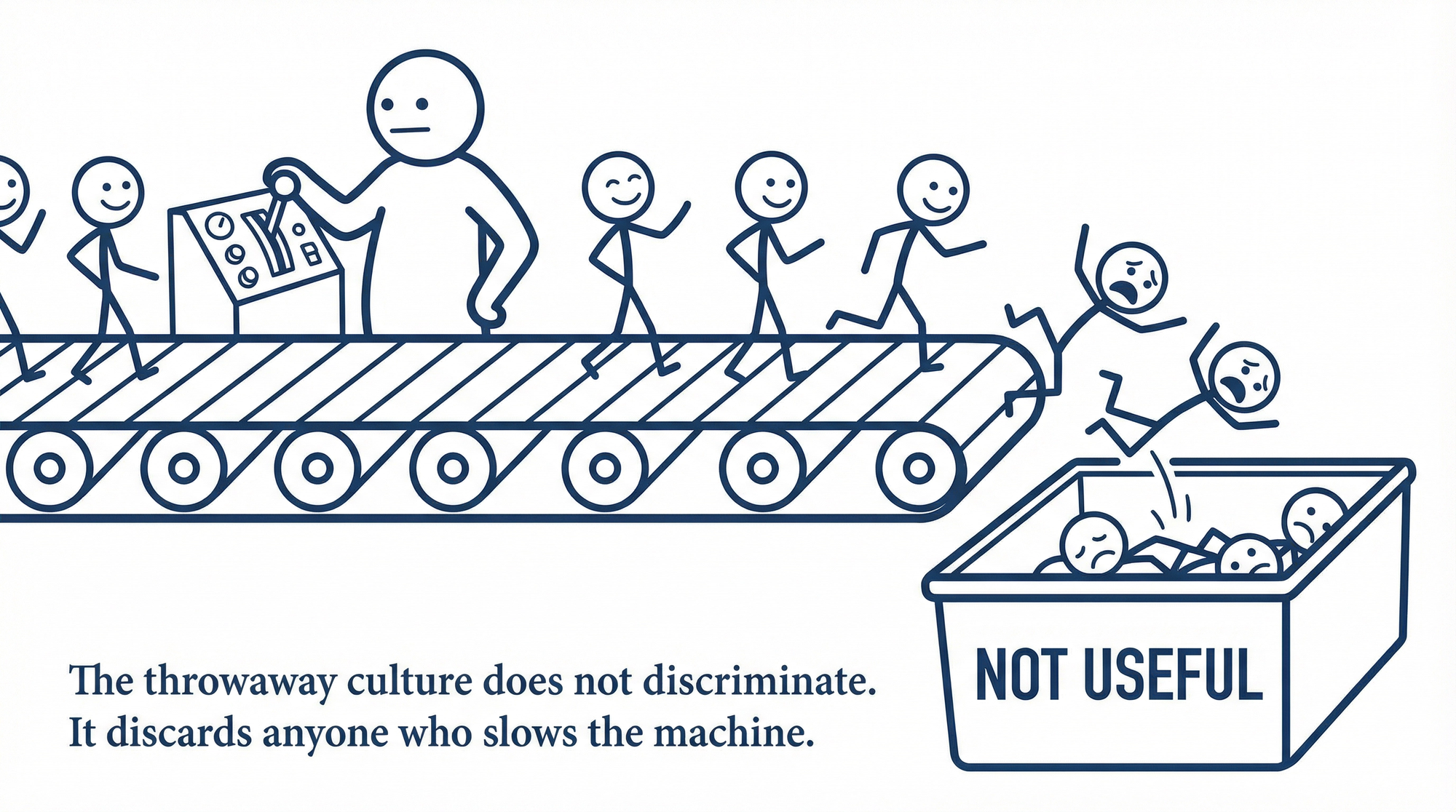
"Persons are no longer seen as a paramount value to be cared for and respected, especially when they are poor and disabled, 'not yet useful' like the unborn, or 'no longer needed' like the elderly. We have grown indifferent to all kinds of wastefulness, starting with the waste of food, which is deplorable in the extreme." (18)
Notice the range. He is not talking about one political issue. He is talking about a mentality that runs through everything. The unborn. The elderly. The disabled. The poor. All of them become expendable when human value is measured by usefulness.
"What is thrown away are not only food and dispensable objects, but often human beings themselves." (19)
And it gets more specific:
"This way of discarding others can take a variety of forms, such as an obsession with reducing labour costs with no concern for its grave consequences, since the unemployment that it directly generates leads to the expansion of poverty. In addition, a readiness to discard others finds expression in vicious attitudes that we thought long past, such as racism, which retreats underground only to keep reemerging." (20)
Pope Francis is drawing a line between things that most people treat as separate issues. Racism, labor exploitation, poverty, disregard for the unborn and elderly... he sees them as symptoms of the same disease. A disease that says: people are valuable when they are useful to me, and disposable when they are not.
This is not a left-wing point or a right-wing point. It is a Gospel point. And it is uncomfortable for everyone, which is usually a sign that something true is being said.
Slavery Is Not History (Paragraphs 22-24)
Pope Francis does not mince words here. He points out that despite international agreements and strategies to combat slavery, it persists:
"Even though the international community has adopted numerous agreements aimed at ending slavery in all its forms, and has launched various strategies to combat this phenomenon, millions of people today, children, women and men of all ages, are deprived of freedom and forced to live in conditions akin to slavery." (24)
He names organ trafficking, sexual exploitation, forced labor, and the exploitation of women specifically. These are not abstract injustices happening in distant lands. The supply chains that produce the clothes we wear and the electronics we use are implicated. The Pope is saying: this is not someone else's problem. It is connected to you.
Conflict and Fear (Paragraphs 25-28)
This section addresses the way fear is weaponized:
"War, terrorist attacks, racial or religious persecution, and many other affronts to human dignity are judged differently, depending on how convenient it proves for certain, primarily economic, interests. What is true as long as it is convenient for someone in power stops being true once it becomes inconvenient." (25)
This is a remarkable sentence. The Pope is saying that in much of the world, moral outrage is selective. We condemn atrocities when it is politically convenient and ignore them when it is not. Truth becomes a tool rather than a standard.
And then this:
"The best way to dominate and gain control over people is to spread despair and discouragement, even under the guise of defending certain values. Today, in many countries, hyperbole, extremism and polarization have become political tools. Employing a strategy of ridicule, suspicion and relentless criticism, in a variety of ways one denies the right of others to exist or to have an opinion." (26)
Read that paragraph slowly. It describes the political environment in almost every Western democracy right now. Ridicule as strategy. Suspicion as default. The denial of the other person's right to even have a perspective. Pope Francis wrote this in 2020. It has only become more true since.
Pandemics and What They Reveal (Paragraphs 32-36)
Writing in the shadow of COVID-19, Pope Francis reflects on what the pandemic exposed:
"The pain, uncertainty and fear, and the realization of our own limitations, brought on by the pandemic have only made it all the more urgent that we rethink our styles of life, our relationships, the organization of our societies and, above all, the meaning of our existence." (33)
The pandemic did not create the problems the Pope describes in this chapter. It revealed them. It showed us how fragile our systems are, how interdependent we are, and how quickly "every man for himself" becomes catastrophic:
"The notion of 'every man for himself' will rapidly degenerate into a free-for-all that would prove worse than any pandemic." (36)
But there is a hopeful line buried in this section that deserves attention:
"If only we might rediscover once for all that we need one another, and that in this way our human family can experience a rebirth, with all its faces, all its hands and all its voices, beyond the walls that we have erected." (35)
That sentence is the hinge of the chapter. The dark clouds are real. But the antidote is simple, if not easy: rediscovering that we need each other. Not as resources. Not as consumers. Not as political allies. As brothers and sisters.
The Illusion of Digital Connection (Paragraphs 42-46)
This may be the section most relevant to anyone under forty. Pope Francis takes on the assumption that digital connection equals real communion:
"Oddly enough, while closed and intolerant attitudes towards others are on the rise, distances are otherwise shrinking or disappearing to the point that the right to privacy scarcely exists. Everything has become a kind of spectacle to be examined and inspected, and people's lives are now under constant surveillance." (42)
"Digital relationships, which exempt the laborious cultivation of friendship, stable reciprocity, and even a consensus that matures over time, have the appearance of sociability. They do not truly build an 'us' but tend to conceal and amplify the same individualism that is expressed in xenophobia and in the contempt of the weak." (43)
That phrase, "the laborious cultivation of friendship," is worth sitting with. Real friendship is laborious. It takes time. It requires showing up when you do not feel like it, listening to things you do not want to hear, and staying when it would be easier to leave. A digital "connection" lets you skip all of that. And what you get in return is something that looks like friendship but is not.
Then the Pope describes what fills the void:
"Even as individuals maintain their comfortable consumerist isolation, they can choose a form of constant and febrile bonding that encourages remarkable hostility, insults, abuse, defamation and verbal violence destructive of others, and this with a lack of restraint that could not exist in physical contact without tearing us all apart. Social aggression has found unparalleled room for expansion through computers and mobile devices." (44)
If you have ever spent ten minutes reading a comment section, you know exactly what he is talking about. People say things online that they would never say to someone's face. The screen becomes a shield that makes cruelty feel costless. But it is not costless. It is corroding the basic human capacity to see the person on the other side of the screen as a person.
"There are huge economic interests operating in the digital world, capable of exercising forms of control as subtle as they are invasive, creating mechanisms for the manipulation of consciences and of the democratic process." (45)
Hope (Paragraphs 54-55)
After forty-five paragraphs of diagnosis, you might expect the chapter to end in despair. It does not. Pope Francis pivots to hope, and the pivot is deliberate. The dark clouds are real, but they are not the whole story:
"I would like in the following pages to take up and discuss many new paths of hope. For God continues to sow abundant seeds of goodness in our human family." (54)
He specifically names the heroes the pandemic revealed:
"The recent pandemic enabled us to recognize and appreciate once more all those around us who, in the midst of fear, responded by putting their lives on the line. We began to realize that our lives are interwoven with and sustained by ordinary people valiantly shaping the decisive events of our shared history: doctors, nurses, pharmacists, storekeepers and supermarket workers, cleaning personnel, caretakers, transport workers, men and women working to provide essential services and public safety, volunteers, priests and religious... They understood that no one is saved alone." (54)
"No one is saved alone." That is the thesis of the entire encyclical in five words. And it is the answer to every dark cloud named in this chapter. The throwaway culture says you are on your own. The Gospel says you are part of a family. The rest of Fratelli Tutti is about what it looks like to live as though that is true.
How to Keep Reading
Chapter 1 is the hardest chapter of Fratelli Tutti. It is a long look at what is broken, and that is never comfortable. But it is necessary. You cannot fix what you will not name.
If this guided reading was helpful, consider picking up the full encyclical. It is free on the Vatican website. Chapters 2 and 3 shift from diagnosis to vision, using the Parable of the Good Samaritan as a framework for what genuine fraternity looks like. Chapters 4 through 8 get practical: migration, politics, dialogue, religion's role in public life, and the pursuit of peace.
Read it slowly. A chapter a week. Maybe with a friend or a small group. The document rewards patience.
And remember what Pope Francis said at the beginning: he is not trying to be exhaustive. He is trying to name trends that hinder fraternity. Once you can see them, you can start choosing differently. That is what the rest of the encyclical is for.