

Picture this scene...
The Hernandez family sits together at the dinner table.
Dad scrolls through LinkedIn. Mom swipes through Instagram reels. Their fourteen-year-old has 1 AirPod in, watching TikTok under the table. Their eight-year-old plays a game on an iPad propped against the salt shaker.
This is not a broken family. They love each other. They go to Mass on Sundays. They help their neighbors.
But something quiet and invisible has settled over their home like a fog, and none of them can quite name what it is.
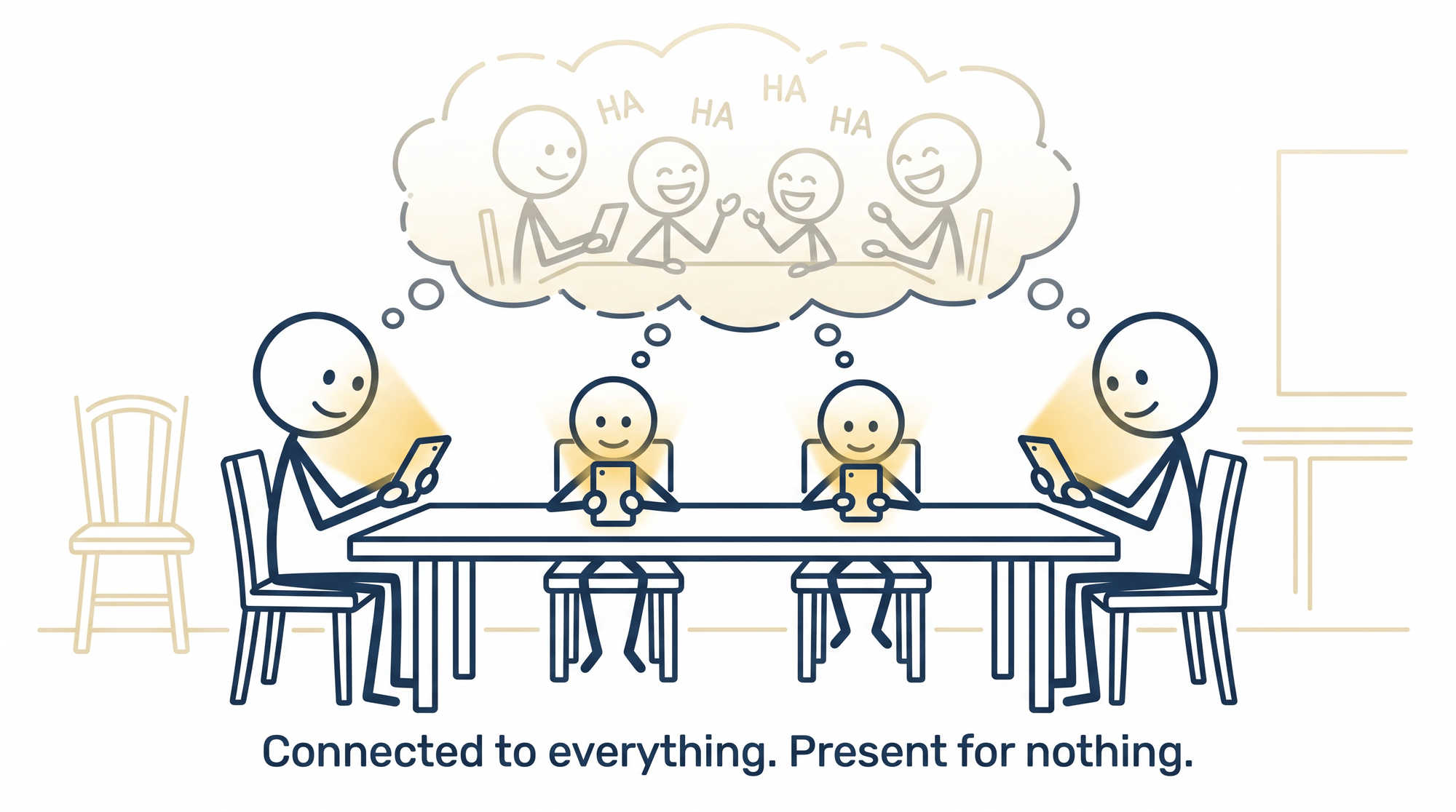
They are not alone. Worldwide, people spend an average of six hours and thirty-eight minutes a day staring at screens. Young adults aged 18 to 24 average over eight hours. And 98% of two-year-olds now watch screens daily. We are more connected than any civilization in human history, and yet somehow, we have never felt more alone.
Into this moment, Pope Leo XIV introduced a phrase in his first encyclical, Magnifica Humanitas, that may come to define how we think about technology for the next generation. He called for "education in digital sobriety."
Not digital censorship. Not a return to the dark ages. Digital sobriety.
It is a phrase worth sitting with.
The World We Have Built
We need to be honest about where we are.
The average person unlocks their phone somewhere between 96 and 352 times per day, depending on which study you read.
Every notification triggers a small hit of dopamine, the same chemical your brain releases when you eat chocolate or receive a compliment. The difference is that your phone can deliver that hit hundreds of times a day, and the apps are scientifically engineered to make sure it does.
This is not an accident.
Pope Leo XIV names it directly. He warns of the "digital attention economy," in which platforms are "designed to capture users' time and attention," and in doing so, weaken "their inner freedom."
That phrase, "inner freedom," deserves special attention.
He is not talking about political freedom or consumer choice. He is talking about the freedom of your soul to choose what is good, true, and beautiful, rather than simply reacting to whatever flashes across the screen next.
The science backs him up.
- A meta-analysis covering more than 1.9 million people found a statistically significant association between increased social media use and depression.
- A 2025 CDC study showed that teenagers with higher non-school screen use were more likely to experience depression symptoms, anxiety symptoms, weight concerns, and irregular sleep.
- A study published in Nature found that excessive screen time's effects on children's mental health were significantly mediated by reduced physical activity and disrupted sleep, accounting for up to 39% of the association.
And here is the part that should make every parent sit up: 82% of college students in a 2025 survey said they believe they are "probably addicted" to their smartphones. Not might be. Probably are.
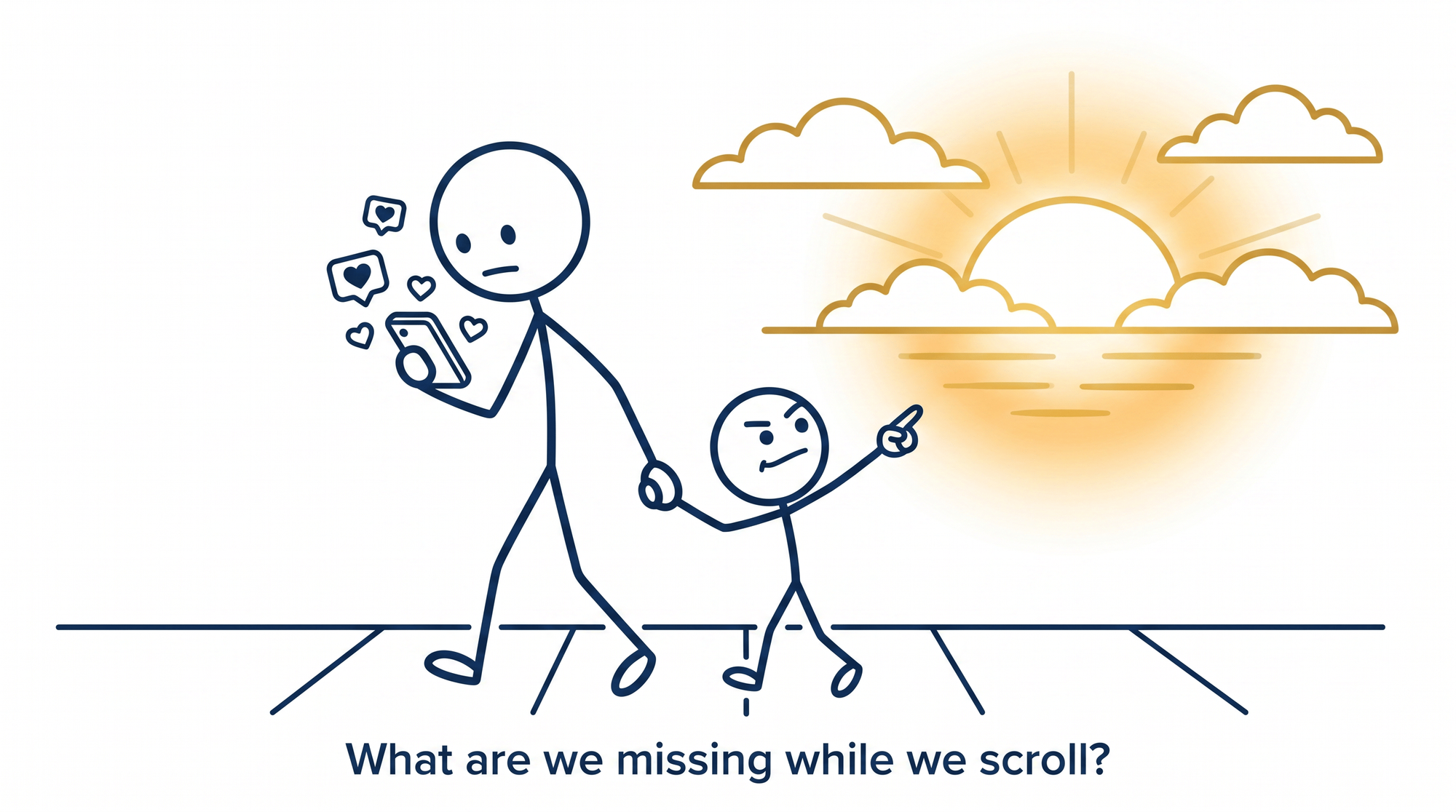
What Pope Leo XIV Actually Said
Magnifica Humanitas is a sweeping encyclical, covering artificial intelligence, human dignity, labor, war, and the common good.
But threaded through the document is a sustained, almost pastoral, concern for what screens are doing to our souls, our families, and especially our children.
Read our "Magnifica Humanitas in laymens terms" version.
The Pope does not mince words.
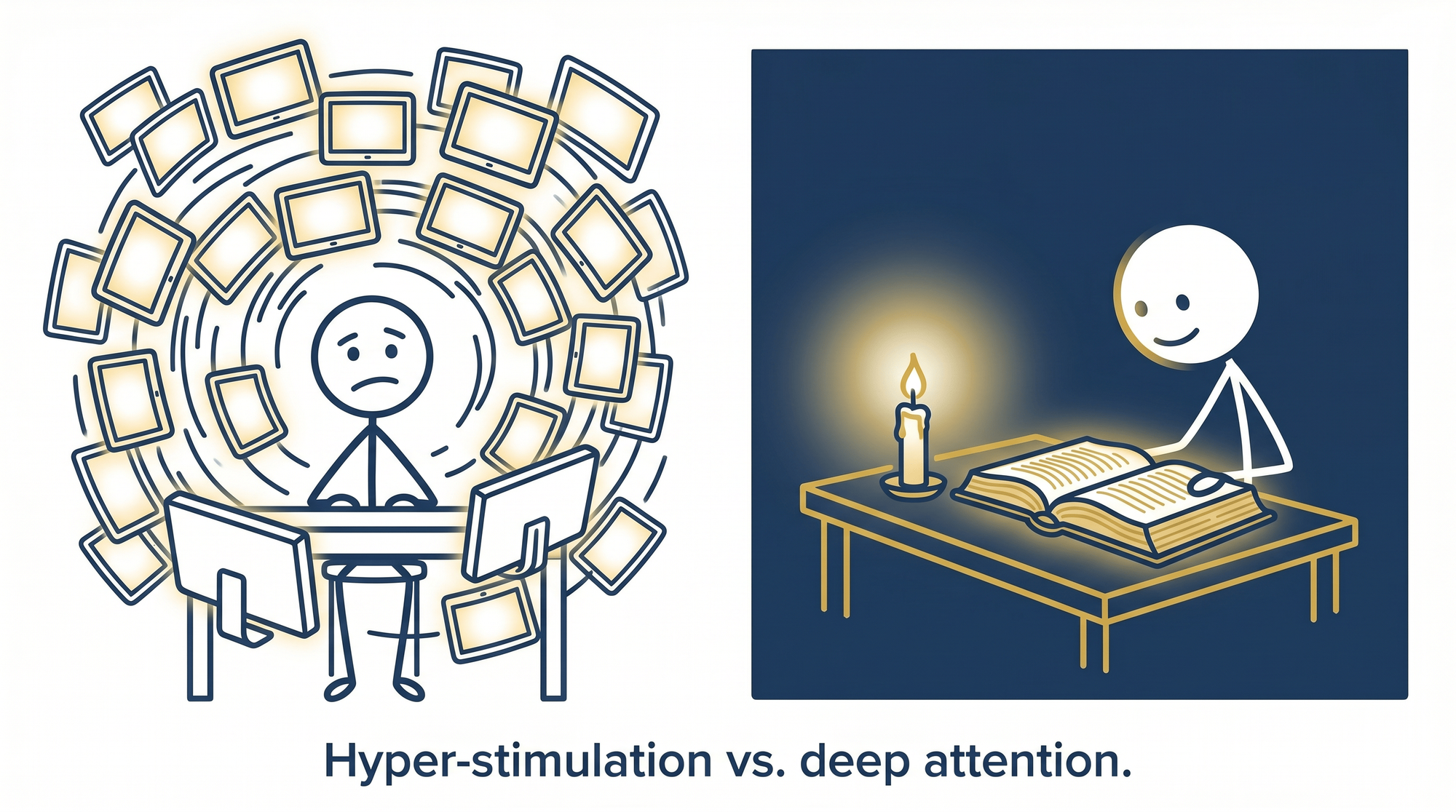
He writes that "the pervasiveness of digital media fosters a culture of immediacy and hyper-stimulation, which gives rise to fatigue, boredom, and apathy concerning the effort required for seeking the truth."
Read that again.
He is saying that our screens are not just distracting us.
They are making us bored by reality.
They are training us to expect constant stimulation, and when the real world cannot compete with a TikTok algorithm, we stop trying to engage with it.
We lose the patience to seek the truth, because truth requires effort, and effort feels unbearable when you have been conditioned to expect everything in fifteen seconds or less.
This is why he calls for digital sobriety, not just less screen time.
Sobriety implies something deeper than moderation. It implies clarity of mind. It implies the ability to see reality as it actually is, without the fog. An alcoholic who achieves sobriety does not just drink less. They learn to face life without a crutch.
The Pope is suggesting that for many of us, the phone has become that crutch.
He also makes a point that is easy to miss: every technology "shapes those who use it." We think of ourselves as the ones using our phones. But our phones are also using us, forming our attention spans, our emotional responses, our patience for conversation, our tolerance for silence. The tool shapes the hand that holds it.
For education specifically, the Pope calls for "a genuinely healthy attitude... requiring rhythms that incorporate silence, in-depth study, reading, and judicious analysis, for without these elements inner freedom may be compromised." He then adds something schools especially need to hear:
"Schools are not called to follow the pace of the digital world but to offer that which the digital sphere by itself cannot provide, namely a shared time for learning and developing trustworthy relationships."
Schools exist to be different from the internet. Not behind it. Different from it.
What Digital Sobriety Is Not
Before we go further, we need to clear something up. Digital sobriety is not digital prohibition.
The Pope is not telling you to throw your phone in a lake.
He is not saying technology is evil.
Magnifica Humanitas explicitly acknowledges that technology can be a powerful force for good.
And the data supports this.
Consider the YouVersion Bible app, which has surpassed one billion global installs. Research from the Center for Biblical Engagement shows that believers who engage with Scripture four or more times per week are 228% more likely to share their faith and 407% more likely to memorize Scripture.
That is a digital tool building up the Kingdom.
Or consider language learning apps. Studies have shown that 59% of participants using app-based language learning improved their oral proficiency by at least one sublevel on standardized assessments, in some cases outperforming traditional classroom instruction. Immigrants learning a new language. Missionaries preparing for the field. Families connecting across cultural barriers.
That is technology serving human flourishing.
Video calls have been shown to significantly reduce loneliness and depression among elderly adults, many of whom would otherwise go days without seeing a familiar face. A grandmother FaceTiming her grandchildren, a deployed soldier seeing his newborn for the first time, a hospice patient saying goodbye to a family member across the country.
These are sacred moments that technology makes possible.
- Maps that keep us from getting lost.
- Telehealth that brings doctors to rural communities.
- Educational apps that teach children to read.
- Emergency alerts that save lives.
Digital sobriety does not ask us to reject any of this.
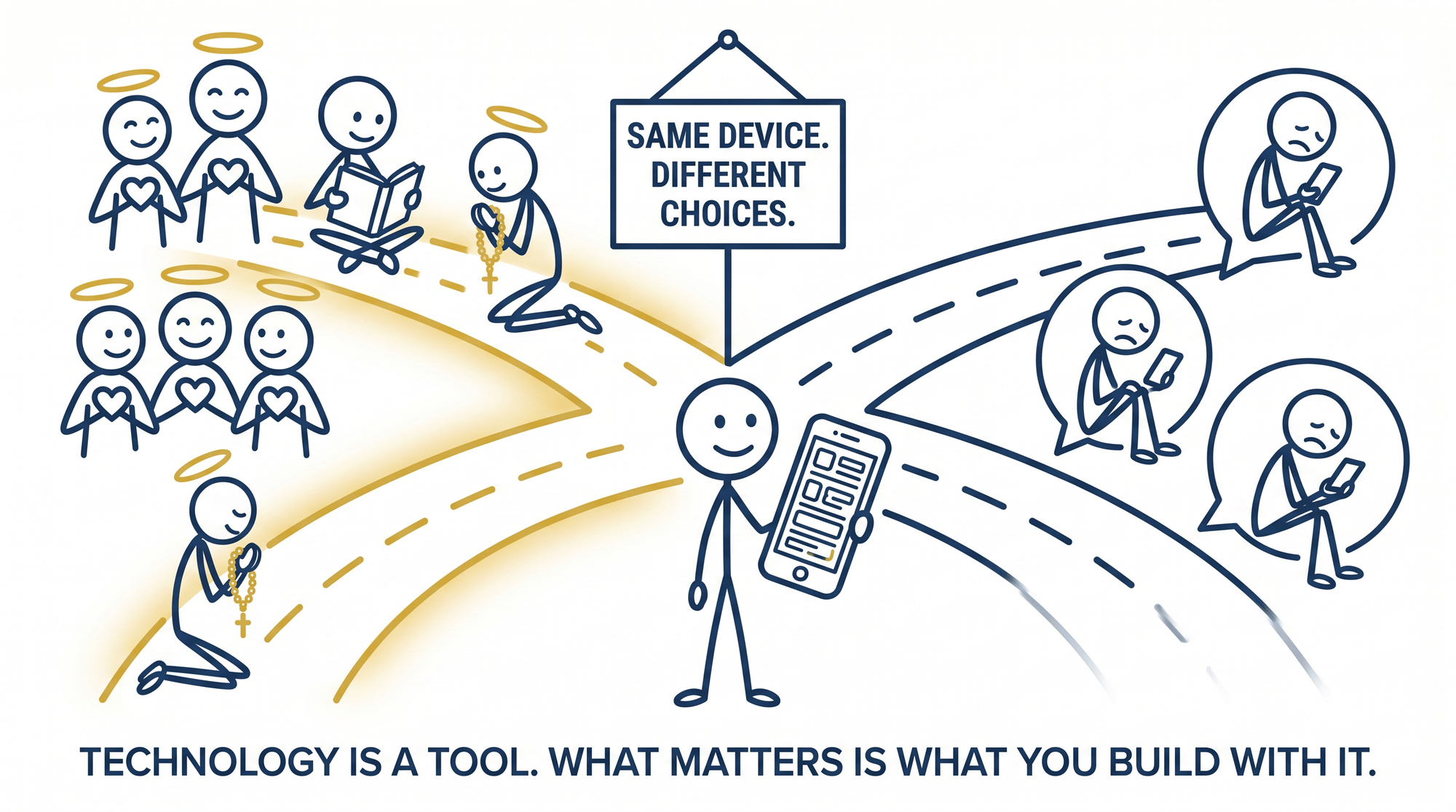
It asks us to be honest about the difference between using a tool and being used by one. It asks us to align our digital habits with the building up of human beings, rather than their distraction, division, and destruction.
The question is not "Is this screen on or off?" The question is "Is this making me more human, or less?"
The Science of What Screens Are Doing to Us
Let us look at the numbers clearly, because the data tells a story the Pope is trying to help us hear.
Children are now the most affected. Kids aged 5 to 8 spend an average of three hours and twenty-eight minutes on screens daily. Tweens clock five and a half hours. The Pope specifically warns about "early and unsupervised exposure to digital devices and social media," noting the damage to sleep, attention, and emotional regulation.
He goes further, naming "easy access to violent or degrading content that offends sensibility, to pornographic and hypersexualized material, to messages that trivialize the body and emotions, and to proposals that normalize risky behavior."
This is not a hypothetical.
A 2025 study found that 73% of teens had encountered explicit content online by age 13... 13!!!
Teenagers are carrying the heaviest burden. The CDC's 2025 study showed direct links between higher non-school screen use and depression symptoms, anxiety symptoms, insufficient peer support, and irregular sleep. A meta-analysis of cohort studies found that each additional hour of screen time per day increased the risk of depression in adolescents.
Adults are not exempt. The average American adult spends over four hours a day on their smartphone alone, with total screen time exceeding seven hours. People who report smartphone addiction are 69% more likely to also report poor sleep quality.
Nearly half of all Americans say they feel addicted to their phones.
Families are fragmenting without anyone leaving the room. Parents spend an average of seven to nine hours on screens daily, and studies consistently show that parental screen time predicts children's screen time. The Hernandez family at the top of this article is not an outlier. It is the norm.
The Pope calls for "an alliance among policymakers, educational institutions, and families that are capable of concretely supporting adults in this task."
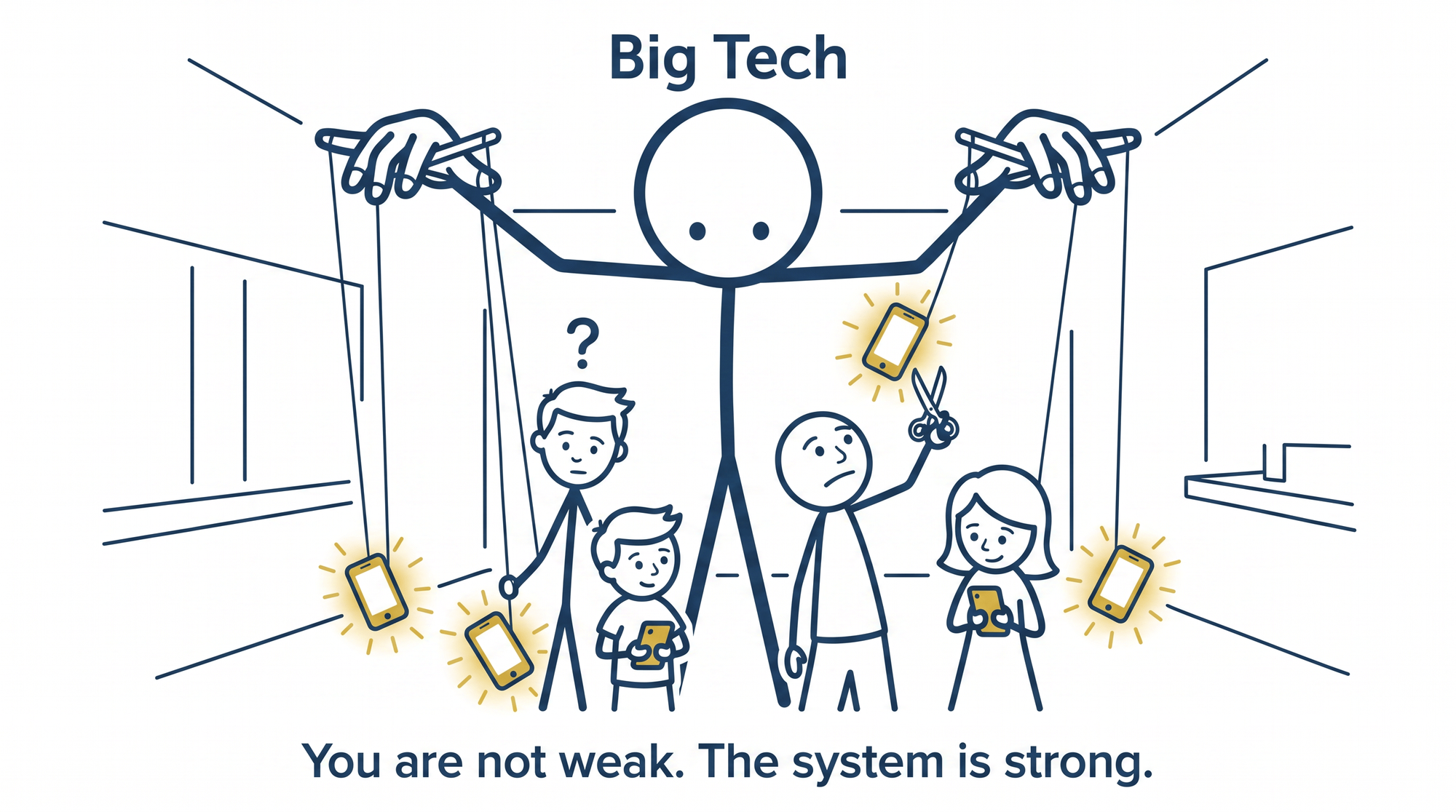
He acknowledges what every parent already knows: it is nearly impossible to fight the attention economy alone.
You are one family against billions of dollars in behavioral engineering.
You need allies.
What Digital Sobriety Looks Like in Practice
So what does digital sobriety actually look like?
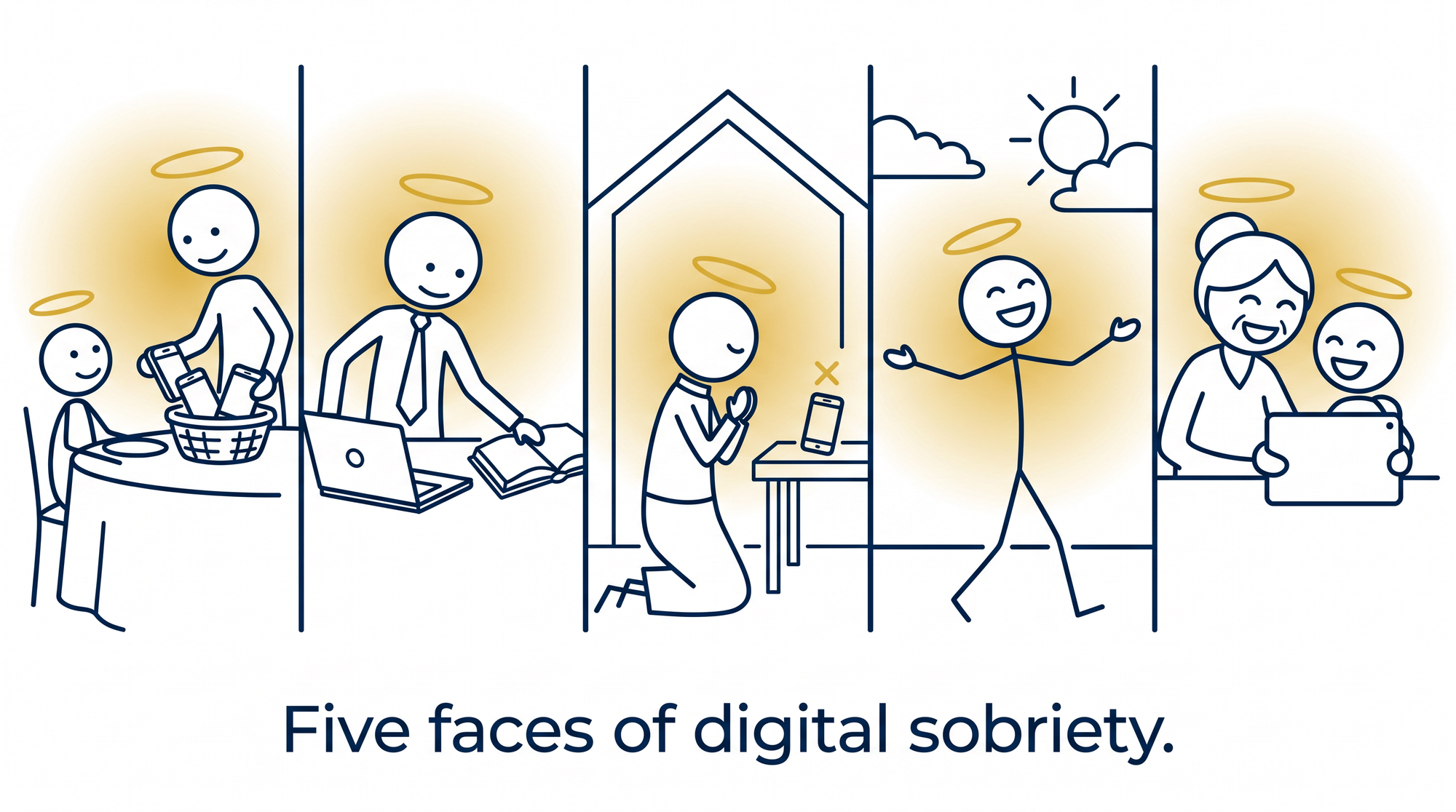
It looks different for different people. The Pope's framework of "sobriety and a sense of limits" gives us the principle. Let us walk through what that might mean for specific groups.
For Parents
The Pope's most direct language in Magnifica Humanitas is about children and screens. He warns that "having a personal mobile device at too early an age and using it without adult supervision can exacerbate young people's vulnerabilities, foster addiction, and expose them to isolation, bullying, and cyberbullying."
Digital sobriety for parents might mean delaying smartphone access until high school. It might mean keeping screens out of bedrooms. It might mean eating dinner with all devices in another room. It might mean having the courage to be the "strict" parent when every other kid in the class has unrestricted access.
It also means examining your own habits first.
Children learn what they see. If you reach for your phone the moment you feel bored, your children will learn that boredom is a problem to be fixed with a screen rather than a space where creativity, prayer, and real thinking can happen.
For Business Owners
If you run a business, screens are your tools.
You cannot just put them away. But digital sobriety for a business owner might mean setting boundaries around when you check email. It might mean turning off notifications during family time. It might mean resisting the urge to respond to every Slack message within seconds.
The Pope writes that we need "rhythms that incorporate silence, in-depth study, reading, and judicious analysis." For someone running a company, that translates to... block time for deep work.
Do not let the urgent crowd out the important.
The same dopamine loop that keeps a teenager on TikTok keeps a CEO from missing his sons homerun because he was checking Slack (or social).
For Those in Religious Life and Ministry
Priests, deacons, religious sisters, youth ministers, catechists. If you serve others in ministry, your phone is both a tool for reaching people and a potential obstacle to the interior life that makes your ministry possible.
Digital sobriety in religious life might look like phone-free prayer times, not just as a rule, but as a protection. It might mean fasting from social media during Lent and Advent, not to perform piety, but to reconnect with the silence God often speaks through. The great mystics did not have notification badges. They had quiet rooms and open hearts.
It also might mean, looking into more ways to use digital and AI to spread the gospel, study the scriptures, and defend the faith (gently).
For Young Adults
You grew up with these devices. Many of you cannot remember life without them. That makes digital sobriety both harder and more radical for you.
Start small.
Put your phone in another room while you study. Delete one app that you know wastes your time. Try going for a walk without headphones and notice what your mind does when it is not being fed content. You might be surprised how restless you feel at first. That restlessness is the withdrawal. It's ok to feel it, it will pass with practice.
That anxious withdrawl actually proves the Pope's point about "inner freedom" better than any statistic could. In time you will learn to see the beauty and calming effect of silent time. It is sacred.
For Grandparents and Retirees
You may actually be the generation best positioned for digital sobriety, because you remember what life was like before the smartphone.
You know what a quiet evening feels like.
You remember reading books for hours, having phone calls that lasted longer than a text exchange, sitting on a porch and watching the world go by without documenting it.
But you are also vulnerable in other ways. The algorithms that feed outrage and fear are remarkably effective on older adults. AI-powered scammers prey upon your digital immaturity.
Digital sobriety for you might mean being intentional about which news sources you consume, limiting how much time you spend reading comment sections, and using your phone primarily for the things it does best: staying connected with the people you love.
It would do you a great service to take a few classes, pickup a book at Barnes & Noble, or better yet bond with the younger generation by learning from them. It's not about being superior to anyone, it's about finding the good, and the Godly, in everything.
The Deeper Invitation
At its core, digital sobriety is about something much larger than screen time.
It is about what kind of person you are becoming.
The Pope puts it this way: we must protect people "from the promise of the perfect machine, from that subtle temptation which renders human thought seemingly superfluous precisely when it is most needed."
The phone promises you will never be bored, never be lost, never be alone, never be uninformed. But in keeping that promise, it takes something from you. It takes your ability to sit with uncertainty. Your willingness to struggle through a hard question. Your capacity for the kind of slow, patient thinking that leads to wisdom.
"The speed and ease with which answers or summaries can be obtained risk extinguishing the desire to ask questions, which is a process that bears fruit only over time."
That line is stunning. He is saying that Google and AI chatbots do not just answer our questions. They can extinguish our desire to wrestle with them. And asking questions, truly wrestling with them, is how human beings grow. It is how we discover truth. It is how we encounter God.
The Catechism reminds us that we are made in the image of God, endowed with intellect, free will, and the capacity for communion with our Creator (CCC 1730).
These are the very faculties that the attention economy targets. Your intellect is monetized through content. Your will is weakened by infinite scroll. Your capacity for fellowship is replaced by parasocial relationships with strangers on the internet.
Digital sobriety is the act of reclaiming what God gave you.
"For an algorithm, an error is a flaw to be corrected; for a person, however, an error can be a catalyst for profound change. A person's future is not calculable, but depends on one's freedom, elevated by the inexhaustible grace of God, and on the relationships cultivated."
You are not an algorithm. Your life is not a feed. Your worth is not measured in engagement metrics. You are a child of God, made for something infinitely deeper than the next notification.
Recommended Reading
If digital sobriety sounds intimidating, start with one thing. Not a complete overhaul. Just one honest change.
Maybe it is charging your phone in the kitchen instead of on your nightstand. Maybe it is a ten-minute walk without earbuds. Maybe it is reading a physical book before bed instead of scrolling. Maybe it is looking your child in the eye when they talk to you, even when your phone buzzes.
For deeper exploration, consider these resources:
Read: Magnifica Humanitas by Pope Leo XIV. The full encyclical is available on Vatican.va. The sections on education and technology (paragraphs 134-152) are particularly relevant to this topic.
Read: The Anxious Generation by Jonathan Haidt, which explores the research on smartphones and teen mental health in rigorous detail.
Pray: Ask God in prayer to show you where your digital habits have become a barrier between you and Him, between you and the people you love, or between you and the person He created you to be. Consider going to adoration chapel for at least 1 hour a week.
Act: Talk to your family about screen time this week. Not a lecture. A conversation. Ask your kids what they think about their own phone use. You might be surprised by what they say.
Frequently Asked Questions
What does "digital sobriety" mean?
Digital sobriety is a term used by Pope Leo XIV in his encyclical Magnifica Humanitas to describe a conscious, disciplined approach to technology use. It means using digital tools intentionally for purposes that build up human flourishing, rather than passively consuming content in ways that weaken attention, relationships, and inner freedom. It is not about rejecting technology, but about using it wisely.
Did Pope Leo XIV say AI and tech is sinful?
No. Pope Leo XIV does not condemn technology itself. He acknowledges that digital tools can serve the common good. His concern is with the "digital attention economy" that exploits users' time and attention for profit, and with unsupervised exposure of children to harmful content. He calls for wisdom, restraint, and intentionality, not a blanket rejection of phones or the internet.
How much screen time is too much for children?
The Pope does not give a specific number of hours, but he warns that "early and unsupervised exposure to digital devices and social media" damages sleep, attention, and emotional regulation. Current research shows children aged 5-8 average over 3 hours daily, and tweens average 5.5 hours. The American Academy of Pediatrics recommends consistent limits and prioritizing sleep, physical activity, and face-to-face interaction over screen time.
What is the "digital attention economy" the Pope talks about?
The digital attention economy refers to the business model of most social media platforms and apps, which are designed to capture and hold users' attention as long as possible in order to sell advertising. Pope Leo XIV warns that these platforms weaken "inner freedom" by creating addictive patterns, noting that parents cannot resist the influence of these business models alone and calling for an alliance of policymakers, schools, and families.
Is digital sobriety only for Catholics?
No. While Pope Leo XIV writes from within Church tradition, his call for digital sobriety speaks to a universal human concern. People of all faiths and no faith are experiencing the effects of smartphone addiction, declining attention spans, and the fragmentation of family life. The science on screen time and mental health applies to everyone. The Pope's framework simply gives us a name for what many people already feel is needed.