

We have come a long way.
In Part 1, we learned that the Church is not an organization. It is a mystery, the Body of Christ, and the Temple of the Holy Spirit.
In Part 2, we explored its structure, from the bishops down to the laity, and discovered that every baptized person has a mission.
In Part 3, we heard the universal call to holiness and saw how religious life serves as a radical witness to the Gospel.
Now we arrive at the end. The final two chapters of Lumen Gentium ask the two biggest questions left. Where is the Church going? And who shows us what it looks like to get there?
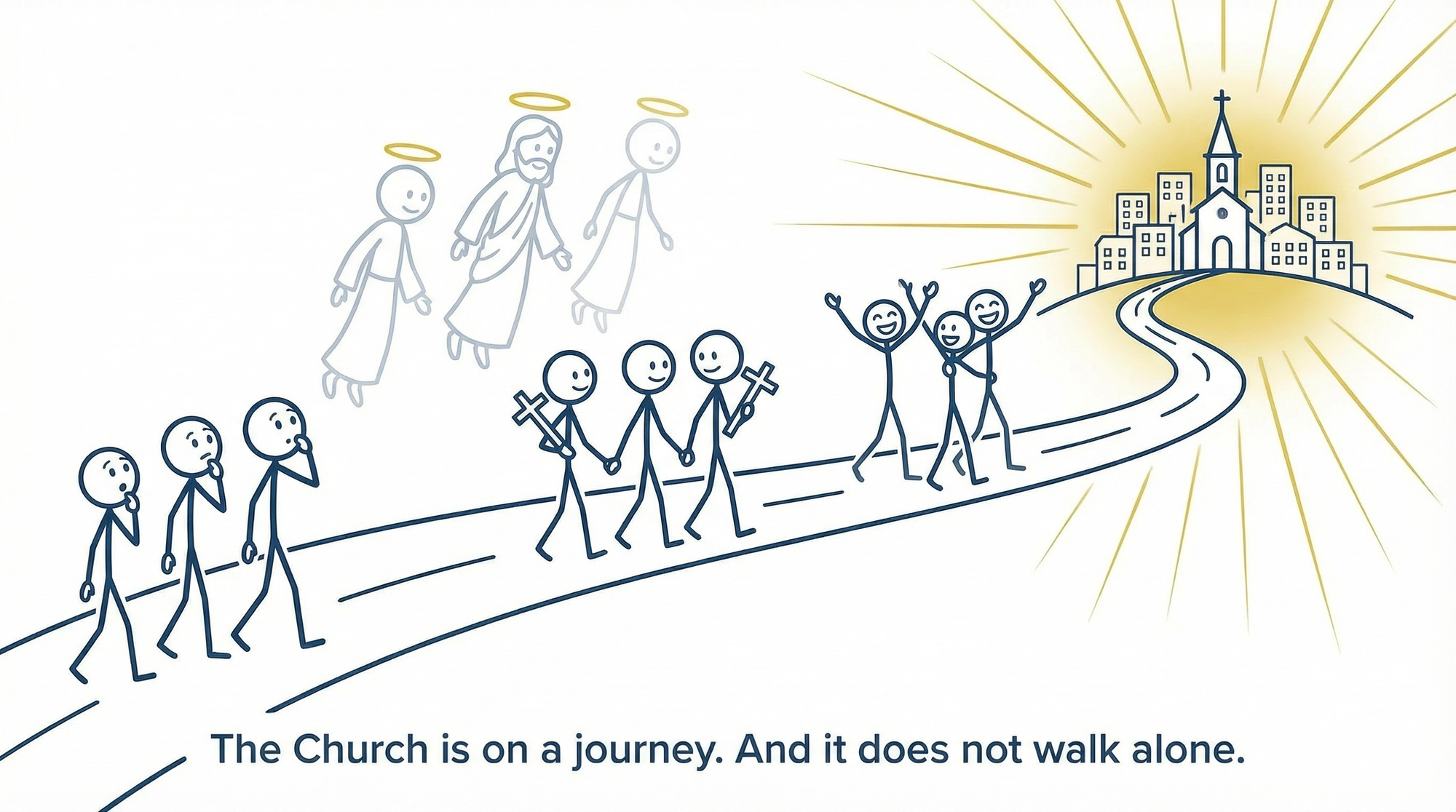
Chapter 7 answers the first question. The Church is a pilgrim. It is on a journey, connected to the saints who have gone before, the faithful who are being purified, and the believers still walking this earth.
Chapter 8 answers the second. Mary, the Mother of God, is the model of what the Church is called to become.
This is where the document lifts its eyes from the present and looks toward eternity.
Chapter 7: The Pilgrim Church and the Communion of Saints
Chapter 7 begins by reminding us of something easy to forget. The Church is not finished yet.
"The Church, to which we are all called in Christ Jesus, and in which we acquire sanctity through the grace of God, will attain her full perfection only in the glory of heaven, when there will come the time of the restoration of all things." (Lumen Gentium 48)
The Church you see on earth is real, but it is not complete. It is imperfect. It stumbles. Its members sin. Its institutions sometimes fail. This is not because the Church is a fraud. It is because the Church is still on the road. She has not arrived yet.
This is what the document means by "pilgrim." A pilgrim is not lost. A pilgrim knows where she is going. But she has not gotten there yet, and the road is long.
Three Churches, One Communion
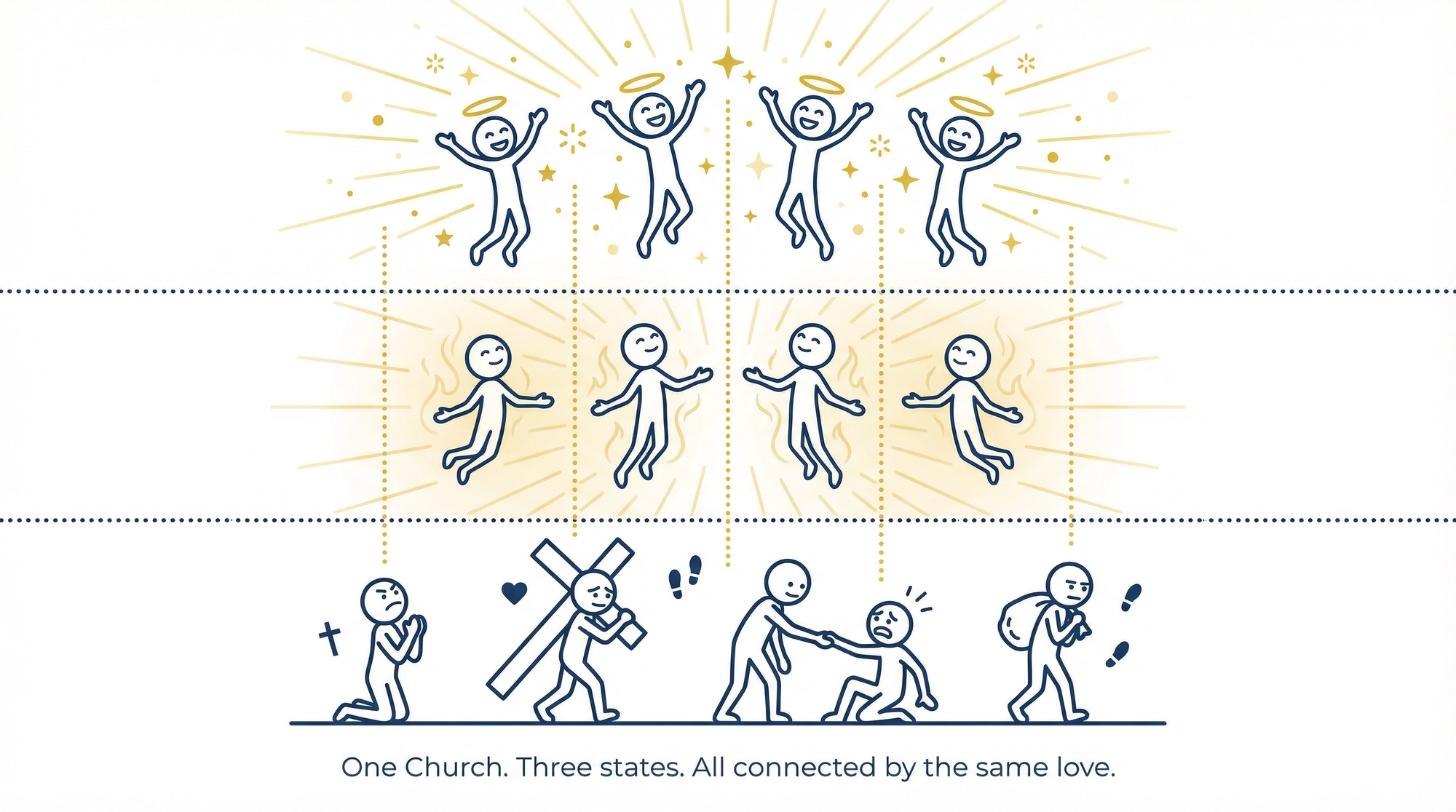
Here is where the document teaches something beautiful and often misunderstood. The Church is not limited to the people sitting in pews on Sunday morning. The Church spans three states of existence.
"Some of his disciples are exiles on earth, some having died are purified, and others are in glory beholding clearly God himself triune and one, as he is. But all in various ways and degrees are in communion in the same charity of God and neighbor and all sing the same hymn of glory to our God." (Lumen Gentium 49)
The Church Militant is us. The Christians still living on earth, still fighting the good fight, still stumbling and getting back up.
The Church Suffering is the faithful who have died and are being purified in purgatory. They are saved but not yet ready for the fullness of God's presence.
The Church Triumphant is the saints in heaven. They have finished the race. They are home.
And all three are one Church. The boundary between earth and heaven is thinner than we think.
The Dead Are Not Gone
The document insists that death does not sever the bond between Christians.
"The union of the wayfarers with the brethren who have gone to sleep in the peace of Christ is not in the least weakened or interrupted, but on the contrary, according to the perpetual faith of the Church, is strengthened by communication of spiritual goods." (Lumen Gentium 49)
When your grandmother who prayed for you every day passes away, her prayers do not stop. When a saint who lived a thousand years ago intercedes for someone praying to God through them today, the connection is real. Death changes the form of the relationship. It does not end it.
This is why we pray for the dead. Not because we doubt their salvation, but because love does not stop at the grave. And this is why we ask the saints to intercede for us. Not because we think they replace Christ, but because they are alive in Christ and closer to Him than we are.
The Saints: Friends, Not Idols
The document addresses a question that Protestants and skeptics raise frequently: isn't praying to saints a form of idolatry?
"It is most fitting, therefore, that we love those friends and co-heirs of Jesus Christ who are also our brothers and outstanding benefactors, and that we give due thanks to God for them, humbly invoking them, and having recourse to their prayers, their aid and help in obtaining from God through his Son, Jesus Christ, the benefits we need." (Lumen Gentium 50)
Notice the language. We invoke the saints. We ask for their prayers. We have recourse to their help. But the benefits come from God, through Jesus Christ. The saints are not an alternative to Christ. They are friends who are already with Him, and they point us toward Him.
The document also guards against excess:
"Let them therefore teach the faithful that the authentic cult of the saints consists not so much in the multiplying of external acts, but rather in the greater intensity of our love, whereby, for our own greater good and that of the whole Church, we seek from the saints example in their way of life, fellowship in their communion, and aid by their intercession." (Lumen Gentium 51)
Three things from the saints: example, fellowship, and intercession. Not magic. Not superstition. Relationship.
The Liturgy: Where Earth Meets Heaven
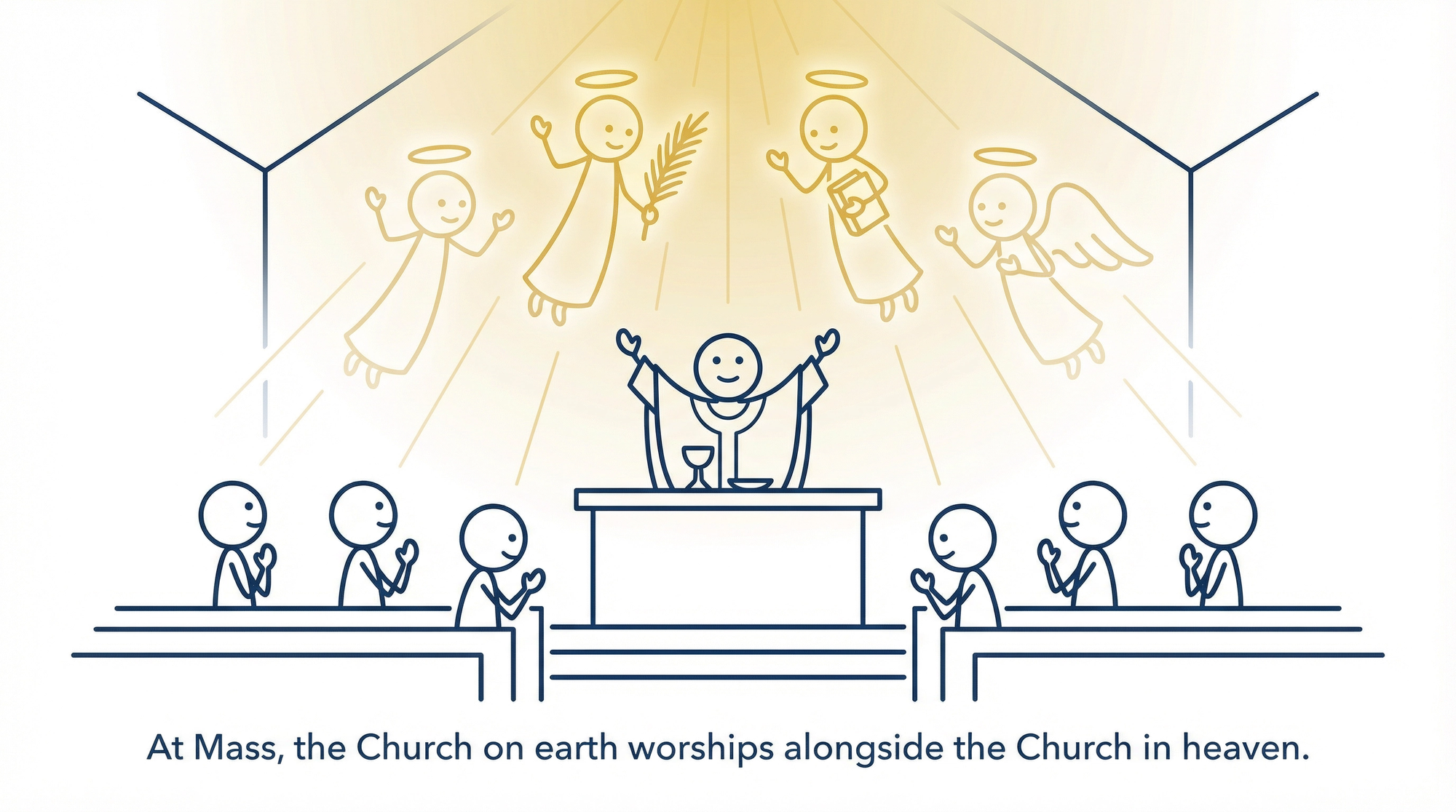
The document makes one more connection that is easy to miss. The place where the pilgrim Church most fully experiences its union with heaven is the liturgy.
When you go to Mass, you are not just sitting in a building with other people. You are joining a worship service that stretches across all three states of the Church. The angels and saints are there. The faithful departed are remembered. Heaven and earth touch.
This is why the liturgy matters. It is not just a ritual. It is a thin place where eternity breaks through.
The Hard Questions About Chapter 7
"The Bible says 'the dead know nothing' (Ecclesiastes 9:5). How can saints intercede if they are unconscious?"
This is one of the most common objections, and it deserves a careful answer. Here is the full verse:
"For the living know that they will die, but the dead know nothing, and they have no more reward, for the memory of them is forgotten." (Ecclesiastes 9:5)
Read in context, Ecclesiastes is written from the perspective of life "under the sun," the limited, earthly viewpoint. The author is describing what death looks like from this side of the grave. But Scripture also gives us the view from the other side. In Revelation 5:8, the elders in heaven offer the prayers of the saints to God. In Revelation 6:9-10, the martyrs who have died cry out to God from under the altar. In Luke 16:19-31, the rich man and Lazarus are both conscious after death. Jesus himself told the thief on the cross, "Today you will be with me in Paradise" (Luke 23:43), not "Today you will cease to exist."
The dead in Christ are not unconscious. They are more alive than we are.
"Praying to saints is communicating with the dead, which Deuteronomy 18:11 forbids."
Deuteronomy 18:10-11 condemns necromancy, the practice of summoning the dead through occult means to gain secret knowledge. This is spiritism, and the Church condemns it just as firmly as any Protestant does.
But asking a saint to pray for you is not necromancy any more than asking a friend to pray for you is necromancy. You are not summoning the dead. You are asking someone who is alive in Christ to intercede with God on your behalf. The mechanism is the same as asking your pastor to pray for you, except the saint happens to be in heaven rather than down the hall.
"1 Timothy 2:5 says there is 'one mediator between God and men.' Saints' intercession violates this."
Here is the verse:
"For there is one God, and there is one mediator between God and men, the man Christ Jesus." (1 Timothy 2:5)
This is the most serious objection, and it is worth taking at full strength. If Christ is the one mediator, doesn't asking anyone else to intercede for you bypass Him?
Look at the context. Two verses earlier, Paul writes: "I urge that supplications, prayers, intercessions, and thanksgivings be made for all people" (1 Timothy 2:1). Paul is asking living Christians to intercede for one another.
If human intercession violates Christ's unique mediation, then every prayer request you have ever made to another person is a sin. But it isn't. Because intercessory prayer does not bypass Christ. It goes through Him.
The saints in heaven do the same thing your praying grandmother does on earth: they ask God, through Christ, to help you. Christ remains the one mediator. The saints are not an alternative route to God. They are fellow travelers who have arrived at the destination and are cheering you on.
"Purgatory is a medieval invention. It is nowhere in the Bible."
Lumen Gentium mentions the faithful "being purified" after death without elaborating extensively. But the idea is present in Scripture more than many realize. Paul writes in 1 Corinthians 3:15 that some will be saved "but only as through fire."
Jesus speaks of a sin that "will not be forgiven either in this age or in the age to come" (Matthew 12:32), implying that some sins can be forgiven after death.
And the ancient Jewish practice of praying for the dead (2 Maccabees 12:46, "it is a holy and wholesome thought to pray for the dead, that they may be loosed from sins") predates Christianity entirely.
Purgatory is not about earning salvation. It is about becoming ready to stand in the full presence of God. If you have ever felt unworthy to be in a holy place, multiply that feeling by infinity. Purgatory is God's mercy completing in us what His grace began.
Chapter 8: The Blessed Virgin Mary
The final chapter of Lumen Gentium does something that caused intense debate among the Vatican II bishops. Rather than writing a separate document about Mary, the council integrated her story into the document on the Church.
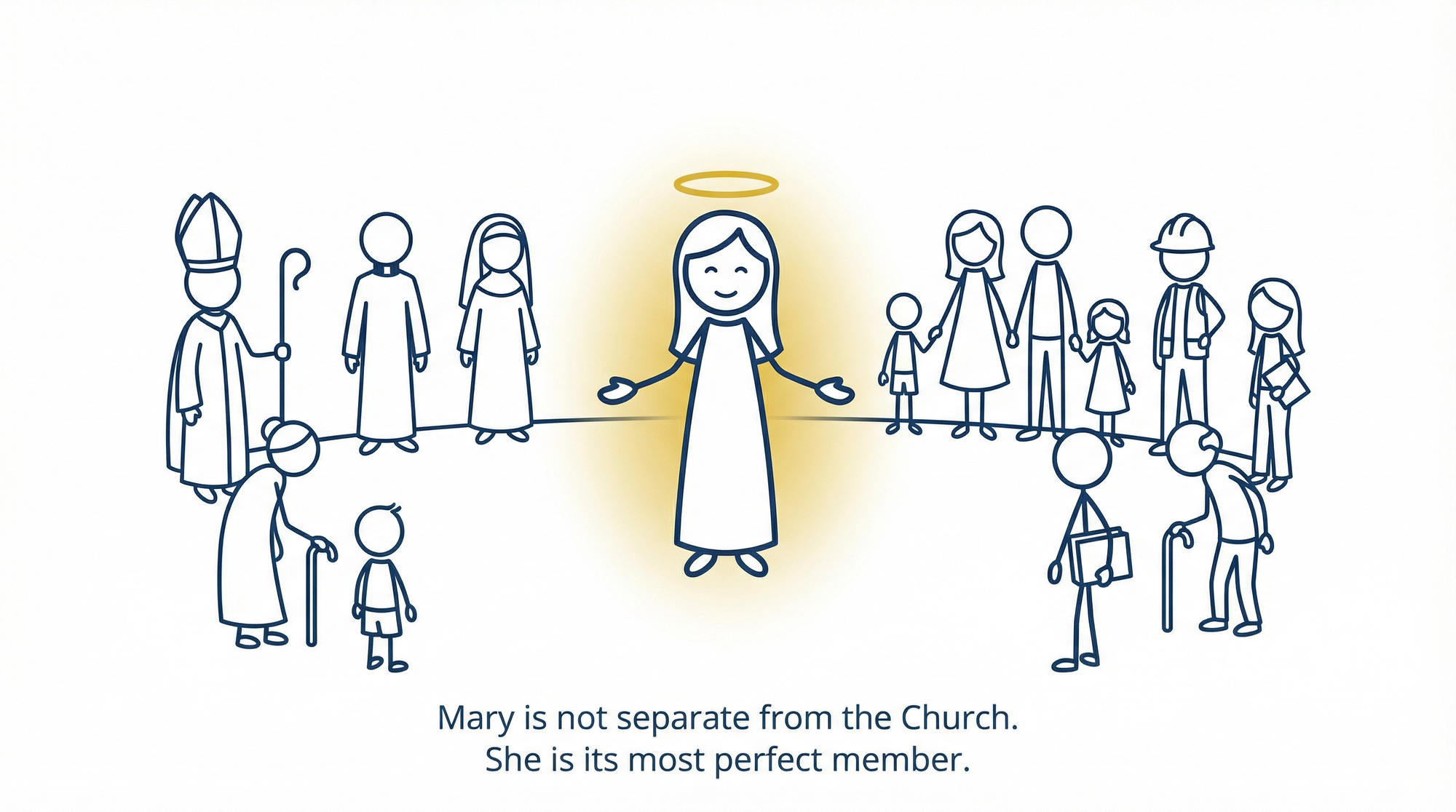
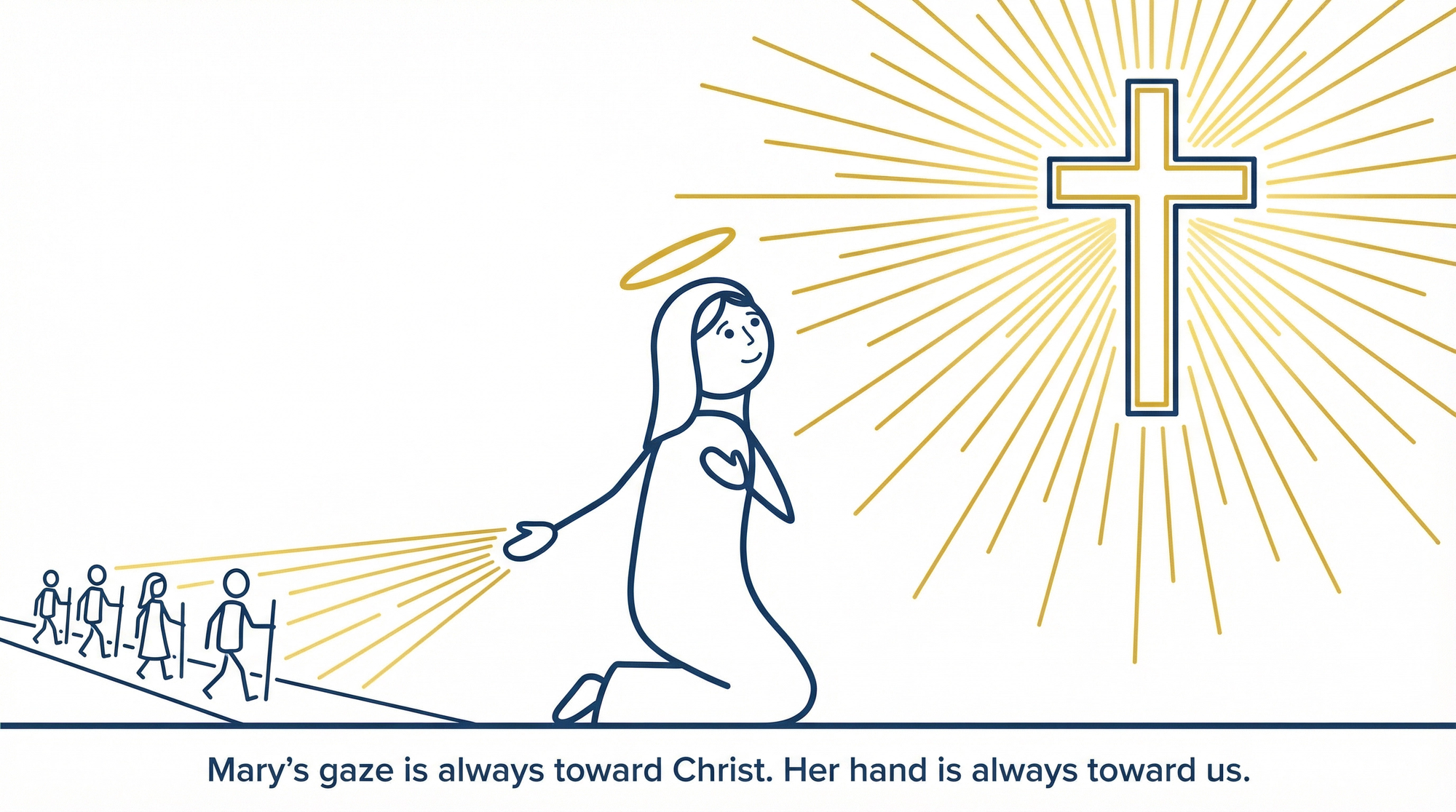
This was deliberate. Mary is not separate from the Church. She is its most perfect member, the living image of what the Church is called to become.
"The Virgin Mary, who at the message of the angel received the Word of God in her heart and in her body and gave Life to the world, is acknowledged and honored as being truly the Mother of God and Mother of the Redeemer." (Lumen Gentium 53)
Mary's Yes Changed Everything
The document traces Mary's role in salvation history back to her consent at the Annunciation.
"The Father of mercies willed that the incarnation should be preceded by the acceptance of her who was predestined to be the mother of his Son, so that, just as a woman contributed to death, so also a woman should contribute to life." (Lumen Gentium 56)
God did not force the Incarnation. He asked. And Mary said yes. That yes made everything possible. The birth of Christ, His ministry, His death and resurrection, the Church itself. All of it flows from one young woman's willingness to trust God with everything.
This is why Mary matters. Not because she is divine. She is not. But because her faith is the model for every Christian who has ever been asked to trust God with something terrifying.
Mary as Model of the Church
Here is the theological heart of Chapter 8. Mary is not just honored for historical reasons. She is the living image of what the Church itself is called to be.
"The Blessed Virgin is also intimately united with the Church. As St. Ambrose taught, the Mother of God is a type of the Church in the order of faith, charity and perfect union with Christ. For in the mystery of the Church, which is itself rightly called mother and virgin, the Blessed Virgin stands out in eminent and singular fashion as exemplar both of virgin and mother." (Lumen Gentium 63)
The Church, like Mary, receives the Word of God. The Church, like Mary, brings Christ into the world. The Church, like Mary, is called to say yes to God even when the cost is unknown. Mary is not a decoration on the Church. She is its blueprint.
"While in the most holy Virgin the Church has already reached that perfection whereby she is without spot or wrinkle, the followers of Christ still strive to increase in holiness by conquering sin, and so they turn their eyes to Mary who shines forth to the whole community of the elect as the model of virtues." (Lumen Gentium 65)
Mary is what the Church is becoming. She shows us the finish line.
Mary and Christ: No Competition
The document addresses the concern that Marian devotion distracts from worship of Christ. It does this with precision.
"There is one mediator, Christ Jesus, and Mary's maternal duty toward men in no wise obscures or diminishes this unique mediation of Christ, but rather shows His power. All the salvific influence of the Blessed Virgin on men originates from divine pleasure, flows forth from the superabundance of the merits of Christ, rests on His mediation, depends entirely on it and draws all its power from it." (Lumen Gentium 60)
Every grace Mary gives comes from Christ. Every prayer she answers is answered through Christ. Every honor given to Mary points back to Christ. There is no competition. There never was.
The document then draws a clear line between veneration and worship:
"This cult differs essentially from the cult of adoration which is offered to the Incarnate Word, as well as to the Father and the Holy Spirit." (Lumen Gentium 66)
Not "differs by degree." Differs essentially. The honor given to Mary is different in kind from the worship given to God. We honor Mary. We worship God alone. The distinction is absolute.
Mary's Motherhood Continues
One final teaching deserves attention. Mary's role did not end at the foot of the cross.
"This motherhood of Mary in the order of grace continues uninterruptedly from the consent which she loyally gave at the Annunciation and which she sustained without wavering beneath the cross, until the eternal fulfilment of all the elect." (Lumen Gentium 62)
Mary is still your mother. She is still interceding. She is still saying yes to God on behalf of the Church. Her motherhood is not a historical fact. It is a present reality.
The Hard Questions About Chapter 8
Chapter 8 generates more controversy than any other part of Lumen Gentium. The objections are real and they come from a place of genuine concern for Christ's honor. They deserve careful, honest responses.
"The Bible says Jesus had brothers and sisters (Matthew 13:55-56). Mary was not a perpetual virgin."
This is one of the strongest textual objections. Matthew 13:55 names James, Joseph, Simon, and Judas as Jesus' "brothers," and mentions "sisters" as well. The plain reading seems to indicate Mary had other children.
But the Greek word adelphoi ("brothers") was used more broadly than our English word. In Genesis 13:8, Abraham calls Lot his "brother," though Lot was his nephew. In Genesis 29:15, Laban calls Jacob his "brother," though Jacob was his nephew. The word covered brothers, half-brothers, cousins, and close kinsmen. The early Church Fathers, including Jerome, Origen, and Epiphanius, all affirmed Mary's perpetual virginity. So did Martin Luther, John Calvin in his early writings, and Ulrich Zwingli. The Reformers themselves did not find the "brothers" argument convincing.
Furthermore, when Jesus was dying on the cross, he entrusted Mary to the apostle John (John 19:26-27). If Mary had other biological sons, this gesture would have been unnecessary and even insulting to them. The fact that Jesus gave his mother to a non-family member suggests there were no other children to care for her.
"Calling Mary 'Mother of God' makes her sound semi-divine."
The title Theotokos ("God-bearer" or "Mother of God") was defined at the Council of Ephesus in 431. It is not a statement about Mary's nature. It is a statement about her Son's nature. If Jesus is fully God and fully man, and Mary is his mother, then she is the mother of God. Denying the title doesn't protect God's honor. It undermines the Incarnation. The alternative, calling her only "Mother of Jesus" or "Mother of Christ's human nature," implies that Jesus can be divided into parts, which is the ancient heresy of Nestorius.
Mary is not divine. She is not eternal. She did not exist before God. But she carried God in her womb. The title honors who Jesus is, not who Mary is.
"Romans 3:23 says 'all have sinned.' The Immaculate Conception contradicts Scripture."
Paul writes:
"For all have sinned and fall short of the glory of God." (Romans 3:23)
If all have sinned, how can Mary be exempt? The answer is that "all" in Paul's letters often carries exceptions. Jesus himself never sinned, yet he was human. Let's look at other examples in the Bible...
Luke 1:6 (about Zechariah and Elizabeth): "And they were both righteous before God, walking blamelessly in all the commandments and statutes of the Lord." If "all have sinned" means zero exceptions ever, then Luke calling them "blameless" is a contradiction. It isn't, because Paul and Luke are speaking in different registers.
Enoch (Genesis 5:24): "Enoch walked with God, and he was not, for God took him." Hebrews 11:5 adds that Enoch "was taken up so that he should not see death" and that "before he was taken he was commended as having pleased God." God literally removed him from the earth without death. If "all means all" with no exceptions, Enoch is a problem.
Paul is making a universal statement about humanity's need for a Savior, not writing a theological spreadsheet that admits zero exceptions. The Immaculate Conception does not say Mary saved herself.
It says God, in anticipation of Christ's sacrifice, preserved her from original sin by a special grace. The greek in Luke 1 confirms this. She was redeemed by Christ like everyone else. The difference is that her redemption was preventative rather than curative, like a vaccine rather than a treatment.
"Marian devotion is just goddess worship with a Christian label."
This is the bluntest objection, and it comes from both Protestants and atheists. The concern is understandable. When you see millions of people processing statues of Mary, praying the Rosary, and reporting apparitions, it can look like worship.
But Lumen Gentium itself draws the line as clearly as language allows: the honor given to Mary "differs essentially from the cult of adoration which is offered to the Incarnate Word, as well as to the Father and the Holy Spirit." Not by degree. In essence. They are different things entirely.
The document also insists that "all the salvific influence of the Blessed Virgin on men originates from divine pleasure, flows forth from the superabundance of the merits of Christ, rests on His mediation, depends entirely on it and draws all its power from it." Every Marian prayer goes through Christ. Every grace attributed to Mary comes from Christ. She is the moon reflecting the sun, not a second sun.
Can Marian devotion be practiced poorly? Absolutely. The document itself warns against "multiplying external acts" rather than growing in genuine love. But the abuse of a practice does not invalidate the practice. People abuse Scripture too. That doesn't mean we throw out the Bible.
The Journey Continues
That is Lumen Gentium.
Bravo brother (or sister), very few people ever actually read these documents. I bet you feel closer to the church and a little more faithful.
Congratulations. 🎉
Eight chapters. One document. A complete portrait of the Church as mystery, community, hierarchy, mission, pilgrimage, and hope.
The Church is the Body of Christ. You are a member. Every baptized person is called to holiness. The saints walk with you. Mary shows you what the finish line looks like. And the whole thing is heading somewhere. Toward the glory of heaven, where the pilgrim Church will finally be home.
If you have read all four parts of this series, you have done something most people never do. You have actually read the most important document of Vatican II. Now the question is: what will you do with what you have learned?