

This might be the most important document the Church has written in the past 100 years, and yet it sits gathering dust on seminary shelves.
Here's the thing...
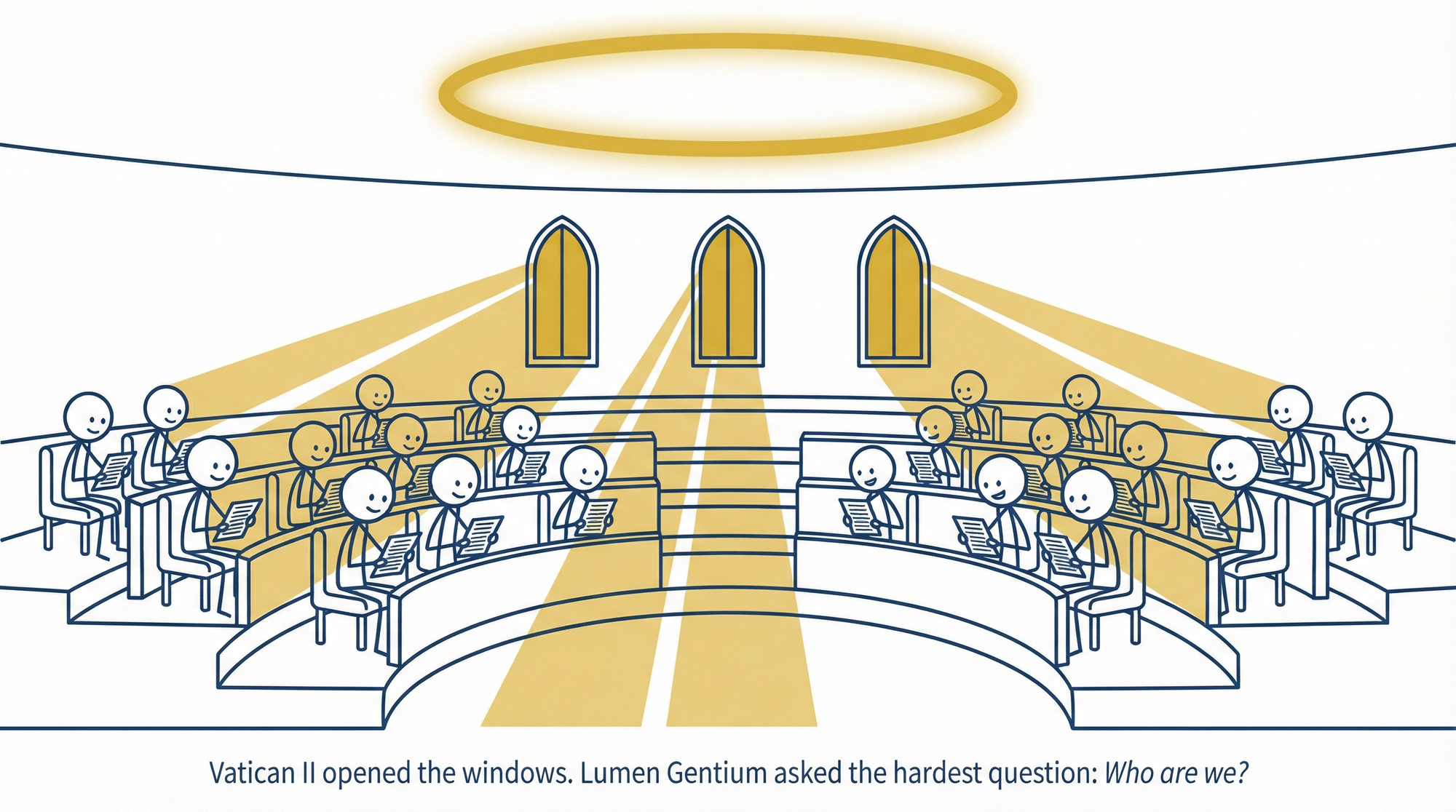
Lumen Gentium (which means "Light of the Nations") completely changed how the Church understands itself. Vatican II in 1964 was not about updating rules or rearranging furniture. It was about looking in the mirror and asking a dangerous question: "Who are we, really?"
This article takes you through the first two chapters.
By the end, you will have actually read the document. You will understand why it matters. And you will see the Church not as an institution or a bureaucracy, but as a living mystery.
Why This Document Exists
Picture 1962. The Church is two thousand years old. It has survived emperors, plagues, wars, and schisms. It has built cathedrals and educated the world. It has also become, in the eyes of many, irrelevant.
Pope John XXIII called the Second Vatican Council to throw open the windows of the Church and let fresh air in. He wanted the Church to speak to the modern world not by defending the past, but by recovering its deepest identity. What is the Church for? Who is it? What does it believe about itself?
Lumen Gentium is the answer. Written and approved between 1962-1964, this dogmatic constitution became the foundation for every other Vatican II document. Nothing else that came out of the council makes sense without understanding this first.
Chapter 1: The Mystery of the Church
The first chapter does something unexpected. It does not start with rules, structure, or history. It starts with mystery.
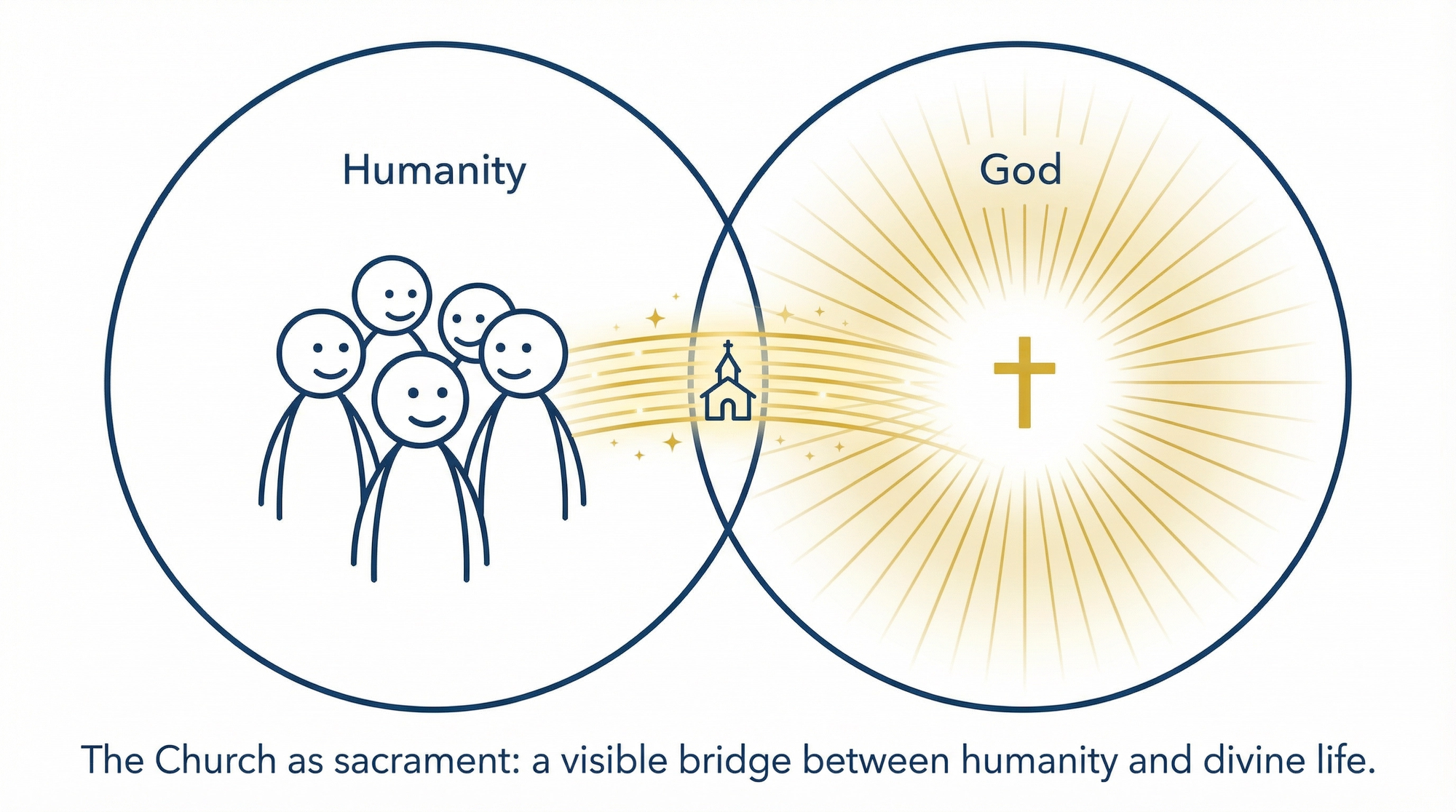
"The Church, in Christ, is in the nature of sacrament, a sign and instrument both of a very closely knit union with God and of the unity of the whole human race." (Lumen Gentium, Chapter 1, Paragraph 1)
This sentence does all the heavy lifting. The Church is not primarily an organization. It is a sacrament. A sacrament is something visible that carries something invisible. When you see a married couple exchange rings, you see visible promises that point to invisible love and commitment. When you see the Church, you are seeing a visible sign of invisible divine life.
This is radical. The Church's job is not to protect itself or enforce rules. Its job is to be a sacrament, a sign and instrument of God's love for the whole human race. Even for people who do not believe in God. The Church exists to show the world what union with God looks like, and to invite everyone into it.
The Church as the Body of Christ
The document then goes deeper. The Church is not just a sacrament. It is the Body of Christ.
"The Church is the body of Christ. The Redeemer, in the very revelation of the mystery of the Father and of Himself, manifests man to himself and brings to light his lofty calling." (Lumen Gentium, Chapter 1, Paragraph 3)
This is not poetry. This is doctrine. When you become a Christian, you do not join an organization. You become a part of something living. You become a member of Christ's body. This means Christ is the head, and we are the members. We think with His thoughts. We act with His hands. We love with His heart.
The document makes an analogy to a human body. Just as a physical body has many parts, each with different functions, so does the Church. You might be a teacher. Someone else is a priest. Another person is a parent. A fourth is a scientist. All these different roles, all these different members, belong to one body. All are essential. None is more important than the Church itself.
This changes everything about how we understand our place in the faith.
The Church as the Temple of the Holy Spirit
But there is more. The Church is not just the Body of Christ. It is also the Temple of the Holy Spirit.
"The Church is the temple of the Holy Spirit. The Spirit dwells in the Church as a whole and in her members, who offer themselves to God as a 'living sacrifice, holy and acceptable to God.'" (Lumen Gentium, Chapter 1, Paragraph 4)
This means the Holy Spirit does not just work in the Church. He lives in the Church. He animates it. He brings it to life. Every baptized person is a dwelling place of the Holy Spirit. This is not reserved for priests or popes. This is true for every Christian.
If you are baptized, the Holy Spirit lives in you. You are a temple. You are holy. This is the foundation for the universal call to holiness that Chapter 2 will explore.
Chapter 2: The People of God
Now the document shifts focus from mystery to people. If the Church is the Body of Christ and the Temple of the Spirit, what does that mean for you and me?
Chapter 2 asks a surprising question: What makes someone part of the Church?
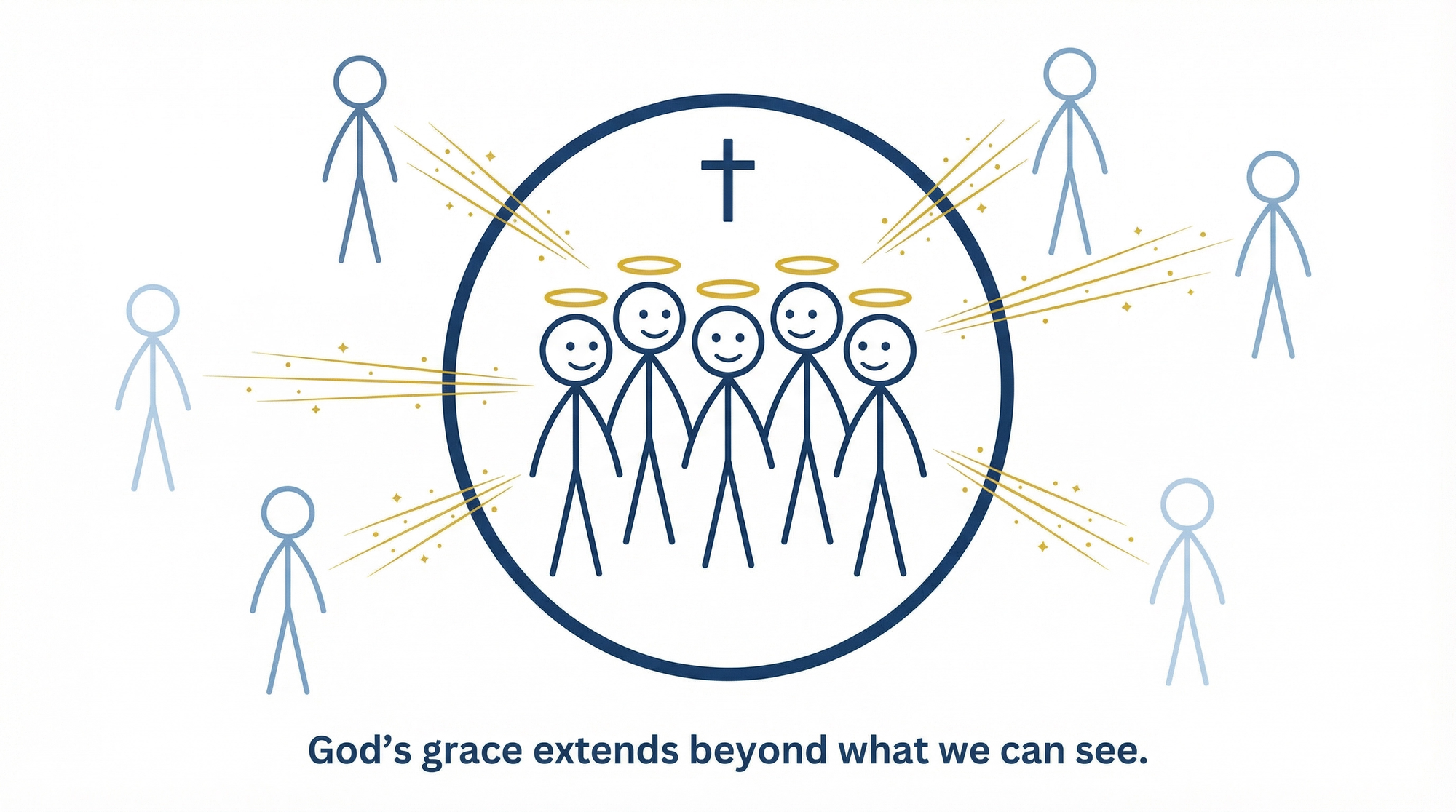
"The one mediator and way to salvation is Christ. He made the Church necessary as the means of salvation, since through His Church He dispenses the graces necessary for salvation. But the divine purpose was not abandoned when some Christians were separated from full communion with the Catholic Church. To those who believe in Christ and have been reborn through baptism in a sincere searching for God's truth and the willingness to obey God's will as they understand it, the grace of God is not denied." (Lumen Gentium, Chapter 2, Paragraph 15, paraphrased)
This is perhaps the most controversial thing the document says. It does not say that salvation comes only through formal membership in the Catholic Church. It acknowledges that other Christian denominations, and even sincere believers outside Christianity, can receive God's grace.
This does not mean all religions are the same. It means God's grace is bigger than our boxes. God respects human freedom. God works in ways we do not always see or understand.
The Universal Call to Holiness
Here is what Chapter 2 emphasizes more than anything else: all Christians are called to holiness.
"All the faithful are called to holiness. For each one will be required to give an account of his own conduct before the tribunal of God." (Lumen Gentium, Chapter 2, Paragraph 39)
This is a revolution. Before Vatican II, holiness was often thought of as something for priests and nuns. Regular people, especially married people with jobs and kids, were expected to live a decent life and leave the real spiritual work to the professionals.
Vatican II says this is backwards. Every baptized person is called to sanctity. The mother raising children is called to holiness. The businessman trying to be honest in his dealings is called to holiness. The student struggling with temptation is called to holiness.
Holiness does not mean being perfect. It means being alive in Christ. It means letting the Holy Spirit gradually transform you into the image of Jesus. It means saying yes to God in the midst of ordinary life.
The Priesthood of All the Faithful
The document makes a distinction that most Catholics have never heard: the common priesthood and the ministerial priesthood.
"Christ the Lord, who consecrated his Church by building her into a kingdom and priests to God his Father, makes the entire community of believers sharers in His priestly office. The baptized, by regeneration and the anointing of the Holy Spirit, are consecrated to be a spiritual house and a holy priesthood." (Lumen Gentium, Chapter 2, Paragraph 10)
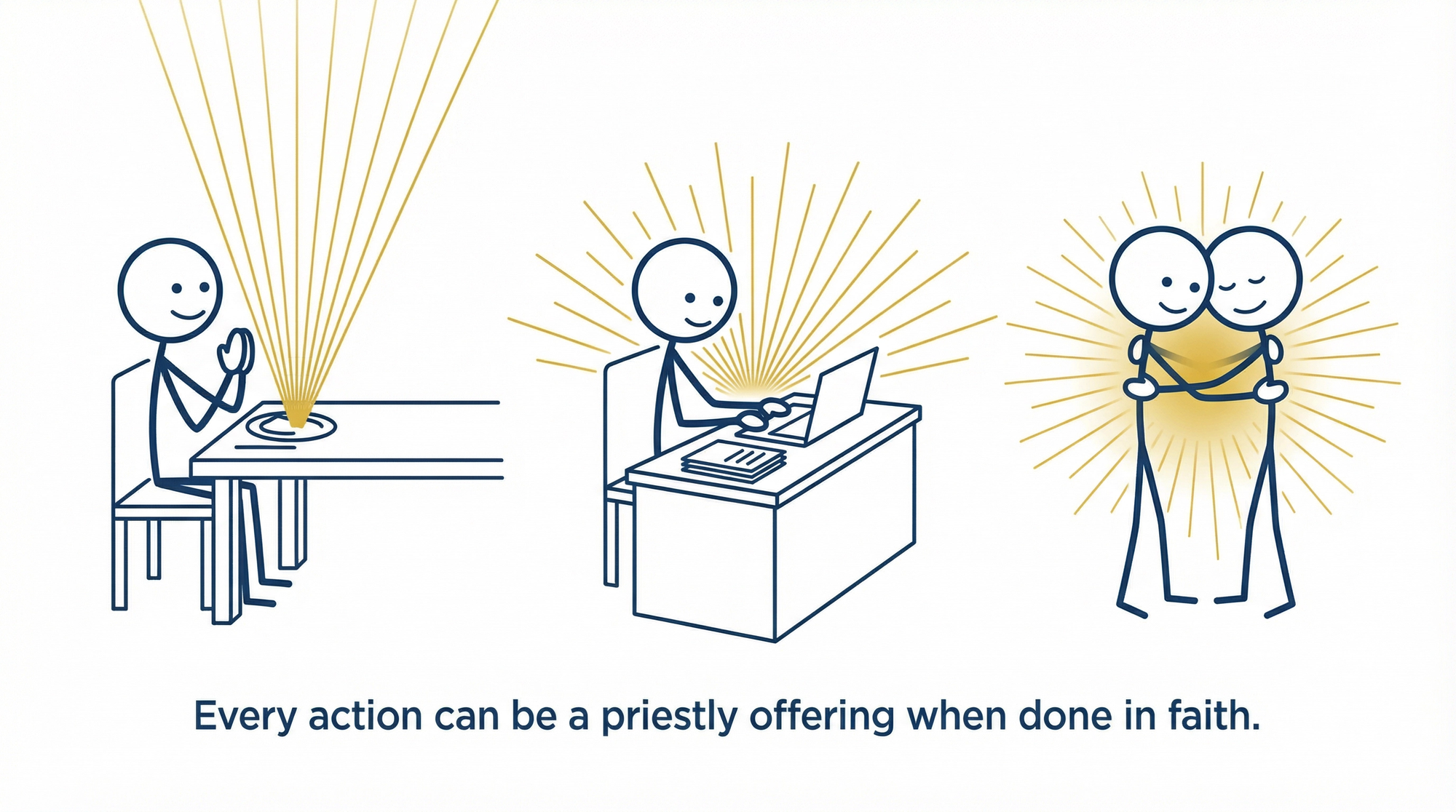
When you are baptized, you become a priest. Not in the ministerial sense. An ordained priest celebrates Mass and forgives sins. But you have a priestly function. You can offer the world to God through your prayers. You can intercede for others. You can sanctify ordinary things.
This does not diminish the special role of ordained priests. It elevates the role of lay people. We are not second-class Christians waiting for the real professionals to do the spiritual work. We are all priests in the royal priesthood of Christ.
The Church's Relationship to Non-Catholics
Chapter 2 addresses the question that had divided the Church for centuries: What about Protestants? What about other religions?
The document uses careful language. It speaks of those who are "separated brethren," maintaining the connection while acknowledging the separation. It acknowledges that other Christian communities have retained elements of apostolic succession, valid sacraments, and sincere faith.
For non-Christian religions, the document shows respect:
"The Catholic Church rejects nothing that is true and holy in these religions. It acknowledges that those who innocently do not know about Christ and His Church, through no fault of their own, but seek God with sincere hearts and try to do His will as they understand it through the dictates of conscience, God's grace works in ways known to Him alone to provide them with the opportunity for salvation." (Lumen Gentium, Chapter 2, Paragraph 16, paraphrased)
This does not mean the Church abandons the belief that Jesus Christ is the fullness of revelation. It means the Church trusts God's judgment more than it fears other people's eternal fate.
How to Keep Reading
Chapters 3-8 of Lumen Gentium continue this journey:
-
Chapter 3 explores the hierarchical structure of the Church: bishops, priests, and the role of the pope.
-
Chapter 4 goes deeper into the universal call to holiness, with sections on lay people, virgins, and married couples.
-
Chapter 5 looks at the call to sanctity in the different states of life.
-
Chapters 6-8 address religious communities, Mary as the model of the Church, and the Church's eschatological hope (her fulfillment at the end of time).
Each chapter builds on these first two. You now have the foundation. The rest is application and detail.