

In Part 1 of this series, we explored Lumen Gentium's first two chapters and discovered something surprising.
The Church is not primarily an institution. It is a mystery (continual learning), the Body of Christ, and the Temple of the Holy Spirit.
Every baptized person belongs to the People of God.
But here is the question that naturally follows: if the Church is a mystery and we are all part of it, who is in charge? And what exactly is the role of everyone who is not a bishop or a priest?
Chapters 3 and 4 answer both questions.
Chapter 3 explains the hierarchical structure of the Church. Chapter 4 does something that had never been done before in a major Church document: it dedicates an entire chapter to you. To the laity. To the ordinary Christian trying to live out their faith in the middle of a busy, complicated life.
By the end of this article, you will understand how the Church is structured, why it matters, and why your baptism gives you a mission that no one else can fulfill.
Chapter 3: The Hierarchy of the Church
Chapter 3 starts at the beginning. Not with organizational charts, but with the apostles.
"The Lord Jesus Christ appointed twelve to be a stable group. They made disciples first in Israel and then in all nations." (Lumen Gentium 19)
Jesus did not start a philosophical school. He built a community and gave it leaders. The apostles were not just teachers or role models. They were given authority to shepherd, teach, and sanctify. And the document is clear that this authority was meant to last:
"Their apostolic mission will last until the end of the world. That is why the Apostles appointed successors. Their office of nurturing the Church is permanent." (Lumen Gentium 20)
This is the foundation of apostolic succession. The bishops of today stand in an unbroken line stretching back to the twelve men Jesus called in first-century Palestine. That is not a metaphor. It is a claim about historical continuity and divine authority.
Bishops: More Than Administrators
The document pushes hard against the idea that bishops are just managers of a religious organization. They are something far more.
"The Lord Jesus Christ is present in the bishops. They shepherd the elect. By episcopal consecration, they receive a special outpouring of the Holy Spirit, as well as the fullness of the sacrament of Orders." (Lumen Gentium 21)
When a man becomes a bishop, something happens to him sacramentally. He receives the fullness of Holy Orders. He carries on the three-fold office that Christ gave to the apostles: teaching, sanctifying, and governing. A bishop is not just someone with authority. He is someone in whom Christ is present to his local church.
The College of Bishops and the Pope
Here is where the document does something carefully balanced. It affirms both the authority of the pope and the authority of the bishops as a body.
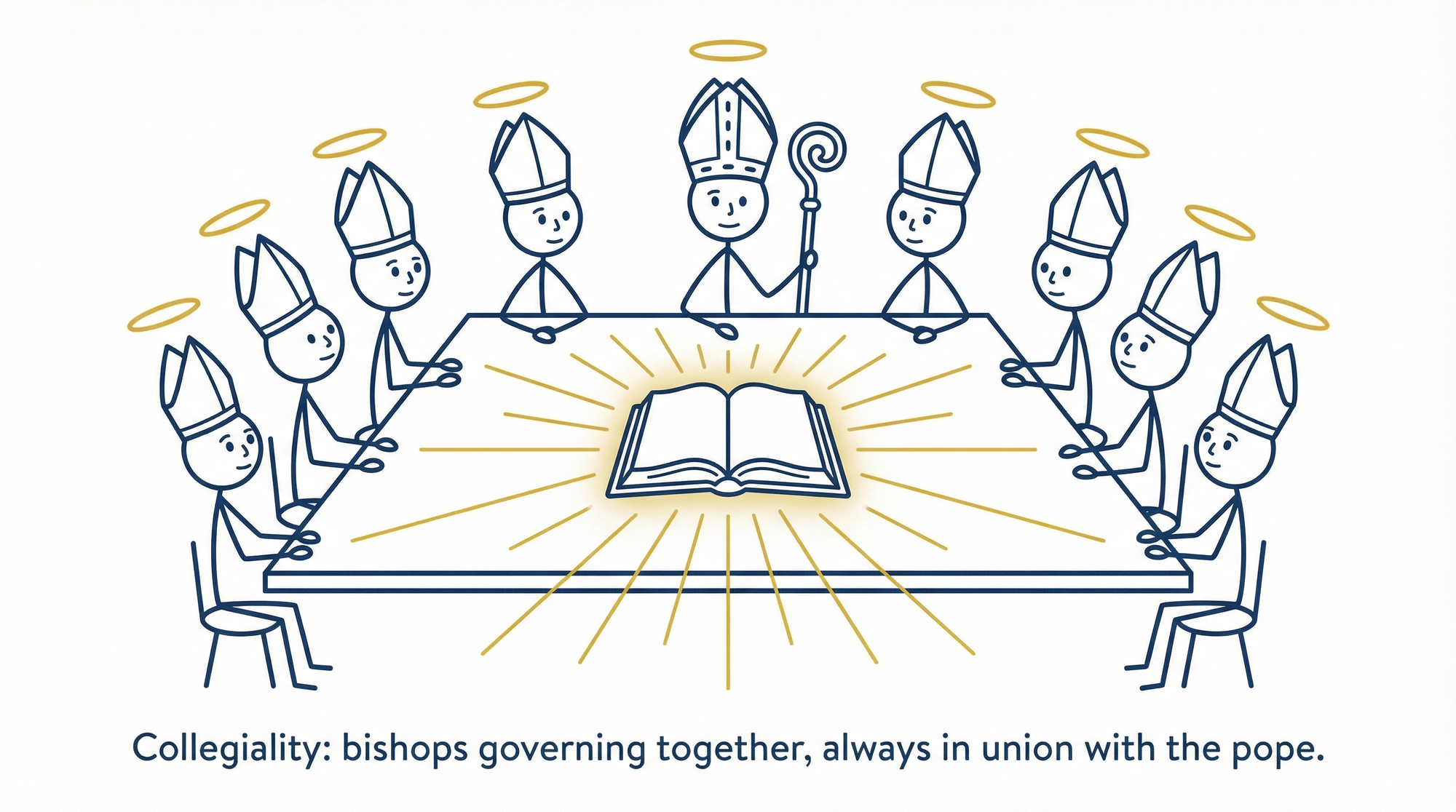
"Just as St. Peter and the other apostles constitute one apostolic college, the Roman Pontiff, the successor of Peter, and the bishops, the successors of the apostles, are joined together. The college or body of bishops has no authority unless it is understood together with the Roman Pontiff, the successor of Peter as its head." (Lumen Gentium 22)
The bishops govern together, but never apart from the pope. The pope has full authority over the universal Church, but he does not govern alone. This is collegiality. Not democracy. Not monarchy. Something in between, something rooted in the way Jesus set things up from the very beginning: Peter and the Twelve, distinct but inseparable.
Priests and Deacons
The document then addresses priests and deacons, situating them within this apostolic structure.
"Bishops, with their helpers the priests and deacons, have taken up the service of the community, presiding in place of God over the flock, whose shepherds they are, as teachers for doctrine, priests for sacred worship, and ministers for governing." (Lumen Gentium 25)
Priests share in the bishop's ministry. They celebrate Mass, hear confessions, preach the Gospel, and shepherd their parishes. Deacons are ordained not to the priesthood but to a ministry of service, assisting in liturgy, preaching, and works of charity.
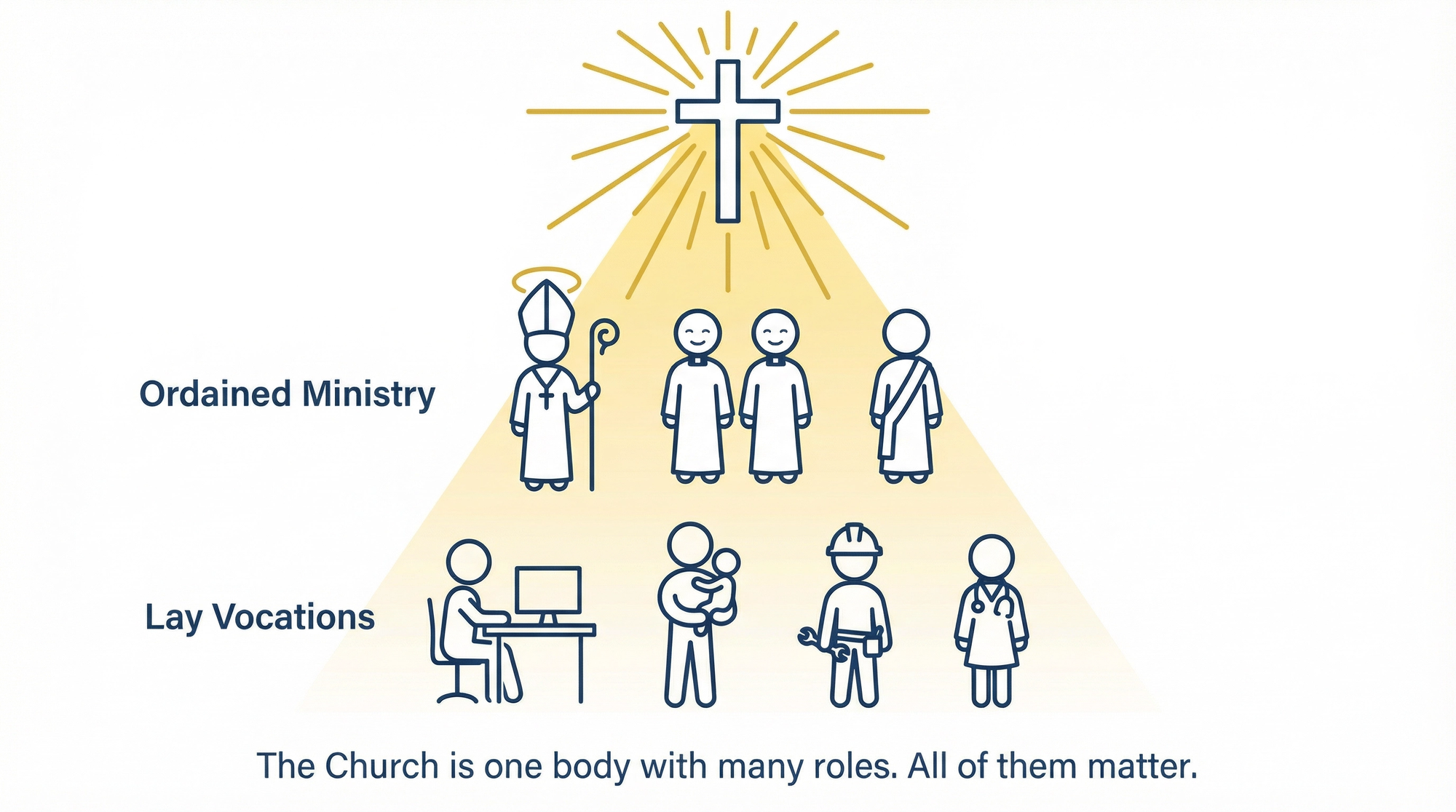
The hierarchy is not a power structure. It is a service structure. Every level exists to serve the People of God. The bishop serves the diocese. The priest serves the parish. The deacon serves wherever the need is greatest.
Infallibility
Chapter 3 also addresses the teaching that makes many people uncomfortable: infallibility.
"The Roman Pontiff, as the head of the college of bishops, enjoys infallibility in virtue of his office when, as the supreme shepherd and teacher of all the faithful, by a definitive act he proclaims a doctrine of faith or morals." (Lumen Gentium 25)
This does not mean the pope is always right about everything. It means that when the pope formally defines a doctrine of faith or morals for the entire Church, speaking in his official capacity as successor of Peter, the Holy Spirit protects him from error. This has happened only twice in history: the Immaculate Conception (1854) and the Assumption of Mary (1950).
The bishops also teach infallibly when they are gathered in ecumenical council or when, even spread across the world, they agree on a matter of faith as definitively to be held. Infallibility is not about power. It is about protection. It is the promise that the Church, guided by the Spirit, will never lead the faithful into error on matters essential to salvation.
The Hard Questions About Chapter 3
These claims provoke serious objections that you need to know about, and the answers to them.
"Peter was never pope. Matthew 16:18 doesn't prove what Catholics say it proves."
This is a real debate. Some scholars read "upon this rock" as referring to Peter's confession of faith, not to Peter himself. Others point out that the "power of the keys" was given to all the apostles (Matthew 18:18), not just to Peter. Paul even rebuked Peter publicly (Galatians 2:11-14), which seems odd if Peter held supreme authority.
But consider the full picture. Jesus renamed Simon as "Rock," gave him the keys of the kingdom, and told him to "feed my sheep" (John 21:15-17). In the early Church, Peter spoke first at the Council of Jerusalem (Acts 15).
The early Church Fathers, including Ignatius of Antioch, Irenaeus, and Cyprian, consistently pointed to Rome's bishop as holding a unique authority. Apostolic succession is not built on one verse.
It is built on a pattern that stretches from the Gospels through the first centuries of Church history. Here's some proof...
Tertullian
“[T]he Lord said to Peter, ‘On this rock I will build my Church, I have given you the keys of the kingdom of heaven [and] whatever you shall have bound or loosed on earth will be bound or loosed in heaven’ [Matt. 16:18–19]. . . . What kind of man are you, subverting and changing what was the manifest intent of the Lord when he conferred this personally upon Peter?” (Modesty 21:9–10 [A.D. 220]).
"Even Tertullian, who was criticizing the pope at the time, acknowledged that this authority was being claimed based on Peter."
Clement
Be it known to you, my lord, that Simon [Peter], who, for the sake of the true faith, and the most sure foundation of his doctrine, was set apart to be the foundation of the Church, and for this end was by Jesus himself, with his truthful mouth, named Peter” (Letter of Clement to James2 [A.D. 221]).
Optatus
“You cannot deny that you are aware that in the city of Rome the episcopal chair was given first to Peter; the chair in which Peter sat, the same who was head—that is why he is also called Cephas [‘Rock’]—of all the apostles; the one chair in which unity is maintained by all” (The Schism of the Donatists 2:2 [A.D. 367]).
Jerome
“‘But,’ you [Jovinian] will say, ‘it was on Peter that the Church was founded’ [Matt. 16:18]. Well . . . one among the twelve is chosen to be their head in order to remove any occasion for division” (Against Jovinian 1:26 [A.D. 393]).
Thank God for the historical context from so many church fathers. Because of their words kept safe, we can know the truth today 2,000 years later.
"Sola Scriptura: the Bible alone should be our authority, not bishops or popes."
This is the foundational Protestant objection, and it deserves respect. The instinct behind it is good: Scripture is God's Word, and nothing should contradict it.
That is in fact what we Catholics believe.
But here is the question sola scriptura struggles to answer: *who interprets Scripture when sincere believers disagree? *
The Bible itself does not claim to be the sole authority. Paul tells the Thessalonians to hold fast to "the traditions you were taught by us, either by our spoken word or by our letter" (2 Thessalonians 2:15).
And here is the smoking gun...
The early Church operated for decades before the New Testament was fully written, and for centuries before the canon was settled. Someone had to decide which books belonged in the Bible. That someone was the Church, guided by the Holy Spirit through its bishops in council.
The teaching authority of the Church does not stand above Scripture. It stands as the servant of Scripture, preserving and interpreting the faith that was "once for all delivered to the saints" (Jude 1:3).
The Magisterium (which includes the Pope), Tradition, and Scripture are all in lock-step. They make sure not to create doctrine that defies or contradicts Scripture, but they also look toward historical evidence for issues Scripture does not speak to directly.
For example, the word "Trinity" never appears in Scripture, even though the concept is clearly present. It took centuries of Tradition and council deliberation to formulate the precise language. Scripture says nothing about the details of Mary's assumption into heaven, or how the Church should navigate artificial intelligence.
The Magisterium looks upon Tradition and Scripture for verification and guidance on what to proclaim for all Christians today. It has never created a doctrine that contradicts Scripture.
"Infallibility is unfalsifiable. How can you test a claim that protects itself from being wrong?"
This is a sharp objection, and it comes from skeptics and Protestants alike. If the Church defines infallibility and also decides when it applies, isn't that circular?
The answer is that infallibility has an extremely narrow scope. It applies only to formal, solemn definitions on faith and morals. It has been invoked only twice (in 2000yrs).
Popes have been wrong about science, politics, personal judgments, and countless other things. The doctrine of infallibility does not claim the pope is always right about every statement. The current Pope, Pope Leo XIV, likes the Chicago Cubs, that's clearly not infallible.
What the doctrine of infallibility actually claims is that when the Church solemnly teaches on a matter essential to salvation, the Holy Spirit prevents catastrophic error.
The test is not whether you can prove it from outside the system. The test is whether, across two thousand years, the Church's solemn teaching has remained internally consistent.
Critics are welcome to examine the record. 😉
Chapter 4: The Laity
Now comes the revolution.
Before Vatican II, the laity were often described in negative terms: they are "not clergy" and "not religious." Chapter 4 changes that completely.
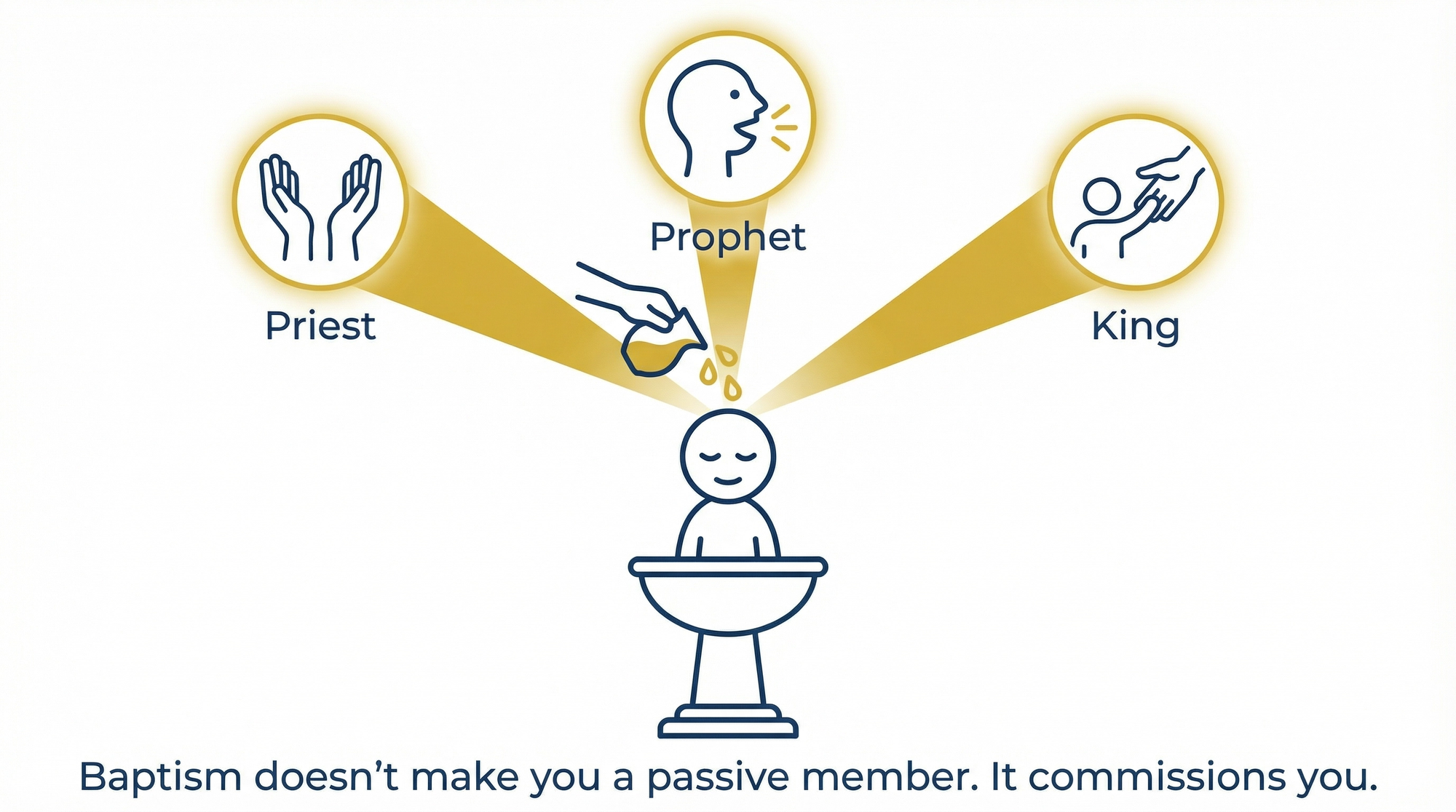
"The term laity is understood to mean all the faithful except those in holy orders and those in the state of religious life specially approved by the Church. These faithful are by baptism made one body with Christ and are constituted among the People of God; they are in their own way made sharers in the priestly, prophetical, and kingly functions of Christ; and they carry out for their own part the mission of the whole Christian people in the Church and in the world." (Lumen Gentium 31)
Read that again. By baptism, you share in Christ's priestly, prophetic, and kingly offices. You are not a spectator. You are a participant in the mission of the Church.
The Secular Character of the Laity
What makes the laity unique is not that they are less spiritual than clergy. It is that they have a specific calling that clergy do not.
"What specifically characterizes the laity is their secular nature. The laity, by their very vocation, seek the kingdom of God by engaging in temporal affairs and by ordering them according to the plan of God. They live in the world, that is, in each and in all of the secular professions and occupations. They live in the ordinary circumstances of family and social life, from which the very web of their existence is woven." (Lumen Gentium 31)
Your job is not a distraction from your spiritual life. It is your spiritual life. The teacher in a classroom, the parent at the kitchen table, the nurse in the hospital, the businessman in a boardroom. Each of those ordinary moments is a place where God's kingdom can break through.
The document says lay people work for the sanctification of the world "from within, as a leaven." You do not change the world by leaving it. You change it by being in it and bringing Christ into every corner of it.
The Laity as Priests, Prophets, and Kings
The document unpacks what it means for lay people to share in Christ's three offices.
As priests, lay people offer their daily lives to God:
"All their works, prayers, apostolic undertakings, family and married life, daily work, relaxation of mind and body, if they are accomplished in the Spirit, indeed even the hardships of life if patiently borne, all these become spiritual sacrifices acceptable to God through Jesus Christ." (Lumen Gentium 34)
Everything. Your morning commute. Your conversation with a coworker. Your patience with a difficult child. Your late night finishing a project. If done in the Spirit, it is an offering to God.
As prophets, lay people proclaim the Gospel through their lives:
"Christ fulfills this prophetic office, not only by the hierarchy who teach in His name and by His power, but also by the laity. He accordingly both establishes them as witnesses and provides them with the appreciation of the faith and the grace of the word so that the power of the Gospel may shine out in daily family and social life." (Lumen Gentium 35)
You do not need a pulpit to proclaim the Gospel. You need a life that radiates it.
As kings, lay people serve:
"Even when preoccupied with temporal cares, the laity can and must perform a work of great value for the evangelization of the world." (Lumen Gentium 36)
Christ's kingship was not about dominion. It was about service. Lay people exercise that kingly office by ordering their corner of the world according to God's plan: by being honest in business, just in leadership, generous in community, and faithful in family.
A Witness to the World
Chapter 4 closes with a line that should stop every lay person in their tracks:
"Each individual layperson must stand before the world as a witness to the resurrection and life of the Lord Jesus and a symbol of the living God." (Lumen Gentium 38)
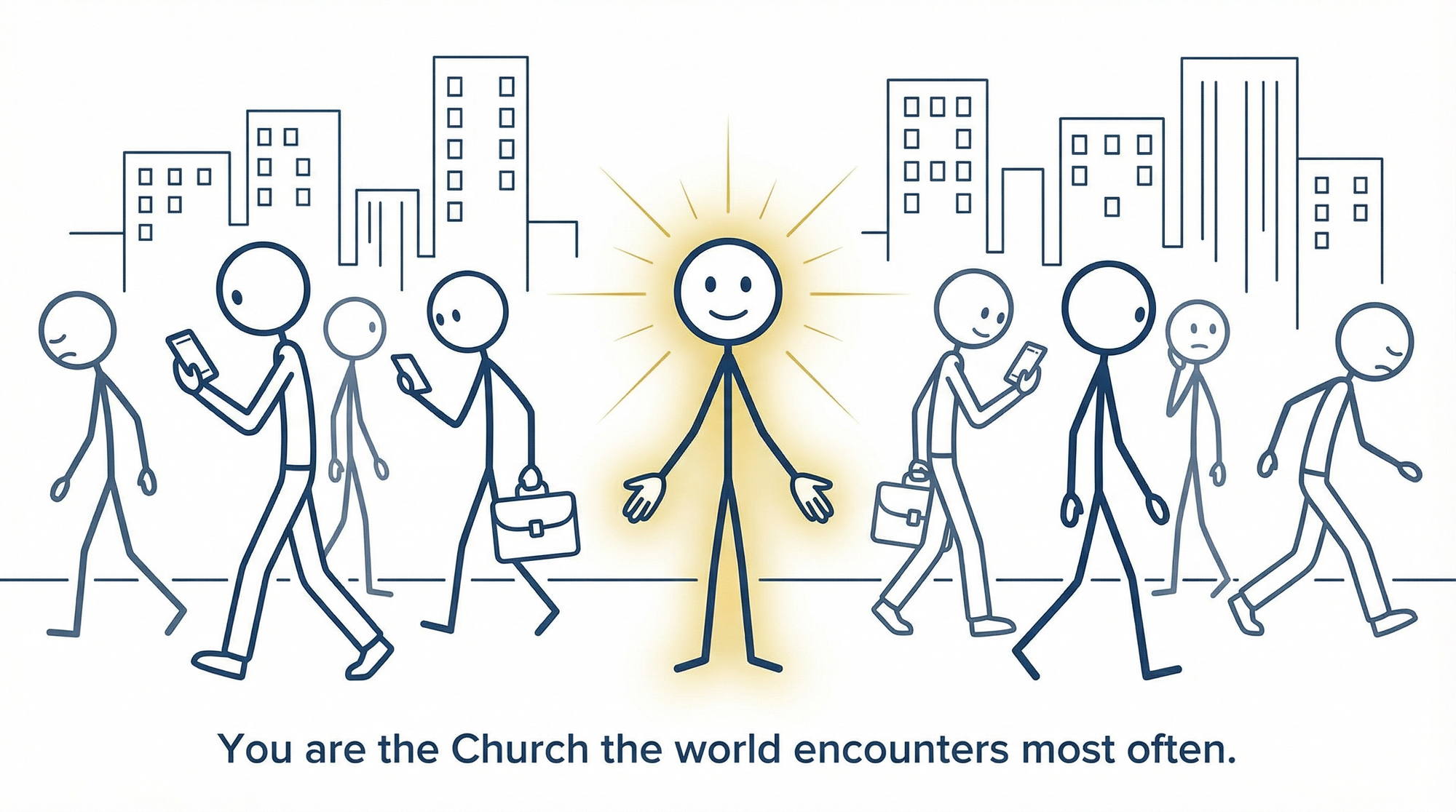
That is your job description. Not the pope's. Not your pastor's. Yours. You are the Church's primary witness to the world, because you are the one the world sees every day.
The Hard Questions About Chapter 4
"This still sounds like a two-tier system. The laity participate, but the clergy hold the real power."
This objection has teeth. Many Protestants, drawing on 1 Peter 2:9 ("a royal priesthood"), argue that every believer is equally a priest before God. The Reformers rejected any essential distinction between ordained and lay Christians.
The problem with that stance, is we don't see them following it. There is clearly a difference between the Protestant pastor and the guests in the pews. They face different directions, it's not "open mic," and often the Protestant pastor is literally set higher than the rest of the congregation.
There are church boards, denominational associations, all of these have clear roles. Yes, we are all called to be priests and kings, but there are different offices. Lets be honest about that.
Lumen Gentium does maintain a distinction. The ministerial priesthood and the common priesthood are, in the document's words, "interrelated" but different "in essence, not merely in degree." For example, ordained priests celebrate Mass, hear confessions, and administer sacraments that lay people cannot. However, they are welcomed to go through 4-8yrs of seminary as well if they think that's their calling.
But here is what the objection misses. The distinction is not about superiority. It is about function. A heart and a hand are both essential to the body. They do different things. Neither is more valuable than the other. The ordained priest serves the community by making the sacraments available. The lay person serves the world by bringing Christ into places the priest cannot go: the office, the classroom, the family dinner table, the factory floor.
The real question is not whether the roles are different. They clearly are. The question is whether one is more important. Lumen Gentium's answer is no. The lay vocation is not a consolation prize for people who didn't become priests. It is a calling in its own right, with a dignity that comes directly from baptism, not from anyone's permission.
How to Keep Reading
Chapters 5 and 6 go deeper into what holiness looks like in practice and how religious life fits into the picture.
Chapter 5's universal call to holiness builds directly on what Chapter 4 says about the laity. Chapter 6 examines the unique calling of those who take vows of poverty, chastity, and obedience.
You now understand the structure of the Church.
The next question is... what does a holy life actually look like?