

Here is a question worth sitting with: Do you think you are called to be holy?
Not "generally good." Not "decent enough." Holy.
If you hesitated, you are not alone. For a very long time, holiness felt like something reserved for other people. Priests, monks, nuns, mystics. The professionals. Regular Christians were expected to follow the rules, show up on Sundays, and leave the heavy spiritual lifting to the experts.
Vatican II said that was wrong.
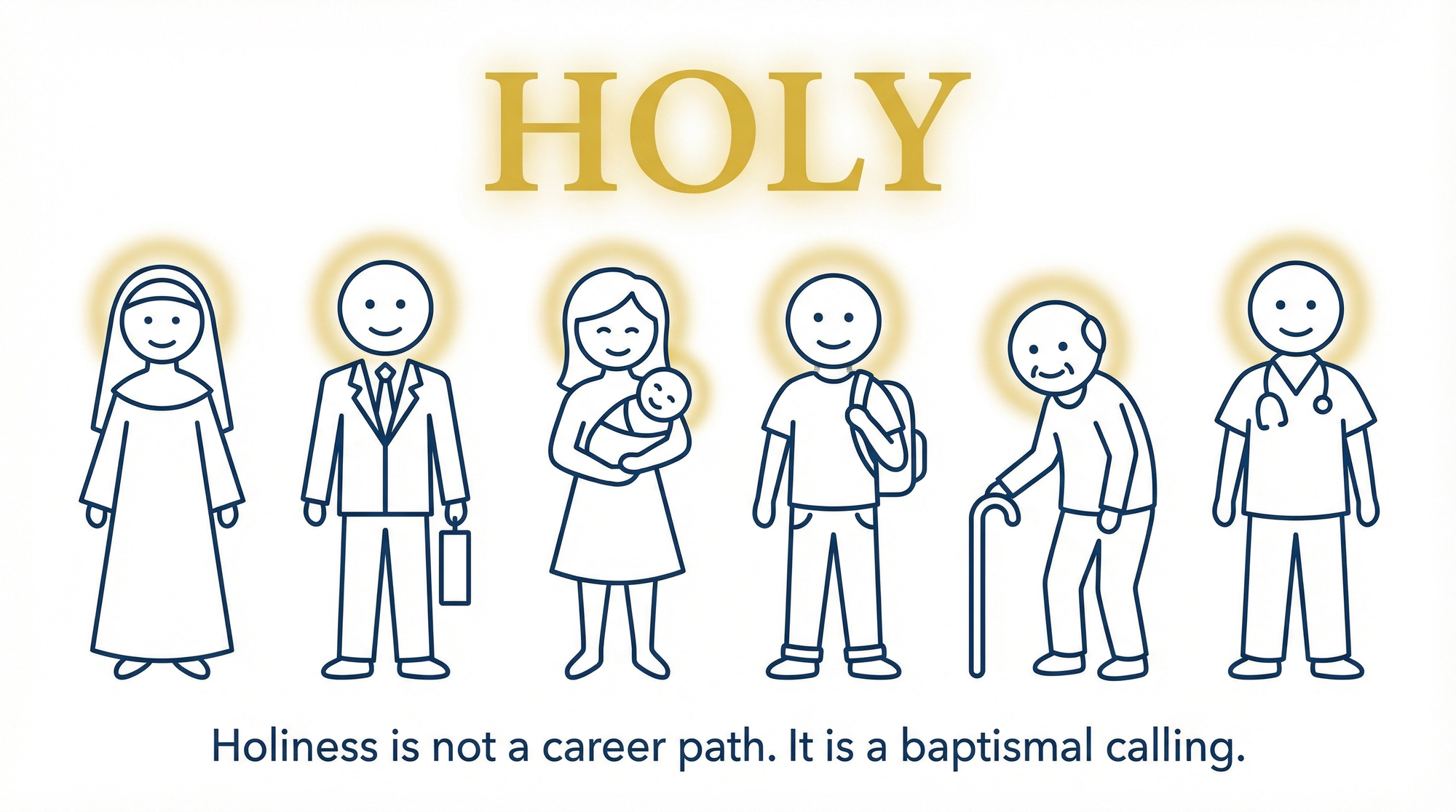
Chapters 5 and 6 of Lumen Gentium tackle holiness head-on. Chapter 5 declares that every single baptized person, regardless of their state in life, is called to the fullness of holiness.
Chapter 6 then examines a specific form of that call: the religious life of those who take vows of poverty, chastity, and obedience.
Together, these chapters paint a picture of a Church where holiness is not a specialization. It is the common inheritance of everyone who has been baptized into Christ.
Chapter 5: The Universal Call to Holiness
Chapter 5 opens with a sentence so simple it is easy to miss how revolutionary it is:
"Everyone, whether belonging to the hierarchy, or being cared for by it, is called to holiness." (Lumen Gentium 39)
Everyone. Not some. Not the spiritually gifted. Not the people with more free time. Everyone.
The document then grounds this call in Christ himself:
"The Lord Jesus, the divine Teacher and Model of all perfection, preached holiness of life to each and everyone of His disciples of every condition. All the faithful of Christ of whatever rank or status, are called to the fullness of the Christian life and to the perfection of charity; by this holiness as such a more human manner of living is promoted in this earthly society." (Lumen Gentium 40)
Notice the phrase "perfection of charity." Holiness is not perfection in the sense of never making mistakes. It is the perfection of love. Growing in love of God and love of neighbor until that love defines everything you do. That is the goal. And it is the same goal for the pope and for the parent changing diapers at three in the morning.
One Holiness, Many Paths
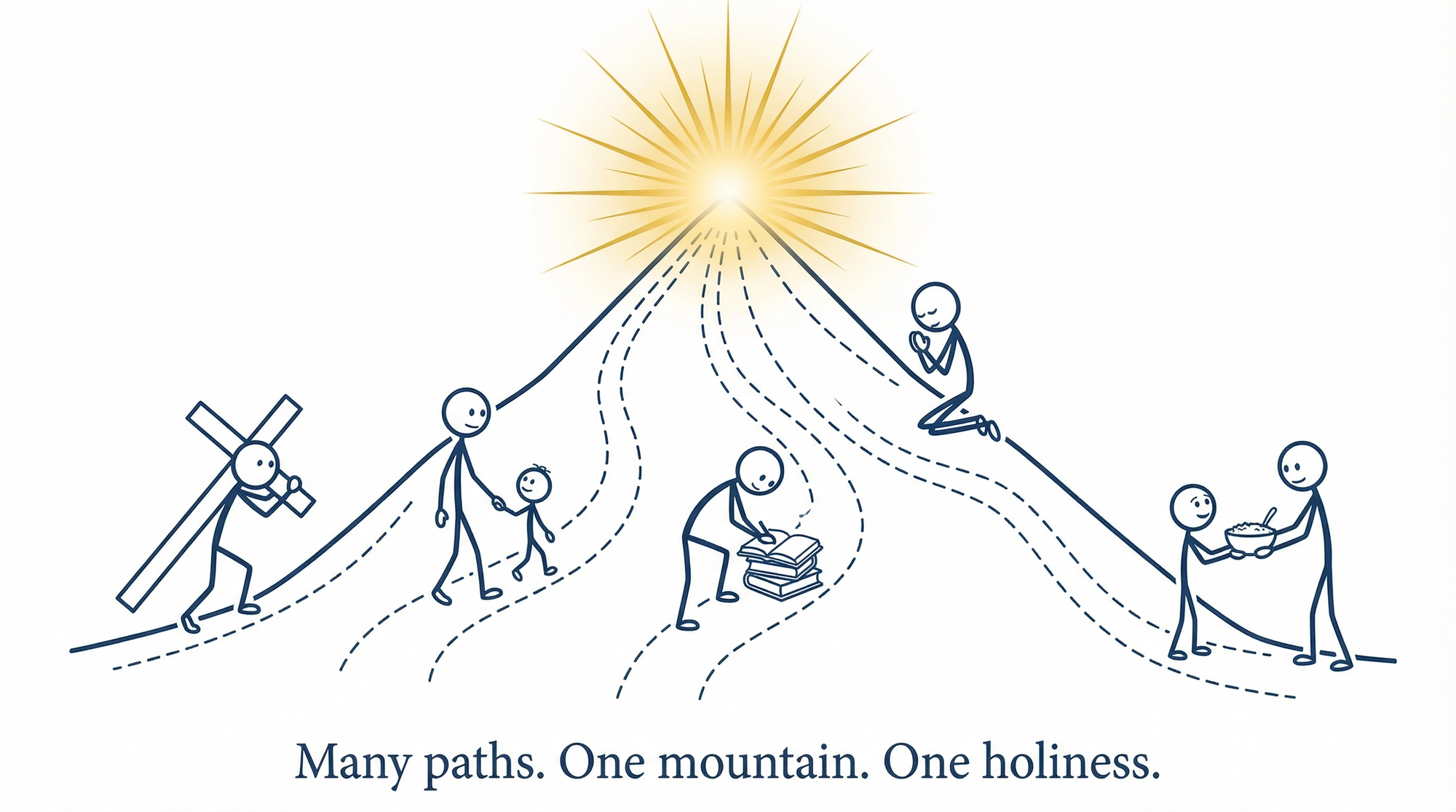
The document makes a critical point: there is one holiness, but there are many ways to live it.
"The classes and duties of life are many, but holiness is one, that sanctity which is cultivated by all who are moved by the Spirit of God, and who obey the voice of the Father and worship God." (Lumen Gentium 41)
A married couple growing in faithfulness to each other is pursuing holiness. A single person offering their loneliness to God is pursuing holiness. A student wrestling honestly with doubt is pursuing holiness. A worker who refuses to cut ethical corners is pursuing holiness.
The path looks different for each person. The destination is the same.
The Means of Holiness
Chapter 5 is practical. It does not just tell you to be holy. It tells you how.
"The pursuit of holiness consists in the use of the sacraments and especially the Eucharist, frequent participation in the sacred action of the Liturgy, application of oneself to prayer, self-abnegation, lively fraternal service and the constant exercise of all the virtues." (Lumen Gentium 42)
The sacraments. Prayer. Service to others. The practice of virtue. These are not exotic spiritual practices. They are available to every Christian, everywhere, in every century.
And at the center of it all is love:
"God pours out his love into our hearts through the Holy Spirit, so the first and most necessary gift is love, by which we love God above all things and our neighbor because of God. Charity, as the bond of perfection and the fullness of the law, rules over all the means of attaining holiness and gives life to these same means." (Lumen Gentium 42)
Love is not one item on the holiness checklist. It is the checklist. Every sacrament, every prayer, every act of service only matters if it flows from and leads toward deeper love. Without charity, the whole thing is empty. With charity, even the smallest act becomes holy.
Holiness in Your Actual Life
This is the part that changes everything if you let it.
Holiness is not achieved by escaping your life. It is achieved by living your life with God. The mother who is patient when patience has run out. The father who stays faithful when the world offers easier options. The worker who does honest work for dishonest employers. The friend who shows up when showing up costs something. The person who prays even when prayer feels pointless.
These are not consolation prizes. These are the front lines of sanctity.
Chapter 5 insists that the hardships of life, if patiently borne, become spiritual sacrifices. Your suffering is not wasted. Your daily grind is not meaningless. Every bit of it can be gathered up and offered to God. And that offering is holy.
The Hard Questions About Chapter 5
"This sounds like works-righteousness. The Bible says we are saved by faith alone, not by our efforts."
This is perhaps the oldest disagreement between Protestants and Catholics, and it deserves careful attention.
Paul writes in Ephesians 2:8-9:
"For by grace you have been saved through faith. And this is not your own doing; it is the gift of God, not a result of works, so that no one may boast."
If salvation is by grace through faith, why does Lumen Gentium emphasize sacraments, virtues, prayer, and service as the "means of holiness"?
Because holiness and salvation are not the same thing.
Salvation is God's gift, received through faith. Holiness is what happens after you receive that gift. It is the process of becoming the person God saved you to be.
James puts it bluntly: "Faith without works is dead" (James 2:26). Paul himself told the Philippians to "work out your salvation with fear and trembling, for it is God who works in you" (Philippians 2:12-13).
The Church does not teach that you earn your way to heaven through good behavior. It teaches that God's grace, freely given, transforms you from the inside out, and that transformation shows up in how you live. The sacraments, prayer, and acts of love are not the price of salvation. They are the evidence that salvation is working.
"If everyone is called to holiness, what makes Christianity different from any self-improvement program?"
The difference is the source. Every self-improvement program starts with you. The universal call to holiness starts with God. The document says "God pours out his love into our hearts through the Holy Spirit."
You do not generate holiness. You receive it.
You cooperate with a grace that was already given before you lifted a finger. This is not bootstrapping. This is surrender.
Chapter 6: Religious Life
If Chapter 5 is the universal call, Chapter 6 is a close look at one particular response to that call: the life of men and women who take vows of poverty, chastity, and obedience.
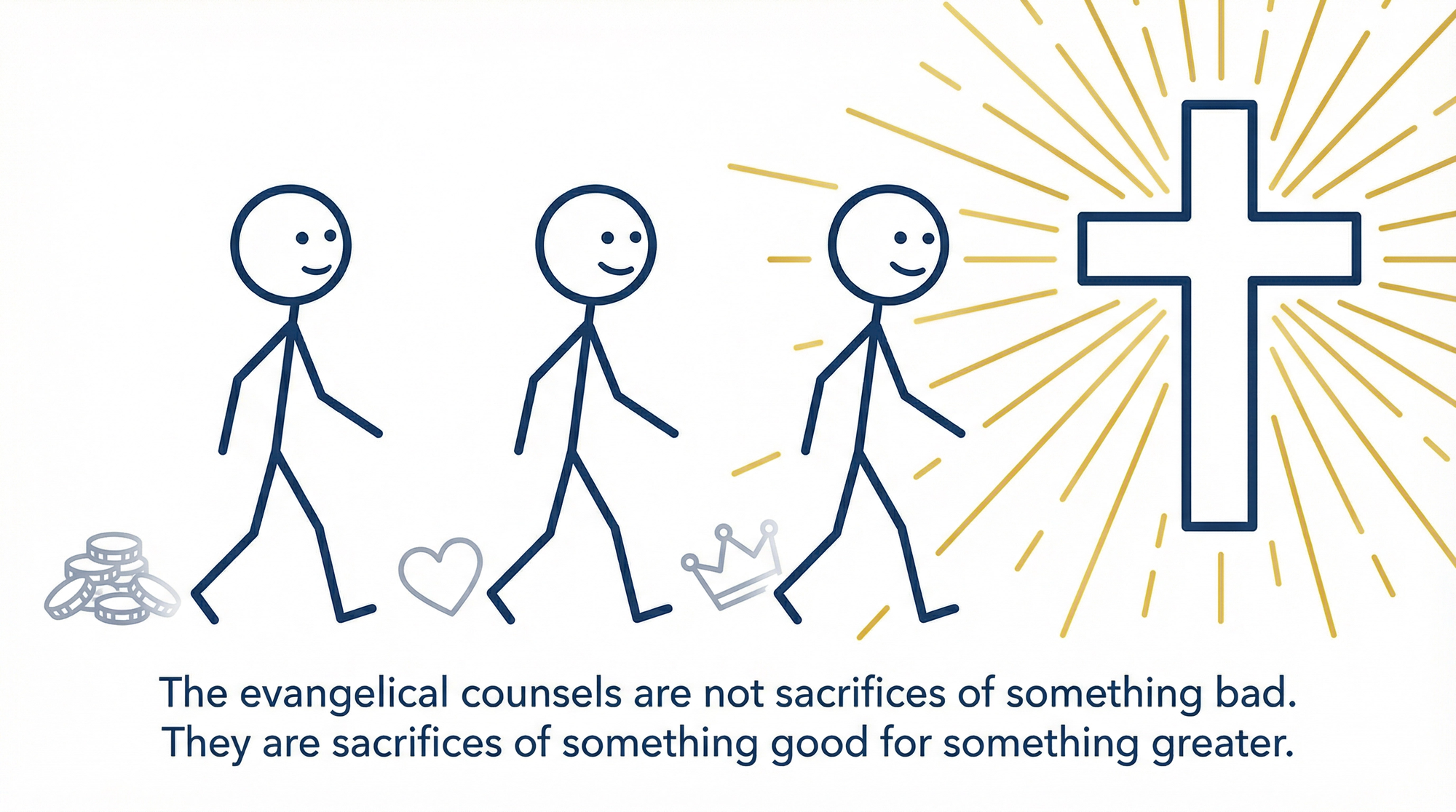
These are the evangelical counsels. They go beyond what is required of every Christian. They are a radical, voluntary gift.
"The evangelical counsels of chastity dedicated to God, poverty and obedience are based upon the words and examples of the Lord. They were further commanded by the apostles and Fathers of the Church, as well as by the doctors and pastors of souls. The counsels are a divine gift, which the Church received from its Lord and which it always safeguards with the help of His grace." (Lumen Gentium 43)
Religious life is not a rejection of the world. It is a witness. It says to everyone watching: the Kingdom of God is real, and it is more valuable than anything this world can offer. When a person voluntarily gives up wealth, romantic love, and personal autonomy for the sake of Christ, they are making the invisible Kingdom visible.
Why Religious Life Matters for Everyone
You might be thinking: I am not called to religious life. Why should I care about this chapter?
Because religious life exists for the whole Church. The document makes this explicit:
"The religious state clearly manifests that the Kingdom of God and its needs, in a very special way, are raised above all earthly considerations. Finally, it clearly shows all men both the unsurpassed breadth of the strength of Christ the King and the infinite power of the Holy Spirit marvelously working in the Church." (Lumen Gentium 44)
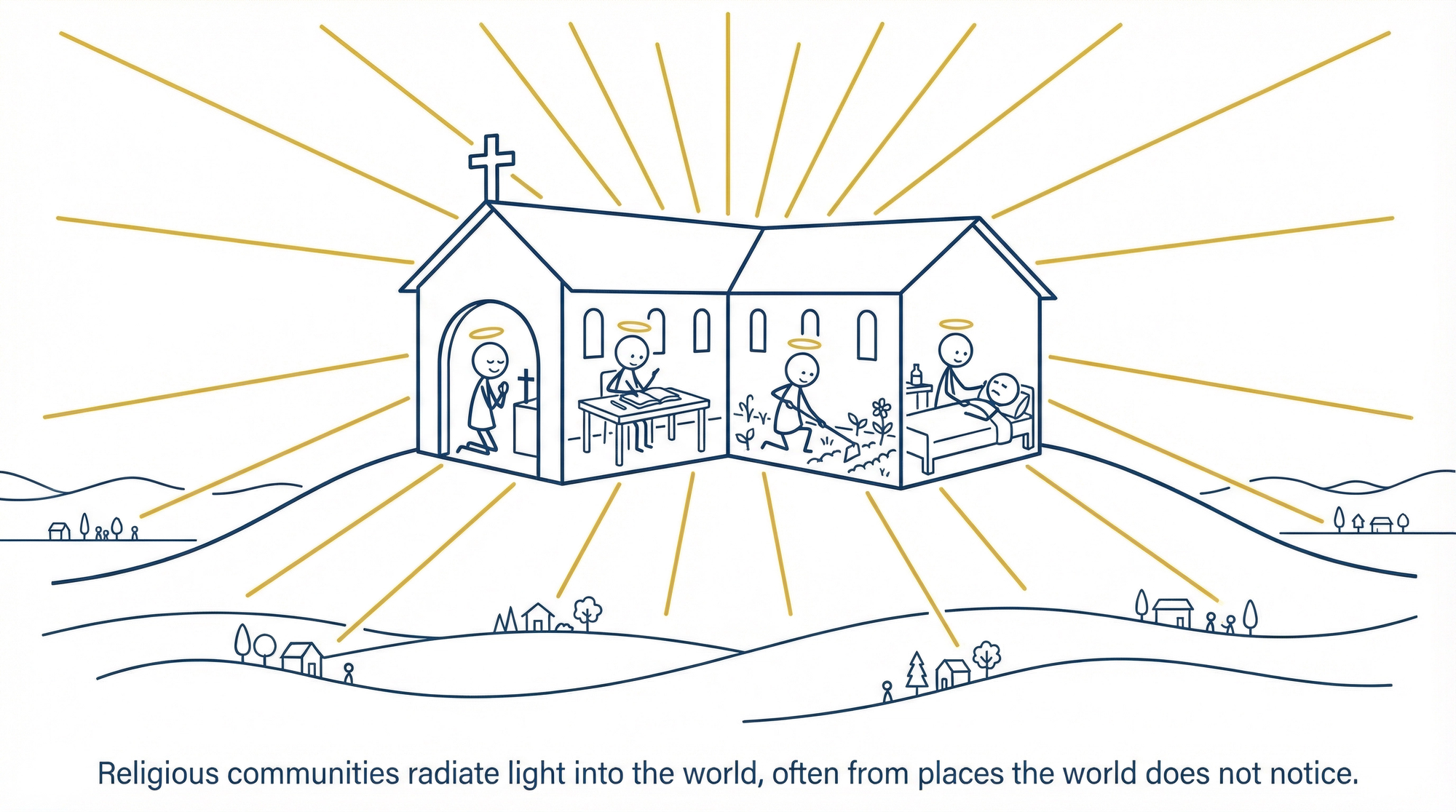
Religious brothers and sisters are a sign. They remind the rest of us what we are all living for. When a community of nuns gives up everything to serve the poorest of the poor, they are showing the whole Church what the Gospel looks like in concentrated form. Their witness sharpens everyone's faith.
Human Flourishing, Not Human Diminishment
The document pushes back against a common misunderstanding: that religious life is a kind of spiritual self-harm, a denial of everything good.
"The profession of the evangelical counsels, though entailing the renunciation of certain values which are to be undoubtedly esteemed, does not detract from a genuine development of the human person, but rather by its very nature is most beneficial to that development." (Lumen Gentium 46)
This is important. Poverty, chastity, and obedience do not shrink a person. They enlarge a person. They strip away the things that distract and weigh us down and create space for God to do His deepest work. The happiest, most alive people many of us have ever met are often those who have given up the most.
Religious Life and the Church
The chapter also clarifies how religious orders relate to the Church's hierarchy:
"The life marked by the profession of the evangelical counsels, while not entering into the hierarchical structure of the Church, belongs undeniably to her life and holiness." (Lumen Gentium 44)
Religious are not a parallel Church. They operate under the authority of the hierarchy. Their rules and constitutions are approved by the Church. But they bring something to the Church's life that the hierarchy alone cannot: a living, breathing witness to the radical demands of the Gospel.
The document closes this chapter with praise:
"The Sacred Synod encourages and praises the men and women, Brothers and Sisters, who in monasteries, or in schools and hospitals, or in the missions, adorn the Bride of Christ by their unswerving and humble faithfulness in their chosen consecration and render generous services of all kinds to mankind." (Lumen Gentium 46)
The Hard Questions About Chapter 6
"The evangelical counsels create a spiritual caste system. If you take vows, you are on the 'narrower path.' Everyone else is second-class."
This is a fair reading of the language, and it bothered Martin Luther enough to fuel the Reformation. Luther argued that all legitimate callings are equally holy. The cobbler who makes shoes faithfully is no less holy than the monk who prays all day. Many modern Protestants share this conviction, but so do we Catholics.
Lumen Gentium does not disagree as much as it might seem. Chapter 5 explicitly says holiness is one and the same for everyone. The married couple and the monk are pursuing the same sanctity. What Chapter 6 adds is that religious life is a particular kind of witness, not a higher grade of Christian. The vows of poverty, chastity, and obedience are not better than marriage, parenthood, and honest work. They are a concentrated sign pointing to what everyone is living for: the Kingdom of God.
Think of it this way. A lighthouse and a candle both produce light. The lighthouse is more visible. That does not make the candle less valuable. It makes them different in function, not in worth.
"The Bible warns against forbidding marriage. Mandatory celibacy contradicts Scripture."
Paul writes in 1 Timothy 4:1-3 that "in later times some will depart from the faith" and will "forbid marriage." Protestants see mandatory clerical celibacy as fulfilling this warning. And Hebrews 13:4 affirms that "marriage should be honored by all."
Two things are worth noting. First, religious vows are voluntary. No one is forced into celibacy. The men and women who take these vows do so freely, as a gift. Second, Jesus himself praised those who "made themselves eunuchs for the sake of the kingdom of heaven" (Matthew 19:12), and Paul expressed a preference for the celibate life, saying "I wish that all were as I myself am" (1 Corinthians 7:7).
The question of mandatory celibacy for diocesan priests is a matter of Church discipline, not doctrine, and it is a legitimate conversation. Our brothers in the Eastern Catholic Churches, who are in full communion with Rome, have always ordained married men to the priesthood.
But the religious life described in Chapter 6 is about something different: a freely chosen, total gift of self. Scripture honors that choice even as it honors marriage.
How to Keep Reading
Chapters 7 and 8 bring Lumen Gentium to its conclusion.
Chapter 7 looks at the Church as a pilgrim community, connected not only to Christians on earth but to the saints in heaven and the faithful being purified.
Chapter 8 places the Blessed Virgin Mary within the mystery of the Church as its most perfect member and its model.
You now understand the structure of the Church, the calling of the laity, the universal call to holiness, and the witness of religious life. What remains is the Church's ultimate hope and its greatest example.