

Here's something that might shake you a little.
If you asked ten Christians what "the gospel" is, you'd probably get ten different answers.
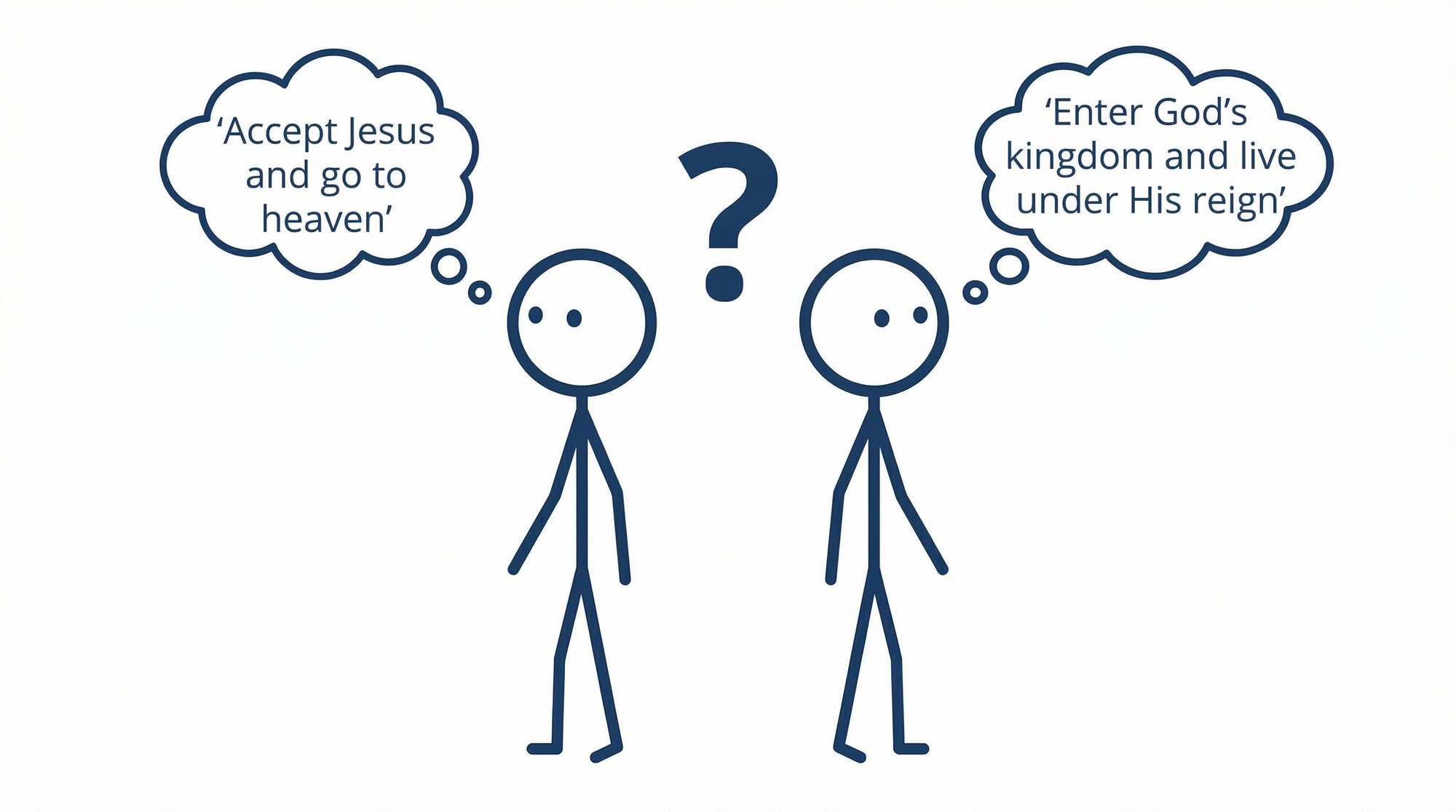
One person might say: "Jesus died for your sins so you can go to heaven."
That's valid.
Another might say: "God's kingdom is breaking into the world, and Jesus invites us to repent and become citizens of it." That's also valid.
Both are Christians. Both are sincere. Both believe they're sharing the core message of Jesus.
But here's the strange part. When you read the Gospels and watch Jesus actually teach, His words sound a lot more like the second person.
This doesn't mean the first answer is wrong. It's not. It contains something essential and true. We are sinners and we need a savior!
But Jesus added some important context that gets missed often today. And that difference matters more than we might think.
What Do We Even Mean by "Gospel"?
Let's start with definitions, because words matter.
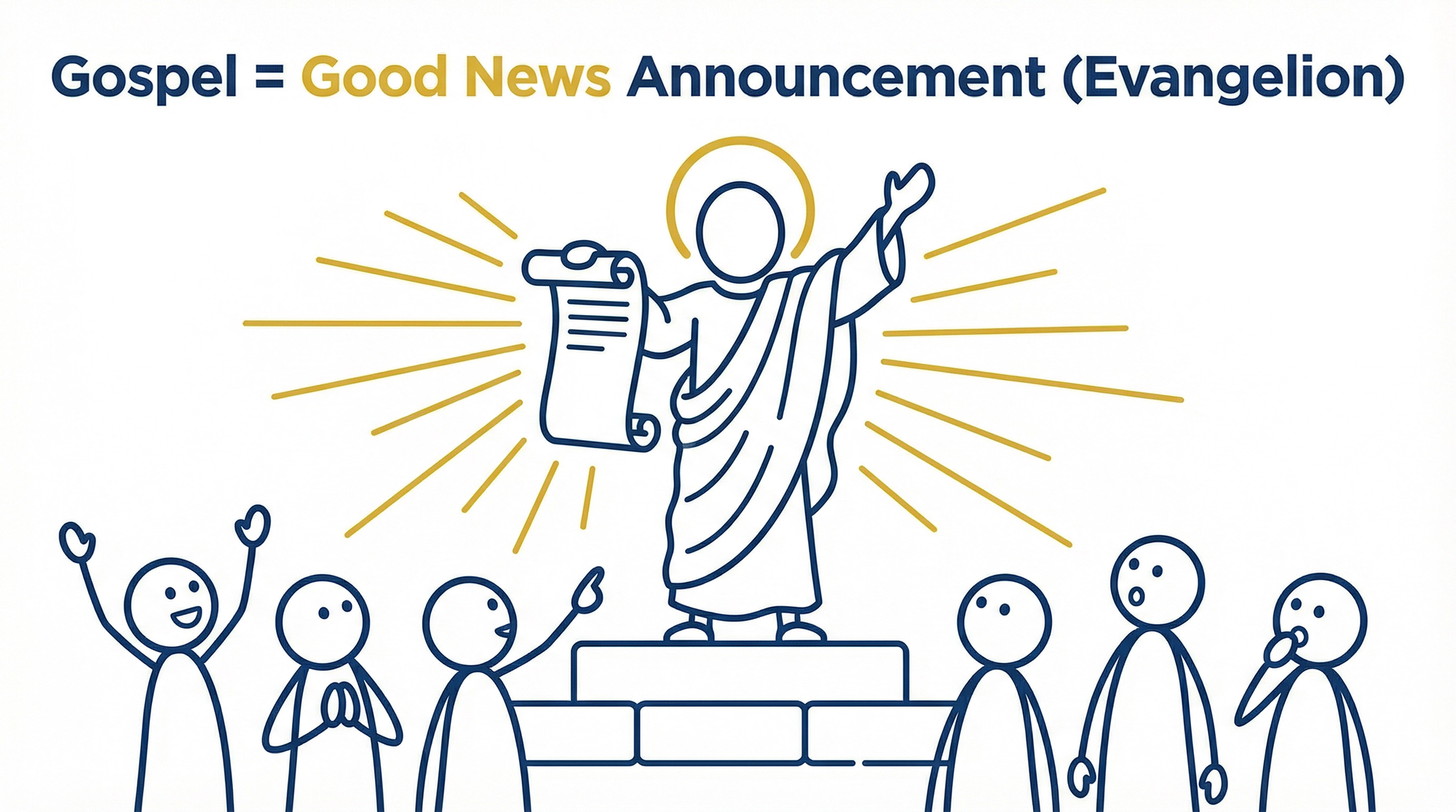
When we say "the gospel," we're talking about a message. The word itself comes from an old English term meaning "good news" or "good spell." In Greek, it's "evangelion," and it was used in the ancient world to describe the announcement of a victor's arrival or a king's proclamation.
A herald would go through the streets declaring important news that affected everyone.
That's what "gospel" means in its most basic form.
It's an announcement.
Good news about something significant.
But there's a catch. The question "what makes good news good?" will shape everything about how you understand the message.
Different people have answered that question differently. Let's dive in deeper into this...
Gospel vs. The Gospels
Before we go further, let's distinguish between two terms we use in the church.
When we say "the gospel," we mean the message of good news being proclaimed. When we say "the Gospels," we mean the four books in the New Testament: Matthew, Mark, Luke, and John.
These four books record the life, teachings, death, and resurrection of Jesus. They're the primary source we have for understanding what Jesus actually said and did.
Understanding this difference matters because it means we can test any claimed "gospel message" against what Jesus actually taught in the Gospels themselves.
So the real question becomes: what did Jesus proclaim as His core message?
When you read His actual words in Matthew, Mark, Luke, and John, what theme appears again and again?
The Drama Unfolds: Two Different Messages
Both of the gospel versions I'm about to share with you come from sincere, Bible-believing Christians. Both have led countless people to genuine faith in Christ. Both contain essential truths about salvation.
The difference is emphasis, not who's right or wrong.
Think of it this way. Imagine two people describing the same mountain. One says: "It's 8,000 feet tall." The other says: "It's the central landmark of this entire valley, affecting water flow, weather patterns, and the lives of everyone who lives here."
Both are true.
But they're focusing on different things. One is focusing on a specific measurement. The other is focusing on how that mountain functions in the whole ecosystem.
That's the difference between our two gospel versions.
The Evangelical Gospel: Personal Salvation in Focus
The version most of us grew up with goes something like this.
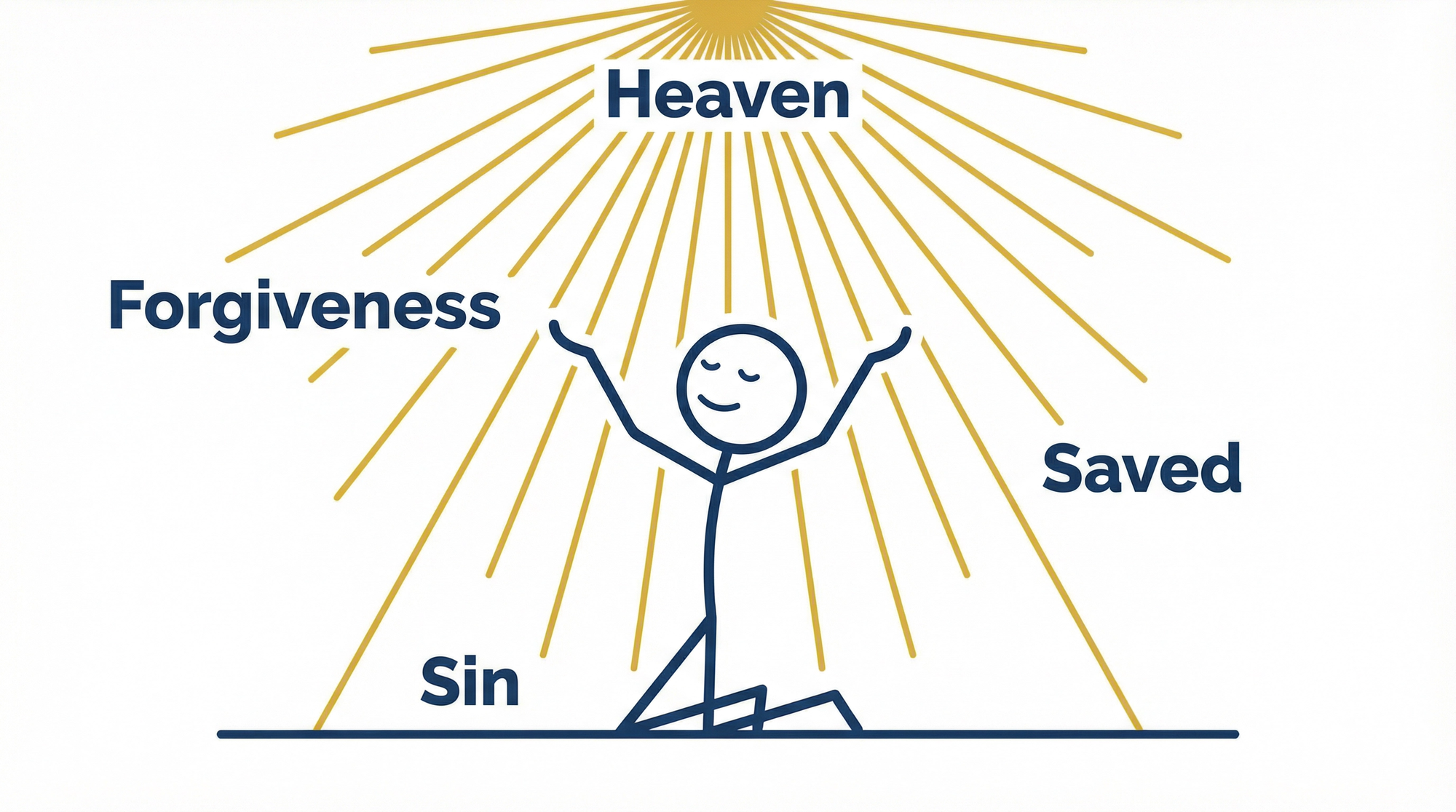
God created the world as good, and He created humanity in His image to live in relationship with Him. But we sinned. We rebelled against God's design. Because of sin, we're separated from God, guilty before Him, and destined for judgment. We're broken and we can't fix ourselves. Then Jesus came, born of a virgin. God the Son took on human flesh, lived a perfect life, died as a sacrifice for our sins, and rose from the dead three days later. His death substitutes for ours. His sacrifice pays the penalty we deserve. Now, anyone who believes in Him and accepts what He did can be forgiven and restored to God. Yay, you can come to Heaven!
The response is personal and individual. You admit you're a sinner. You believe that Jesus died for you. You ask Him into your heart. You receive His forgiveness and His eternal life. From that moment on, you're saved. You're a Christian. You're going to heaven.
This gospel presentation is clear. It's accessible. It gives you a specific moment of decision. It answers some of the deepest human questions: Am I forgiven? Will I go to heaven? Can I have confidence that I'm right with God?
Many of us came to faith through this message. It's powerful and true.
But here's the thing: this isn't what dominates Jesus' own teaching in the Gospels.
The Kingdom Gospel: Jesus' Primary Message
When you read through Matthew, Mark, Luke, and John with fresh eyes, looking specifically at what Jesus said, a different theme emerges almost immediately.
Mark tells us that after John the Baptist was arrested, Jesus came into Galilee proclaiming this message:
"The time is fulfilled, and the kingdom of God has come near. Repent and believe in the gospel!" (Mark 1:14-15)
The word "kingdom" appears in the Gospels over 100 times. Jesus' parables, His healings, His ethical teachings, His call to follow Him, His entire message orbits around one central reality: the kingdom of God is breaking into the world.
But here's what this doesn't mean. The kingdom is "not only" a place you go to when you die. It's not only in heaven. It's not an internal spiritual state only.
"Thy kingdom come, thy will be done, on earth as it is in Heaven."
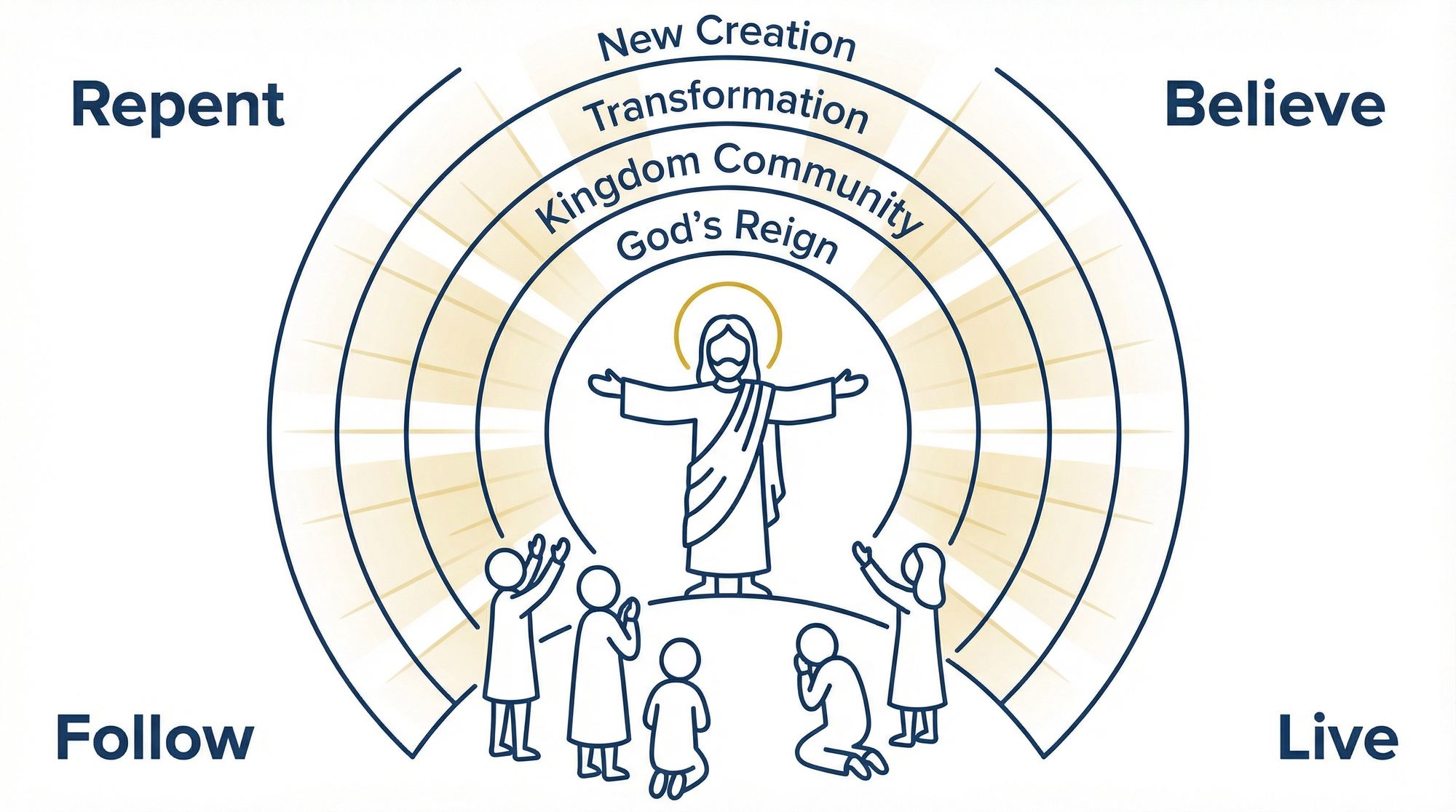
What Jesus means by "kingdom" is God's active reign and rule. It's the reality of God's power working in the world right now. It's what happens when God's will is done, when His values are lived out, when His authority is recognized and submitted to.
It's the whole plan, from the beginning. All of us working together, under God's reign, in obedience and in faith.
The problem that Jesus identifies in His teaching isn't just personal guilt. It's rebellion. We've built our own kingdoms. We pursue our own power, our own wealth, our own comfort, our own glory.
We're living as if WE are the center of the universe instead of God.
That's the rebellion He's addressing. That's the "repentance" He is speaking of.
The solution isn't just individual forgiveness, though that matters. The solution is the arrival of God's kingdom. When you repent, you're not just saying you're sorry for sins. You're turning around. You're abandoning your self-ruled kingdom and surrendering to God's kingdom.
You're accepting Jesus as King. In ALL areas of your life.
And then you're invited into a new way of living, right now, as a citizen of God's kingdom. You start learning what it looks like to live under His rule. You practice His values. You love your neighbor. You seek justice. You live the ethics of the kingdom. You belong to His community.
This gospel emphasizes discipleship as essential, not optional. It emphasizes community as central, not peripheral. It emphasizes justice and transformation as part of the good news, not side issues.
Why This Difference Matters
These two gospel presentations produce different kinds of Christians.
The Evangelical Gospel, because it focuses on the moment of decision, can sometimes create "Christians" who are primarily concerned with whether they're going to heaven when they die. Did I say the right prayer? Did I believe enough? Am I saved? This creates an individual, future-focused faith.
The Kingdom Gospel, because it focuses on becoming a citizen of God's reign, creates disciples who are concerned with how they're living now as followers of Jesus. It shapes a present-focused, community-oriented, transformational faith.
BOTH are needed!
One is not wrong. Both are true. But they're answering different questions and producing different results.
The Evangelical Gospel: Deep Dive
Let's explore the first version in more depth, because this is the one most of us know best.
The classical presentation of the Evangelical Gospel often follows what's sometimes called "The Bridge" or "The Romans Road" because it walks through key passages in Romans that lay out the logic.
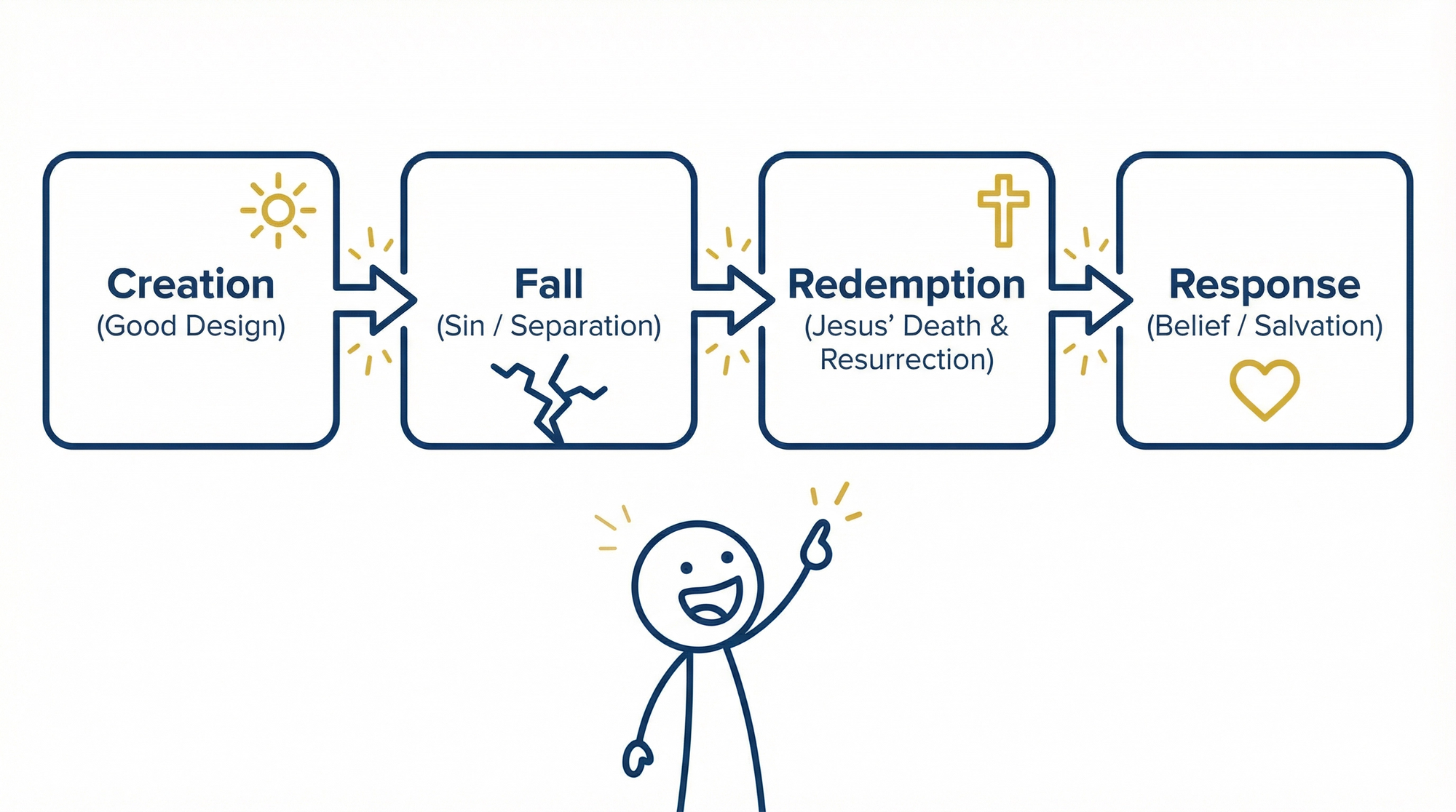
Here's the structure: Creation, Fall, Redemption, Response.
Creation: God made a good world and humanity in His image. We were designed for relationship with God, with a purpose and a calling.
Fall: Adam and Eve sinned, and that sin has corrupted all humanity. Paul writes in Romans:
"All have sinned and fall short of the glory of God." (Romans 3:23)
Because we're sinners, we're separated from God. And:
"The wages of sin is death." (Romans 6:23)
Death isn't just physical. It's spiritual separation from God, eternally.
Redemption: But God loves us. He sent His own Son to die in our place. Jesus paid the penalty that we deserve. His death on the cross was a substitution, a payment. His resurrection three days later proved His victory over sin and death. Now His righteousness is available to us by faith.
Response: You admit that you're a sinner. You believe that Jesus died for you and rose from the dead. You invite Him into your life as your Savior. Paul summarizes:
"If you declare with your mouth, 'Jesus is Lord,' and believe in your heart that God raised him from the dead, you will be saved." (Romans 10:9)
The verses that anchor this gospel are familiar:
"For God so loved the world that he gave his one and only Son, that whoever believes in him shall not perish but have eternal life." (John 3:16)
"For it is by grace you have been saved, through faith and this is not from yourselves, it is the gift of God, not by works, so that no one can boast." (Ephesians 2:8-9)
This gospel emphasizes justification by faith alone. It emphasizes that we can't earn our salvation by works. It's a free gift, received through faith. It gives personal assurance. If you've believed, you're saved. God promised. You can know it.
The strengths of this gospel are real. It's clear about how to be saved. It directly addresses guilt and fear. It provides genuine confidence in God's love. It has been profoundly effective in cultures that emphasize individual choice and personal decision.
But when you read Jesus' actual words in the Gospels, you notice something. This logical flow, Creation, Fall, Redemption, Response, is not how Jesus taught. Jesus talked about the kingdom almost constantly. But He didn't teach systematic theology the way Paul explains it in Romans.
The Kingdom Gospel: What Jesus Actually Preached
Here's where things get interesting, because when we look closely at the Gospels, a different emphasis emerges.
"The time is fulfilled, and the kingdom of God has come near. Repent and believe in the gospel!" (Mark 1:14-15)
This is Jesus' core announcement. The kingdom of God is here. It's breaking into the world. Everything is changing. The old order is being invaded by God's reign.
To understand what Jesus means by "kingdom," we have to understand the Jewish context. The people of Israel had been waiting for the kingdom of God to arrive for centuries. The prophets had spoken about it. The people longed for it.
They understood it as God's active rule over creation, a time when injustice would be overturned, when God's will would be done, when creation would be restored.
But here's the radical thing Jesus teaches: the kingdom is not just future. It's present. It's breaking in right now, through His ministry.
It's here, invading the world, even while the age of sin and brokenness continues.
This is what theologians call the "already but not yet" tension.
The kingdom has already arrived in Jesus. But it's not yet fully consummated. We live in an overlap of ages. God's kingdom is here, and we're invited to live as citizens of it right now.
But it's not yet visible and complete. We're waiting for Jesus' return when the kingdom will be fully established and creation will be completely restored.
How Jesus Taught About the Kingdom
Jesus didn't teach through logical arguments. He taught through parables and actions and lived example.
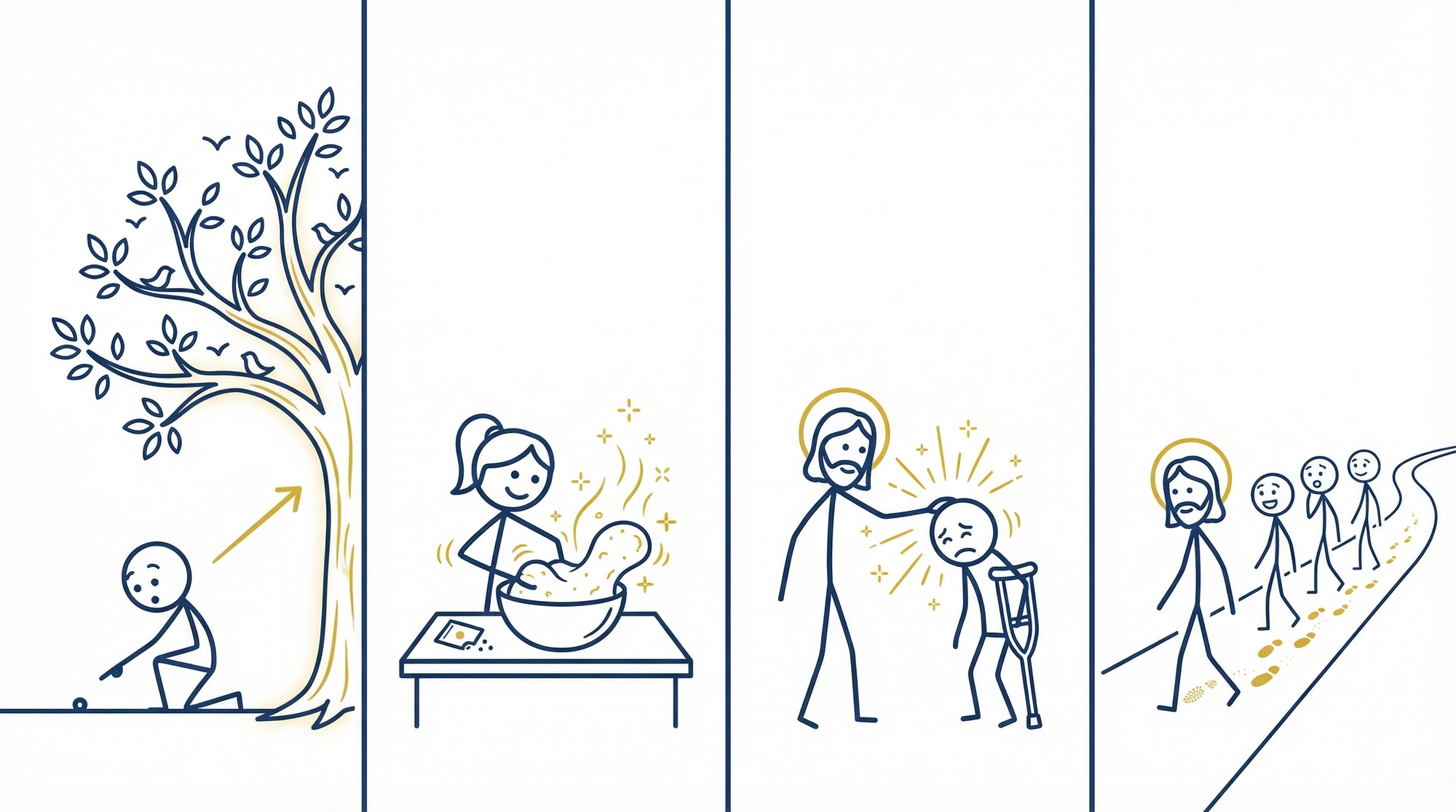
He told parables about the kingdom. A mustard seed planted in the ground grows into a tree. That's the kingdom. Small, hidden at first, but growing and transforming the landscape. A woman mixes yeast into dough, and the yeast spreads through all the flour. That's the kingdom. It's working from within, spreading, transforming.
He taught His most famous sermon, the Sermon on the Mount, as a description of kingdom ethics. Here's what it looks like to live under God's reign: blessed are the poor in spirit, those who mourn, the meek. Love your enemies. Do to others as you'd want done to you. Be salt and light in the world. Seek first the kingdom of God and His righteousness.
He performed miracles and healings as demonstrations of the kingdom. When Jesus healed the sick, cast out demons, restored the broken, He was showing what God's kingdom looks like. It's a reality where suffering is addressed, where God's power overcomes evil, where wholeness is restored.
He called disciples to follow Him, not just to believe a set of propositions, but to apprentice themselves to Him, to learn His way, to become like Him, to participate with Him in the kingdom's advancement.
The Problem: Rebellion Against God's Reign
The fundamental problem that Jesus identifies is not primarily guilt. It's rebellion.
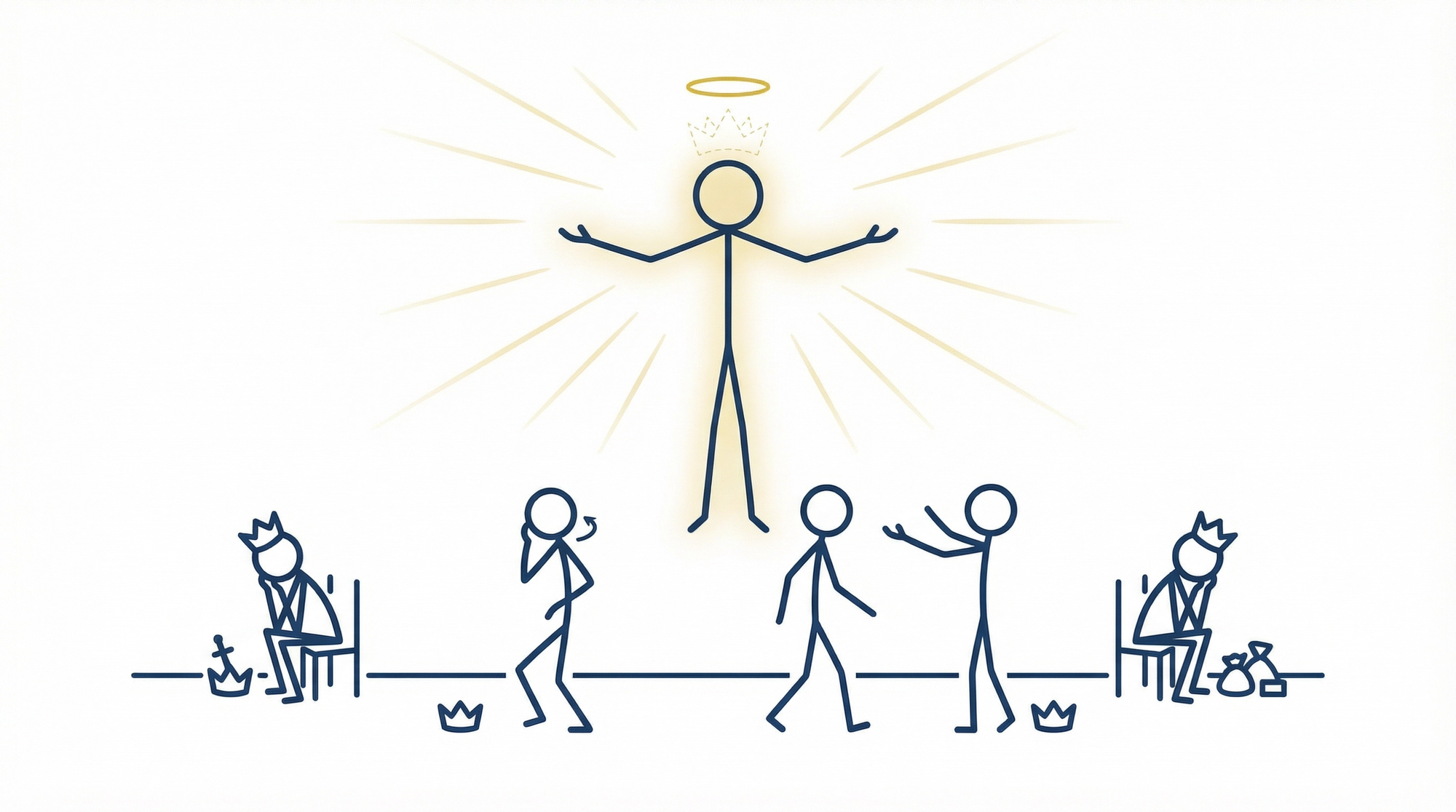
Humanity has refused to acknowledge God as King. We've built our own kingdoms. We pursue our own power, our own wealth, our own reputation, our own pleasure. We act as though we're the center of the universe instead of God. We reject His rule.
This rebellion has a corporate dimension and an individual dimension. There are systems and structures that oppose God's kingdom, that build on injustice and exploitation. And there are individual hearts that resist God's rule, that want to be their own god.
The consequence of this rebellion is fragmentation and death. Relationships break. Communities fracture. Wars rage. Creation itself groans under the weight of our rejection of God's reign. There's injustice, suffering, emptiness, and separation from God, both now and eternally.
The Solution: Jesus as King
Jesus didn't come primarily to forgive individual guilt, though that DOES happen. He came as King, to establish God's kingdom and to call people into it.
His incarnation was itself a statement about the kingdom. God became human and lived perfectly, demonstrating what it looks like to live in complete submission to God's reign. Every action, every teaching, every relationship of Jesus' life showed what humanity looks like when we're fully aligned with God's kingdom.
His death was not primarily a transaction to cover our guilt, though it definitely accomplishes that. His death was a collision between two kingdoms. The kingdom of God, represented in Jesus, directly challenged the political and religious powers of the world.
Those powers killed Him.
But His death broke their power.
He submitted to death, but death couldn't hold Him. His resurrection was God's vindication of the kingdom. Evil and death did their worst. God's kingdom overcame.
His resurrection proved that God's kingdom is stronger than the kingdoms of this world. It's the ultimate sign that God is winning, that His reign is breaking in, that a new creation is coming.
The Invitation: Kingdom Citizenship
Jesus' invitation is to become a citizen of God's kingdom.
Repentance, in this context, means turning from the rule of self and submitting to the rule of God. It means abandoning your own kingdom and bowing to His. It's a change of direction, a new allegiance.
Faith means trusting Jesus as the rightful King. It means believing that His rule is good, that His way is true, that submitting to Him is actually your deepest freedom and flourishing.
Discipleship means becoming an apprentice, a learner, someone who follows Jesus and learns from Him how to live as a kingdom citizen.
It's not optional. Every knee will bow, one day.
Everyone who comes to Jesus comes to learn from Him, to become like Him, to join His mission.
And kingdom life is lived in community. You don't just become a kingdom citizen by yourself. You join the kingdom community. You belong to the church, the family of God's people, those who are learning together how to live under God's reign.
Kingdom Living Now
What does kingdom living look like in practice?
It looks like the great commandments that Jesus emphasized: love the Lord your God with all your heart, soul, mind, and strength, and love your neighbor as yourself. That's the essence of kingdom living.
It looks like the Sermon on the Mount lived out: seeking justice, showing mercy, living with integrity, caring for the vulnerable, peacemaking, standing against injustice.
It looks like the fruits of the Spirit: love, joy, peace, patience, kindness, goodness, faithfulness, gentleness, and self-control. These are the character qualities of a kingdom citizen.
It looks like the values of the kingdom constantly undermining the values of the world. In God's kingdom, the last are first, the weak are strong, the servant is the leader, the poor are blessed, the merciful are exalted. These are radically different from the world's values of power, wealth, status, and self-preservation.
It looks like hope anchored in the future. We're not just trying to improve the world through our own effort. We're living now in light of the reality that Jesus is returning, that the kingdom will be fully established, that creation will be restored, that we'll live eternally in a renewed heaven and earth. That hope sustains us through present difficulties.
Comparing the Gospels: Where They Overlap and Where They Differ
Here's the crucial thing: these two gospel versions are not contradictory. They both arise from Scripture. They both are essential. But they have different emphases, and that creates different results.
What Both Messages Share
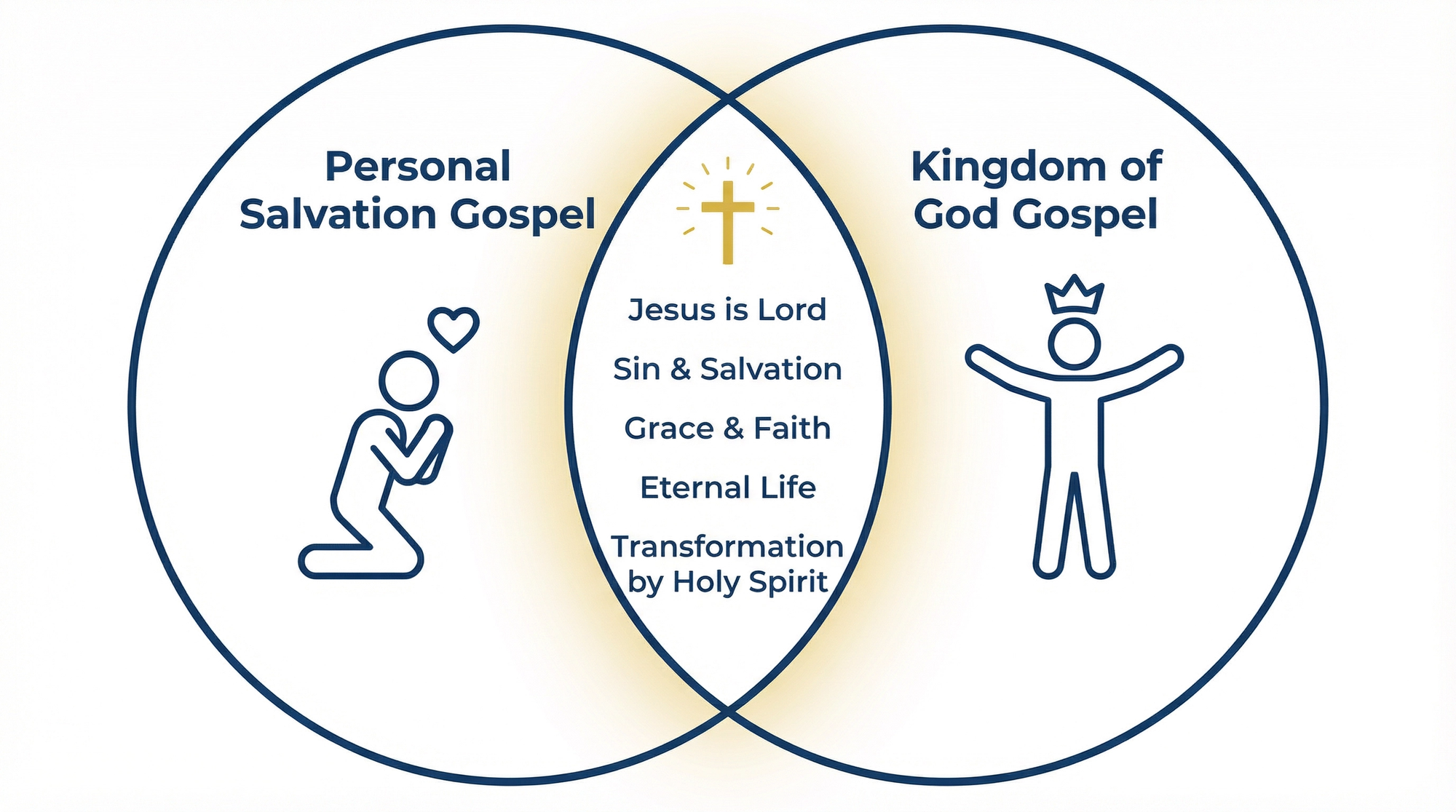
Both the Evangelical Gospel and the Kingdom Gospel agree on the absolute essentials:
Jesus is fully God and fully human. He is the Son of God, the Word made flesh. He is the Messiah, the one Israel was waiting for.
Sin is real and universal. All of us have sinned. We've rebelled against God. We deserve judgment.
Jesus' death on the cross is substitutionary. He died in our place. His death pays the penalty for our sins. His sacrifice is the foundation of our salvation.
Salvation is by grace through faith. We can't earn it through works. We receive it as a gift through faith in Jesus.
Repentance and faith are necessary. We have to turn from sin and put our trust in Jesus.
We need the Holy Spirit to transform us. The Spirit works in us to make us holy, to produce the fruits of the kingdom, to conform us to Christ.
Eternal life is ours in Jesus. Those who believe will not perish but have eternal life.
Both gospels affirm all of this. The difference is not doctrinal. It's emphasis and scope.
What the Evangelical Gospel Can Miss
The Evangelical Gospel, because it focuses so intensely on the moment of individual decision, can sometimes minimize:
The kingdom of God as a present reality that should shape how we live immediately upon accepting Jesus as our savior. It can become future-focused, emphasizing heaven after you die, rather than kingdom living in the here and now.
We don't want Christians sitting on the bench waiting for Heaven. We want active Christians building the kingdom "on earth as it is in Heaven." This isn't a "works-based" religion, it's what Jesus Himself asked of us.
It's what James meant when he said "Faith without works is dead." (James 2:20)
Discipleship as essential. It can create a distinction between converts and disciples, as though conversion is the main goal and discipleship is optional extra credit for especially committed Christians. Jesus didn't make that distinction. He called everyone to be disciples.
Community as integral to faith. The Evangelical Gospel is often presented as a purely individual transaction between you and Jesus. Community can become something you do after you're saved, rather than something central to what it means to follow Jesus.
Justice and social transformation as part of the gospel. The Evangelical Gospel can become spiritualized, focused purely on spiritual matters while ignoring systemic injustice, poverty, and suffering.
Jesus' kingdom includes care for the marginalized, transformation of unjust systems, and the healing of creation. That's why He talked so much about feeding the hungry, healing the sick, giving to the poor, and freeing the oppressed. He wanted us to do like He was doing.
What the Kingdom Gospel Can Miss
The Kingdom Gospel isn't blameless either, because it focuses on God's cosmic plan and present transformation, can sometimes minimize:
The individual nature of salvation. A person can nod along with kingdom talk and miss the reality that each individual needs to repent and believe. You can agree with the theology without actually submitting your own heart to Jesus as King. We are all sinners, yes even me.
The clarity of what it means to be saved. The Evangelical Gospel's emphasis on the decision moment and personal assurance provides something valuable. The Kingdom Gospel, while not denying these things, doesn't always make them as explicit and accessible.
The substitutionary nature of the atonement. The Christus Victor. When you emphasize the kingdom and social transformation, it's easy to drift toward seeing Jesus' death primarily as an example or a symbol, rather than as a real payment for sin. Jesus' death is both a demonstration of kingdom love and a genuine sacrifice that pays the penalty of sin.
Why the Difference Matters
Consider the practical results.
An Evangelical Gospel approach can produce converts who are assured of their salvation but not transformed disciples. They believe the right things about Jesus, but they're not learning to live like Jesus.
They're not part of a community practicing kingdom values.
They're not involved in justice and transformation. They come to church and believe the right doctrine, but their lives look a lot like everyone else's.
A Kingdom Gospel approach can produce beautiful communities of people learning to live together under God's reign, seeking justice, caring for the vulnerable.
But without clarity about personal salvation, about the reality that each person needs to repent and believe, you can have community without commitment, theology without transformation, talk of the kingdom without actual allegiance to the King.
The best Christianity holds both together.
- We need the clarity of personal salvation.
- We need the transformation of discipleship.
- We need individual faith.
- We need community.
- We need the assurance of justification.
- We need the practice of kingdom living.
- We need both the vertical relationship with Jesus and the horizontal relationships that demonstrate the kingdom.
The Apostolic Addition: How the First Leaders Expanded Jesus' Message
After Jesus ascended, the apostles took His kingdom message into the world. But they didn't change the fundamental message. They clarified it and applied it to new contexts.
James: Kingdom Ethics in Action
James, Jesus' own brother, emphasized something critical: faith without works is dead.
"What good is it, my brothers and sisters, if someone claims to have faith but has no deeds? Can such faith save them?" (James 2:14)
James is not teaching that works save you. But he's insisting that genuine faith produces transformation. You can't claim to follow the King and then live however you want. The kingdom transforms how you actually live.
James emphasized care for the poor and vulnerable:
"Religion that God our Father accepts as pure and faultless is this: to look after orphans and widows in their distress." (James 1:27)
Kingdom living means practical care for those in need. It means standing against favoritism and injustice. It means letting the values of God's kingdom replace the values of the world.
James expanded Jesus' message by insisting: the kingdom is not just an idea you believe. It's a way of life you practice.
John: The Kingdom of Love
John, the disciple closest to Jesus, centered everything on one reality:
"God is love." (1 John 4:8)
John understood the kingdom fundamentally as the invasion of God's love into a loveless world. The ultimate test of whether you belong to God's kingdom is whether you love God and you love other people:
"And this is his command: to believe in the name of his Son, Jesus Christ, and to love one another as he commanded us." (1 John 3:23)
John also emphasized the contrast between the kingdom of light and the kingdom of darkness. Light and darkness are incompatible. You can't partially follow Jesus. You can't live in both kingdoms. You have to choose. You have to walk in the light.
John connected eternal life not to an afterlife location but to relationship:
"Now this is eternal life: that they know you, the only true God, and Jesus Christ, whom you have sent." (John 17:3)
Eternal life is knowing God. It's a relationship that begins now and continues forever.
John expanded Jesus' message by insisting: the kingdom is fundamentally about love, and it requires total allegiance.
Peter: Kingdom Suffering and Hope
Peter, the rock on whom Jesus said He'd build the church, dealt with a reality Jesus had warned about: following the King means conflict with the kingdoms of this world.
"Dear friends, do not be surprised at the fiery ordeal that has come on you to test you, as though something strange were happening to you. But rejoice inasmuch as you participate in the sufferings of Christ, that you may be overjoyed when his glory is revealed." (1 Peter 4:12-13)
Peter taught that suffering is not a sign that you've made a mistake. It's a sign that you're genuinely living as a kingdom citizen in a world that opposes God's reign. The kingdoms of this world don't like when God's kingdom advances. There will be opposition. But the victory is certain. Jesus has already won. We're waiting for that victory to be fully revealed.
Peter also taught that we're living as "aliens and strangers" in a foreign land, waiting for our true home. We don't belong to this world's systems. Our citizenship is in God's kingdom. We're looking forward to an inheritance that can never perish, spoil or fade. This inheritance is kept in heaven for you (1 Peter 1:4).
Peter expanded Jesus' message by insisting: the kingdom is costly, but it's worth everything. Suffering is part of the journey. Hope is our anchor.
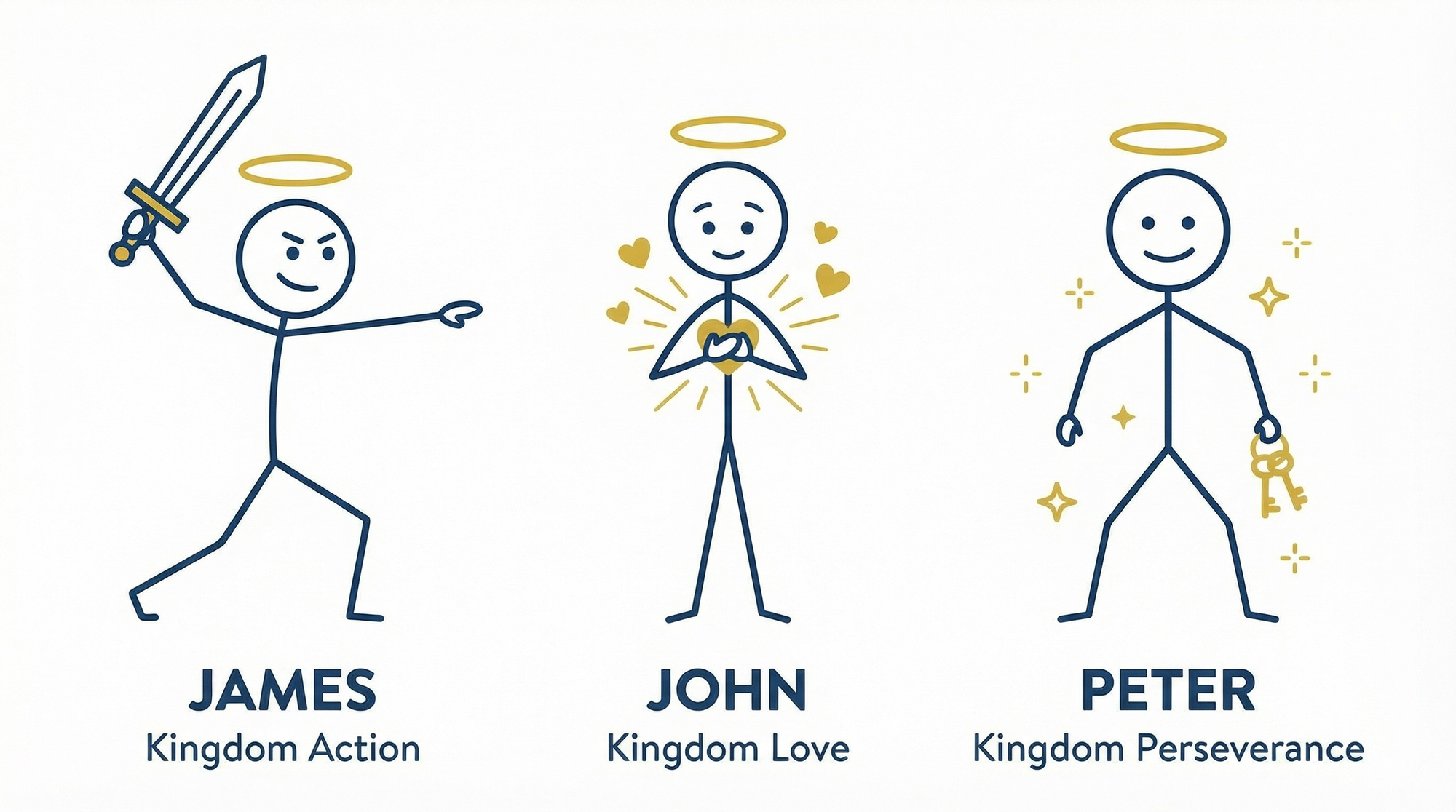
The apostles didn't change the core message. Jesus was King. God's kingdom was breaking in. People needed to repent and believe. Disciples needed to follow and learn. Community was central.
But they clarified theological implications. Paul explained the mechanics of justification. James made discipleship practical. John deepened the relational foundation. Peter addressed the cost and the hope.
They applied these principles to new contexts. Churches were forming. Gentiles were coming to faith. The apostles had to think through what it meant to live as kingdom citizens in Rome, in Corinth, in Jerusalem, in Asia Minor. Their epistles give us that wisdom.
The Great Commission: Every Believer's Kingdom Mission
Before ascending, Jesus gave His followers a mission:
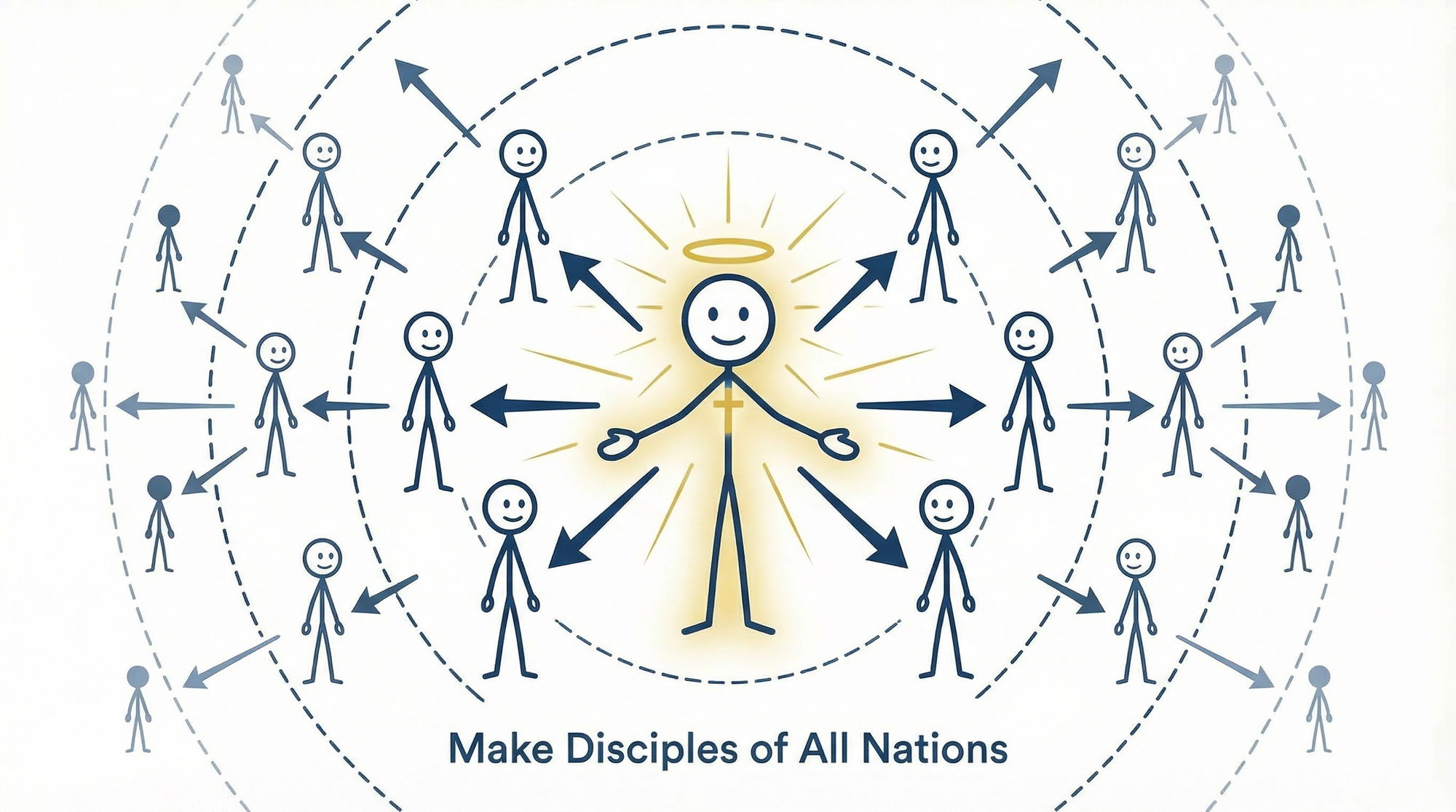
"All authority in heaven and on earth has been given to me. Therefore go and make disciples of all nations, baptizing them in the name of the Father and of the Son and of the Holy Spirit, and teaching them to obey everything I have commanded you." (Matthew 28:18-20)
This is the Great Commission. It's not optional. It's not just for pastors and evangelists.
It's for every follower of Jesus.
Look at what Jesus emphasizes. "All authority" is His. He's not asking us to convince people through our superior arguments. He's inviting us to represent His kingdom, which is already established. His authority is total.
"Make disciples" is the mission, not just converts. A disciple is an apprentice, a learner, someone committed to becoming like their master. This is transformation, not just intellectual agreement.
"Of all nations." The kingdom is not just for one group. It's meant for all people everywhere. Kingdom citizens share the good news with the whole world.
"Teaching them to obey everything I have commanded you." The focus is on obeying Jesus' teachings, practicing kingdom ethics, living kingdom values. Discipleship is not just knowledge. It's obedience.
Baptizing them. In the name of the Father, Son, and Holy Spirit.
None of these are optional instructions. It's THE Great Commission. All of us are called to this, now, not later.
Why This Matters to Everyone
It's sometimes said that the Great Commission is for missionaries and church planters. But Jesus didn't say that. He said it to His disciples. That's everyone who follows Him. You're a kingdom citizen. You're called to participate in making disciples.
That doesn't mean you have to move to another country. It doesn't mean you have to leave your job. But it does mean that in your family, your work, your friendships, your community, you're representing the kingdom. You're inviting people to follow Jesus. You're helping people grow as disciples. You're demonstrating kingdom values.
The priesthood of all believers, a principle emphasized throughout Scripture, means that every Christian has a role in advancing God's kingdom. You don't need special permission or special training. You just need to be a follower yourself and invite others to follow.
This is how the kingdom advances. Not through Christian celebrities. Through ordinary people, in ordinary relationships, inviting others to know Jesus and learn from Him.
Your Kingdom Evangelism Toolkit: From Conversion to Discipleship
Now let's get practical. How do you actually live this out? How do you share the kingdom gospel? How do you help people become disciples, not just converts?
The Kingdom Gospel Mnemonic: KING'S CALL
Here's a way to remember and communicate the core elements of the kingdom gospel.
K: Kingdom Announced - God's reign is breaking into the world through Jesus. The old powers are being challenged. A new reality is available.
I: Invitation Extended - Come and surrender to the King. This is not a demand. It's an invitation to the best life available. Jesus invites us into relationship with Him and participation in His kingdom.
N: New Life Begins - When you repent and believe, you're transferred from the kingdom of darkness into the kingdom of light. You become an actual literal child of God. You're born again. You become a citizen of God's kingdom. Your sins are forgiven. You have a clean slate.
G: Growing in Obedience - Kingdom life is a lifelong process of learning to live like Jesus, of growing in character, of practicing kingdom values, of becoming more like the Master you're apprenticed to.
S: Second Coming Awaits - Jesus is coming back to judge the world and to fully establish His kingdom. Every knee will eventually bow. That future hope shapes how we live now. We're not trying to fix the world ourselves. We're living in light of Jesus' return.
C: Community Essential - You don't follow Jesus as a solo Christian. You belong to a family, a church, a community of kingdom citizens who support each other, who practice kingdom values together, who grow together.
A: All Nations Reached - The gospel is meant for everyone. We're part of a global movement of people from every nation, every culture, every language, all bowing to the same King.
L: Lifelong Journey - From the moment you come to faith until the day you meet Jesus, you're growing. Kingdom life is not a destination you reach. It's a journey you're on. Look to Jesus for help. Pray often.
L: Life Eternal - But that journey doesn't end at death. It continues. We'll live forever in the new heaven and new earth, in the physical renewal of creation, in the complete kingdom reality.
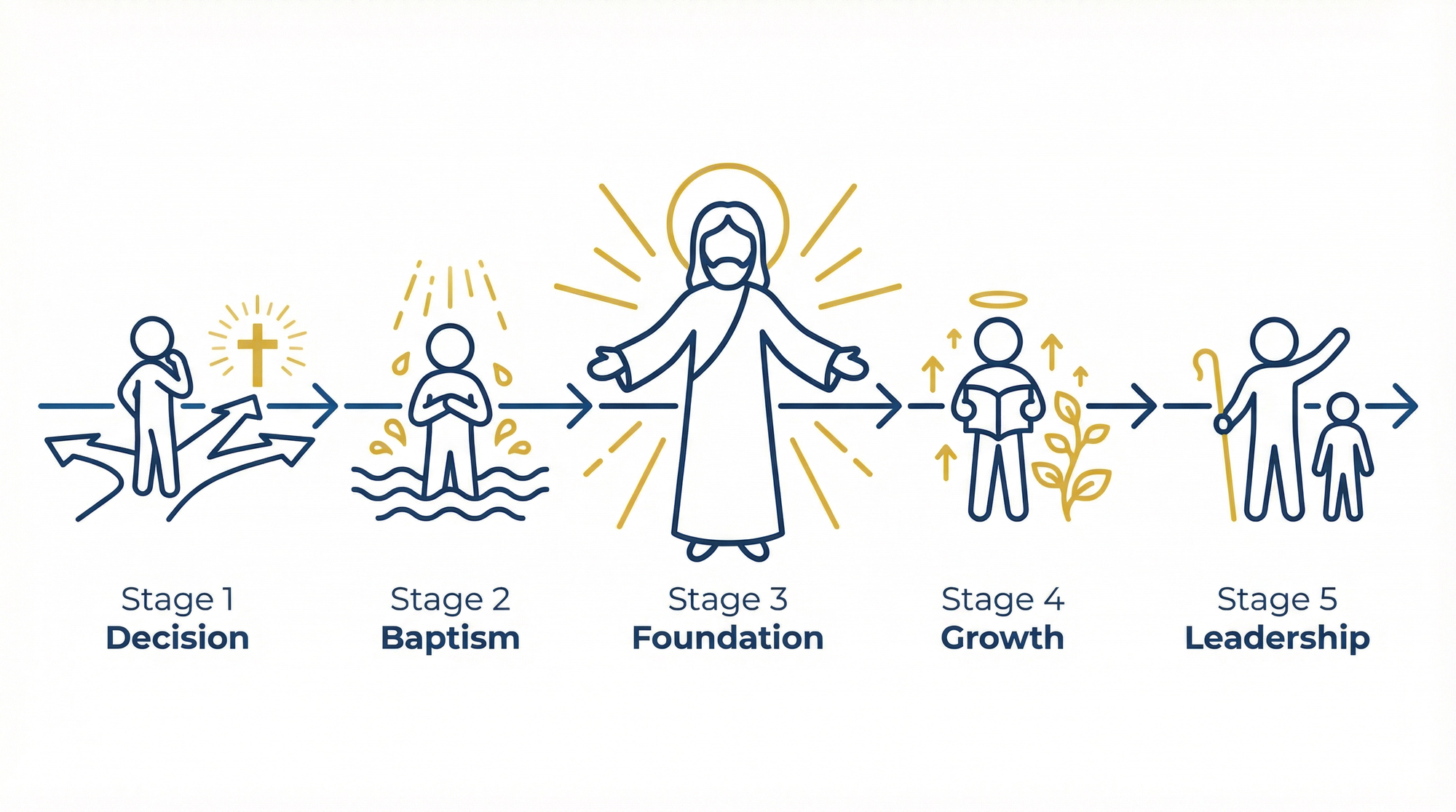
After Someone Responds: The Discipleship Pipeline
Let's say someone you've been praying for, someone you've been talking with about Jesus, makes a decision to follow. They repent. They believe. They want to be a kingdom citizen.
What happens next? How do you help them grow?
Immediate Steps (First Few Days)
Celebrate what's happened. Help them understand it. They've made a decision that changes everything. They've been born again. They've become a citizen of God's kingdom. Their allegiance has shifted from their own kingdom to God's kingdom.
Connect them with a church community if they're not already in one. Kingdom life is community life. They need to be part of a church family.
Help them understand baptism. In Scripture, baptism is more than just a public declaration of loyalty to Jesus. It is the beginning of regeneration. Baptism saves you. (1 Peter 3:21) It's also the outward sign of an inward transformation. It's them saying to the world: I'm a kingdom citizen now. I belong to Jesus.
First Month: Foundation Building
Have them start reading one of the Gospels. I'd suggest Mark. It's the shortest. It moves fast. It shows Jesus in action. Book of Acts is great too. If they're not a big reader ask them to commit to 1 page a day in Proverbs, it's an easy practical start. Remind them, they're in the kingdom now, this is part of it.
Find them a spiritual mentor or a discipleship partner. This could be you. It could be someone else in the church. This is someone who can answer questions, who can guide them, who can help them understand what they've gotten themselves into.
Teach them the basics. How do you pray? How do you read the Bible? What's repentance? What's confession? What does it mean to follow Jesus?
Help them join a small group or a Sunday school class. Community is essential. They need to be around other Christians who are also learning.
Ongoing Growth: Kingdom Formation
Move them toward deeper Bible study, particularly the Gospels and the epistles. They need to hear Jesus' actual words and the apostles' guidance.
Give them opportunities to serve. Kingdom living is not just passive belief. It's active participation. Serving others is how you practice the values of the kingdom.
Encourage them to get involved in a mission. This could be local missions or global missions. It could be community service. It could be evangelism. The key is that they're not just receiving kingdom benefits. They're advancing the kingdom.
Keep them connected to a community of faith. A small group, a church family, a discipleship partnership. Isolation kills faith.
What to Look for in a Church
The church is where kingdom life is learned and practiced together.
Look for a church that emphasizes both salvation and discipleship. If a church is content with just getting people to say yes to Jesus and is not interested in them growing and changing, that's a red flag. Discipleship is not optional.
Look for a church that teaches the Bible seriously and applies it to life. That takes both the Word and the world seriously.
Look for a church that cares for the poor and the vulnerable. If a church is comfortable while people around it are suffering and in need, something is wrong. Kingdom values include justice and mercy.
Look for a church that practices community genuinely. People know each other. They care for each other. They practice Jesus' command to love one another.
Look for a church with leadership that is accountable, humble, and committed to growth. Leaders should be humble learners themselves, not arrogant authorities.
Be wary of churches that promise spiritual secrets or spiritual elitism. Everyone has equal access to God. There are no insider groups that have figured it all out.
Be wary of churches that avoid difficult questions or discourage doubt. Real faith can handle questions. Growing disciples ask questions.
Kingdom Living in Practice
As people grow as disciples, help them think through how kingdom values apply to their actual lives.
Personal Holiness: Help them grow in the fruits of the Spirit. This is not about being perfect. It's about being transformed, gradually becoming more like Jesus, learning to love more deeply, to respond with more patience, to act with more integrity.
Relational Health: The great commandments are to love God and love your neighbor. Help people think about how they're doing this in their actual relationships. Are they honest? Are they kind? Are they seeking to serve others? Are they willing to forgive?
Social Justice: Jesus cared deeply about the vulnerable, the poor, the marginalized. Help people think about how their faith applies to the suffering around them. Not everyone is called to do social work or be an activist. But everyone should care. Everyone should do what they can.
Mission Engagement: Help people find ways to participate in advancing the kingdom. Some will be evangelists. Some will be teachers. Some will be helpers. Some will give. Everyone has a role.
Spiritual Disciplines: Teach people the practices that sustain a kingdom life. Prayer. Bible reading. Worship. Rest. Service. Community. These are not requirements. They're gifts, practices that connect us to God and to each other.
Why the New Earth Matters
One more thing: help people understand where all this is heading.
Jesus is coming back. When He does, He will judge all people and all nations. He will gather His followers. He will renew creation. He will establish His kingdom fully and visibly. Those who have believed in Him will live forever in a renewed heaven and earth.
This is not escape from creation. The new earth will be physical. It will be real. It will be the restoration and renewal of this creation, freed from sin and decay.
Why does this matter for how you live now? Because you're learning to live as a citizen of that kingdom now. The practices and values of the kingdom that we're developing now, we'll continue forever. We're rehearsing the reality we're waiting for.
The Gospel That Changes Everything
So here's where we land.
The gospel you were probably taught focused on your individual salvation. Jesus died for your sins. Believe in Him and you'll go to heaven. That's true and essential. But it's not the whole story that Jesus emphasized.
The gospel Jesus actually preached focused on the arrival of God's kingdom. God's reign is breaking into the world. He's calling you to repent, to turn from self-rule to God's rule. He's inviting you to become a citizen of His kingdom. He's asking you to learn from Him how to live under His reign. And He's gathering a community of kingdom citizens who are practicing these values together, waiting for His return when the kingdom will be fully established.
Both are true. Both are biblical. But they're different emphases, and those differences matter.
If you focus only on personal salvation without the kingdom, you get converts who are assured of heaven but not transformed disciples. You get Christianity that's purely spiritual with no concern for justice. You get churches that are more like clubs than communities.
If you focus only on the kingdom without clear personal salvation, you get communities that are beautiful and transformative but lack the clarity of commitment. You get people who agree with the theology but haven't actually surrendered their own hearts to the King.
The best gospel holds both together. Personal salvation and kingdom transformation. Individual faith and community practice. Assurance of justification and the journey of sanctification. Hope for heaven and commitment to justice now.
Your Next Steps
Study Jesus' words with fresh eyes. Read through the Gospels looking specifically for kingdom language. Notice how often Jesus talks about the kingdom. Notice how He describes it. Notice what He calls people to do about it.
Evaluate your own gospel presentation. Whether you're sharing your faith informally or formally, think about what you emphasize. Do you talk about Jesus dying for sins? Yes. But do you also talk about Him as King? Do you invite people to follow Him as disciples? Do you connect them to community?
Begin practicing kingdom evangelism. Use the KING'S CALL framework if it helps. But more importantly, let your own life be a demonstration of kingdom values. Let people see how the gospel is changing you. And invite people to join you in following Jesus.
Commit to making disciples, not just converts. When someone you know comes to faith, don't just celebrate and move on. Walk with them. Help them grow. Connect them to community. Encourage them in discipleship.
And recognize the beautiful reality: the gospel is not just good news about your individual destiny. It's the announcement that God's kingdom is breaking into the world. It's the reality that the King is calling. It's the invitation to be part of something cosmic and beautiful and world-changing.
That's the gospel that changes everything.
And you get to be part of it. Isn't that GOOD NEWS!