

Here is a thought experiment that changed the way I see church history.
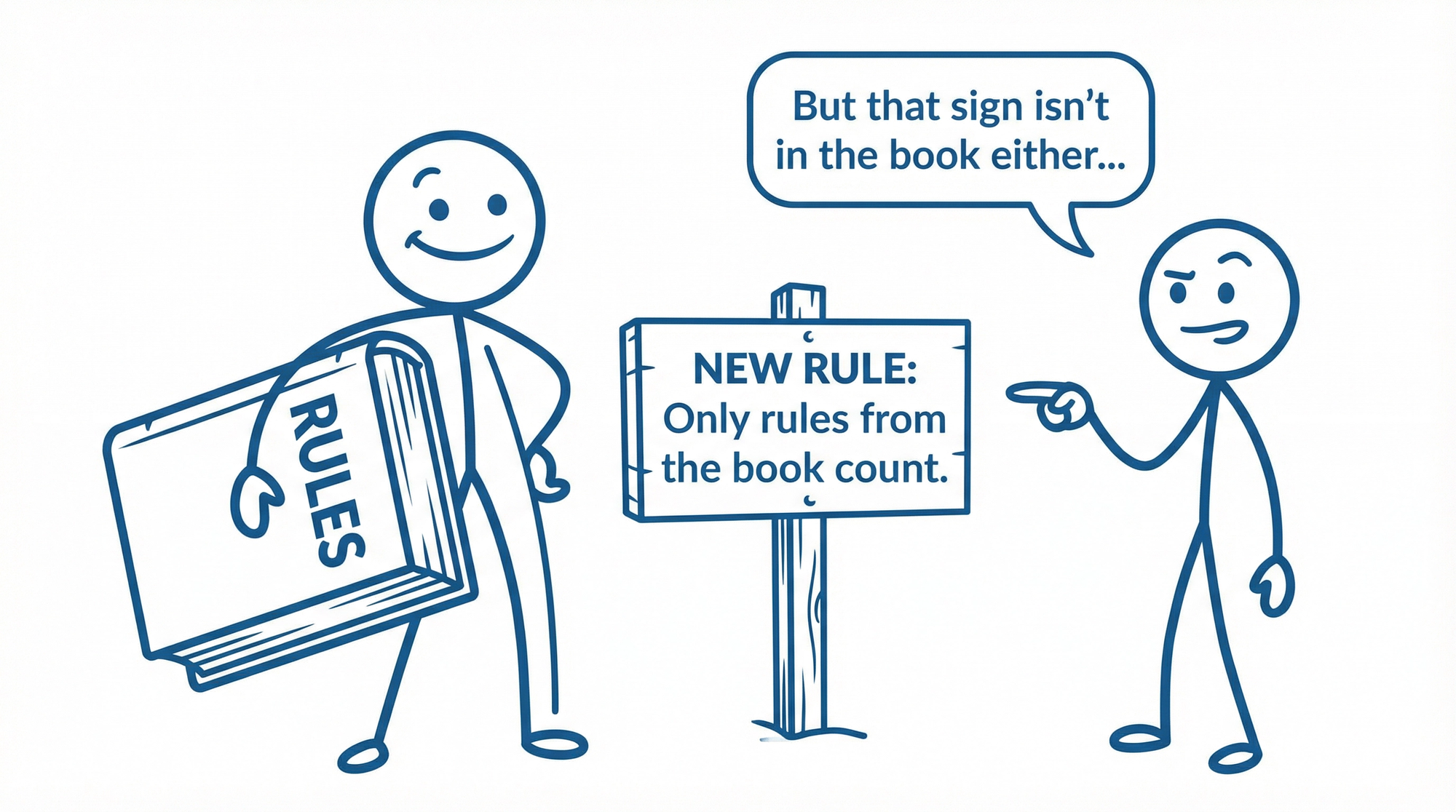
Imagine you have a friend who insists that every rule in his house must be written down in his official Family Rule Book. No unwritten rules allowed. Written rules only. He is serious about this. He has given whole speeches about it.
Then one day you visit, and he tells you to take your shoes off at the door.
You ask: "Where is that in the Family Rule Book?"
He pauses. Flips through the pages. It is not there.
He is enforcing an unwritten rule while insisting all rules must be written. He has violated his own principle in the very act of applying it.
That is what I want to walk through with you today, except the "Family Rule Book" is the Bible, and the "unwritten rule" is the authority to start new churches when you disagree with the old one.
If you are Protestant and reading this, I am not questioning your faith or your love for Jesus.
I am asking a logic question.
If sola scriptura is true, then it should be able to hold up...
Does the Bible Authorize Starting New Churches?
This is where it gets interesting.
If sola scriptura is true, then every essential Christian doctrine and practice must have clear biblical warrant. The Reformers themselves insisted on this. They rejected Catholic traditions precisely because those traditions relied on something other than Scripture alone.
So let's apply their own standard to their own foundational act.
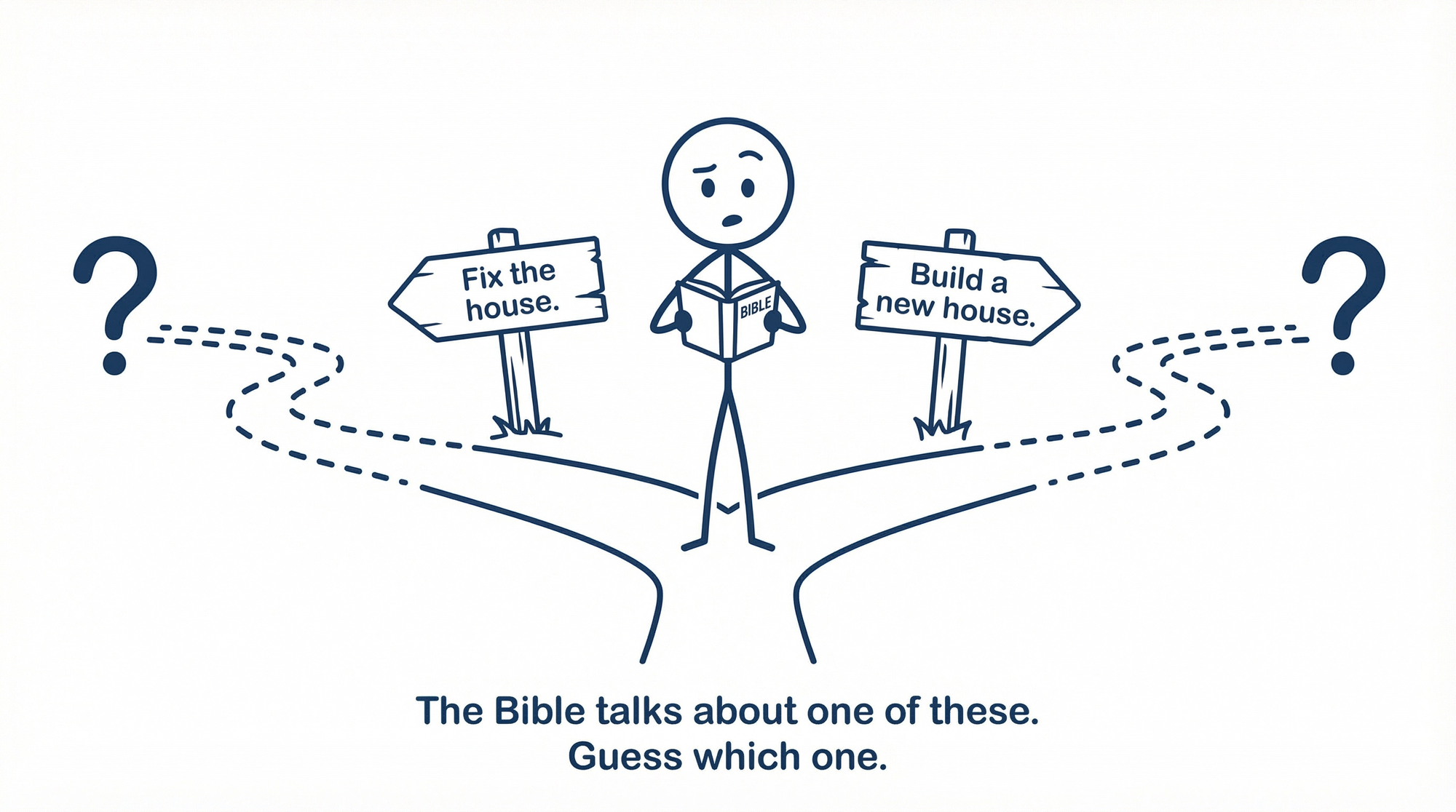
The Bible contains no explicit command, permission, or example of believers starting new churches because they disagree with the existing church's doctrine.
Read that again. Let it sit.
There is no verse that says, "If the church gets it wrong, go start your own." There is no apostolic instruction that reads, "When you disagree with church leadership on doctrine, found a new congregation." There is no precedent in the New Testament for what Luther, Calvin, Zwingli, and the other Reformers did.
Now, does the Bible talk about correcting error? Absolutely. Does it talk about church discipline? Yes. Does it give instructions for dealing with false teachers? Of course.
But dealing with error within a structure and replacing that structure with a new one are two very different things. And that distinction matters enormously.
Why Does This Contradiction Matter?
Let me be direct about why I think this matters, and I want to say it with genuine respect for Protestant believers.
This is not about who loves Jesus more. This is not about whose worship is more authentic or whose people are more sincere. I grew up Protestant. I know the depth of faith in those communities. I have seen the Holy Spirit move in Protestant churches. None of that is in question.
What is in question is a logical claim about authority. And that claim has consequences.
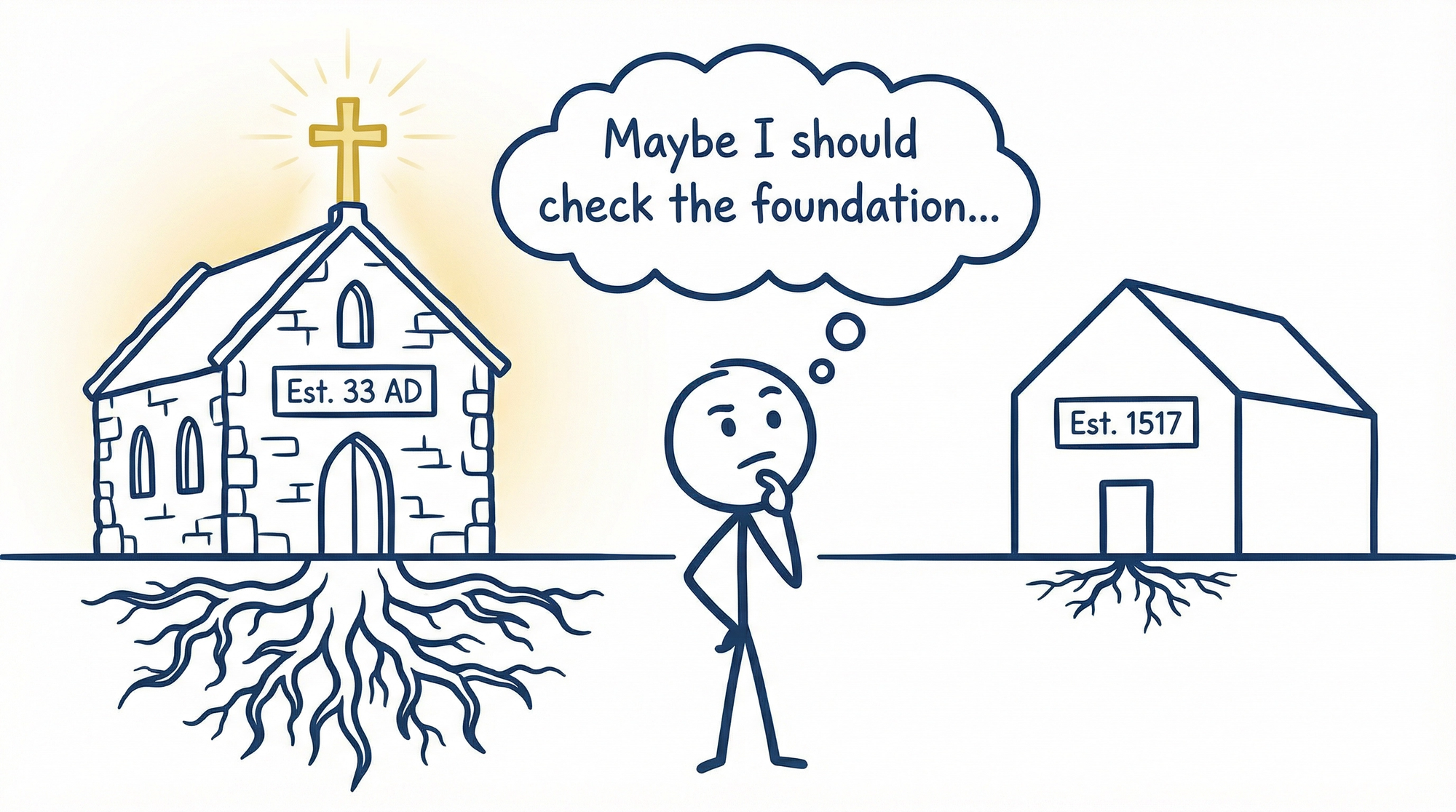
If the foundational act of Protestantism (separating from the established church to form new ones) cannot be justified by the very principle Protestantism claims as its foundation (Scripture alone), then Protestantism has a structural problem at its root. The building might be beautiful, but the foundation has a crack.
And if the foundation has a crack, it is worth asking: is there a church that does not have this problem? Is there a church whose existence does not depend on an unauthorized act of separation?
That question leads you to exactly two places: the Catholic Church and the Orthodox churches. Both claim unbroken apostolic succession going back to the apostles themselves. Neither needed to "start over." Neither required an unauthorized moment of founding.
You do not have to accept every Catholic or Orthodox doctrine right now.
But the logic of the sola scriptura contradiction at least opens the door to the possibility that the older churches deserve a serious second look.
Frequently Asked Questions
Is sola scriptura itself found in the Bible?
This is actually a separate but related problem. The phrase "sola scriptura" is not in the Bible. Protestants typically point to 2 Timothy 3:16-17 ("All Scripture is God-breathed and useful...") as support. But that verse says Scripture is useful and sufficient to equip. It does not say Scripture is the sole authority. Paul wrote that verse while also asking Timothy to bring him his scrolls and to remember the oral teaching Paul had given him. The passage affirms the value of Scripture without making the exclusivity claim Protestants need.
What about the corruption in the medieval Catholic Church? Didn't that justify leaving?
Corruption is a serious charge, and some of the Reformers' complaints about practices like indulgence abuse were legitimate. But corruption in leadership does not invalidate a church's authority any more than a corrupt president invalidates the Constitution. Jesus Himself chose Judas as an apostle. The existence of bad actors does not destroy the structure. And more to the point, the question here is not "Was Rome corrupt?" but "Does the Bible authorize the response of starting new churches?" Those are two separate questions.
Do Catholics believe Protestants are not real Christians?
No. The Catholic Church explicitly teaches that baptized Protestants are true Christians, members of the Body of Christ, and that Protestant communities contain genuine "elements of sanctification and truth" (Vatican II, Unitatis Redintegratio, 3). This article is about a logical problem with a theological system, not about the sincerity or salvation of Protestant believers.
If there are so many denominations, doesn't that prove sola scriptura does not work?
The number itself is debated. Some scholars argue the real number is much lower depending on how you define "denomination." But even the most conservative counts put it in the thousands, and the trend is always toward further fragmentation, not unity. Whether 200 or 40,000, the fragmentation pattern is consistent with the structural problem described in this article: a principle that authorizes individual interpretation without a binding interpretive authority will always produce disagreement.
What about the Orthodox? They split from Rome too.
The Great Schism of 1054 is a complex historical event, and both Catholic and Orthodox Christians understand it differently than the Protestant Reformation. The Orthodox do not hold sola scriptura. They appeal to apostolic tradition and the authority of ecumenical councils, just as Rome does.
Is this argument original?
The core insight has been observed by Catholic apologists for centuries. What makes this formulation useful is its simplicity: it uses the Protestant's own stated principle as the standard of evaluation. You do not need to accept any Catholic premise to see the contradiction. You only need to accept the premise Protestants themselves claim.
Where Do You Go From Here?
If this article raised questions you have not considered before, that is a good thing. Questions are how we find truth.
I would encourage you to do three things:
-
Test the argument yourself. Find the strongest counterargument you can. See if it holds. I welcome the pushback.
-
Read the early Church Fathers. Clement of Rome (writing around 96 AD), Ignatius of Antioch (writing around 110 AD), and Irenaeus of Lyon (writing around 180 AD) all describe a church structure that looks remarkably like what Catholics and Orthodox practice today.
-
Ask the hard question. If sola scriptura really cannot justify its own founding moment, what does that mean for everything built on top of it?
You do not have to have all the answers tonight. But the question deserves an honest look.
For more deep dives into the questions that matter most, explore of our articles and sign up for our newsletter so you never miss a new article.
You might like to read "Was Mary Sinless? What the Original Greek Says."