

Feast Day August 28
Born: November 13, 354ad, in Thagaste, North Africa
Died: August 28, 430, Hippo Regius
Augustine stood in a garden in Milan, tears streaming down his face, unable to move.
Inside the house, a friend was reading.
Outside, the weight of his own failures pressed down like a physical thing. He was brilliant, ambitious, successful. He was also completely lost.
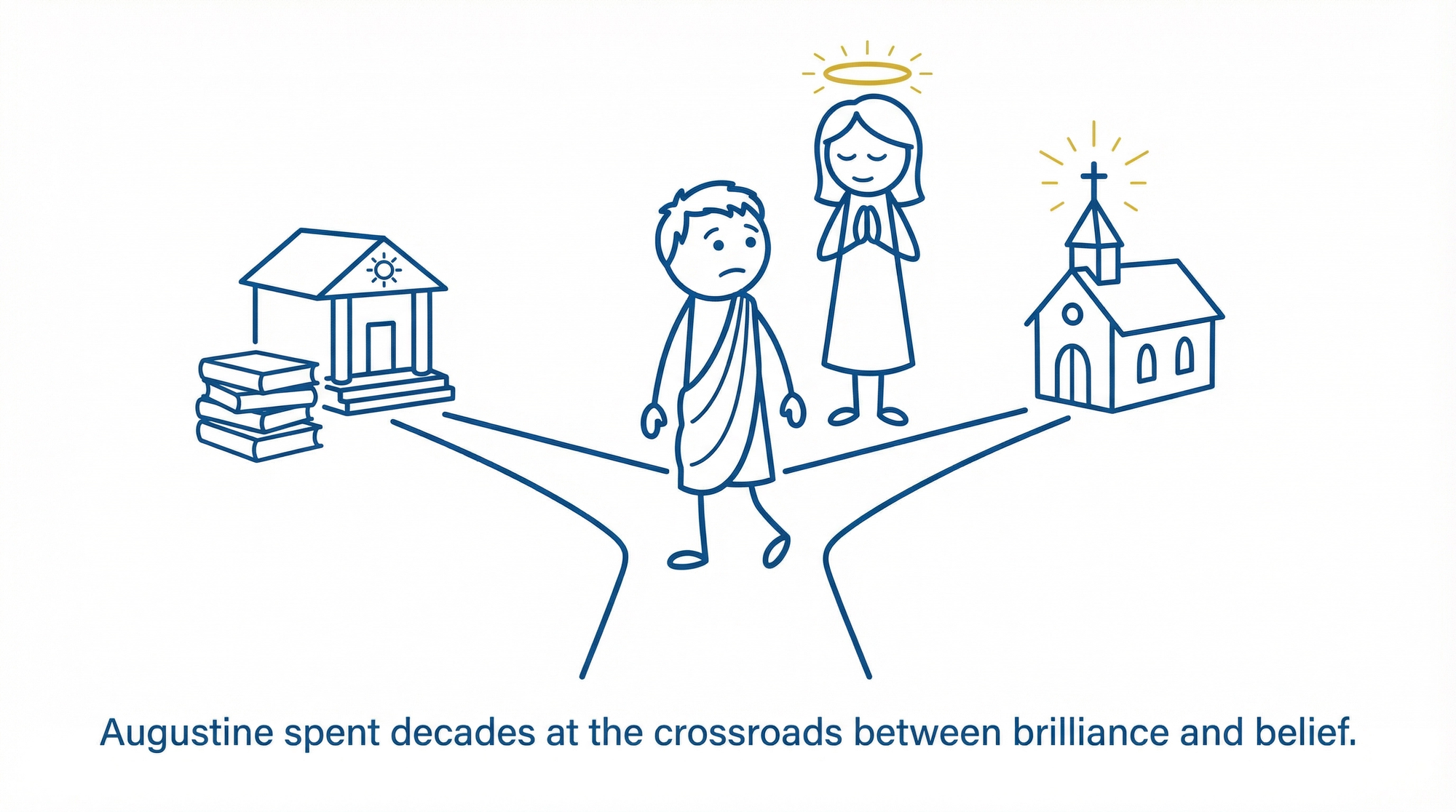
For years Augustine had run from himself.
He'd chased pleasure, power, philosophy, and false religions. His mother Monica had prayed for his conversion for nearly two decades, and he'd spent those years getting further away, not closer. He felt the pull toward something true, something pure, something that demanded everything. But he couldn't bring himself to surrender.
Then, in that garden, something broke.
This is the story of Saint Augustine, the man whose desperate search for truth turned him into one of the greatest minds in the history of Christianity.
A man who left behind over five million words of theology, philosophy, and spiritual insight.
A man whose ideas shaped everyone who came after him, from Thomas Aquinas to Martin Luther to the modern world's ongoing debates about free will, grace, and the meaning of time itself.
The World He Came From
Augustine was born on November 13, 354 in Thagaste, a small town in Roman North Africa (modern-day Souk Ahras, Algeria). The Roman Empire was still powerful but cracking at the edges. Christianity was spreading, but pagan religions and ambitious new philosophies competed fiercely for people's souls.
His household was a battleground in miniature. His father Patricius was a pagan Roman official who wanted his son to succeed in the world's terms. His mother Monica was a devout Christian who wanted his soul. Young Augustine, brilliant and restless, absorbed both impulses. He wanted to conquer the intellectual world. He also sensed, deep in a place he couldn't quite name, that the world wasn't enough.
Monica prayed constantly. Patricius pushed Augustine toward achievement. The tension between those two forces would shape everything Augustine became.
A Brilliant, Restless Mind
Augustine's intellectual gifts showed early. By age eleven he was sent to study at Madaurus, where he devoured Latin literature and fell in love with Virgil and Cicero. He mastered the art of rhetoric, the ancient world's equivalent of law school and marketing combined.
By his twenties, he was teaching rhetoric in Carthage. By his late twenties, he'd moved to Rome. By thirty, he held one of the most prestigious academic positions in the Western Roman Empire: imperial professor of rhetoric at Milan, the de facto capital. He had money, status, and the intellectual respect he craved.
Yet something gnawed at him. There was a restlessness he couldn't quiet, no matter how high he climbed.
Around age seventeen, Augustine had taken a concubine in Carthage. She would remain his companion for fifteen years, and together they had a son, Adeodatus, whose name means "Gift from God." Augustine loved this woman. When his mother later arranged a respectable marriage and forced him to send her away, Augustine grieved deeply. She returned to Africa vowing never to give herself to another man. It was, by all accounts, a genuine love. And losing her tore him apart.
The Years of Searching
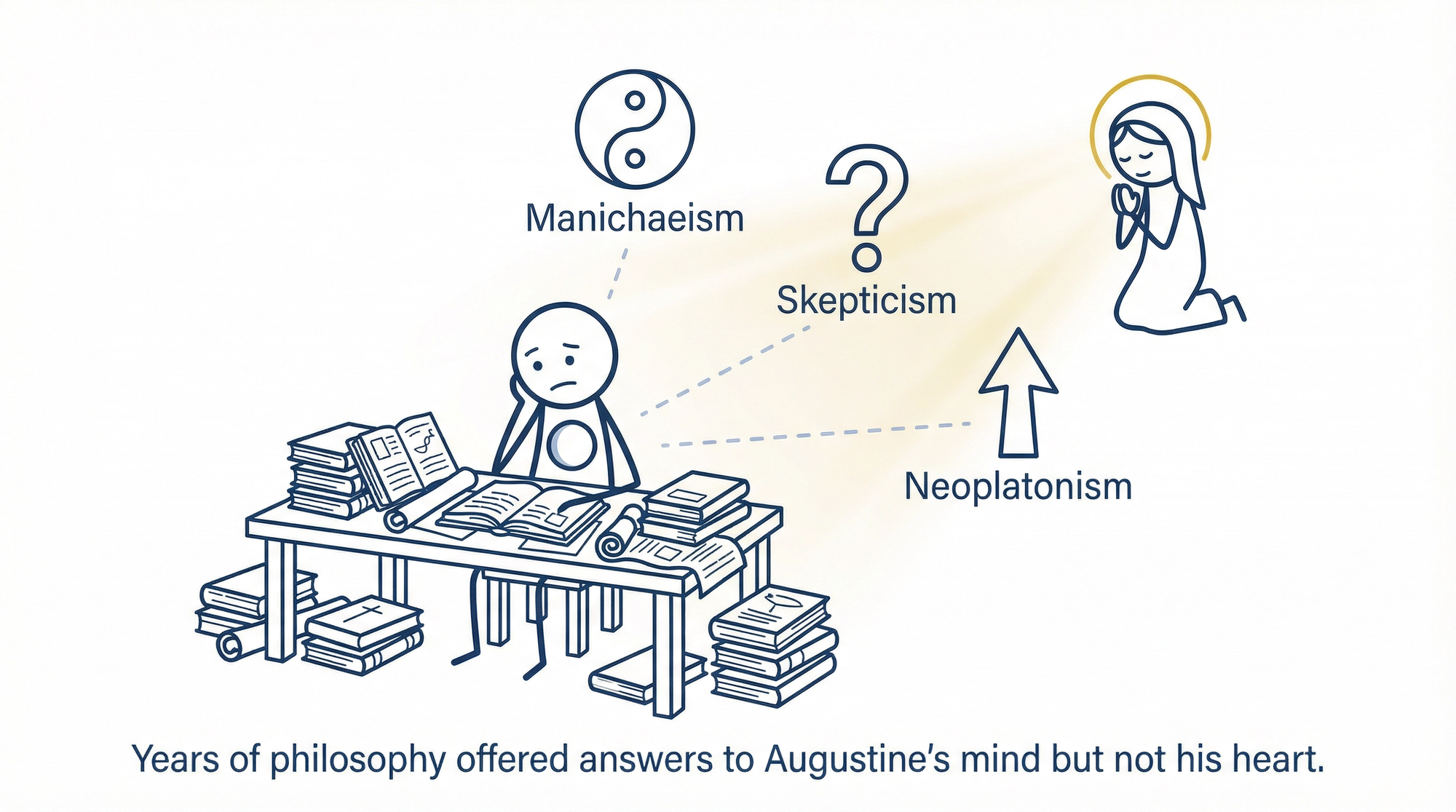
At nineteen, Augustine fell hard for Manichaeism, a popular religious movement that taught the universe was divided between forces of light and darkness in eternal conflict. It promised intellectual sophistication and seemed more advanced than the simple faith of his mother. Augustine spent nine years as a devoted follower.
But Manichaeism couldn't answer his hardest questions. When he finally met Faustus, the movement's most celebrated teacher, Augustine found the man charming but intellectually shallow. The system that had once seemed brilliant now felt hollow.
He drifted into Academic Skepticism, the ancient philosophy that questioned whether truth could be known at all. He explored Neoplatonism, which taught that the material world was an illusion and the spiritual was all that mattered. Each system offered something. None of them offered enough.
Augustine knew what his deeper problem was. He just couldn't bring himself to fix it. He lived in pursuit of pleasure and worldly success. These weren't abstract sins to him. They were his life, and he wasn't ready to give them up. He prayed a famous prayer during these years:
"Give me chastity and continence, O Lord. But not yet."
He was honest about his weakness. That honesty would become one of his greatest gifts to the world.
Ambrose and the Turning Point
In Milan, Augustine met the man who would change everything. Ambrose, the bishop of Milan, was a man of such intellectual depth and spiritual power that Augustine couldn't dismiss him as a simple believer. Ambrose showed Augustine something he'd never encountered: a Christian mind that could match and exceed the pagan philosophers.
More importantly, Ambrose introduced Augustine to allegorical interpretation of Scripture. The literalist objections that had troubled Augustine for years dissolved when Ambrose showed how the Bible's figurative language pointed toward deeper spiritual truths. For the first time, Augustine's intellectual search and spiritual hunger began pointing in the same direction.
The Garden Scene
By the summer of 386, Augustine was breaking. He could feel the chains of his own desires loosening but couldn't make the final surrender. His pride held him back. His old life had its grip.
One day, in a garden, Augustine heard a child's voice singing a strange, repetitive song from over the wall: "Tolle, lege. Tolle, lege." Take up and read. Take up and read.
Augustine took it as divine instruction. He went to where his friend Alypius was sitting and picked up a scroll of Paul's letters. His eyes fell on these words:
"Let us walk honestly as in the day, not in carousing and drunkenness, not in sexual immorality and sensuality, not in quarreling and jealousy. But put on the Lord Jesus Christ, and make no provision for the flesh, to gratify its desires." (Romans 13:13-14)
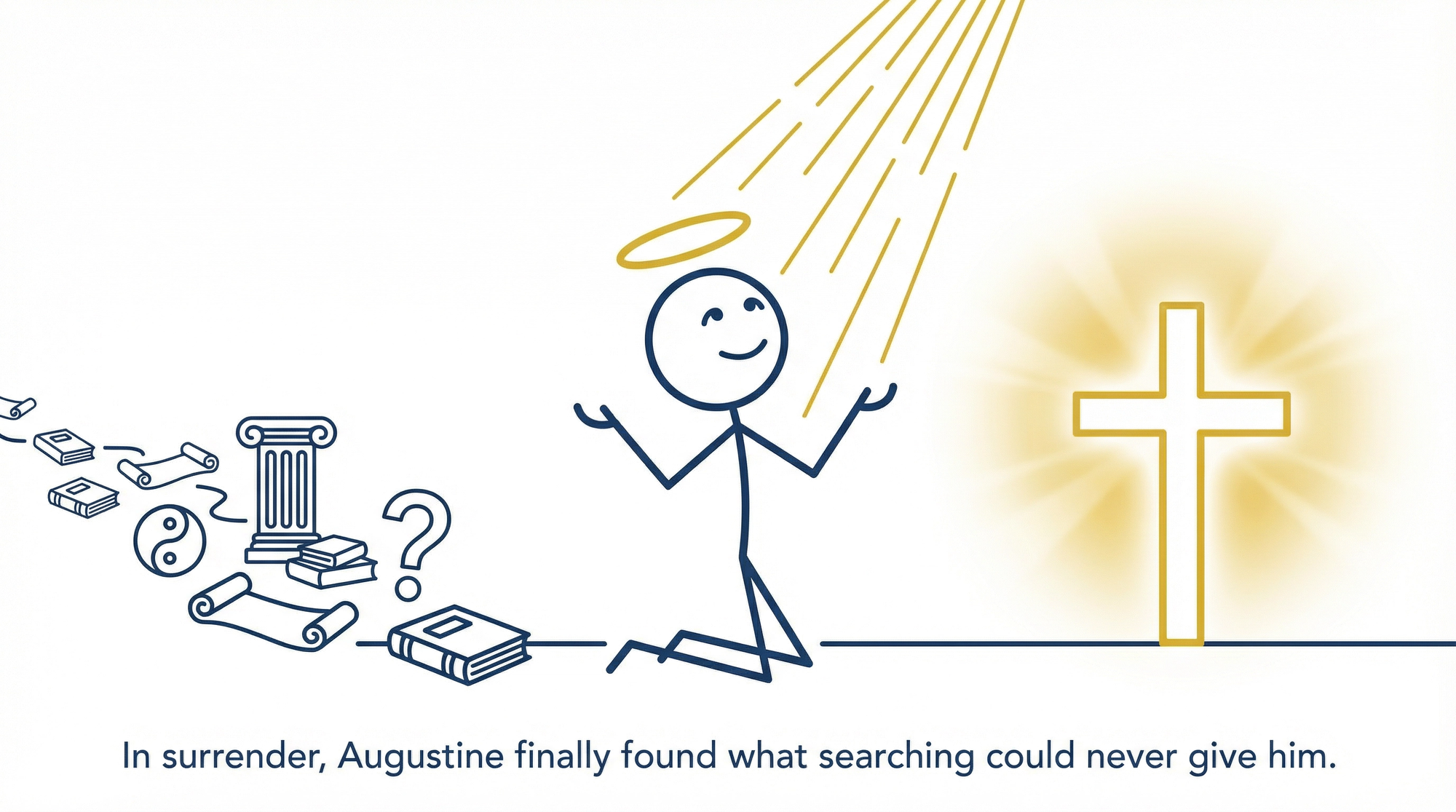
That was it. In those words, Augustine found what philosophy could never give him. Not arguments, but surrender. Not answers, but love. He wept. His friend wept. The conversion was complete.
On Easter Eve of 387, Ambrose baptized Augustine at Milan's cathedral. The preparation had been intense: sixty catechetical sessions across the weeks of Lent, two each day. This was not a casual decision. It was the most serious commitment of Augustine's life.
Shortly after, as the family prepared to sail home to Africa, Monica died at Ostia. She had spent decades praying for her son's conversion. She lived just long enough to see it happen.
From Bishop to Legend
Augustine returned to North Africa. His son Adeodatus, brilliant and beloved, died the following year at just sixteen. Augustine was alone now, stripped of the relationships that had defined him. He turned entirely toward God.
In 391, while visiting Hippo Regius, Augustine was essentially drafted into the priesthood by the local congregation, who recognized his gifts. He wept at his ordination, not from joy but from the weight of what was being asked of him. Within five years, he was bishop of Hippo, a position he would hold for the rest of his life.
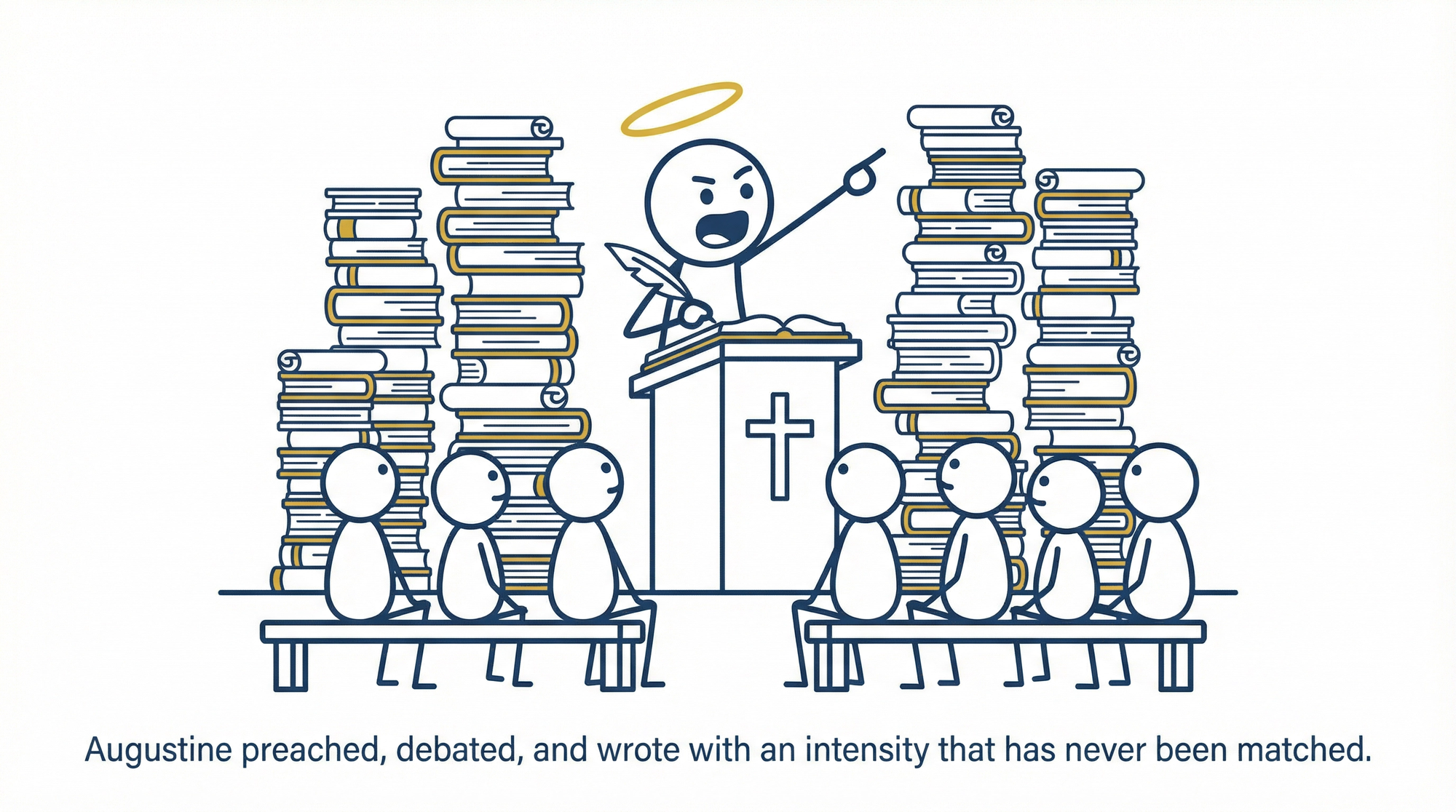
For thirty-four years, Augustine served that small North African community. He preached sermons that routinely exceeded an hour. He debated heretics with ruthless logic and bottomless charity. He answered letters from across the Christian world. And he wrote. Constantly. Furiously. Brilliantly.
The Mind That Shaped Christianity
Augustine didn't just live a dramatic life. He thought more deeply about the Christian faith than almost anyone before or since. His ideas became the foundation that later theologians, philosophers, and even secular thinkers built on. Here are some of his most important contributions.
Grace and Free Will
Augustine's most consequential theological battle was against Pelagius, a British monk who taught that humans could achieve holiness through their own efforts without any special help from God. Augustine, drawing from Paul's Letter to the Romans, argued the opposite: human nature was so deeply wounded by the Fall that we cannot even begin to choose good without God's grace reaching us first.
This wasn't academic hairsplitting. The question of whether we save ourselves or God saves us sits at the heart of Christianity. The Church sided with Augustine, condemning Pelagianism at the Council of Ephesus in 431. Augustine earned the title "Doctor of Grace" for this work, and his teaching on grace became foundational for the entire Church.
Evil as the Absence of Good
Augustine solved a problem that had tormented him since his Manichaean days: if God is good and all-powerful, where does evil come from? His answer was elegant. Evil is not a thing that exists on its own. It is the absence of good, the way darkness is the absence of light, the way cold is the absence of heat. God did not create evil. Evil is what happens when a free creature turns away from God's goodness.
The Nature of Time
In Book XI of the Confessions, Augustine asked a question that still puzzles philosophers today: what is time? His answer was startling. The past no longer exists. The future doesn't exist yet. Only the present is real. But the present is just an infinitely thin edge between what was and what will be. So how do we experience time at all?
Augustine's answer: time exists in the soul. We experience the "present of the past" through memory, the "present of the present" through direct experience, and the "present of the future" through expectation. God, by contrast, exists in an eternal present where all moments are simultaneously real. This insight anticipated modern philosophy by over a thousand years.
The Two Cities
In The City of God, Augustine divided all of human history into two invisible societies:
"Two loves have made the two cities. Love of self, even to the point of contempt for God, made the earthly city. And love of God, even to the point of contempt for self, made the heavenly city."
These two cities are not visible kingdoms. They're woven together throughout history, and only God knows who belongs to which. This framework shaped how the Western world thought about the relationship between church and state, sacred and secular, for over a thousand years.
The Books That Changed the World
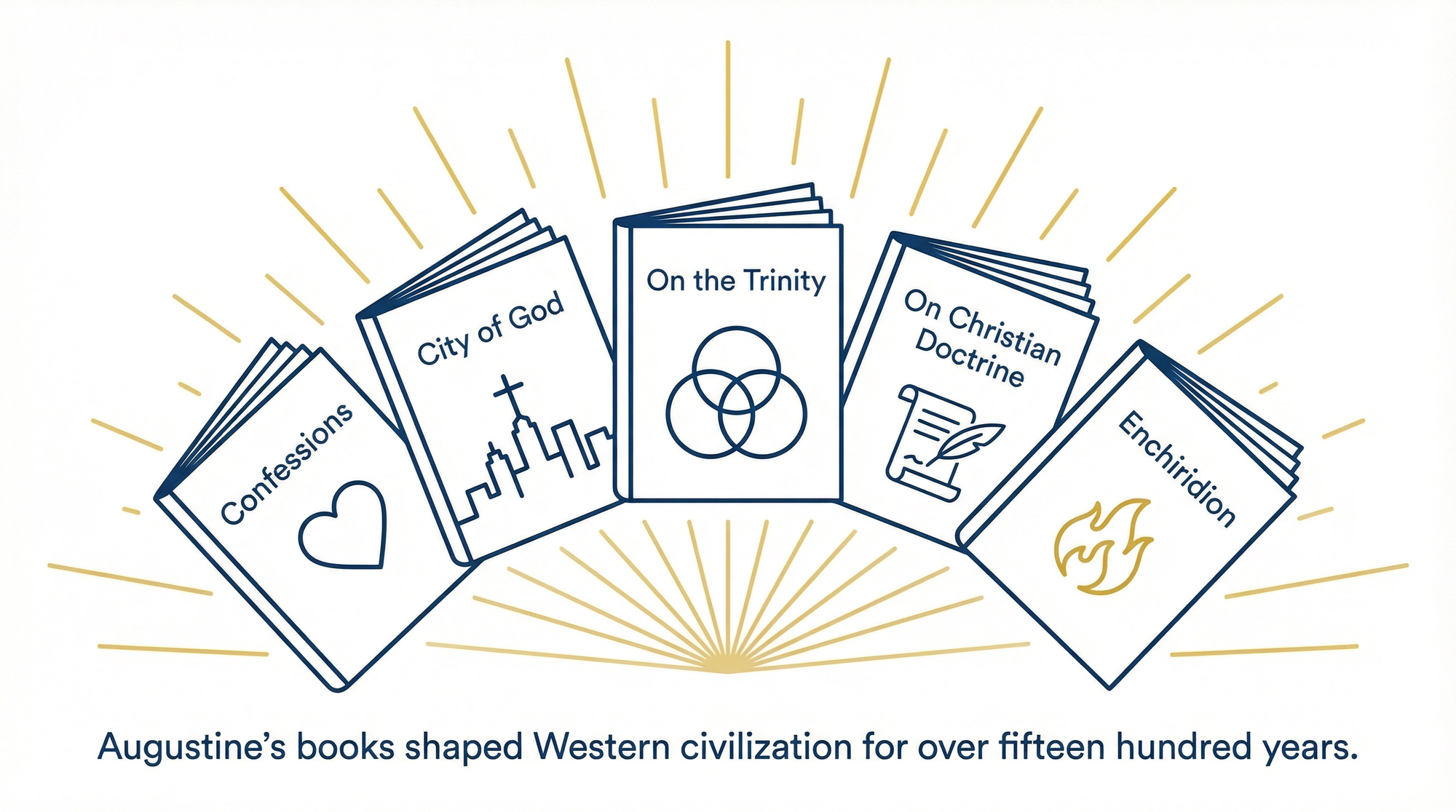
Augustine left behind more than five million words. His writings filled shelves in every monastery in Europe and shaped the intellectual life of the Western world. These are his most important works.
Confessions
Augustine invented Christian autobiography. For the first time, a great thinker was willing to be completely vulnerable about his failures, his lust, his pride, his wandering.
The first nine books (chapters) tell the story of his life from childhood through conversion. The final four books are a meditation on memory, time, and the act of creation itself.
The opening is one of the most quoted lines in all of Christian literature:
"You have made us for yourself, O Lord, and our hearts are restless until they rest in you."
And this passage, written years after his conversion, shows that Augustine never stopped being honest about his struggle:
"Late have I loved you, beauty so old and so new! Late have I loved you! And see, you were within and I was in the external world, and sought you there. You were with me, but I was not with you. You called, you shouted, and you burst open my deafness. You breathed your fragrance on me, and I drew in my breath and now I pant for you. I tasted you, and now I hunger and thirst for you. You touched me, and I burned for your peace."
Thirteen hundred years later, the Confessions still speaks because struggle is universal. We all know what it means to want truth but be bound by our own desires.
City of God
When Rome fell to the Visigoths in 410, pagans blamed Christianity: the old gods were angry because Rome had abandoned them.
Augustine spent thirteen years writing his response. The City of God is a massive, brilliant defense of the Christian vision of history.
It argues that earthly kingdoms rise and fall, but the City of God endures forever. It shaped European political thought for centuries and remains one of the most important works ever written about faith and civilization.
On the Trinity
Over fifteen years, Augustine wrote this dense, careful exploration of how one God can be three Persons.
His innovation was the "psychological analogy," the idea that the human mind, made in God's image, mirrors the Trinity through memory, understanding, and will.
These three are distinct yet inseparable, just as the Father, Son, and Holy Spirit are distinct yet one God. Augustine was careful to say that no analogy is perfect. But he gave the Church a way to think about the mystery without flattening it.
On Christian Doctrine
This is Augustine's guide to interpreting Scripture and preaching it well. He argued that Christians could "spoil the Egyptians," taking the best tools of pagan rhetoric and philosophy and using them to serve truth. His principle that preaching should "instruct, delight, and move" influenced how the faith was taught for the next fifteen hundred years.
Enchiridion on Faith, Hope, and Love
Late in life, Augustine distilled his mature theology into a concise handbook. It covers the essentials: what Christians believe, what they hope for, and how love ties it all together. It's the most accessible entry point into Augustine's thought for modern readers.
A Legacy That Never Ended
Augustine died on August 28, 430, as Vandal armies besieged Hippo. In his final days, too weak to hold the pages of Scripture, his scribes wrote the Psalms in large letters and pasted them to the walls of his room so he could read God's word until his last breath.
His body died. His ideas were just getting started.
Thomas Aquinas, writing eight hundred years later, cited Augustine more than any other Church Father. The Angelic Doctor built his great Summa Theologica on foundations Augustine had laid.
Martin Luther was an Augustinian friar. His theology of grace, the spark that ignited the Protestant Reformation, drew directly from Augustine's writings. John Calvin claimed Augustine as his own, declaring that Augustine's teaching on grace belonged to the Reformed tradition. The Reformation has been called an "acute Augustinianization of Christianity," which is extraordinary when you consider that the man they all claimed died a thousand years before any of them were born.
The Augustinian religious order was founded to preserve his spiritual legacy and continues today across the world.
In philosophy, Augustine's reflections on time anticipated questions that wouldn't be formally taken up again until the modern era. His exploration of memory, consciousness, and the inner life of the soul made him the first Western thinker to write seriously about what we now call subjectivity. Philosophers still argue with Augustine about free will, the nature of evil, and the relationship between time and eternity.
He is one of the four great Fathers of the Western Church and a Doctor of the Church. His titles include Doctor of Grace, and he is the patron saint of theologians, philosophers, printers, brewers, and all those who are searching.
What St. Augustine Means for You
Augustine's life teaches something our culture desperately needs: your restlessness might be a gift.
Augustine spent years running from himself. He was uncomfortable, searching, unable to find peace in pleasure or philosophy or achievement. That discomfort didn't mean he was broken. It meant his soul was too large for the things he was trying to fill it with.
If you're searching, if you're restless, if you feel like something is missing no matter what you accomplish, Augustine says: good. That hunger is real. It's pointing toward something real. That's God calling you home.
Augustine also teaches that no one is beyond conversion. He wasn't secretly good all those years. He was genuinely lost, genuinely choosing pleasure over truth, genuinely running from God. Yet God's patience with him never broke. Monica's prayers were answered. The garden scene came. Change happened.
The barriers you think are permanent might not be. The person you think will never change might surprise you. The person you are right now is not who you have to be forever.
Augustine learned something that took him decades to understand: God's love is not something you earn through achievement or deserve through goodness. It's freely given. It meets you in your restlessness. It answers your deepest questions not through arguments but through transformation.
You don't have to be good enough first. You don't have to have all the answers. You just have to stop running and let yourself be loved.
Connection to Today's Readings
Augustine's feast day celebrates his life of seeking truth and finding it in Christ.
His conversion came through Scripture, through the witness of faithful believers like Ambrose and Monica, and through God's relentless grace. Augustine reminds us that the search for meaning is sacred work, and that God meets us in our honest questions, not our confident certainties.
His story speaks to anyone who has ever felt pulled in two directions: the comfortable life they know and the deeper life they sense God is calling them toward.
Augustine chose the deeper life. And the world has never been the same.
Prayer for Restlessness & Searching
Lord God, I come before you as Augustine once did, restless and searching. I thank you for his life and his witness, and I ask that through the intercession of St. Augustine, you would grant me grace. Give me the honesty to see myself as I truly am. Give me the courage to surrender my plans and my pride to your will. Give me the patience to trust that your love is working even in my confusion and my failures. Help me, like Augustine, to find that you are closer to me than I am to myself, and that no amount of running can take me beyond the reach of your love. Amen.
St. Augustine, pray for us.