

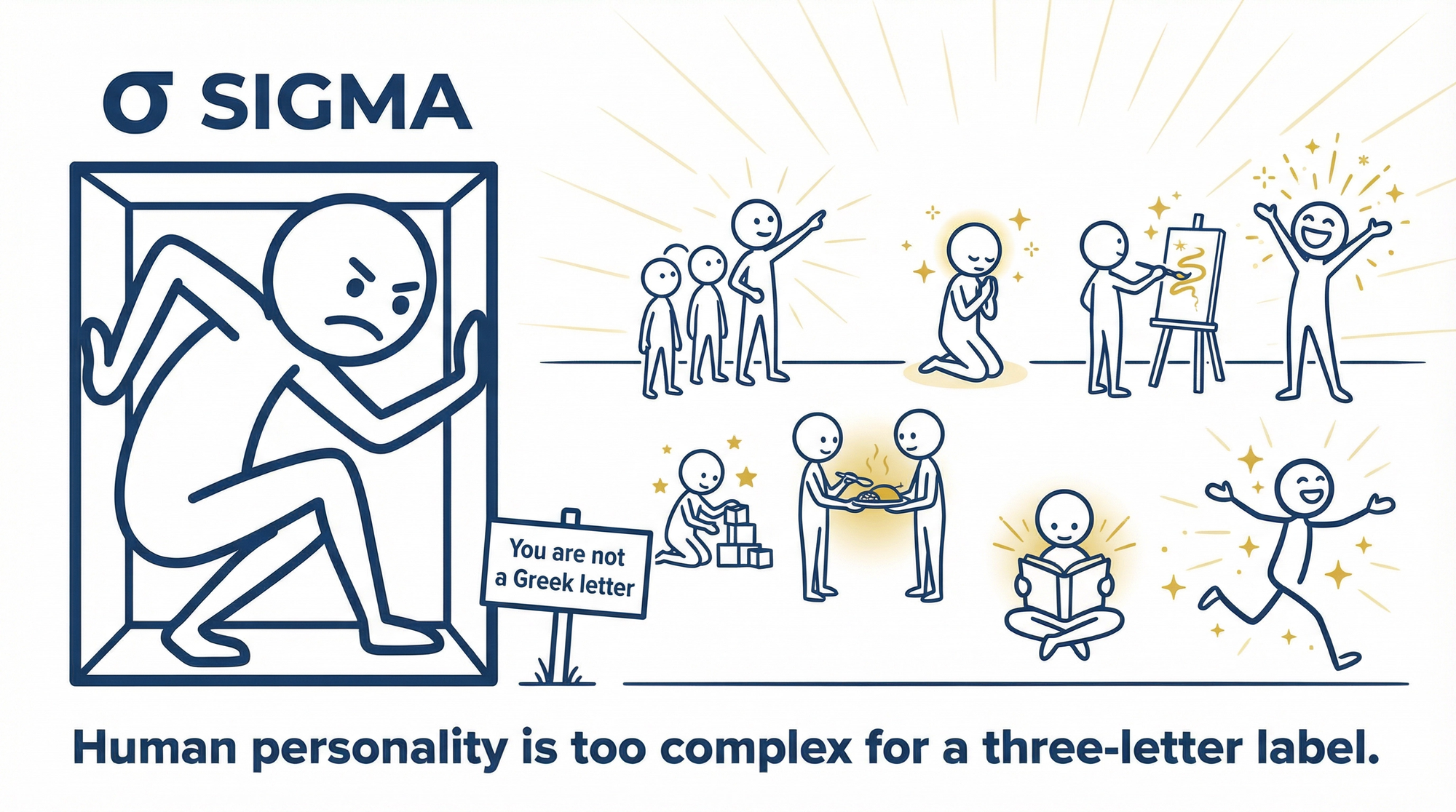
Millions of young men are scrolling through videos right now trying to figure out which Greek letter they are...
Alpha. Beta. or SIGMA!!!
The internet has built an entire personality system around these categories, promising men that if they can just identify their type and optimize for it, they will finally become the man they were meant to be.
There is just one problem. The entire framework is built on debunked science, invented by a blogger with zero credentials, and collapses the moment you hold it up against scripture.
The wolf research it was based on? The scientist who conducted it spent 30 years trying to get his own book pulled from shelves because his conclusions were wrong.
The "sigma male" label? It was coined in 2010 by a far-right internet personality named Theodore Beale, who openly admitted his system was "not science or incontrovertible fact."
And yet this framework has captured the imagination of an entire generation of men, including Christian men, who are searching for an answer to the most fundamental question a man can ask: What kind of man should I be?
As a Catholic man with 20 years of studying both business and theology, I have spent a lot of time wrestling with questions of masculine identity, leadership, and what it means to follow Christ in a world that is constantly selling you a counterfeit version of manhood.
What I have found is that the answer to that question was never a personality type. It was always a Person.
The Science That Started It All (And Why the Scientist Tried to Kill It)
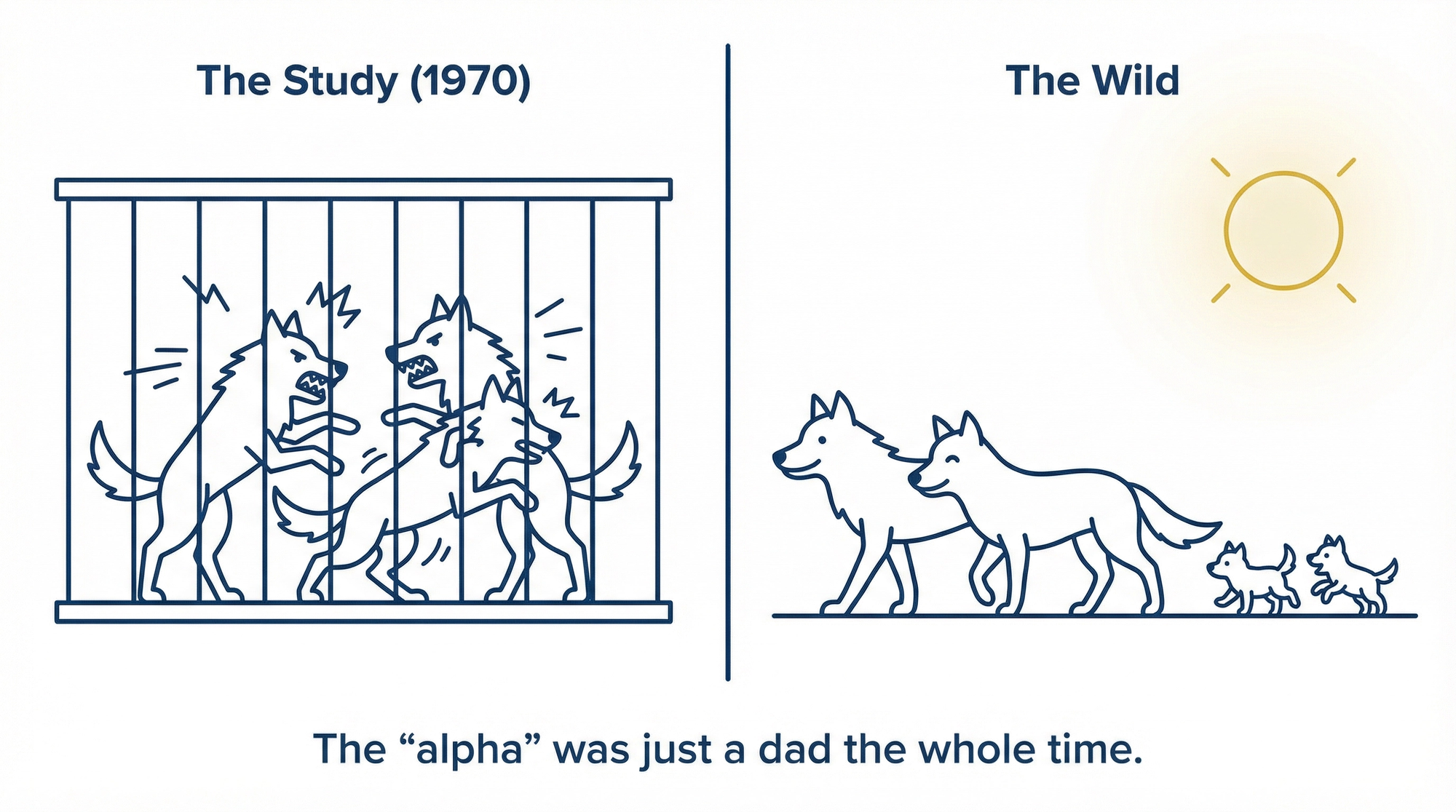
The entire alpha/beta male concept traces back to a single source: wolf behavior research conducted by L. David Mech in 1970. His book The Wolf introduced the idea that wolf packs are organized around a dominant "alpha" male who fights his way to the top and rules through intimidation and strength.
The problem? Mech was studying captive wolves. Unrelated animals thrown together in artificial enclosures. His observations were the equivalent of studying human behavior inside a prison yard and concluding that all human societies work that way.
When Mech later studied wild wolf packs on Ellesmere Island over 13 summers of fieldwork, he discovered something completely different. Wild wolf packs are not dominance hierarchies at all. They are families. The "alpha" is simply a dad. The "beta" is simply a mom. The pack is their children. There is no cage match for dominance. There is no brutal hierarchy of strong over weak. There is a father leading his family.
Mech published his retraction in 1999, writing that calling a wolf an alpha "is usually no more appropriate than referring to a human parent or a doe deer as an alpha." He spent decades trying to get his original book out of print and finally succeeded in 2022. But by then, the damage was done. The "alpha male" concept had escaped the lab and infected popular culture, self-help books, and eventually the church.
The Sigma Male: A Blogger's Invention With 46 Billion Views
If the alpha male concept rests on retracted science, the sigma male concept rests on nothing at all.
The term was invented in 2010 by Theodore Beale (who writes under the pen name Vox Day) as part of what he called a "socio-sexual hierarchy." Beale is not a psychologist. He is not a sociologist. He is not a scientist of any kind. He is a blogger and self-described Christian nationalist who created a taxonomy of male personality types with Greek letter labels: alpha, beta, delta, gamma, omega, sigma, and lambda.
Beale himself acknowledged that his framework is "not science or incontrovertible fact" but "merely the lens through which I tend to view the current sexual-social hierarchy."
That is it. That is the entire intellectual foundation of the sigma male concept. One man's personal opinion, published on a blog, with no research, no peer review, no data, and no scientific methodology of any kind.
And yet by 2023, the hashtag #sigma had accumulated over 46 billion views on TikTok. The "Sigma Grindset" became one of the most viral meme formats on the internet, featuring clips from American Psycho and Fight Club as aspirational models of sigma masculinity.
The critical irony is thick: both Patrick Bateman and Tyler Durden were originally written as critiques of toxic masculinity and consumer culture. David Fincher made Fight Club as a satire. Their adoption as sigma role models represents a spectacular misreading of the source material.
What Actual Psychology Says (It Is Not What You Think)
Academic psychology's verdict on the alpha/beta/sigma framework is clear: these are not recognized psychological constructs. They appear in no peer-reviewed personality taxonomy. Not the Big Five. Not the DSM. Not the HEXACO model. The sigma male has effectively zero presence in scientific literature.
Scott Barry Kaufman, Scientific Director of the Imagination Institute at the University of Pennsylvania, has called the alpha male myth "one really persistent myth that is literally costing human lives." His research, along with work by Joey Cheng, Jessica Tracy, and Joseph Henrich, points to something far more nuanced than a three-letter hierarchy.
The legitimate science in this space is the Dominance-Prestige dual model, which identifies two distinct strategies for gaining social status:
Dominance is status acquired through intimidation and coercion. It is associated with narcissism, aggression, disagreeableness, and what psychologists call "hubristic pride." This is what most people picture when they think of the alpha male.
Prestige is status freely given by others in recognition of skill and expertise. It correlates with authentic pride, genuine self-esteem, conscientiousness, and prosociality. And here is the kicker: research shows that prestige plays a significantly more important role in establishing men's attractiveness than dominance does.
In other words, the actual science says the opposite of what the manosphere teaches. The man who earns respect through competence, generosity, and service is more attractive and more successful than the man who demands it through force and intimidation.
Primatologist Frans de Waal, elected to the National Academy of Sciences, confirmed this through decades of chimpanzee research. The most successful alpha males in primate groups are not bullies. They are generous, empathetic, and serve as peacekeepers.
When de Waal hears someone described as an "alpha male," he pushes back: "People, usually with an alpha male, they mean a bully. Someone who beats you over the head and lets you know every day that he's the boss."
Even Jordan Peterson, who is often cited by the manosphere, does not actually use the alpha/beta/sigma framework. He draws on Jungian archetypes and mythological patterns, not Greek letter categories.
His famous lobster hierarchy argument has drawn pointed scientific criticism from neuroscientists who note that while low serotonin increases aggression in lobsters, the opposite is true in humans, where low serotonin is associated with increased aggression.
The bottom line from psychology: human status is contextually flexible, culturally transmissible, and irreducible to fixed types. You are not a Greek letter.
What the Philosophers Saw (Long Before the Internet)
No philosopher ever theorized about alpha, beta, or sigma males. But the Western philosophical tradition contains strikingly precise analogs to each archetype, and the comparison reveals both the intuitive appeal of the framework and its intellectual poverty.
Aristotle's "great-souled man" (the megalopsychos of Nicomachean Ethics, Book IV) is the closest classical parallel to the alpha. This figure claims much and deserves much. He considers greatness the crown of the virtues. He is wholly unservile. But critically, Aristotle grounded alpha-like traits in actual virtue, not mere dominance. The man who claims greatness without deserving it exhibits a distinct vice: vanity. Aristotle would have looked at most internet alpha male content and classified it as vanity, not virtue.
The Stoics map most naturally onto the sigma archetype. Marcus Aurelius counseled radical inner sovereignty and indifference to external opinion. Epictetus taught freedom through mastering what is within your control and releasing what is not. Yet authentic Stoicism differs from internet sigma culture in one crucial respect: the Stoics emphasized social duty, kindness, and service. Marcus Aurelius was an emperor who took his obligations to others with deadly seriousness. Stoic self-sufficiency was never about withdrawing from the world. It was about serving the world from a position of inner freedom.
Kierkegaard's "knight of faith" from Fear and Trembling may be the most precise philosophical sigma analog ever conceived, and it was written in 1843. This figure maintains a purely individual relationship with the absolute that transcends universal ethical obligations. He looks ordinary on the outside but is internally oriented toward something beyond all social games. He operates in pure isolation and cannot explain himself to others. Kierkegaard explicitly contrasted this with the "tragic hero" who sacrifices himself for the group. The knight of faith stands alone before God.
Nietzsche's Ubermensch transcends both master and slave morality to create entirely new values. But Nietzsche would have found the sigma male grindset of crypto trading and gym selfies profoundly mediocre.
Every philosophical tradition that touches on the sigma archetype arrives at the same conclusion, which is genuine self-mastery is not about opting out of responsibility.
It is about being so internally grounded that you can serve without being enslaved and lead without being corrupted.
What the Bible Actually Shows Us About Masculine Identity
Now we arrive at the heart of it. When you bring the alpha/beta/sigma framework to scripture, something fascinating happens. It does not just fail. It shatters.
The reason is simple: Jesus Christ, Christianity's model of perfect manhood, does not fit any category because He is the source that all the categories are trying to imitate in broken, fragmented ways.
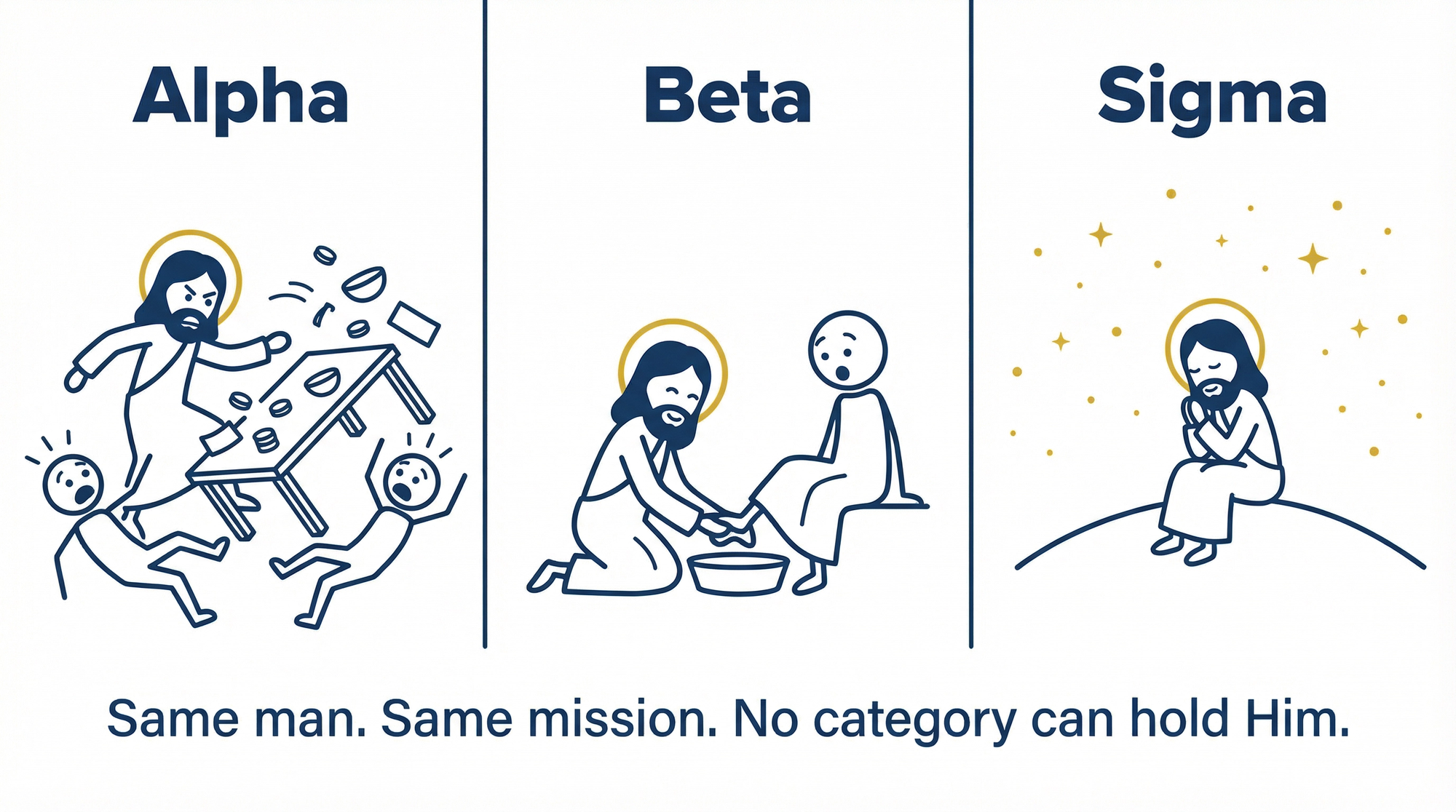
The Alpha Qualities of Christ
By almost any standard, Jesus presents Himself as the most dominant figure in human history. He commanded storms into silence. He raised the dead. He cast out demons with a word. He walked into the temple and physically drove out the money changers with a whip (spoiler, it wasn't a whip, check the Greek) He made with His own hands. He stood before Pilate, the representative of the most powerful empire on earth, and said, "You would have no authority over me at all unless it had been given you from above" (John 19:11).
David Lose, president of United Lutheran Seminary, wrote that Jesus is "by almost any standard the alpha male of all alpha males." He healed the sick, fed thousands, walked on water, and spoke with an authority that made religious leaders tremble.
If you want alpha, look at Christ.
The Beta Qualities of Christ
But Jesus also washed His disciples' feet. He wept at the tomb of His friend Lazarus. He ate with tax collectors and sinners. He allowed a woman of ill repute to anoint His feet with tears and perfume in the middle of a dinner party. He held children on His lap when His disciples tried to shoo them away. He told His followers that the greatest among them must become the servant of all.
He was born in an animal shelter. He grew up in a backwater town. He chose fishermen and tax collectors as His inner circle, not Pharisees and power brokers. He owned nothing. He had no permanent home during His ministry. And He died the death of a criminal, executed on a garbage heap outside Jerusalem.
If you want humble service, look at Christ.
The Sigma Qualities of Christ
And then there is the solitary, self-directed Christ who fits no hierarchy and answers to no earthly authority. He withdrew alone into the wilderness for 40 days before beginning His public ministry. He repeatedly slipped away from crowds to pray in solitude. He operated completely outside the religious establishment of His day, with no official title, no institutional backing, and no political power.
When the crowd tried to make Him king by force after He fed the five thousand, He simply walked away (John 6:15). When the Pharisees tried to trap Him in political debates, He refused to play their game. When His own family came to collect Him because they thought He had lost His mind, He looked at His disciples and said, "Here are my mother and my brothers" (Mark 3:34).
He was not competing for position within the hierarchy. He was not submitting to it either. He was operating on an entirely different plane, answerable only to the Father.
If you want radical autonomy grounded in divine mission, look at Christ.
Why No Category Can Hold Him
Here is the point. The alpha takes Christ's strength and strips away His tenderness. The beta takes Christ's service and strips away His authority. The sigma takes Christ's independence and strips away His mission and His community.
Each archetype is a fragment of the whole. A shard of a mirror that reflects one angle of the face of God while distorting everything else. That is why men are drawn to these categories: they sense something true in each one. But they are worshiping the piece instead of the Person.
This is idolatry in its most subtle and seductive form.
It takes one attribute of God, inflates it, and worships it in isolation. Power without love becomes tyranny. Service without backbone becomes cowardice. Independence without purpose becomes isolation.
Christ is the only model who holds all of these together without contradiction. He is the King who kneels to wash feet. The Lion of Judah who is also the Lamb who was slain. The Alpha and the Omega. Not the alpha male. The Alpha and the Omega. The beginning and the end. The entirety of the alphabet, not one letter from it.
Virtue Over Archetype
Thomas Aquinas, building on Aristotle, treated both aggressive domination and passive weakness as vices.
They are opposite extremes flanking the virtue of fortitude (which includes perseverance, patience, and magnanimity).
The virtuous man is not the alpha who dominates or the beta who submits or the sigma who withdraws. He is the man who, through grace and disciplined habit, develops the strength to do the right thing in the right way at the right time.
The Catholic Gentleman blog captured this tension well: "In trying to rediscover a robust, Catholic understanding of manliness, we might oversimplify it or flatten it out."
Their recommended model of Christian manhood was not Achilles or John Wick. It was Samwise Gamgee from The Lord of the Rings.
The most emotionally tender character in the entire story. The one who weeps, who serves, who carries his friend up a mountain when his friend cannot walk. And also the one who fights a giant spider, charges into battle, and never once quits.
Sam is not an alpha. He is not a beta. He is not a sigma. He is a saint. And that is the only category that matters.
The Real Crisis Behind the Greek Letters
Daniel Darling, director of the Land Center for Cultural Engagement at the Southern Baptist Convention, addressed the sigma male trend directly in a 2024 column for WORLD Magazine titled "The False Promise of the Sigma Male."
He warned that "some Christian young men are retreating to these perpetually online embattlements, where they are imbibing a syncretistic mixture of Christianity and barbarism."
That word syncretistic is important. It means the blending of contradictory belief systems into one. And that is exactly what happens when Christian men try to bolt the alpha/sigma framework onto their faith.
You end up with a Jesus who is only strong, only dominant, only independent. You lose the foot-washing. You lose the weeping. You lose the cross.
Darling offered this alternative: "The paradox of Biblical manhood is that it is at the same time both tough and tender, resilient and relational, ambitious and yet servant-hearted."
That paradox is not a weakness of the Christian model. It is its greatest strength. It is what makes it irreducible to a simple category. And it is why the alpha/beta/sigma system can never contain it.
Mark Driscoll, former pastor of Mars Hill Church in Seattle, was perhaps the most prominent figure to explicitly promote alpha-male Christianity, describing mainstream Christianity as producing a "neutered and limp-wristed" Christ.
And then what happened...
His ministry collapsed in 2014 amid scandals over domineering leadership. As David French observed, Driscoll's theology "conformed Christianity to traditional masculinity rather than conformed masculinity to Christianity."
That distinction matters more than anything else in this conversation. Are you conforming Christ to your preferred masculine archetype? Or are you conforming your masculinity to Christ?
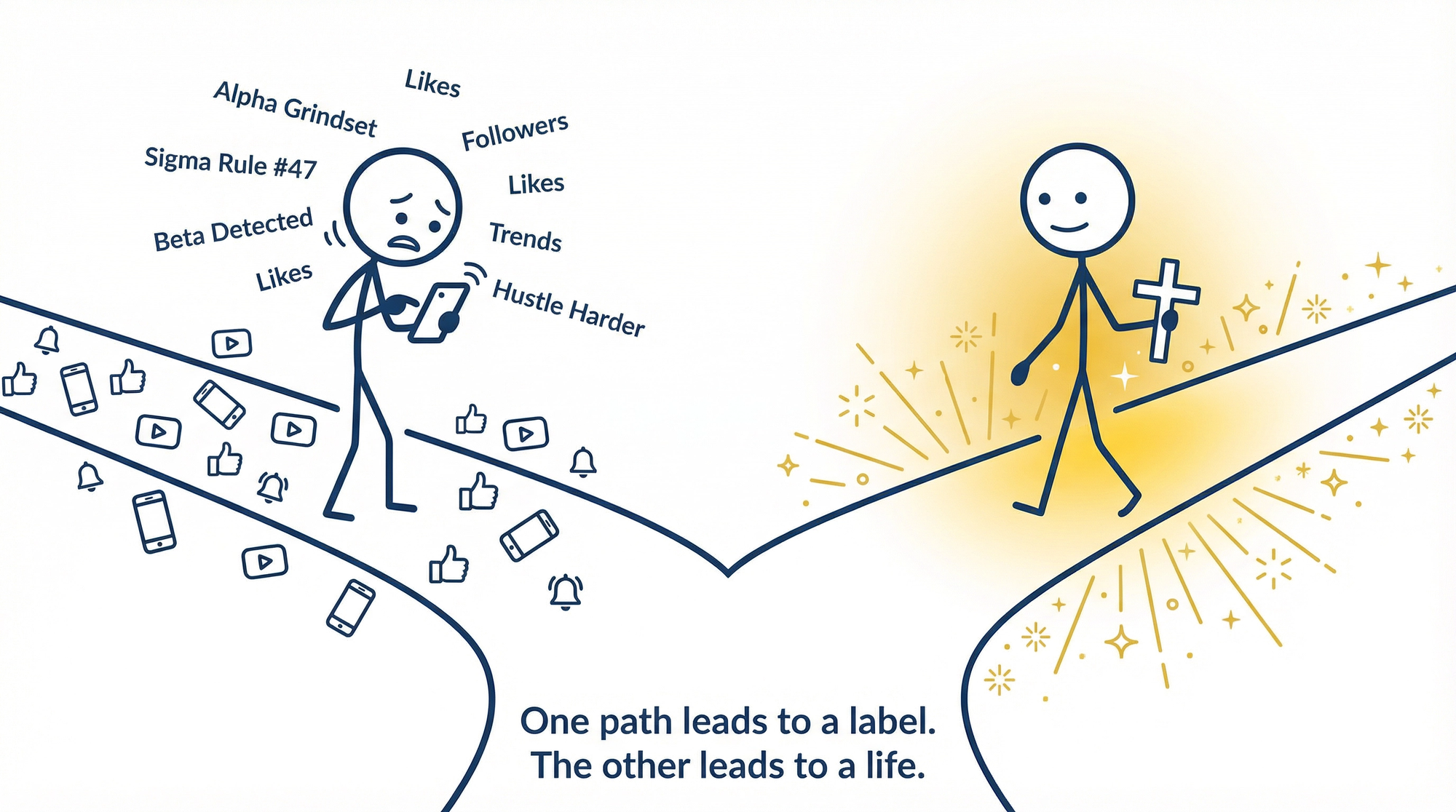
Imitatio Christi: The Only Framework That Matters
Thomas a Kempis wrote The Imitation of Christ around 1418. It has been in continuous print for over 600 years and is the most widely read Christian devotional work after the Bible itself. Its thesis is deceptively simple: stop trying to become something and start imitating Someone.
The first line of the book sets the agenda: "He who follows Me, walks not in darkness," says the Lord. These are the words of Christ, by which we are taught to imitate His life and manners.
Not His personality type. His life and manners.
A Kempis was not interested in categorizing men. He was interested in transforming them. And the method of transformation was not self-optimization or identity selection. It was imitation. Looking at Christ. Studying how He lived. And then doing what He did.
This is radically different from the alpha/beta/sigma approach, which starts with the question "What am I?" and tries to optimize from there. The Christian approach starts with the question "Who is He?" and allows the answer to reshape everything.
You do not need to figure out whether you are an alpha, a beta, or a sigma. You need to figure out whether you look like Christ.
And if you do not, the answer is not a new personality label. The answer is repentance, prayer, and the slow, daily work of becoming more like the One you follow.
When you face a moment that requires strength and command, you imitate the Christ who drove out the money changers.
When you face a moment that requires tenderness and humility, you imitate the Christ who washed feet.
When you face a moment that requires solitary courage, you imitate the Christ who went alone into the garden of Gethsemane.
You do not pick a type. You respond to the moment with the fullness of Christ in you. That is what Paul meant when he wrote, "I have been crucified with Christ and I no longer live, but Christ lives in me" (Galatians 2:20).
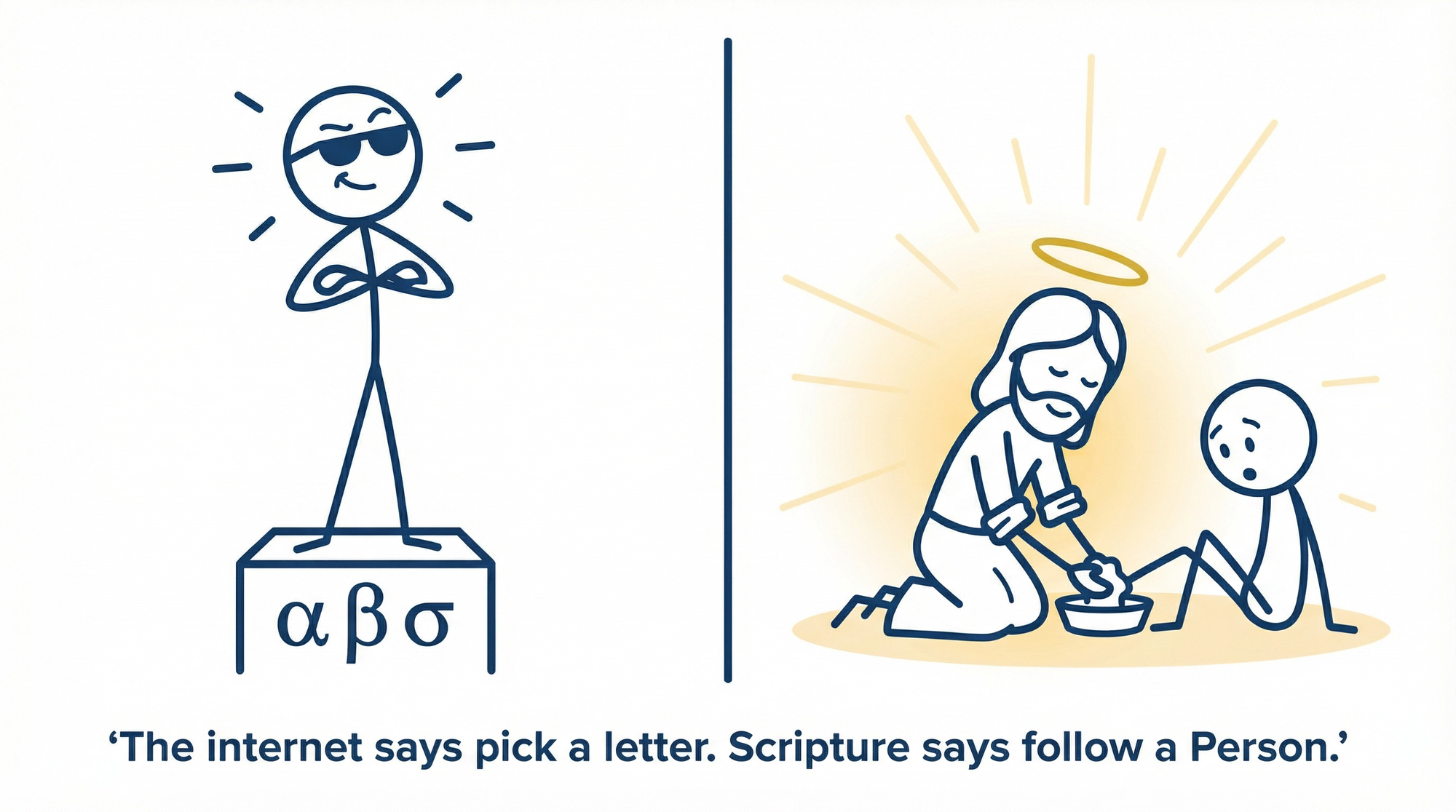
The internet is asking: What Greek letter are you?
Scripture is asking: Do you look like Jesus?
Only one of those questions matters. And only one of those questions, honestly answered, can actually make you the man you were created to be.
Where to Go From Here
If this resonated with you, start here:
Pick up The Imitation of Christ by Thomas a Kempis. Read Book One, Chapter One. It is short. It will reorient everything.
Then read Philippians 2:5-11, where Paul lays out the pattern of Christ's self-emptying love. He had equality with God but did not grasp at it. He emptied Himself. He took the form of a servant. He was obedient even to death. He told us to love our enemies, to turn our swords to plowshares, to turn the other cheek.
That is not alpha. That is not beta. That is not sigma. That is something the internet does not have a Greek letter for. It is the pattern of the God who became man so that men could become like God.
Stop scrolling for a personality type.
Start imitating the Person who transcends them all.