

As a former Protestant myself, this question weighed on me the biggest.
If it's true it changes a lot.
If it's not true, it changes a lot.
Protestants say she was just a normal girl who God used. They even make the case that it has to be this way or else, how can God use us common folk.
Catholics say she was sinless from birth and remained perpetually a virgin.
So who is right? Is there a way to get past the theological tug-of-war and look at what the text itself actually says?
There is. But you have to go back to the original language.
The New Testament was written in Greek. And the Greek of Luke's Gospel contains something that almost never survives the trip into English.
It is not a hidden verse or a secret manuscript.
It is sitting right there in Luke 1:28, in the word the angel Gabriel used to greet Mary. A word that carries grammatical information English simply does not have a way to express.
When you understand what that word actually says, and what it meant to the people who first heard it, the question of Mary's sinlessness stops feeling like a denominational debate. It starts feeling like something the text has been quietly telling us all along.
This is not about picking a side.
This is about reading the original language carefully and honestly, and following where the grammar leads.
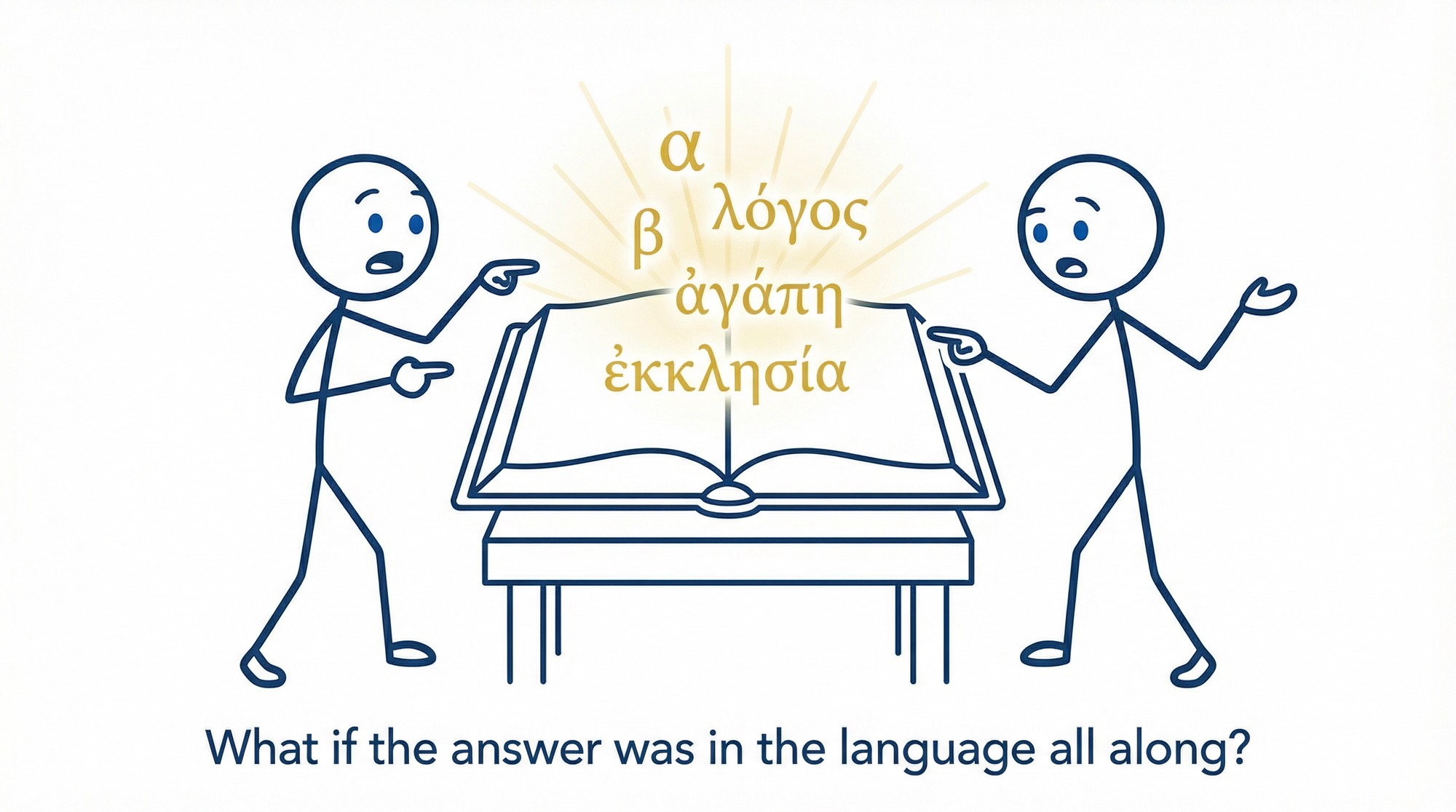
The Translation Problem
English is a wonderful language. But English is not Greek, and some things get lost on the way across.
When Gabriel greets Mary in Luke 1:28, the Greek word at the heart of his greeting is kecharitomene. Your English Bible does its best with this word. The King James Version says "highly favoured." The Douay-Rheims says "full of grace." The NIV says "you who are highly favored." Each of these is a translator making a judgment call, trying to carry a word into English that does far more than any of these renderings suggest.
Here is the problem. None of these translations tells you what the grammar is doing. And the grammar is doing something remarkable.
The New Testament was written in Koine Greek, the everyday Greek of the first-century Mediterranean world. When you read the original text, you are not reading someone's translation of a thought. You are reading the actual words, in the actual language, with the grammatical structure the author chose on purpose. And Greek grammar communicates things that English grammar simply cannot.
This matters more than most people realize. Because the grammatical form Gabriel uses to address Mary is not just a compliment. It is a title. And it is packed with theological meaning that disappears the moment you translate it.

Gabriel's Greeting: The Perfect Tense That Changes Everything
Here is the verse in full:
"And the angel came in unto her, and said, Hail, thou that art highly favoured, the Lord is with thee: blessed art thou among women." (Luke 1:28)
That English rendering is the King James Version. But the original Greek says something the English cannot fully carry. Let us look at the actual Greek text.
The word is kecharitomene. It is not just a random collection of letters. It is a Greek participle, functioning as a title. Gabriel is not describing something Mary has. He is identifying what she is. And the grammar of that participle is the perfect passive form.
Do you know what the perfect tense means in Greek? This is the key.
In English, we have basically three verb tenses: past, present, future. Greek has more options, and each option conveys a different kind of meaning. The perfect tense in Greek means something was completed in the past, but the effects of that completion continue into the present. It is a completed action with enduring present results.
For example. If I say "I have written a book," the writing happened in the past, but the book exists now. The completed action produces ongoing effects. That is the perfect tense.
Now listen to what Gabriel is saying. He uses the perfect tense. He is telling Mary that she has been graced, fully and completely, and the effects of that grace are present and enduring. This did not just happen. This completed action with lasting effects already exists in her.
But there is more. It is also passive voice. In Greek, passive voice means the action is done to you, not by you. Someone else is the agent. Someone else caused this. Mary did not grace herself. This grace was done to her by God.
And it gets even more profound. This participle is functioning as a title. Gabriel does not say, "Hello, you are favored." He says, in effect, "Hail, the Kecharitomene," almost like her name. He is saying, "You, whose defining identity is that you have been completely graced by God, in a way that is ongoing and permanent, and that was done to you rather than achieved by you."
The only other place in the New Testament where the verb form of this word appears is Ephesians 1:6. Paul is talking about how God "has freely bestowed his favor" on believers in Christ, using the aorist tense, a different tense entirely. The aorist means a single, completed action. Paul uses it for believers generally. But Luke uses the perfect for Mary alone. The tenses carry different weight.
Think about what the grammar is saying. At the moment Gabriel walks into the room, he encounters a woman who has already been completely and permanently transformed by grace. That grace is not new. That grace is not beginning at the Annunciation. It is already the defining reality of who she is.

Elizabeth's Confirmation: The Same Grammar, Different Word
Mary goes to visit her cousin Elizabeth, and something extraordinary happens. Elizabeth becomes filled with the Holy Spirit and cries out. This is not casual conversation. This is prophecy.
And here is something remarkable. Luke tells us exactly what verb Elizabeth uses when she prophesies about Mary. He uses the word anaphōneō. In the Septuagint, the Greek translation of the Hebrew Bible used in the early Church, this verb appears when people make liturgical shouts before the Ark of the Covenant, the holiest object in Judaism. The Ark contained the tablets of the law and was believed to be the place where God Himself dwelt.
Let that sink in. Luke uses the verb that describes liturgical shouts before God's presence.
Elizabeth's words are these:
"Blessed are you among women, and blessed is the fruit of your womb! And why is this granted to me that the mother of my Lord should come to me?" (Luke 1:42-43)
But notice the word she uses for blessed. It is eulogēmenē. Different word from Gabriel's kecharitomene. Same grammatical structure. Perfect passive participle. Again, a completed action, already accomplished, done to her by God, with enduring effects.
Two different Greek words, both in the perfect passive, both describing Mary's state. They are pointing to the same reality from different angles.
But there is more. Elizabeth says Mary is blessed "among women." In Hebrew rhetoric, this is called a superlative. It does not mean "one of many blessed women." It means "the most blessed of all women." Every major biblical commentary agrees on this translation. When the Psalmist says someone is "highest among the nations," he does not mean one nation among many. He means the highest.
Then Elizabeth does something even more striking. She calls Mary "the mother of my Lord." The Greek is hē mētēr tou kyriou mou. "Kyrios," Lord, is not just a title of respect. In the Septuagint, this is the divine title. This is how Jesus is called Lord in the New Testament. Elizabeth is not calling Mary the mother of a nice man. She is calling her the mother of the Lord, using the divine title.
And Elizabeth places Mary's blessedness in direct grammatical parallel with the blessedness of Christ. Both are perfect passive participles. Both point to a grace that was already accomplished, already present, that God did to them rather than something they achieved.
The cumulative weight is remarkable. An angel and a Spirit-filled prophet, using two different Greek words, both in the perfect passive, both confirming that something has already been completed in Mary, a gracing that was accomplished in her past and continues to define her present.

The Theological Question the Grammar Forces
If Mary was already fully and permanently graced before the Annunciation, when did that gracing happen?
If the passive voice means God did it, and the perfect tense means it was completed with enduring effect, what moment in Mary's existence does this point to?
The Church's answer is not an invention layered on top of Scripture. It is the theological conclusion that the grammar itself leads you to when you follow it honestly.
The answer is this: The Immaculate Conception. And let me tell you what this actually means, because the modern misunderstanding is profound.
The Immaculate Conception does not mean Mary did not need a Savior.
It does not mean she was born without a human mother and father. It does not mean what the doctrine of the Virgin Birth means, which is about how Jesus was conceived.
The Immaculate Conception means this. God's grace preserved Mary from original sin from the first moment of her existence, in anticipation of the merits of Christ. Original sin is the wound that every human being inherits, the state of separation from God that comes to us through Adam. It is not a personal sin. It is a wound. The Immaculate Conception says that God, knowing what Christ would accomplish, extended the benefits of Christ's redemption backwards through time to the moment of Mary's conception and preserved her from that wound.
Is that in Scripture? Not explicitly. But it is not contrary to Scripture either. It is what the grammar of Scripture, followed rigorously, requires.
Look at the Catechism. Paragraph 490 says the Immaculate Conception is "the unique privilege by which the Almighty preserved [Mary] from the stain of original sin from the moment of her conception." And paragraph 491 says the Fathers of the Church teach that Mary was "kept free of all stain of sin."
This is grace first, consistent with the passive voice. God acts. Mary receives. She is not achieving her own holiness. She is the object of God's action. And that action happened at her conception, because that is the only moment in her life that the perfect tense grammar would logically point to.
The grammar is leading you somewhere. The Church simply follows where it leads.
Joachim and Anna: What the Earliest Christians Remembered
But the story does not begin with Luke's Gospel. It begins earlier.
The Protoevangelium of James is a document written around 145 AD, about forty to fifty years after the last New Testament book was written. It is not Scripture. It is not part of the canon. But it is the earliest surviving document that names Mary's parents, a man and woman named Joachim and Anna.
What is the authority of this document? This is important to clarify. It does not carry the weight of Scripture. But it carries the weight of what the earliest generation of Christians, the ones closest to the original events, chose to remember and record about Mary.
Think about that. The first Christians did not emerge from nowhere with beliefs about Mary. They inherited traditions. They preserved memories. They recorded stories. The Protoevangelium gives us a window into what those earliest Christians believed about Mary's origins.
The narrative is striking. Joachim and Anna are barren, unable to have children. An angel comes to each of them separately and announces that they will conceive a child. Anna conceives Mary. The couple dedicates her to the Temple when she is three years old. She grows up in the Temple, surrounded by holiness, protected by priestly figures, living a life set apart from the beginning.
Do you see the pattern? Barrenness overcome by divine intervention. A miraculous conception announced by an angel. A child set apart from the very beginning of life.
This is not unique to Mary. Look at the Old Testament. Sarah, barren, conceives Isaac, and God tells Abraham the child will be special. Hannah, barren, conceives Samuel, and she dedicates him to the Temple. Elizabeth, barren, conceives John the Baptist, who will be the forerunner of Christ.
Every time the Bible records a miraculous conception through a barren woman, it is signaling that the child is set apart. God is doing something unusual. God is intervening directly. The pattern in the Protoevangelium follows the same rhythm. From the very beginning of her existence, Mary is marked out.
The liturgical tradition of the Church has honored these names for centuries. Joachim and Anna are not obscure figures. They have a feast day, July 26, on the universal liturgical calendar. The Church does not honor people from obscure private devotion on the universal calendar. The Church honors them because there was a continuity of belief about Mary's origins that stretched back to the earliest Christian communities.
Additional early witnesses confirm this tradition. The Gospel of the Nativity of Mary, another early apocryphal work, recounts similar themes. The Church Fathers quoted and commented on these traditions, passing them forward. The line is not broken. It is continuous.
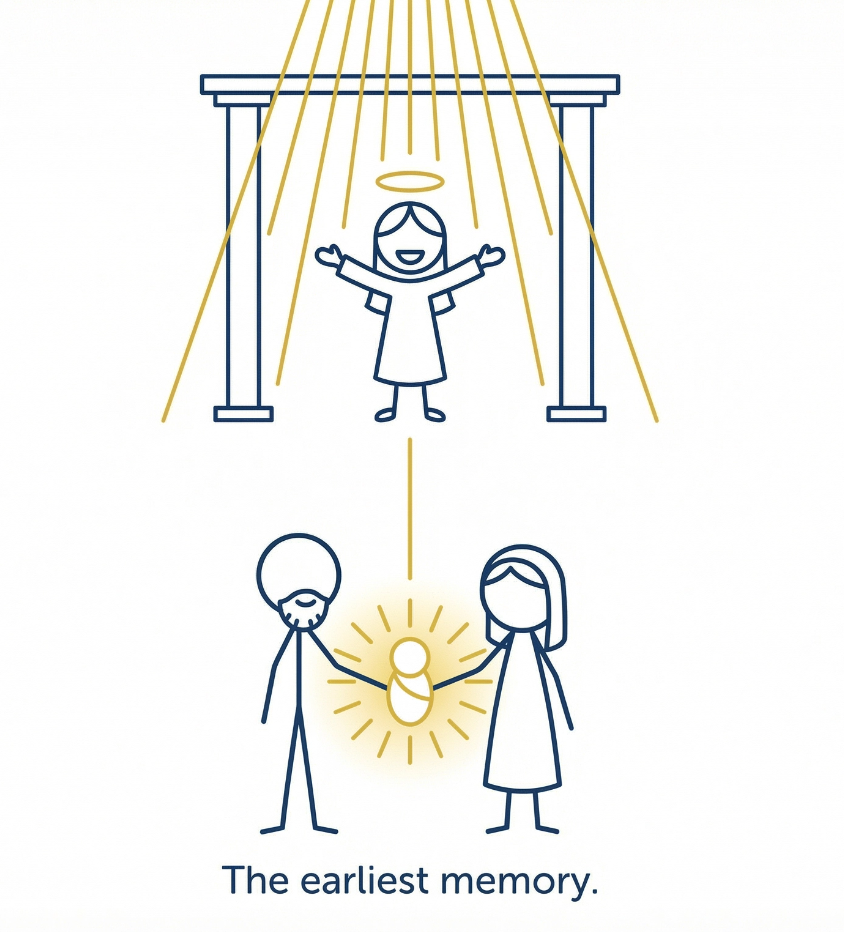
The Pattern of Grace: Why This Matters
Here is what emerges when you put all of this together. Mary does not appear in the New Testament as a blank slate. She arrives already graced, with a history that the earliest Christians remembered and recorded.
Gabriel does not bestow grace on Mary at the Annunciation. He encounters her already saturated with grace, already transformed, already prepared. And the reason the earliest Christians believed this was that they knew the traditions about her origins. From the moment of her conception, through her presentation in the Temple, through her whole life, this woman was being prepared for something extraordinary.
The Immaculate Conception is not the Church adding something to Scripture. It is the Church preserving what the grammar actually says and what the earliest traditions confirm. God prepared this woman. Not because she was weak and needed fixing. But because she was chosen to be the mother of God Himself. The grace was cosmic in scope. It went all the way back to the moment she began to exist.
There is a theological principle the early Church Fathers talked about called typology. Mary as the New Eve. Justin Martyr wrote about this. Irenaeus developed it further. If sin entered the world through a woman who was created without sin and then fell, then redemption enters through a woman preserved without sin who says yes. The parallel is too perfect to be accidental.
And Paul gives us the theological framework:
"But where sin increased, grace abounded all the more." (Romans 5:20)
The grace of Christ is infinite. It flows backward and forward through time. It goes back to preserve Mary from original sin. It reaches forward to transform everyone who believes.
Grace first. Always grace first. Not earned, not achieved, not merited. Received. Received by the woman who would say:
"Behold, I am the handmaid of the Lord; let it be to me according to your word." (Luke 1:38)
Teaser Close: But What Happened to Her?
The Greek tells us something remarkable. God fully graced Mary before the Incarnation. The earliest Christians preserved detailed traditions about her origins. They remembered her parents' names. They remembered her dedication to the Temple. They remembered a woman prepared by grace from the beginning.
But here is the question the earliest Christians asked next. If God did this for Mary at the beginning of her life, what did God do for her at the end?
Scripture records people being taken up bodily. Enoch walked with God and "was no more, because God took him" (Genesis 5:24). Elijah was taken up in a chariot of fire, and as the Psalms say, God receives him without seeing death (2 Kings 2:11). Even Philip the deacon, after baptizing the Ethiopian eunuch, "was caught up by the Spirit" (Acts 8:39-40).
God did this for a patriarch. God did this for a prophet. God did this for a deacon. What would God do for the woman whose body carried the incarnate Word of God?
The earliest Christians had an answer to that question too. And Scripture, the Fathers, and the liturgical traditions of the early Church all point in the same direction.