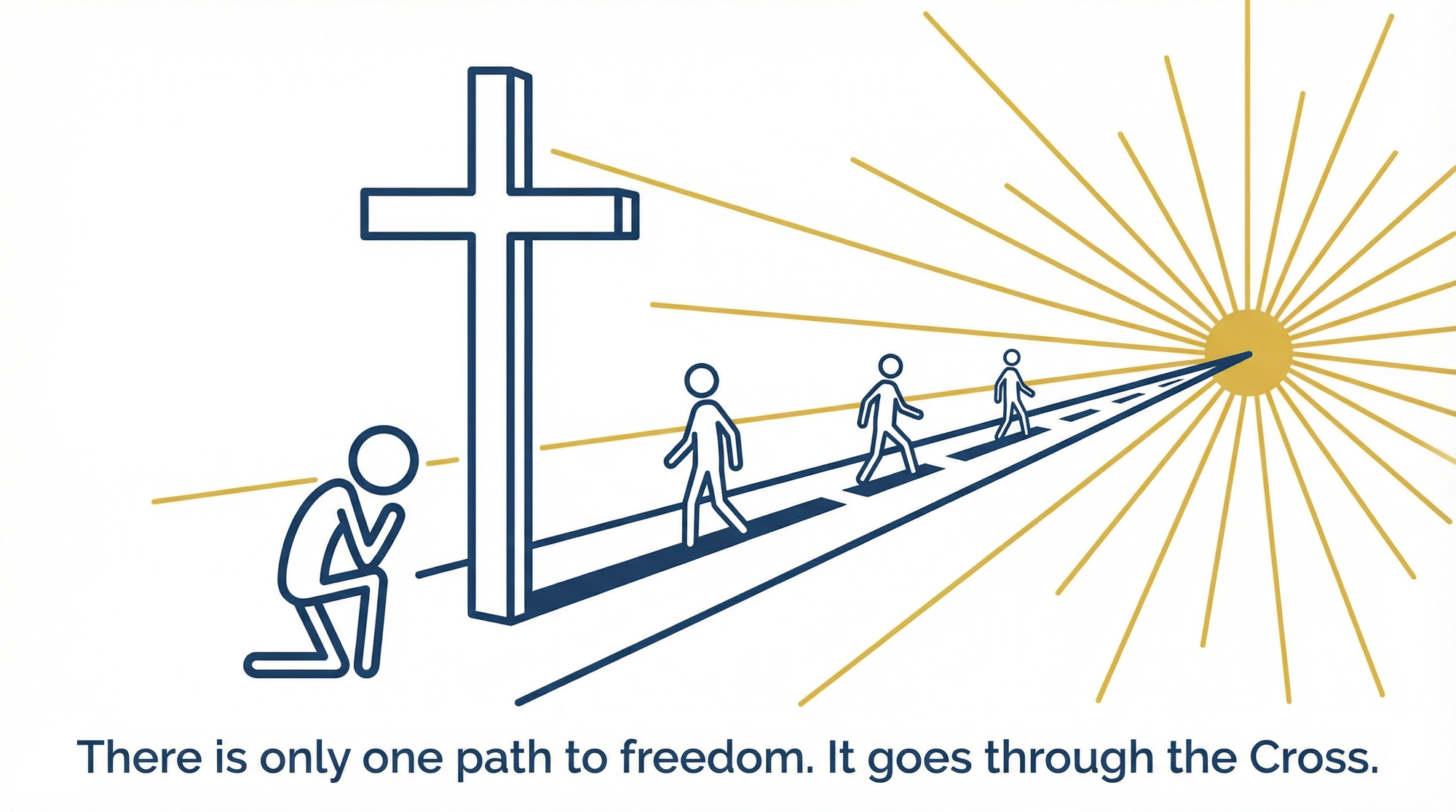
You found the Church.
Maybe you came in through the front door, maybe through the side. Maybe you were baptized as an infant and wandered back. Maybe you fought your way in from atheism, from Protestantism, from nothing at all.
However you got here, you found the truth, and the truth lit a fire in you.
But somewhere between your conversion and today, another formation slipped in alongside it. A podcast here. A Twitter thread there. A guy with a crucifix in his bio who seemed to be saying the hard things nobody in your parish would say.
And now you carry two formations in your chest at the same time, and you are not entirely sure which one is speaking when you open your mouth.
This article is not written from the outside.
It is written by a man who understands the appeal. The crisis of masculinity is real. The feminization of culture is real. The frustration of watching the Church seem to go soft on issues that matter is real.
None of that is in dispute here.
What is in dispute is the solution. Because the red pill is offering pagan answers to Christian questions. And the fruit tells the story.
[STICK FIGURE ILLUSTRATION: A stick figure stands at a fork in a road. One path is lit by a soft, steady light from above (labeled "The Gospel"). The other path glows red and neon, lined with screens and loudspeakers (labeled "The Red Pill"). The stick figure holds a Bible in one hand and a phone in the other. Caption: "Two formations. One soul. You cannot serve both."]
The Only Diagnostic Tool You Need
Before we examine a single red pill claim, we need to establish the test. Not a test invented for this article. The test Christ Himself gave us.
"By their fruits you shall know them. Are grapes gathered from thornbushes, or figs from thistles? So, every healthy tree bears good fruit, but the diseased tree bears bad fruit." (Matthew 7:16-17)
This is not metaphor. This is diagnostic methodology, given by God in the flesh. You do not evaluate a teaching by how clever it sounds, how angry it makes your opponents, or how many views it gets. You evaluate it by what it produces in the lives of the people who follow it.
Paul gives us the criteria with surgical precision:
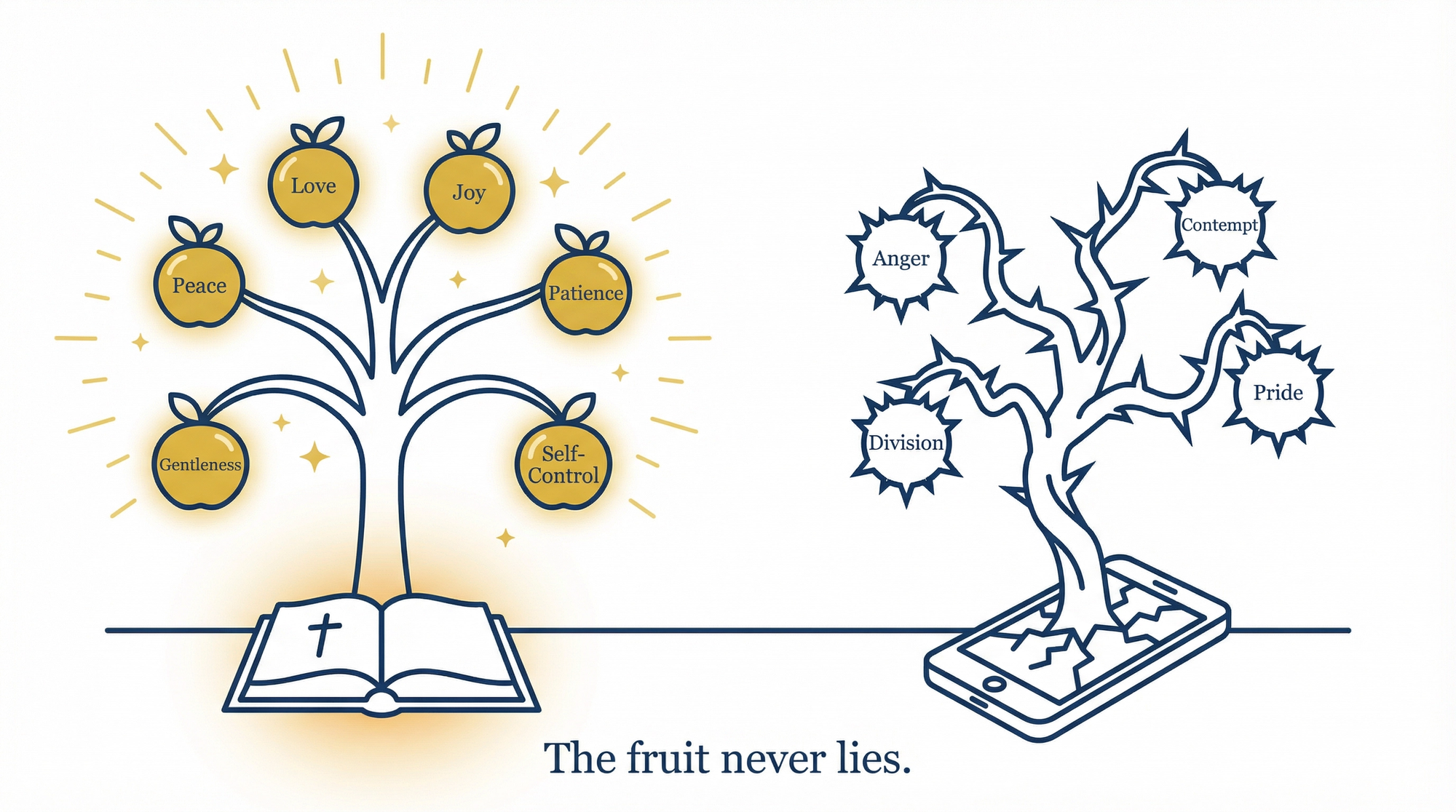
"But the fruit of the Spirit is love, joy, peace, patience, kindness, goodness, faithfulness, gentleness, self-control; against such things there is no law." (Galatians 5:22-23)
And just three verses earlier, the contrast:
"Now the works of the flesh are evident: sexual immorality, impurity, sensuality, idolatry, sorcery, enmity, strife, jealousy, fits of anger, rivalries, dissensions, divisions, envy, drunkenness, orgies, and things like these." (Galatians 5:19-21)
Two lists. One test. Be ruthlessly honest with yourself. After you consume red pill content, after you spend an hour in the comment sections, after you finish a combative podcast episode, which list shows up in your life? In your marriage? In the way you talk to your wife? In the way you talk about women? In the way you treat a brother who disagrees with you?
St. Ignatius of Loyola built an entire science of discernment around this principle. In the First Rule of Discernment, he taught that the Holy Spirit produces genuine peace, consolation, and an increase of faith, hope, and love. The enemy produces agitation, sadness, and interior obstacles, often disguised as clarity and zeal.
Read that again. The enemy disguises agitation as clarity. He disguises contempt as discernment. He disguises anger as courage.
The fruit test cuts through every disguise. It always has.
What the Red Pill Actually Teaches (Under the Catholic Paint)
Before we can test the red pill against the tradition, we need to strip it to its actual premises. Not the version defenders retreat to when pressed ("We just think men should lift weights and have standards"). The actual philosophical architecture underneath the movement.
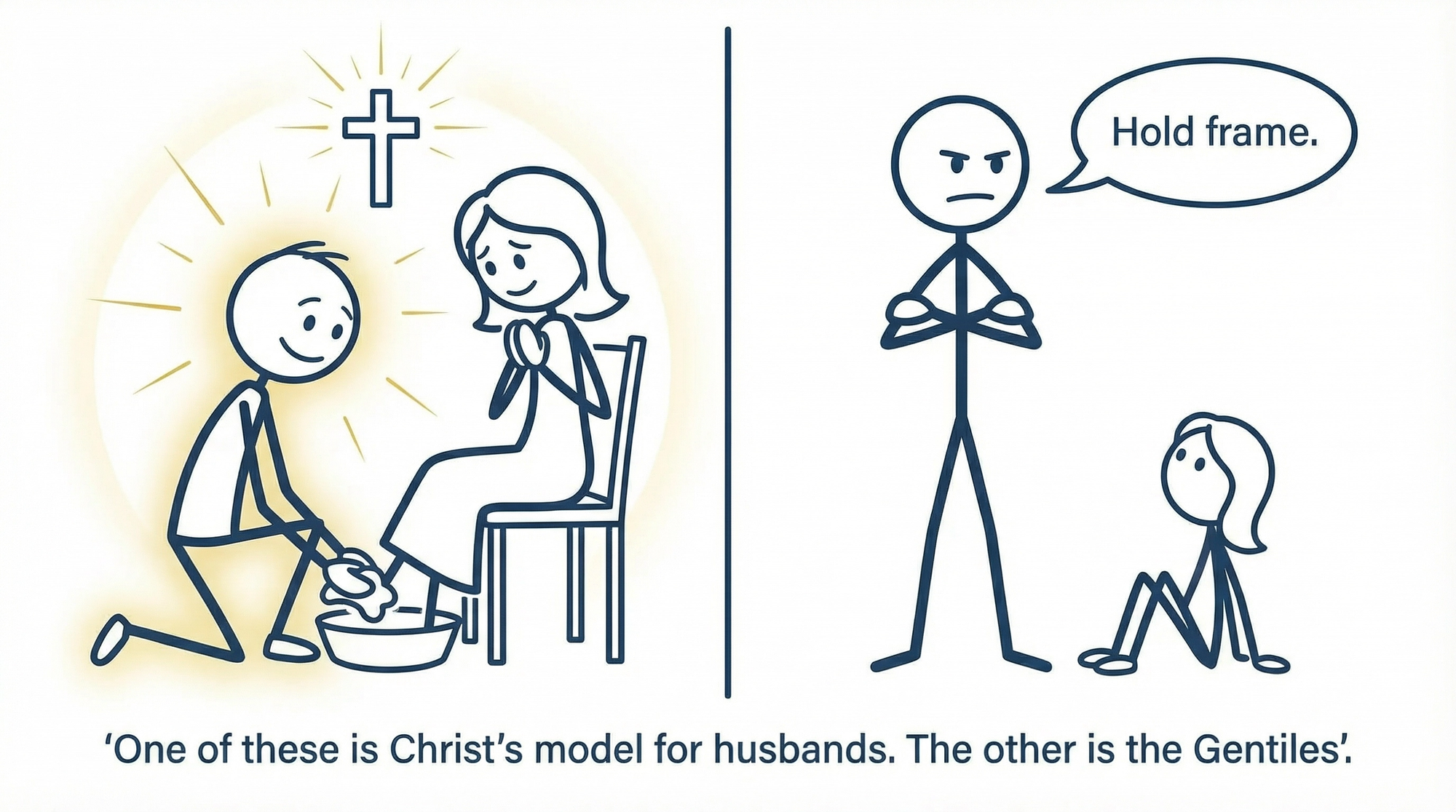
First premise: Relationships are fundamentally power transactions. The red pill framework teaches that male-female relationships are organized around "frame," dominance, and strategic positioning. The man who "holds frame" wins. The man who shows vulnerability loses.
Second premise: Women are understood primarily through their sexual strategy. Concepts like hypergamy, sexual market value, and AWALT ("All Women Are Like That") reduce female personhood to a set of biological drives to be decoded, managed, and leveraged for male advantage.
Third premise: Masculinity is proven through dominance. Real men lead through strength, frame control, and emotional stoicism. Tenderness, vulnerability, and deference are coded as weakness.
Fourth premise: Those who "see" are justified in contempt for those who don't. The red pill creates a gnostic division between the "awakened" (red-pilled) and the "asleep" (blue-pilled), including blue-pilled Christians and blue-pilled clergy.
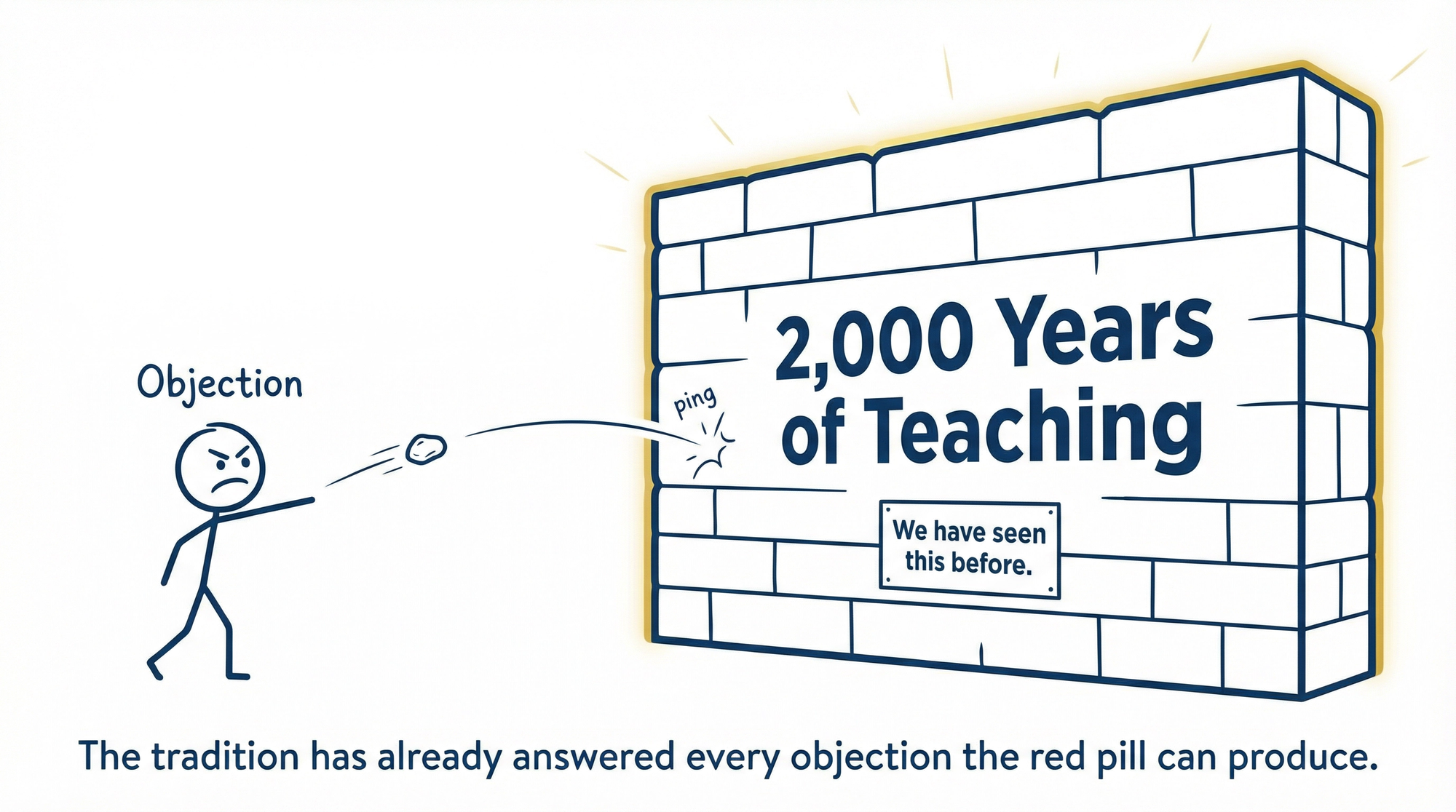
Now let us hold each of these premises against 2,000 years of teaching and see what survives.
"It Shall Not Be So Among You"
The first premise collapses immediately on contact with Christ.
"You know that the rulers of the Gentiles lord it over them, and their great ones exercise authority over them. It shall not be so among you. But whoever would be great among you must be your servant, and whoever would be first among you must be your slave, even as the Son of Man came not to be served but to serve, and to give his life as a ransom for many." (Matthew 20:25-28)
Notice what Christ does here. He does not reinterpret the pagan model of relational power. He does not nuance it. He repudiates it. "It shall not be so among you" is a direct command, not a suggestion open to cultural negotiation.
The Catechism draws this out explicitly. Marriage is not a power arrangement. It is an image of Christ's relationship with His Church (CCC 1616). And that relationship is defined by one of the most staggering passages in all of Scripture:
"Have this mind among yourselves, which is yours in Christ Jesus, who, though he was in the form of God, did not count equality with God a thing to be grasped, but emptied himself, by taking the form of a servant, being born in the likeness of men. And being found in human form, he humbled himself by becoming obedient to the point of death, even death on a cross." (Philippians 2:5-8)
That word "emptied" is kenosis in Greek. It means self-emptying. Self-pouring-out. It is the exact opposite of "holding frame." Christ did not hold frame. He gave up frame entirely for the sake of the beloved. And Paul says this is the mind you are to have.
Husbands are told to love their wives "as Christ loved the Church and gave himself up for her" (Ephesians 5:25). Gave himself up. Not "maintained dominance over." Not "held frame against." Gave. Himself. Up.
St. John Chrysostom, one of the most unapologetically direct voices in the entire patristic tradition, preached this in Homily 20 on Ephesians:
"Would you that your wife should obey you, as the Church obeys Christ? Then take care of her, as Christ does for the Church. Yes, even if you must give your life for her... He brought the Church to His feet by His great care, not by threats or fear or anything of that kind."
Not by threats. Not by fear. Not by frame. By care. That is Chrysostom. That is the tradition. The red pill is not.
The Instrumentalization of the Human Person
The second red pill premise, that women are to be understood primarily through their sexual strategy, commits what St. John Paul II identified as the fundamental sin against love.
In his Theology of the Body, John Paul II established the personalist norm: a person must never be reduced to an instrument of another person's use. The opposite of love is not hatred. It is use.
"God created man in his own image, in the image of God he created him; male and female he created them." (Genesis 1:27)
Both. In God's image. Both. Not male as subject and female as object of analysis. Both as imago Dei, bearing irreducible dignity that no "sexual market value" score can quantify.
Look at Adam's first response to Eve. It is not evaluation. It is not assessment. It is wonder:
"Then the man said, 'This at last is bone of my bones and flesh of my flesh; she shall be called Woman, because she was taken out of Man.'" (Genesis 2:23)
"At last." Recognition. Gratitude. Awe. Not "What is her SMV?" Not "Is she hypergamous?" Not "AWALT." The first man's first words at the sight of the first woman were an act of reverence, not a market analysis.
The red pill's entire taxonomy of female behavior, hypergamy, branch-swinging, fitness testing, reduces the imago Dei to evolutionary psychology. The Catechism is explicit about the dignity this violates:
"Each of the two sexes is an image of the power and tenderness of God, with equal dignity though in a different way." (CCC 2335)
The equal dignity is not optional. It is not a concession to feminism. It is the teaching of the Church grounded in the first chapter of Genesis. Any framework that systematically trains men to view women through a lens of utility rather than dignity is not supplementing the faith. It is contradicting it at the most fundamental anthropological level.
What Does Masculine Holiness Actually Look Like?
If the red pill model of masculinity is not Christian, then what is? The tradition does not leave us guessing. It gives us models. Real men. Not archetypes. Saints.
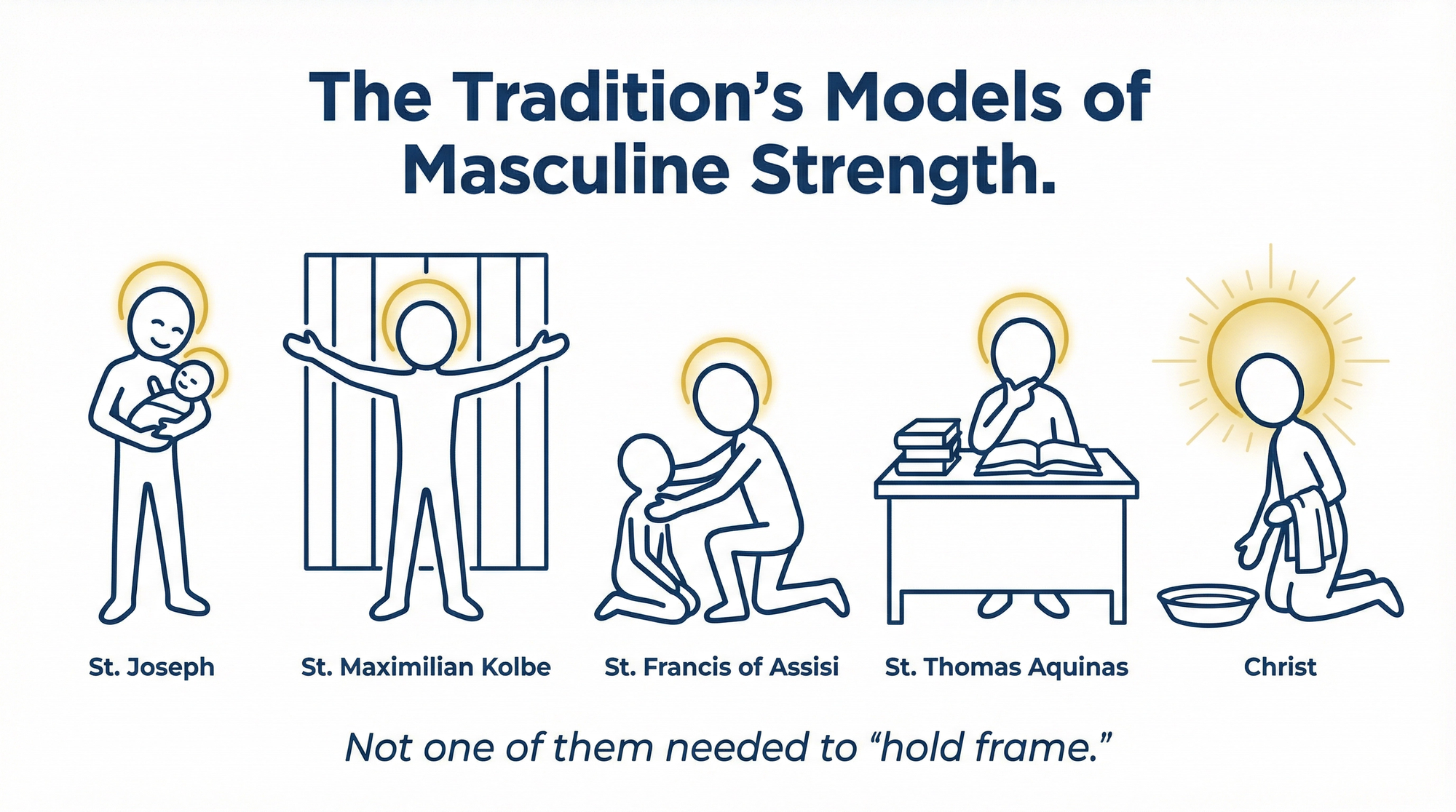
St. Joseph. Not a single recorded word in all of Scripture. His entire life is defined by quiet obedience, protective tenderness, and hiddenness. He is the patron of the Universal Church, and he accomplished everything the Church celebrates about him in total silence. His masculinity required no audience. No podcast. No followers. No "frame."
St. Maximilian Kolbe. A Franciscan priest in Auschwitz who volunteered to die in place of a stranger, a man he had never met, because the man had a family. He spent two weeks starving in a death bunker, leading the other condemned men in prayer and hymns. When the guards came to finish him off with a lethal injection, they found him sitting upright, peaceful. That is masculine strength.
"Greater love has no one than this, that someone lay down his life for his friends." (John 15:13)
St. Francis of Assisi. Kissed lepers. Called himself the least of all creation. Owned nothing. Converted more souls through poverty and gentleness than any argument ever has.
St. Thomas Aquinas. The greatest intellect in Church history, and he had a method. The Summa Theologica always begins with Videtur quod, "It seems that..." He presented the strongest possible version of his opponent's argument before responding. He gave the objection full voice and full dignity. He never "owned" anyone. He understood them so thoroughly that his refutation was irresistible precisely because it was charitable.
And Christ Himself. He washed His disciples' feet (John 13:1-17). He wept openly at the death of His friend (John 11:35). He held children and rebuked those who pushed them away (Mark 10:13-16). He was silent before His accusers (Matthew 27:14). He forgave the men who were killing Him while they were killing Him (Luke 23:34).
The red pill concept of masculinity has far more in common with Nietzsche's Übermensch, the strong man who imposes his will and creates his own values, than with anything in Scripture or the Fathers. This is not a minor philosophical distinction. Nietzsche knew exactly what he was doing. He wrote The Antichrist specifically to oppose the Christian model of virtue. His vision of the strong man was designed to be the opposite of Christ.
When you adopt a framework for masculinity that is architecturally Nietzschean, you are not supplementing your Christianity. You are replacing its anthropology with the work of the man who hated it most.
The Oldest Heresy in New Clothes
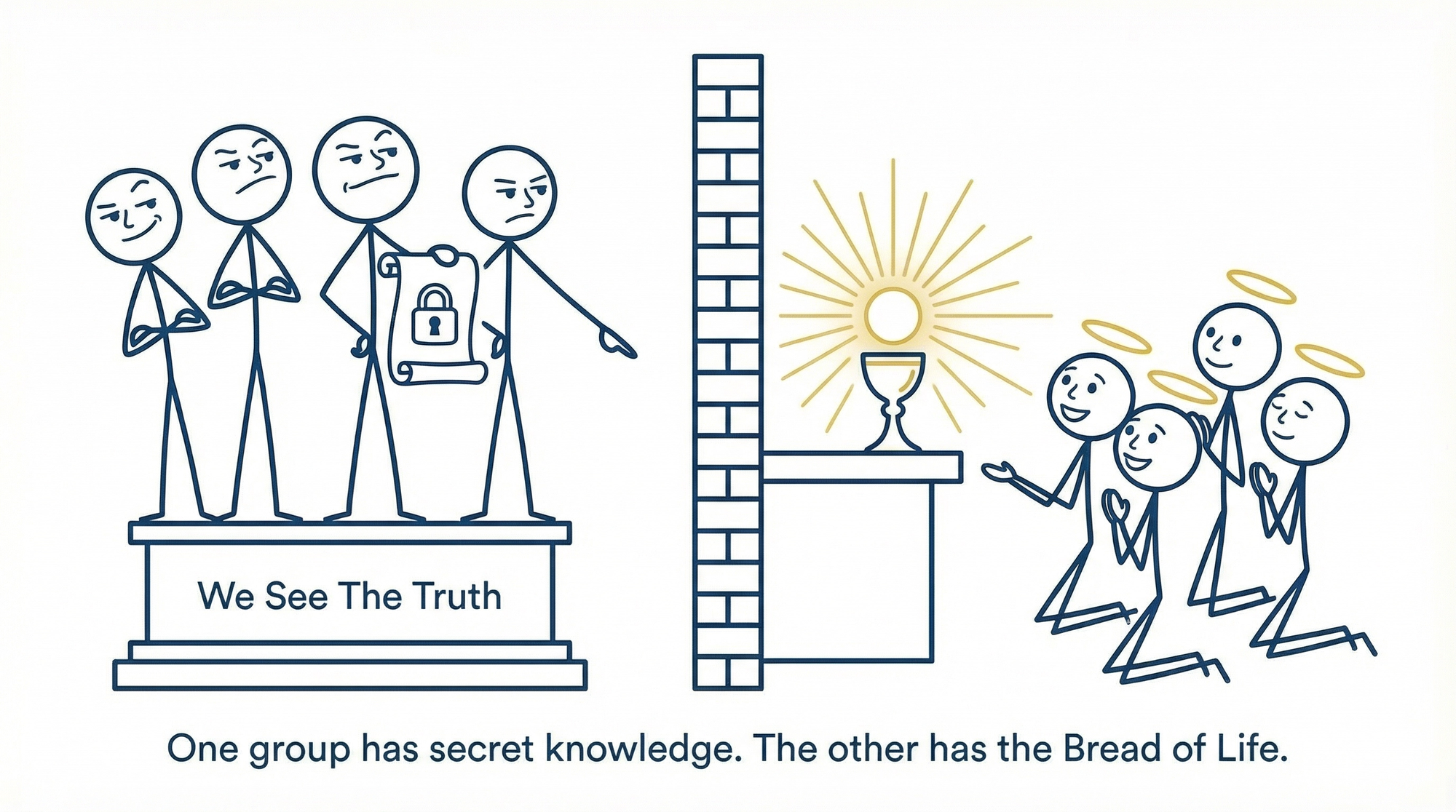
The fourth red pill premise, the gnostic division between the "awakened" and the "asleep," is not new. It is older than the Canon of Scripture. And the Church condemned it before the ink on the Gospels was dry.
Gnosticism, in its many forms, always teaches the same structure. There are those who possess secret knowledge (gnosis) that the ordinary masses lack. This knowledge elevates the knower into a spiritual elite. Those who lack it are dismissed as ignorant, enslaved, or asleep.
The red pill maps onto this structure with uncomfortable precision. Those who have "taken the red pill" see reality as it truly is. Those who have not are "blue-pilled," asleep, feminized, deceived. The terminology changes. The architecture is identical.
Paul addressed this directly:
"Knowledge puffs up, but love builds up. If anyone imagines that he knows something, he does not yet know as he ought to know." (1 Corinthians 8:1-2)
And Christ told a parable specifically about this spiritual posture:
"Two men went up into the temple to pray, one a Pharisee and the other a tax collector. The Pharisee, standing by himself, prayed thus: 'God, I thank you that I am not like other men, extortioners, unjust, adulterers, or even like this tax collector.' But the tax collector, standing far off, would not even lift up his eyes to heaven, but beat his breast, saying, 'God, be merciful to me, a sinner!' I tell you, this man went down to his house justified, rather than the other." (Luke 18:10-14)
The Pharisee's prayer is the red pill prayer. "God, I thank you that I am not like the blue-pilled men." Christ says the man who beat his breast and asked for mercy went home justified. Not the one who had reality figured out.
St. Irenaeus spent his entire theological career fighting exactly this structure. In Against Heresies, he insisted that the ordinary faith of the Church, received through Baptism, nourished by the Eucharist, taught by the bishops, lived in community, is the fullness of truth. No secret knowledge needed. No red pill required.
The moment your identity as a Christian is organized around what you know that others don't, rather than around the sacraments, works of mercy, and the Eucharist, you have drifted from the Gospel into gnosticism. The label on the outside does not change the architecture on the inside.
The Lord's Servant Must Not Be Quarrelsome
If the premises of the red pill fail the theological test, its mode fails the moral test just as decisively.
Paul wrote to Timothy with a clarity that leaves no room for negotiation:
"The Lord's servant must not be quarrelsome but kind to everyone, able to teach, patiently enduring evil, correcting his opponents with gentleness. God may perhaps grant them repentance leading to a knowledge of the truth." (2 Timothy 2:24-25)
Notice the theology buried in that passage. It is God who grants repentance. Not your argument. Not your takedown. Not your devastating tweet. Your job is to create the conditions where grace can operate. Combativeness actively works against that.
"Let every person be quick to hear, slow to speak, slow to anger; for the anger of man does not produce the righteousness of God." (James 1:19-20)
The anger of man does not produce the righteousness of God. That is not a suggestion about tone. It is a theological statement about efficacy. Your anger, however justified it feels, does not accomplish what God's righteousness accomplishes. It cannot. It was never designed to.
St. Francis de Sales, Doctor of the Church and one of the greatest evangelists in Christian history, lived this:
"Nothing is so strong as gentleness, nothing so gentle as real strength."
The early Church did not conquer Rome by winning debates. They converted an empire through witness, through martyrdom, through lives so conspicuously marked by charity that pagans said, "See how they love one another" (Tertullian, Apologeticus). That witness, not argument, is what broke the back of paganism.
The Catechism places specific moral obligations on how we speak about others, including people we disagree with. CCC 2475-2476 addresses rash judgment and detraction. CCC 2477 addresses calumny. These are not minor offenses. The casual contempt that saturates red pill content is not edginess. It is not "telling it like it is." Under the moral categories the Church actually uses, it is sin.
And here is the part that should make red pill apologists uncomfortable: St. Thomas Aquinas, in the Summa Theologica (II-II, Q. 114), taught that we owe it to others in justice to communicate pleasantly. In justice. Not as a nicety. Not as a strategy. As a debt owed to the dignity of the other person. Aquinas would have classified the dominant communication style of the red pill Catholic internet as a violation of the virtue of affability, which he treated as a moral obligation, not a personality preference.
The Enemy's Most Sophisticated Strategy
Now we arrive at the spiritual warfare underneath all of this. Because this is not finally an intellectual problem. It is a spiritual one.
St. Ignatius of Loyola identified the enemy's most dangerous tactic in the Rules for Discernment of the Second Week of the Spiritual Exercises. For a soul already oriented toward God, a new convert, a man on fire for truth, the enemy does not tempt with obvious sin. That would be too crude. Instead, he operates under the appearance of good.
He takes a legitimate desire, the desire for masculine strength, for truth, for clarity about the differences between men and women. He validates the desire. He feeds it real grievances. And then he redirects it toward a mode that produces the works of the flesh while feeling like righteousness.
Anger feels like strength. Contempt feels like discernment. Winning an argument feels like advancing the Kingdom. But the fruit tells the real story.
Ignatius gives a specific diagnostic: trace the movement to its END. Where does this formation lead? If your "zeal for truth" ends in broken relationships, contempt for your wife, alienated family members, an inability to receive correction from your pastor or your brother, then regardless of where it started, it did not end in God. The trajectory reveals the source.
"The enemy acts like a false lover, seeking to remain secret and undetected. For just as a seducer does not want his words and suggestions made known... so the enemy of our human nature does not want his deceits to be revealed." (St. Ignatius, Spiritual Exercises)
Here is the application. If your formation cannot survive exposure to your spiritual director, your priest, your wife, or your brother in Christ... if it only functions inside the echo chamber of the podcast and the Twitter feed... that secrecy itself is a diagnostic sign. The Spirit operates in light. The enemy requires darkness.

Objections and Responses
The tradition we are drawing from, the Scholastic tradition of Aquinas, always presents the strongest version of the opposing argument before responding. This is not a weakness. It is a sign of confidence. Truth does not fear the strongest objection. It welcomes it.
Objection 1: "Ephesians 5:22 says wives submit. The Bible IS red pill."
Response. Ephesians 5:22 does not begin at verse 22. It begins at verse 21:
"Submit to one another out of reverence for Christ." (Ephesians 5:21)
Mutual submission is the context. The husband's headship is then defined in verse 25 as sacrificial self-giving unto death. Chrysostom, cited above, is explicit: not by threats, not by fear, by care. Any reading of Ephesians 5 that produces dominance rather than kenosis has misread Ephesians 5. The text itself says so.
Objection 2: "The Church HAS been feminized. We are saying what the bishops will not."
Response. Acknowledging a real problem does not validate every proposed solution. A doctor who correctly diagnoses cancer but prescribes arsenic is not a hero. The feminization critique has real substance. Leon Podles documented it in The Church Impotent decades before the red pill existed. But the answer is more formation in the actual tradition, the saints, the sacraments, ascetic discipline, spiritual direction, not less tradition supplemented with evolutionary psychology and Nietzsche. The red pill correctly identifies a wound and then pours poison into it.
Objection 3: "Jesus flipped tables. He was not gentle."
Response. Christ's anger was righteous anger directed at religious leaders exploiting the vulnerable, expressed in the context of a life overwhelmingly defined by patience, tenderness, tears, and service. He washed feet. He wept at a tomb. He was silent before Pilate. He forgave from the cross. To take one episode from a three-year ministry and build an entire masculine identity around it while ignoring everything else is prooftexting, ripping a passage from its context to serve a predetermined conclusion. Christ's anger was occasional, targeted, and in service of the vulnerable. Red pill anger is habitual, generalized, and in service of the self. These are not the same thing.
Objection 4: "AWALT is just acknowledging fallen nature. The Church teaches concupiscence."
Response. The Church does teach that concupiscence remains after Baptism (CCC 1264) and that all human beings, male and female, are inclined toward disordered desire. But there are two critical differences. First, the Church applies this universally. All humans are fallen, not only women. The red pill applies deterministic analysis almost exclusively to female behavior while exempting male behavior from the same scrutiny. That is not theology. It is bias in theological clothing. Second, the Church teaches that grace is real and operative. The sacraments actually work. Regeneration actually changes people. AWALT is a functional denial of sanctifying grace. It says all women, regardless of faith, prayer, or virtue, are reducible to their biological programming. If you believe the sacraments work, you cannot believe AWALT. Pick one.
Objection 5: "You are just tone-policing. Truth does not care about feelings."
Response. Truth is a Person (John 14:6). And that Person cared enough about people's feelings to weep with them, eat with them, and die for them. This is not about tone. It is about moral theology. Aquinas treats affability as a requirement of justice, not a personality preference. Paul commands correction with gentleness (2 Timothy 2:25). James says the anger of man does not produce the righteousness of God (James 1:20). Colossians commands speech seasoned with salt and full of grace (Colossians 4:6). These are moral obligations, not stylistic suggestions.
Objection 6: "Red pill just teaches men to be strong. What is wrong with that?"
Response. Nothing is wrong with strength. The Church has always taught it. Exodus 90 involves ascetic discipline more demanding than anything the manosphere produces. Aquinas taught that fortitudo is a cardinal virtue. The question is not whether men should be strong. The question is: strong for what purpose, and formed by whom? Strength oriented toward dominance and ego is a work of the flesh regardless of how many rosaries accompany it. Strength oriented toward sacrificial service and conformity to Christ is a fruit of the Spirit. Same gym. Completely different formation. The red pill smuggles a pagan telos, strength for dominance, inside a container of legitimate goods.
Objection 7: "Who are you to judge? Timothy Gordon is a faithful Catholic."
Response. Christ did not say "judge not." He said, "Judge not, that you be not judged" (Matthew 7:1), referring to the state of another person's soul. Three verses later He commanded the fruit test (Matthew 7:16), which requires evaluative judgment of teaching and its effects. Paul told the Galatians that if even an angel from heaven preached a different gospel, let him be accursed (Galatians 1:8). He told the Thessalonians to test everything and hold fast to what is good (1 Thessalonians 5:21). Being a baptized Catholic in good standing does not make every opinion you express a Catholic teaching. The test is not the speaker's credentials. The test is the fruit, the conformity to Scripture, and the consistency with the Magisterium.
The Real Red Pill is the Gospel
If you want to talk about "waking up" and "seeing reality," the tradition already has its own version. It is infinitely more radical than anything the manosphere has produced.
"Do not be conformed to this world, but be transformed by the renewal of your mind, that by testing you may discern what is the will of God, what is good and acceptable and perfect." (Romans 12:1-2)
Do not be conformed to this world. The Greek word is syschematizesthe. Do not let the world press you into its mold. Not the mold of secular progressivism, and not the mold of the red pill either. Both are patterns of this world. Both are conformity. Neither is transformation.
The real "red pill" is the Gospel itself. It is Baptism. It is the Eucharist. It is the daily Examen. It is Confession. It is the complete overturning of the world's values, not in the direction of dominance, but in the direction of the Cross.
The Beatitudes are the most genuinely counter-cultural, reality-shattering claims ever made:
"Blessed are the meek, for they shall inherit the earth. Blessed are the merciful, for they shall receive mercy. Blessed are the peacemakers, for they shall be called sons of God. Blessed are those who are persecuted for righteousness' sake, for theirs is the kingdom of heaven." (Matthew 5:5, 7-10)
Blessed are the meek? That is a claim so radical it still offends people 2,000 years later. The red pill cannot make a claim that radical. It does not have the theological infrastructure to sustain one.
"For the word of the cross is folly to those who are perishing, but to us who are being saved it is the power of God... For the foolishness of God is wiser than men, and the weakness of God is stronger than men." (1 Corinthians 1:18, 25)
The weakness of God is stronger than men. The entire red pill framework is organized around the pursuit of human strength. Paul says the weakness of God is stronger than any version of that. The Cross, the ultimate act of apparent weakness, is the most powerful event in human history.
You do not need to be red-pilled. You already took the only pill that matters, at the baptismal font. The question is whether you will let it actually transform you, or whether you will dilute it with a worldly philosophy that flatters your ego while starving your soul.
Examine Your Fruit
If you have read this far and something in you is unsettled, pay attention to that. That unsettled feeling might be the Holy Spirit doing what He does, not condemning, but convicting. Gently. With love. Toward truth.
Ask yourself honestly:
Since consuming red pill content, has my marriage improved? Does my wife feel more loved, more honored, more safe? Or does she feel managed, evaluated, and controlled?
"Husbands, love your wives, and do not be harsh with them." (Colossians 3:19)
Am I quicker to listen or quicker to argue?
"Let every person be quick to hear, slow to speak, slow to anger." (James 1:19)
Can I receive correction from my pastor, my wife, my brother in Christ? Or do I dismiss anyone who challenges me as "blue-pilled"?
"Whoever loves discipline loves knowledge, but he who hates reproof is stupid." (Proverbs 12:1)
Is my identity as a Christian built on the sacraments, prayer, works of mercy, and the Eucharist? Or is it built on podcasts, Twitter, and the feeling of being right?
Run the Galatians 5 test. Run it on the last month of your life. Is this formation producing love, joy, peace, patience, kindness, goodness, faithfulness, gentleness, self-control?
Or is it producing something else?
The fruit does not lie. It never has.
Where to Go From Here
The crisis of masculinity is real. Your desire for strength, purpose, and clarity is God-given. But the enemy is clever. He does not try to take that desire away. He redirects it toward a counterfeit that feels like truth while producing the works of the flesh.
If you are ready for formation that actually produces the fruit of the Spirit, start here:
Read the Theology of the Body. Start with Christopher West's Theology of the Body for Beginners if the full text of John Paul II feels daunting. This is the Church's actual, authoritative teaching on sex, gender, the body, and the meaning of masculinity and femininity. It is more radical than anything the red pill has ever published.
Read The Imitation of Christ by Thomas à Kempis. Six hundred years in print. The most widely read Christian devotional after the Bible. Book One, Chapter One. It will reorient everything.
Find a spiritual director. Not a podcast. Not a Twitter account. A priest or experienced layperson who knows your name, your sins, your marriage, and your struggles, and who can help you discern the movements of your own soul. In person.
Try Exodus 90. Ninety days of genuine ascetic masculine discipline, rooted in prayer, community, and accountability. It is harder than anything the manosphere will ask of you, and it is ordered toward Christ.
Go to Confession. If the fruit test convicted you, the sacrament is waiting. That is what it is for.
You do not need to be red-pilled. You need to be transformed by the renewal of your mind. You need the Beatitudes, the sacraments, the saints, and the Cross.
"You will know the truth, and the truth will set you free." (John 8:32)
The red pill promises to set you free. But honestly look at your life, are you actually free? Or are you trapped, alone, and angry?
Brother, only the Gospel can actually set you free.