

Feast Day: March 28
Born: c. 1060, Sherborne, England
Died: March 28, 1134, Cîteaux, France
Imagine you are twenty years old. You come from a good English family with land and a future. You have been educated at one of the finest abbeys in the country. And you decide to walk away from all of it.
Not because you have lost your faith. Because you are looking for something more real.
That is how the story of Stephen Harding begins. What happened next... decades of wandering, failure, near-total collapse, and then an explosion of grace so dramatic it reshaped the map of Europe... reads less like a hagiography and more like a story you would binge-watch on a streaming service if someone had the courage to make it.
Stephen Harding is not one of the famous saints. You will not find his face on a holy card in most parish gift shops. But the movement he built, the Cistercian Order, produced St. Bernard of Clairvaux, shaped medieval Christianity, and created an organizational model so brilliant that management scholars still study it today. And it very nearly never happened.
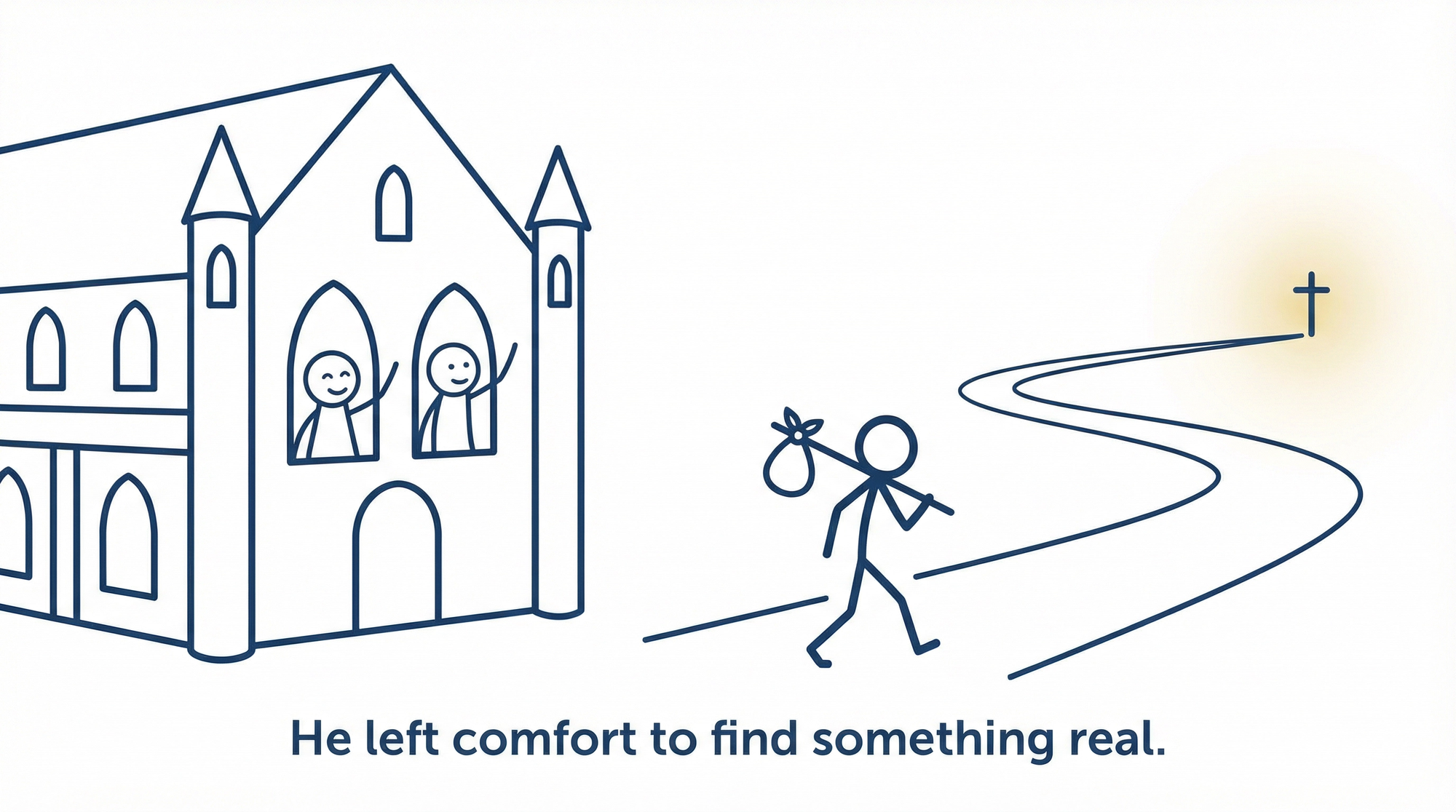
The Runaway: From England to Everywhere
Stephen Harding was born around 1060 in Sherborne, Dorsetshire, in the south of England. He was placed in Sherborne Abbey as a young boy, a common practice for sons of noble families. The monks educated him. He learned to read and write. He was on the path toward a stable, respectable monastic life.
And then the Normans showed up.
The Norman Conquest of 1066 turned England upside down. The old Anglo-Saxon aristocracy was displaced. Monasteries were reorganized under Norman leadership. Everything Stephen knew was disrupted. Somewhere in that disruption, something shifted inside him. He left the abbey, fled to Scotland, and then became a wandering scholar.
He traveled to Paris, where he studied. He may have spent time as a soldier. He eventually made a pilgrimage to Rome on foot, which in the eleventh century was not a vacation. It was months of walking through bandit-infested countryside, sleeping in fields, begging for bread. He prayed the Psalms as he walked, chanting them mile after mile across the spine of Europe.
By the time he reached Rome, he was not the same man who had left England. He was not interested in comfort or prestige or a secure position in the Church. He was interested in one thing: finding a community that actually lived the Gospel the way the early monks had intended.
On his way back from Rome, he found it. Or thought he had.
Molesme: When "Good Enough" Is Not Enough
Stephen joined the Benedictine abbey at Molesme in Burgundy, led by Abbot Robert. Robert was a holy man with a reputation for reform. He wanted to return to the pure observance of St. Benedict's Rule, the simple, radical, prayer-and-work lifestyle that Benedict had laid out in the sixth century.
The problem was that over five hundred years, Benedictine monasteries had drifted. They had accumulated wealth, land, political influence, and elaborate liturgical customs that would have made Benedict's head spin. The monks wore fine fabrics. The abbeys looked like palaces. The daily schedule was crammed with so many ceremonies that there was barely time left for manual labor and simple prayer.
Robert and Stephen looked at this situation and said: this is not what we signed up for. They wanted poverty, simplicity, silence, hard work, and the Rule as it was originally written.
But the rest of the monks at Molesme were not interested. Tensions rose. And in 1098, Robert, Stephen, and about twenty other monks did something that took extraordinary courage: they left.
This was not like quitting a job. In the eleventh century, leaving your monastery was a serious matter. It required permission from the local bishop. It meant walking away from security, community, and everything you had known.
They got permission from Archbishop Hugh of Lyon. And they walked into the swampy, uninhabited marshland south of Dijon, to a place called Cîteaux.
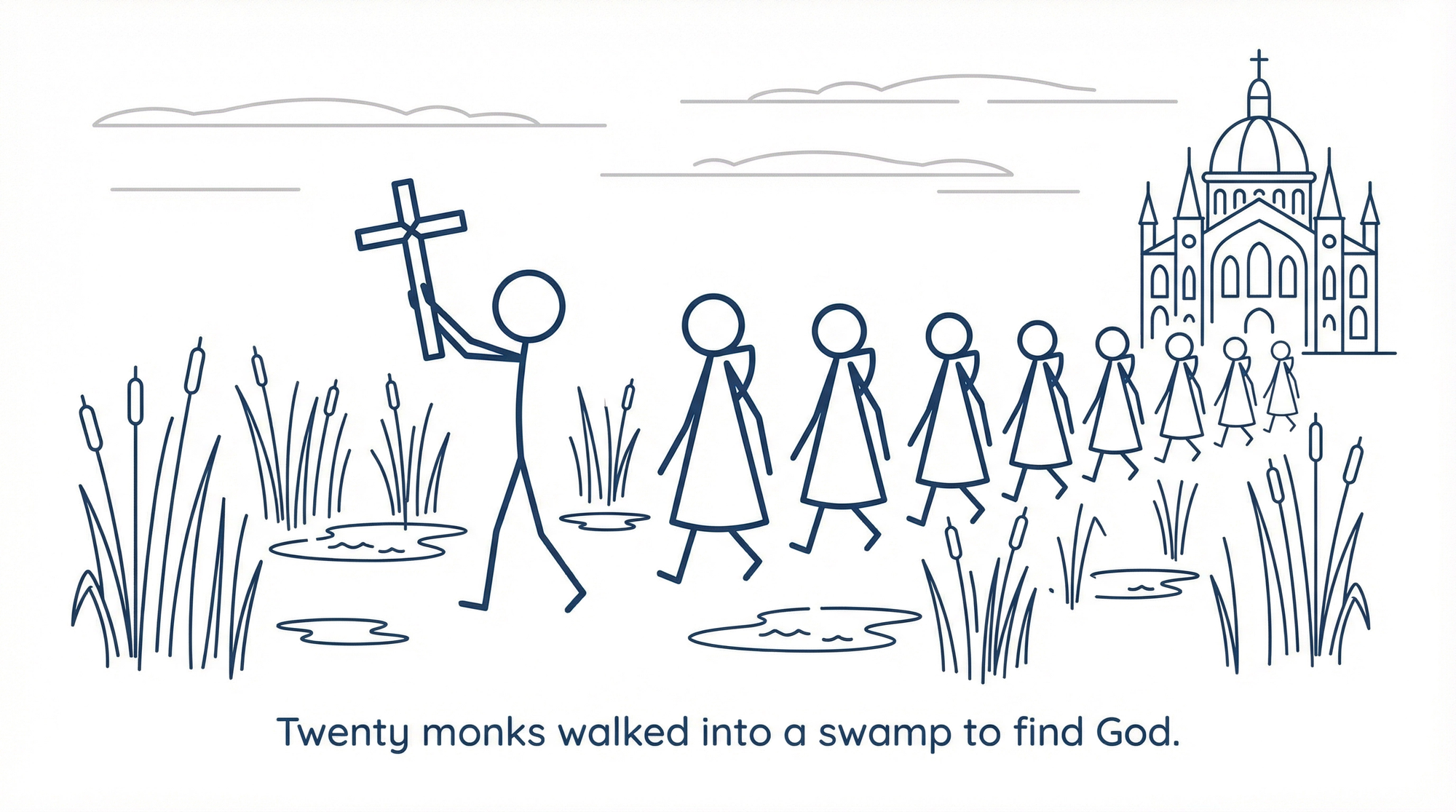
Cîteaux: Beautiful Suffering in the Mud
Cîteaux was not a charming French village. It was a swamp. The name itself comes from the Latin Cistercium, related to the word for "reeds," the kind of plants that grow in boggy, mosquito-infested wetlands. This was not a location chosen for its real estate value. It was chosen because nobody else wanted it.
And that was exactly the point.
The monks built rough shelters. They cleared land. They prayed. They worked. They lived the Rule of St. Benedict in its original simplicity: plain food, plain clothing, manual labor, communal prayer, and silence. No gold chalices. No silk vestments. Just men trying to live with God in the mud.
Robert served as the first abbot. But within a year, the monks back at Molesme complained to the Pope that they wanted their abbot back, and Pope Urban II ordered Robert to return. The second abbot, Alberic, led the community for about nine years before his death. And then, around 1109, Stephen Harding became the third abbot of Cîteaux.
He was roughly fifty years old. He had been wandering, literally and spiritually, for three decades. He had traveled from England to Scotland to Paris to Rome to Molesme to the swamp. And now, at last, he was in charge.
What happened next almost destroyed everything.
The Dark Years: When God Seemed Silent
Here is the part of Stephen's story that no motivational speaker would include in a keynote. It is also the part that makes him a saint for our time.
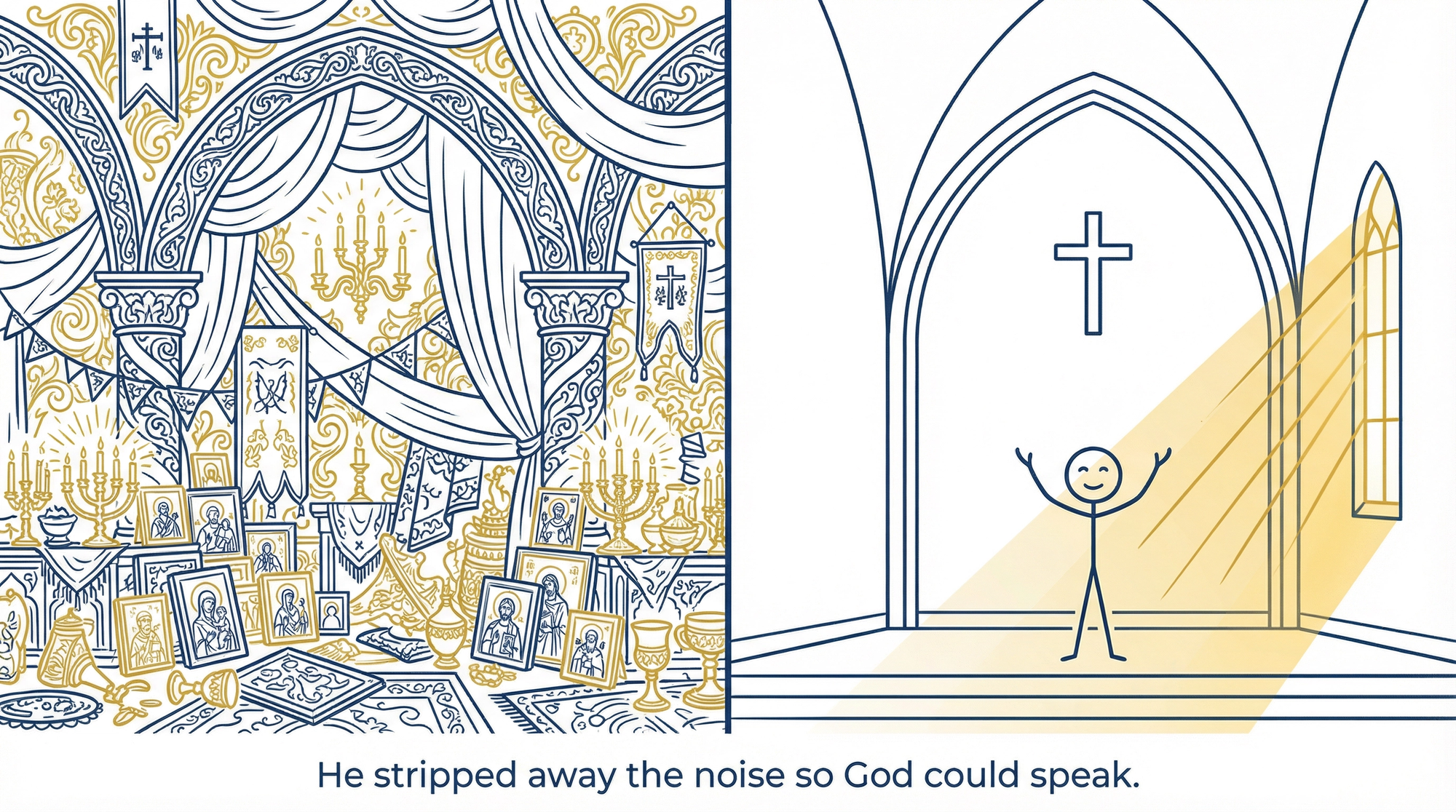
Under Stephen's leadership, Cîteaux committed to radical austerity. The monks would accept no tithes from parishes. They would not hire servants. They would do all the work themselves. They would strip their churches of ornament. They would live poor, pray hard, and trust God.
And then the recruits stopped coming.
Monasteries survive by attracting new members. No new monks means no new hands to work the fields, no new voices to chant the psalms, no future. And Cîteaux, with its harsh conditions and uncompromising standards, was not exactly a destination resort. Young men heard about the lifestyle and went elsewhere. To the comfortable monasteries. To the ones with heated rooms and decent food.
Stephen watched the community shrink. Monks who had joined left because the life was too hard. Then, somewhere around 1111, disease swept through the monastery. More than half the community died.
Think about that. You have given up everything, your homeland, your inheritance, your comfort, to build something you believe God has called you to build. And now half your brothers are dead, your monastery is nearly empty, and no one wants to join you. The dream is dying in the mud where it started.
Stephen began to wonder if he had made a terrible mistake. Was God displeased with the severity he had imposed? Had the whole experiment been his own pride disguised as holiness?
And then something happened that changed everything.
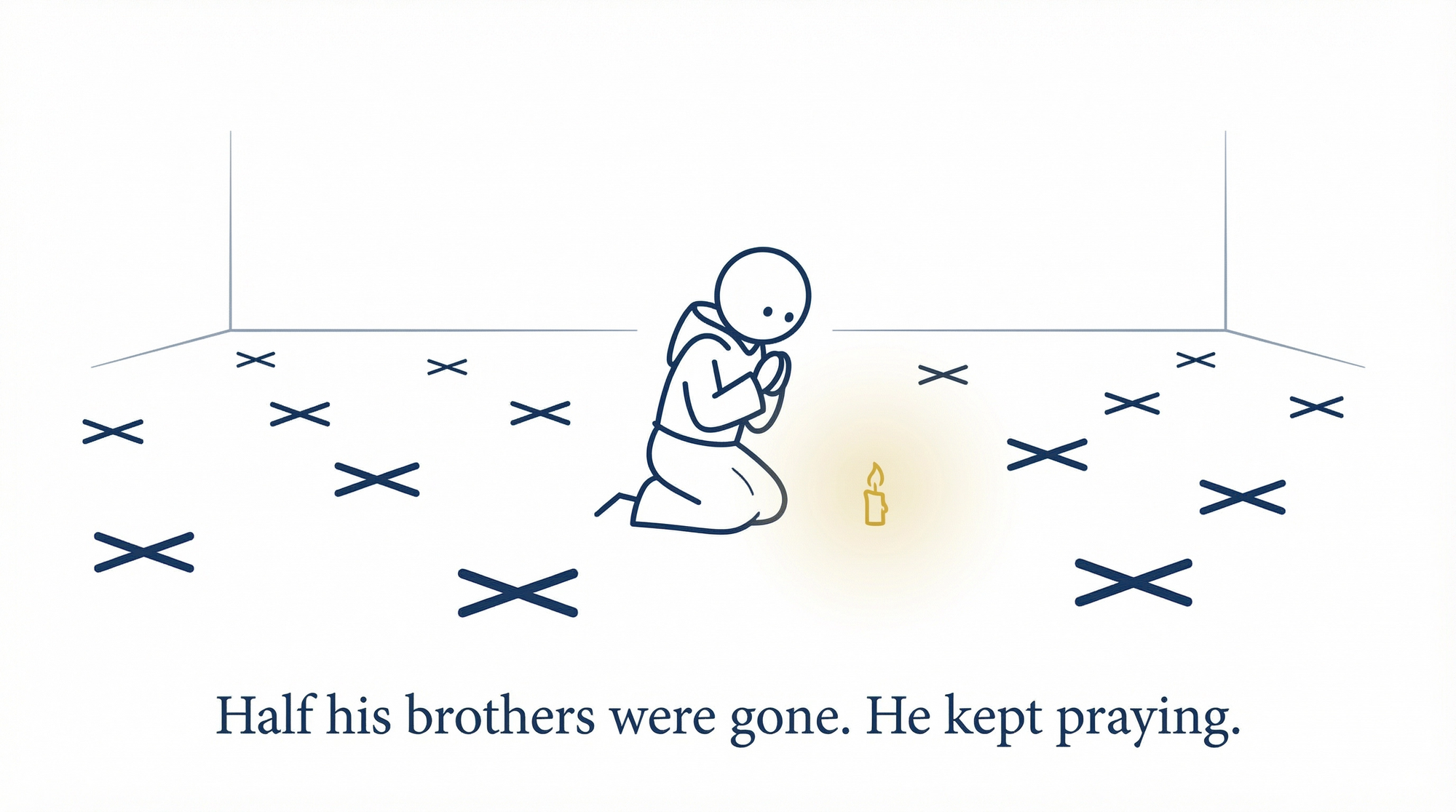
The Miracle at the Door
According to Cistercian tradition, one of the deceased monks appeared to Stephen in a vision and assured him that the foundation was pleasing to God. Hold on. Do not give up. Something is coming.
A few months later, in the spring of 1112, a young man appeared at the gates of Cîteaux. He was about twenty-two years old, from a noble Burgundian family, and he had brought twenty-nine of his relatives and friends with him. Thirty men, all at once, asking to join the strictest, poorest, most austere monastery in France.
The young man's name was Bernard.
Bernard of Clairvaux would go on to become one of the most influential figures in the entire history of Christianity. He would found dozens of monasteries, advise popes and kings, write theology that shaped the tradition for centuries, and become a Doctor of the Church. And he chose Cîteaux. He chose the swamp. He chose Stephen Harding's uncompromising vision of monastic life.
The arrival of Bernard was like a dam breaking. Suddenly, Cîteaux was overflowing with vocations. Within a few years, Stephen had to found new monasteries just to hold everyone. La Ferté in 1113. Pontigny in 1114. Clairvaux under Bernard's leadership in 1115. Morimond in 1115. By the time Stephen died, there were over seventy Cistercian houses across Europe. By the end of the twelfth century, there would be more than five hundred.
The movement that nearly died in a plague became one of the largest religious orders in the history of the Church.
The Genius of the Charter of Charity
Stephen Harding was not just a man of prayer. He was a man of remarkable organizational intelligence. His greatest contribution to the Church was not a spiritual treatise but a governance document: the Carta Caritatis, the Charter of Charity, approved by Pope Callixtus II in 1119.
The problem was simple: the Cistercian Order was growing fast. How do you keep a sprawling network of autonomous communities unified in spirit without turning them into a centralized bureaucracy?
The older Benedictine model, especially the Cluniac system, solved this by centralizing everything. The Abbot of Cluny controlled all the monks in all the daughter houses. Efficient, but it concentrated too much power in one person and stifled local leadership.
Stephen invented something different. The Charter of Charity established that every Cistercian monastery would be self-governing under its own abbot. But all abbots would gather annually at Cîteaux for a General Chapter, where they would hold each other accountable and make decisions together. The abbot of the founding house had the right to visit and inspect its daughter houses, but the daughter houses also had the right to inspect the mother house.
Mutual accountability. Shared governance. Decentralized authority held together not by power but by charity. By love. Hence the name.
Management historians have called it one of the earliest examples of a network organizational structure. It was democratic before democracy. Federalist before federalism. And it worked so well that the Cistercian Order survived for nine hundred years and counting.
The Harding Bible and the Love of Beauty in Simplicity
Stephen was also an accomplished scribe and scholar. One of his greatest achievements was a massive, multi-volume Bible, the Harding Bible, which he personally oversaw and which is considered one of the finest manuscripts of the twelfth century. He was passionate about accuracy, going so far as to consult Jewish rabbis to verify the Latin text against the original Hebrew.
This detail tells you something important. He was not anti-intellectual. He was not against beauty. He was against false beauty, ornament for the sake of showing off. The Cistercian aesthetic that Stephen championed was not ugly. It was stripped down to essentials so that the beauty that remained was honest and true. Plain stone walls. Clear glass windows instead of stained glass. Unadorned chant. The beauty of proportion, simplicity, and light.
If you have ever walked into a Cistercian church, Fontenay, Sénanque, Rievaulx, you know what this looks like. It takes your breath away. Not because of gilt and marble, but because of silence made visible. That was Stephen's vision. It is still there, nine centuries later, doing exactly what he intended: pointing the soul toward God without distraction.
What Stephen Harding Means for You
Here is why this eleventh-century English monk matters right now, today.
Stephen Harding spent most of his adult life watching his dream almost fail. He wandered for years before finding his vocation. He poured himself into a community that nearly died. He faced doubt, disease, abandonment, and the very real possibility that everything he had built was going to collapse.
And then grace showed up at the door in the form of a twenty-two-year-old named Bernard.
If you are in a season of waiting... if you have started something you believe God called you to start, and it feels like it is dying... Stephen Harding is your saint. He is the patron of the almost-abandoned dream. The saint of the nearly-empty monastery. The holy man who kept showing up when showing up seemed pointless.
He did not live to see the full impact of what he built. By the time he died on March 28, 1134, old, infirm, and nearly blind, there were about seventy Cistercian houses. He could not have imagined five hundred. He could not have imagined that his Charter of Charity would become a model for governance that would influence Western civilization. He could not have imagined that the order he co-founded would still be alive nine centuries later, with monks and nuns around the world praying the same psalms he chanted as he walked to Rome.
He just showed up. Every day. In the mud. And trusted that God would do the rest.
That is what saints do. And that is what March 28 invites us to remember.
A Prayer to St. Stephen Harding
Lord God, You called Your servant Stephen Harding through years of wandering and searching to find his home in the simplicity of Your love. Through his intercession, grant us the courage to pursue what is true even when it is difficult, the patience to endure when our efforts seem fruitless, and the faith to trust that You are working even when we cannot see the fruit. Through Christ our Lord. Amen.
St. Stephen Harding, pray for us.