

Somewhere right now, a teenager is sitting in the back of a car coming home from a funeral, staring out the window, thinking...
If God is real, why did He let this happen?
Somewhere else, a college freshman who grew up going to Mass every Sunday is in a dorm room at two in the morning reading an article titled "Why I Left Christianity," nodding along because the argument seems bulletproof. A loving God and a suffering world cannot coexist. Pick one.
And somewhere, a grandmother is on her knees in front of a crucifix, tears streaming, praying for a grandchild who just told the family they do not believe anymore. The reason? Suffering. Always suffering.
This is the question.
The big one.
The one that has toppled more faith than every atheist book ever written combined. And it is not an intellectual puzzle for most people. It is a wound. Wounds do not respond well to clever arguments. They respond to truth delivered with compassion.
So let us not argue. Let us explore. The Church has been thinking about this for two thousand years, and what she has found is not a bumper sticker answer. It is something far more surprising, far more demanding, and far more beautiful than most people expect.
The Question Nobody Is Really Asking
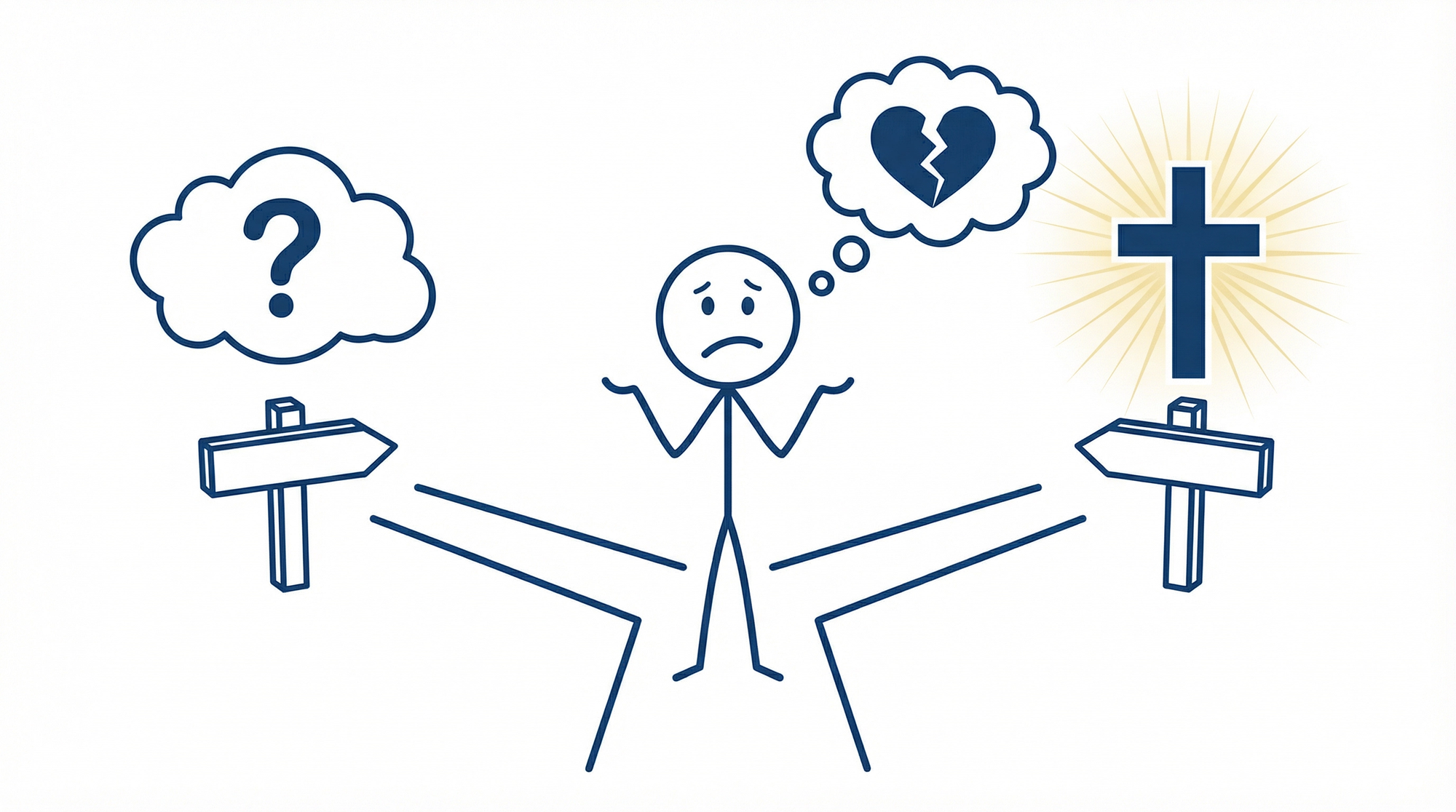
When someone asks "Why does God allow suffering?" they are almost never asking a philosophical question. They are asking a personal one.
The philosophy student who poses the "problem of evil" in a classroom wants a logical answer. But the seventeen-year-old whose best friend just died in a car accident does not want logic. She wants to know if the universe is safe. She wants to know if her friend is okay. She wants to know if a God who let that happen can still be trusted.
The Catechism acknowledges this directly. It does not pretend the question is easy:
"To this question, as pressing as it is unavoidable and as painful as it is mysterious, no quick answer will suffice." (CCC 309)
If anyone is selling you a three-step solution to the problem of evil, they are not taking the question seriously enough.
What the Church offers instead is not an explanation that removes the mystery. It is an invitation into a story that transforms it.
What Suffering Is Not
Before we explore what suffering is, we need to clear away what it is not. There is a lot of bad theology floating around, and some of it has done real damage.
It Is Not God Punishing You
This is the most destructive misconception in all of Christianity. The idea that if something bad happens to you, it must be because you did something wrong. Your child is sick? You must have sinned. You lost your job? God is disciplining you. You have depression? You must not be praying hard enough.
Jesus demolished this. In the Gospel of John, His disciples see a man born blind and ask the obvious question:
"Rabbi, who sinned, this man or his parents, that he was born blind?" Jesus answered, "Neither this man nor his parents sinned." (John 9:2-3)
Neither. The suffering was not a punishment. Full stop.
Yes, sin has consequences. Some suffering is the natural result of bad choices. But the blanket assumption that suffering equals divine punishment is not Christian theology. It is the theology of Job's friends. And God rebuked them for it:
"The Lord said to Eliphaz the Temanite: 'My anger burns against you and against your two friends, for you have not spoken of me what is right, as my servant Job has.'" (Job 42:7)
It Is Not Evidence That God Does Not Care
This is the error that drives most people away from faith. The logic seems airtight: If God is all-powerful, He could stop suffering. If God is all-loving, He would want to stop suffering. Suffering exists. Therefore, God is either not all-powerful, not all-loving, or not real.
But notice what the argument assumes: that a loving being would never allow the one he loves to experience pain.
Think about that for ten seconds and it collapses.
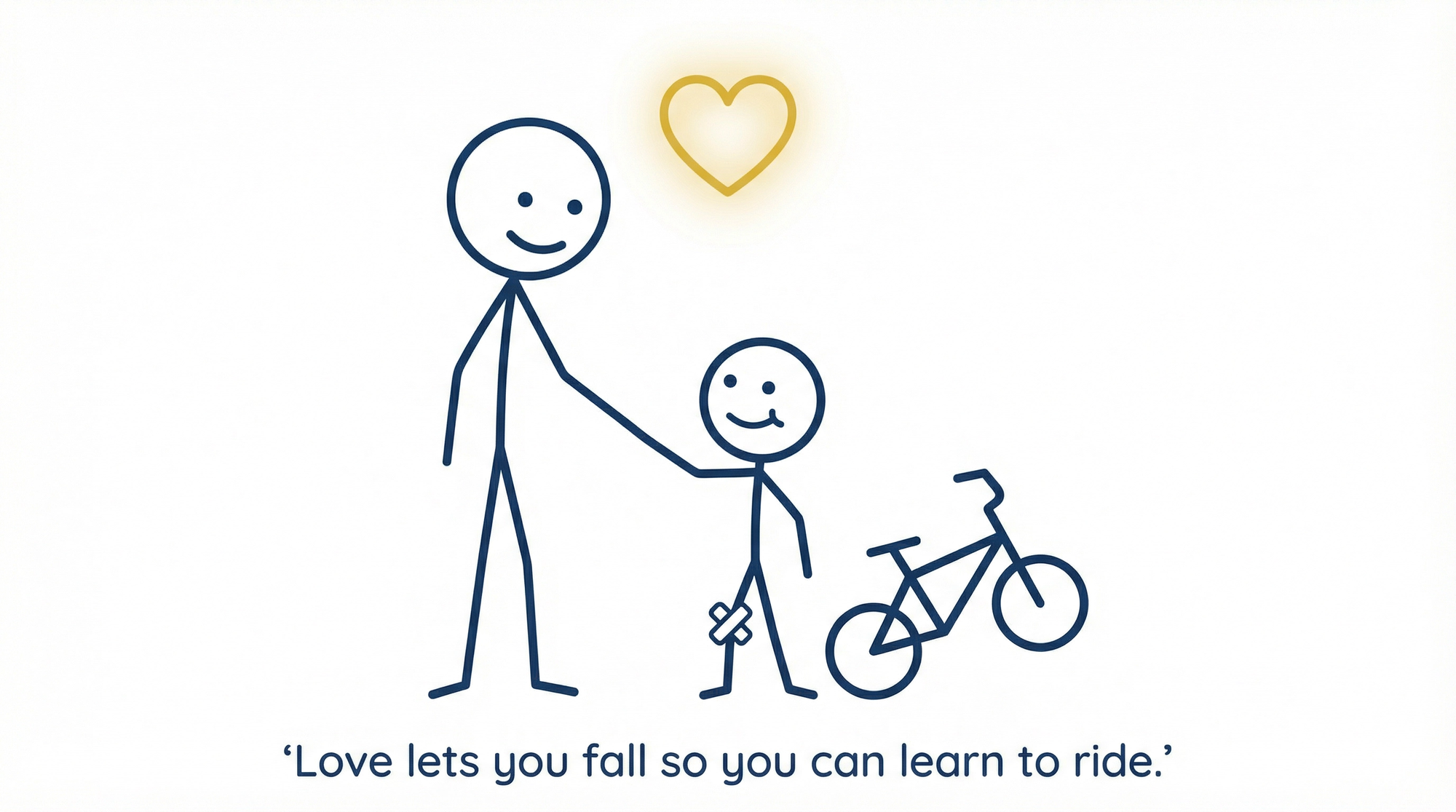
Has your mom ever held you down for a vaccination? Has a surgeon ever cut into someone to save their life? Has a coach ever pushed an athlete past the point of comfort? Has a parent ever let a toddler fall while learning to walk instead of carrying them forever?
Love does not mean the absence of pain. Love means the presence of purpose within pain.
The Book of Job: God Answered the Hardest Question With a Bigger Question
Many scholars believe Job is the oldest book in the Bible. And what is it about? Suffering. The very first extended meditation in Scripture wrestles with the exact question we are exploring.
Job is a righteous man. God Himself says so. He loses everything... his wealth, his children, his health. His friends show up and spend chapters telling him it must be his fault. His wife tells him to curse God and die. Job refuses, but he does something brave. He demands an answer from God. He wants to know why.
Then God shows up. In a whirlwind.
God does not explain the suffering. He does not give Job a lecture. Instead, He asks a series of questions:
"Where were you when I laid the foundation of the earth? Tell me, if you have understanding. Who determined its measurements... surely you know! Or who stretched the line upon it?" (Job 38:4-5)
"Have you commanded the morning since your days began, and caused the dawn to know its place?" (Job 38:12)
"Can you bind the chains of the Pleiades or loose the cords of Orion?" (Job 38:31)
For four chapters, God essentially says: The universe is so vast, so far beyond your comprehension, that the frame through which you are viewing your suffering is simply too small.
This is not God dodging the question. This is God expanding the questioner. You are operating with about one percent of the relevant information. You are a creature demanding that the Creator explain Himself through a keyhole. He is inviting you to walk through the door.
Job's response is not intellectual satisfaction. It is something deeper:
"I had heard of you by the hearing of the ear, but now my eye sees you." (Job 42:5)
He moves from knowing about God to knowing God. The suffering was not explained. It was transformed by encounter.
The answer is not an explanation. The answer is a Person.
The Cross: Where Everything Changed
Every religion in history has attempted to explain suffering. Only Christianity puts God inside of it.
We do not worship a God who watches suffering from a distance and offers explanations. We worship a God who entered into suffering, experienced it from the inside, and transformed it from within.
The Catechism says it plainly:
"God is in no way, directly or indirectly, the cause of moral evil. He permits it, however, because he respects the freedom of his creatures and, mysteriously, knows how to derive good from it." (CCC 311)
And then this astonishing line:
"From the greatest moral evil ever committed, the rejection and murder of God's only Son, caused by the sins of all men, God, by his grace that 'abounded all the more,' brought the greatest of goods: the glorification of Christ and our redemption." (CCC 312)
The single worst event in the history of the universe became the single greatest event in the history of the universe. Not because the suffering was good, but because God is so powerful that He can bring ultimate good out of ultimate evil.
This is not a philosophical principle. This is the Cross.
St. John Paul II and the Discovery That Changed Everything
No modern thinker has explored suffering more deeply than St. John Paul II. And he did not do it from an armchair.
Karol Wojtyła grew up in occupied Poland. His mother died when he was eight. His brother died when he was twelve. His father died when he was twenty. He lived through the Nazi occupation and the Soviet takeover. He was shot in an assassination attempt in 1981. He spent the last decade of his life battling Parkinson's disease in front of the entire world.
This was not a man who theorized about suffering. He was baptized in it.
In 1984, he published Salvifici Doloris ("On the Christian Meaning of Human Suffering"), and it contains what may be the most profound insight ever written about pain. Christ does not merely explain suffering. He transforms it by entering into it. And because of that, every person who suffers can unite their suffering to Christ's, and that union gives their suffering redemptive power.
St. Paul said it first:
"Now I rejoice in my sufferings for your sake, and in my flesh I am filling up what is lacking in the afflictions of Christ on behalf of his body, which is the church." (Colossians 1:24)
Wait. What is lacking in Christ's suffering? Was it not enough?
John Paul II explains: nothing is lacking in the value of Christ's sacrifice. It is infinite. What is "lacking" is our participation in it. Christ has opened a door, but we have to walk through it. He has offered us the dignity of being co-workers in the redemption of the world, and the currency of that work is love expressed through sacrifice.
This is what "offering it up" actually means. It is not passive acceptance of injustice. It is the most radical act of spiritual rebellion possible. It takes the very thing that evil intended to use to destroy you and hands it to God as a weapon against evil itself.
Think of it this way. A bully punches you and expects you to crumble. Instead, you take that punch and use the pain to fuel an act of love for someone else. You have just reversed the polarity of the suffering. What was meant for destruction became a vehicle for grace.
Four Answers (And Why You Need All of Them)
The Church does not offer one answer to the question of suffering. She offers a framework with multiple layers.
1. Free Will and the Price of Love
God created us with free will because love requires freedom. A robot programmed to say "I love you" is not loving. A person who chooses to say it is. But genuine freedom means the genuine possibility of choosing evil. Much of the suffering in the world is the direct result of human beings using their freedom badly.
"God created man a rational being, conferring on him the dignity of a person who can initiate and control his own actions." (CCC 1730)
Could God have created a world without free will? Perhaps. But it would have been a world without love, without virtue, without courage, without sacrifice. It would have been a terrarium, not a family.
2. The Fallen World
But what about earthquakes? What about cancer? What about a child born with a genetic disorder? No human chose those things.
The physical world itself has been affected by the Fall. When humanity turned away from God, the harmony between Creator, creature, and creation was fractured. St. Paul writes:
"For we know that the whole creation has been groaning together in the pains of childbirth until now." (Romans 8:22)
The natural world is not functioning as it was designed to. It is broken, and its brokenness produces suffering. This does not mean God sends earthquakes as punishment. It means we live in a world that is not yet fully healed. The redemption Christ won on the Cross has begun but is not yet complete.
3. Suffering as a Path to Growth
No parent wants their child to suffer. But every good parent knows that some suffering is necessary for growth. The teenager who never faces a challenge becomes an adult who cannot handle adversity.
"For the moment all discipline seems painful rather than pleasant, but later it yields the peaceful fruit of righteousness to those who have been trained by it." (Hebrews 12:11)
God can use suffering as raw material for transformation. Just as fire purifies gold by burning away impurities, suffering can purify the soul by burning away attachments, pride, and spiritual complacency.
St. Teresa of Ávila, who suffered enormously from illness throughout her life, once told God: "If this is how You treat Your friends, no wonder You have so few of them." She was not being irreverent. She was being honest. And God honored that honesty by making her one of the greatest mystics the Church has ever known.
4. The Mystery That Remains
After all of this, suffering retains an element of mystery. We do not claim to have a complete answer.
"We firmly believe that God is master of the world and of its history. But the ways of his providence are often unknown to us." (CCC 314)
This is not intellectual cowardice. This is intellectual honesty. Any system that claims to have a neat, complete, fully satisfying answer to the problem of evil is either lying or has not taken the question seriously enough.
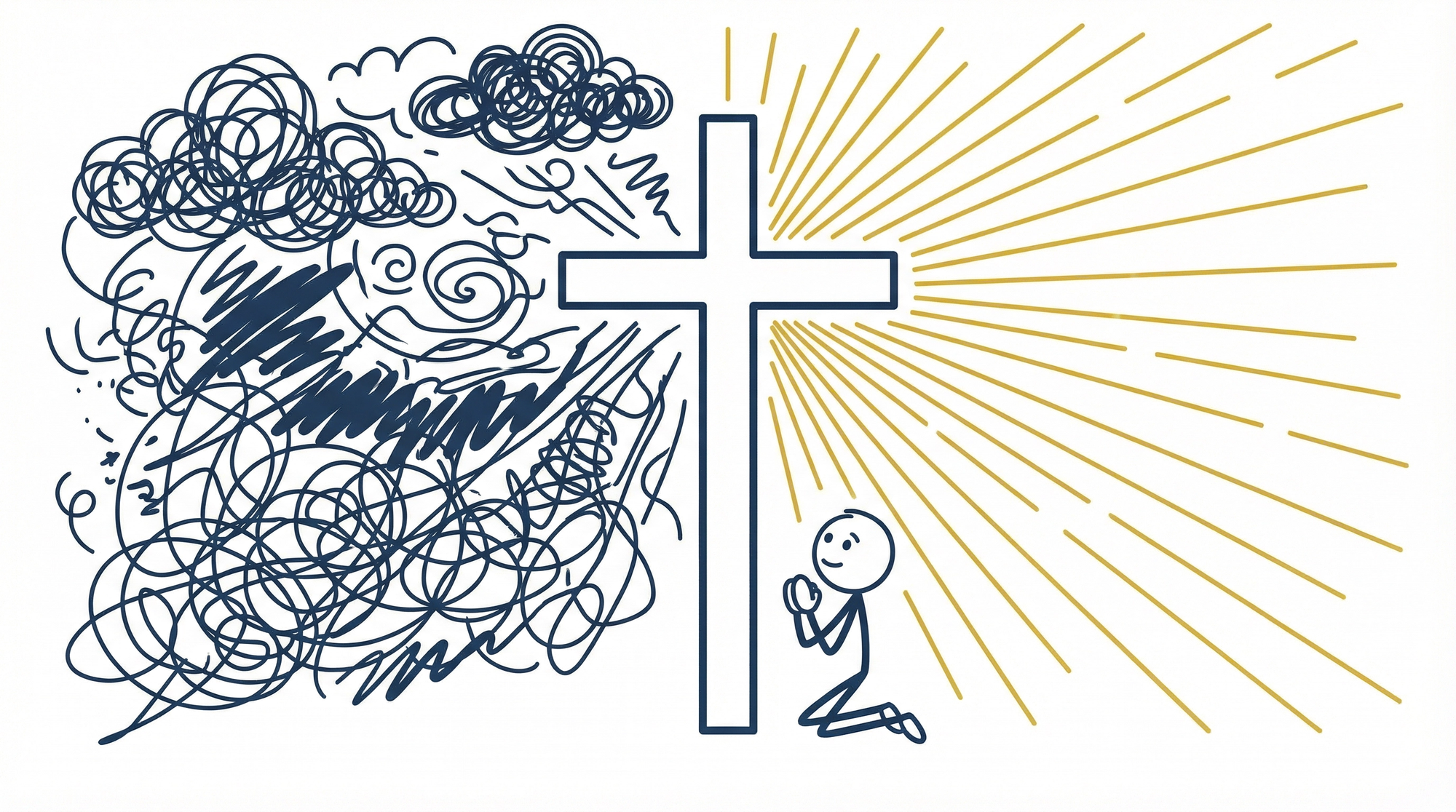
The answer to suffering is not a concept. It is a crucifix. God hanging on a cross, suffering with us, suffering for us, transforming suffering from the inside out.
What the Saints Discovered Inside the Furnace
The saints are the Church's laboratory. They took this theology and tested it in the most extreme conditions possible. Their testimony is remarkably consistent.
St. Thérèse of Lisieux died of tuberculosis at twenty-four. In her final months, she experienced a devastating dark night of the soul in which she felt as though heaven did not exist. Yet she continued to offer every moment of her agony for the conversion of sinners.
St. Maximilian Kolbe volunteered to take the place of a stranger in the starvation bunker at Auschwitz. He spent two weeks dying of hunger and thirst while leading the other condemned men in prayer and hymns. When the guards came to finish him off with a lethal injection, he held out his arm willingly. A witness said his face was calm and radiant.
St. Mother Teresa spent nearly fifty years in a spiritual darkness in which she felt no consolation from God. Yet she served the poorest of the poor in Calcutta every single day. Her suffering, offered in love, became the engine of one of the greatest charitable works in modern history.
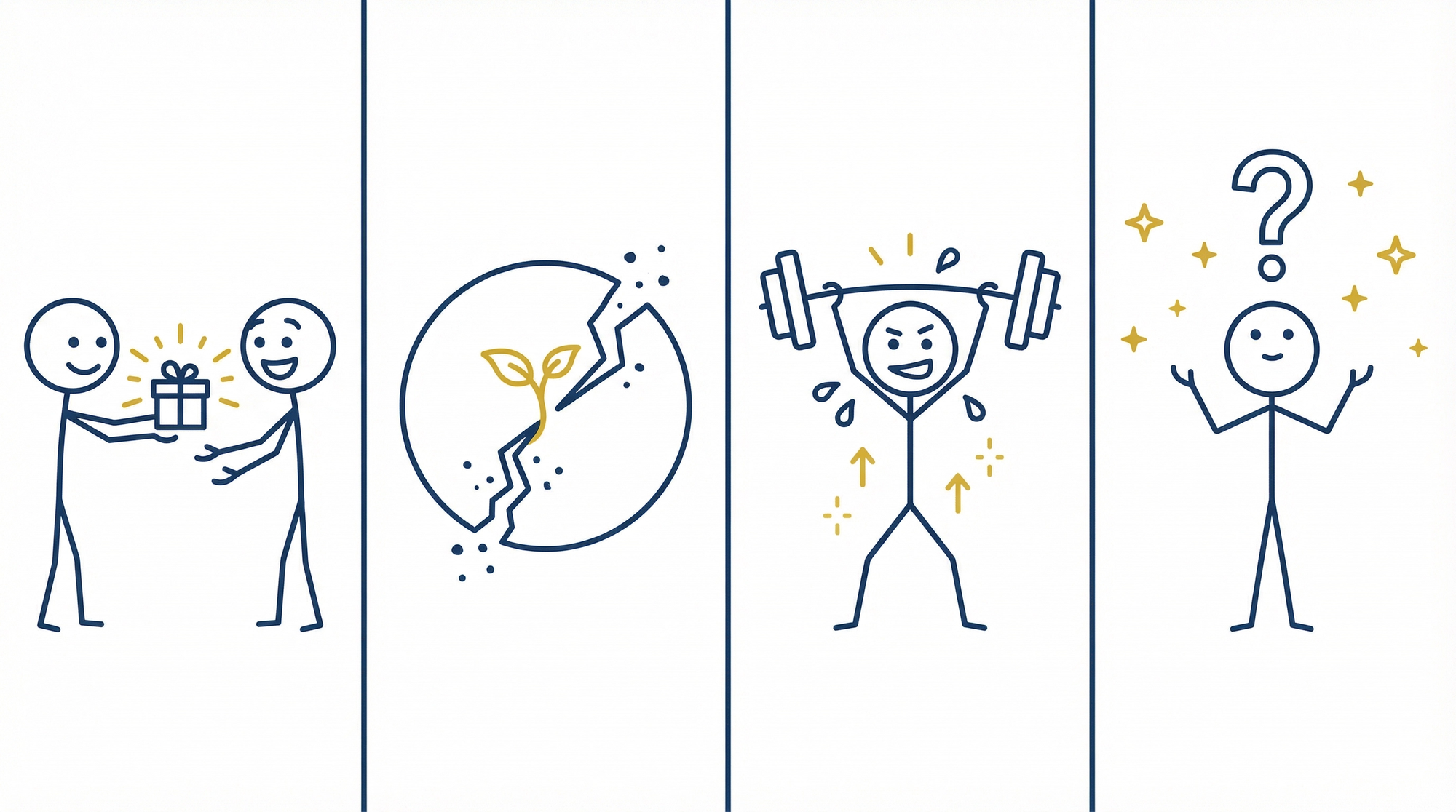
None of them enjoyed their suffering. None of them sought it out. But all of them discovered something inside it they could not have found any other way: a deeper union with Christ, a more powerful love, and a fruitfulness that continues long after their deaths.
If You Are Suffering Right Now
If you are reading this in the middle of real pain, not theoretical, not academic, but the kind that makes you wonder if you can make it through the day... I want to say something directly.
Your suffering matters. It is not meaningless. It is not random. It is not a sign that God has abandoned you.
You are allowed to be angry. You are allowed to cry. You are allowed to ask God why with every ounce of emotion in your body. Job did. David did. Jesus Himself did:
"My God, my God, why have you forsaken me?" (Matthew 27:46)
Asking why is not a failure of faith. It is an act of faith. You are directing your anguish toward the One who can actually do something about it. That is prayer in its rawest, most honest form.
And if you can, even in the smallest way, try this: take one moment of your pain and silently say, "Lord, I offer this for [someone you love]." You may not feel anything. You may not understand how it works. But the entire weight of two thousand years of tradition testifies that something happens in that moment. Your suffering, united to Christ's, becomes a prayer more powerful than any words you could say.
You are not alone. You are held by a God who knows exactly what your pain feels like, because He has been inside it.
Where to Go From Here
Read the Book of Job. Start with chapters 38 through 42, where God finally speaks. Let it wash over you.
Pick up Salvifici Doloris by St. John Paul II. It is available free on the Vatican website. It is short. Read it slowly. It will change how you see every moment of pain for the rest of your life.
And the next time suffering comes... because it will... try the experiment. Offer it. Give it to God. See what happens. The saints who did this consistently report the same thing: what looked like destruction became the raw material for the most meaningful thing they ever did.
The question is not whether God is good. He proved that on the Cross. The question is whether we will trust Him enough to let Him transform our suffering the way He transformed His own.