

If you're a Protestant walking into a Catholic church a little early on a Sunday, you might see someone reciting the Rosary with her hands on beads.
Then you also might see someone lighting a candle and whispering a prayer to Mary.
From the outside, it looks exactly like worship.
If it is worship, then Catholics are violating the first and most fundamental commandment of God.
So the question is real, and it deserves an honest answer, not a defensive one.
The first thing you need to know is that this question has confused people for five hundred years, and the confusion is not because Catholics are hiding something.
It is because the distinction between two different kinds of reverence is real, important, and genuinely hard to explain in a culture that does not have clear language for it anymore.
The Distinction That Makes All the Difference
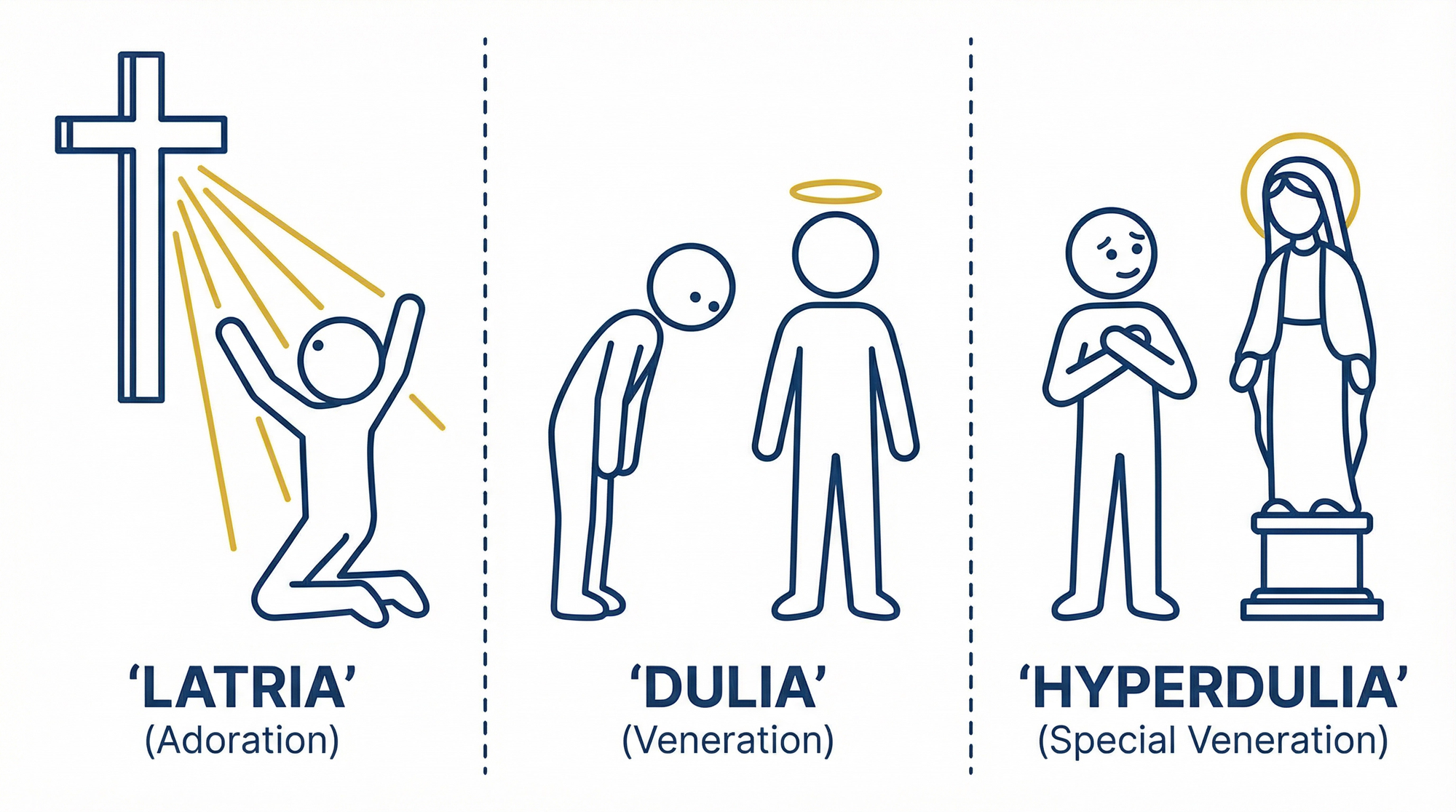
The most important word you have never heard of is latria.
Latria is the Greek word for the kind of honor and worship that belongs to God alone. It means the deepest reverence, the complete surrender of the will, the recognition of ultimate authority and power. You give latria to God because God is God. Nobody else deserves it. Not an angel, not Mary, not a saint, not a Pope, not even a king.
There is another word: dulia.
Dulia is the Greek word for the honor and respect we can rightly give to those who are holy and worthy of honor. You can honor your parents. You can respect a saint. You can recognize the dignity of someone who lived a life of radical faith. That is dulia. It is real reverence, but it is fundamentally different in kind from the absolute worship we give to God.
And there is a third word: hyperdulia.
That is the special honor given to Mary because she holds a unique place in salvation history. She said yes to becoming the Mother of God. No other human being will ever hold that position. So while she is not worshiped like God is worshiped, she is honored in a way that no other creature is honored.
The Catechism explains it this way:
"The Catholic Church's devotion to Mary is intrinsic to Christian worship. Mary's veneration differs essentially from the adoration which is given to the incarnate Word and to the Father and the Holy Spirit." (CCC 971)
That word, "essentially," means something fundamental has changed. It is not a matter of degree, like the difference between liking something and loving it. It is a matter of kind, like the difference between a painting and a flower.
Most people in the modern world have lost the ability to hold two kinds of deep respect in mind at the same time. We tend to think in terms of poles. You either worship something with absolute devotion, or you barely respect it at all. The middle ground where you can honor someone deeply without worshiping them feels impossible to most Americans.
But consider this. A soldier salutes his commanding officer. That salute is a sign of honor and respect. That same soldier would never salute God. The honor is real in both cases, but it is fundamentally different in kind.
What Scripture Actually Says About Mary
People often assume that the Catholic devotion to Mary is something the early Church added later. That it came from pagan religions or medieval superstition. But when you actually open the Bible, you find something surprising from the very beginning.
The Archangel Gabriel does not greet Mary the way he greets anyone else in Scripture. When he appears to Zechariah, he just announces what he is there to do. But with Mary, he begins differently:
"Hail, favored one, the Lord is with you!" (Luke 1:28)
The Greek word translated as "favored one" is kecharitomene, which literally means "full of grace." The angel is addressing her with special honor and respect from the first word.
Then Elizabeth, when the Spirit fills her and she recognizes who is standing in front of her, cries out:
"Blessed are you among women, and blessed is the fruit of your womb!" (Luke 1:42)
Notice what she does not do. She does not fall down and worship Mary. She does not offer her prayer to Mary. But she does offer her praise. She blesses her. She recognizes her as someone special, someone set apart.
Even Mary herself, in the Magnificat, seems to understand what her role is:
"Surely, from now on all generations will call me blessed." (Luke 1:48)
She is not saying all generations will worship her. She is saying they will recognize her as blessed, as specially chosen. There is honor there, but it is not worship.
Later, in the Gospel of John, Jesus is at a wedding in Cana. His mother approaches him:
"They have no wine." Jesus said to her, "Woman, how does your concern affect me? My hour has not yet come." His mother said to the servers, "Do whatever he tells you." (John 2:3-5)
This is fascinating because Jesus's response sounds almost cold. "Woman, how does your concern affect me?" But then Jesus performs his first miracle. And afterward, the servers do whatever Mary tells them to do, because she had instructed them to follow Jesus' guidance.
What is happening here? Mary is not commanding divine power. But she is being listened to, respected, and followed. She has a kind of authority in this scene, but it is not divine authority. It is the authority of someone who knows Jesus and trusts in his power, and who others trust to guide them toward what is right.
What the Early Church Fathers Said
If you want to understand what the early Christians believed, you need to listen to the Church Fathers. These were the people who lived closest to the apostles, who were either taught by them or taught by those who were taught by them.
And they had a lot to say about Mary.
St. Ephraem, who lived in the fourth century, wrote hymns honoring Mary. He called her "the Mother of Christ" and spoke of praying to her for intercession. The prayers were not worship. But they were real prayers for help.
St. Jerome, who translated the Bible into Latin, called Mary "ever-virgin" and defended that teaching against those who doubted it. He wrote about the unique honor due to her because of who she was.
St. Augustine, one of the greatest minds the Church has ever known, wrote about Mary's role in our redemption. He recognized her as someone special, someone who cooperated with God's plan in a way no other human being did.
None of these men were confused about the difference between honor and worship. They worshiped God alone. But they honored Mary deeply, and they believed that honor was not just acceptable, it was right and good.
The prayers to Mary that developed in the early Church reflect this understanding. When an early Christian prayed to Mary, they were not asking her to save them. They were not giving her the worship that belongs to God alone. They were asking for her prayers on their behalf, just as you might ask a living person to pray for you.
The "Praying to Mary = Worship" Objection
Let us address this directly because it is the thing that trips up most people trying to understand Catholicism.
When a Catholic prays to Mary, they are not doing what they do when they pray to God. But in English, we only have one word for both actions. We "pray." And when you use the same word for two different things, confusion is inevitable.
When Catholics pray to God, they are praying to someone who is omniscient, omnipotent, and eternal. God knows every thought before it is spoken. He has the power to answer every prayer. He is present everywhere at the same time. They are worship prayers, adoration prayers, surrender prayers.
When Catholics pray to Mary, they are asking someone who loves them and who is close to Jesus to intercede on their behalf. They are asking for her prayers, her help, her advocacy. It is the same kind of thing as asking a living saint to pray for you, except Mary is no longer limited by being in one place at a time.
Why would anyone ask Mary to pray for them? For the same reason you would ask anyone to pray for you. Connection. Confidence. The belief that this person's prayers matter.
A mother's prayers for her children are powerful. A saint's prayers matter. And if Mary is the Mother of God, if she stood at the foot of the cross and watched her son die for the world, if she is now in heaven, interceding for us, why would we not ask for her prayers?
The Catechism puts it this way:
"We can, then, understand the meaning of the devotion we show to Mary. If we honor Mary, we honor Christ." (CCC 971)
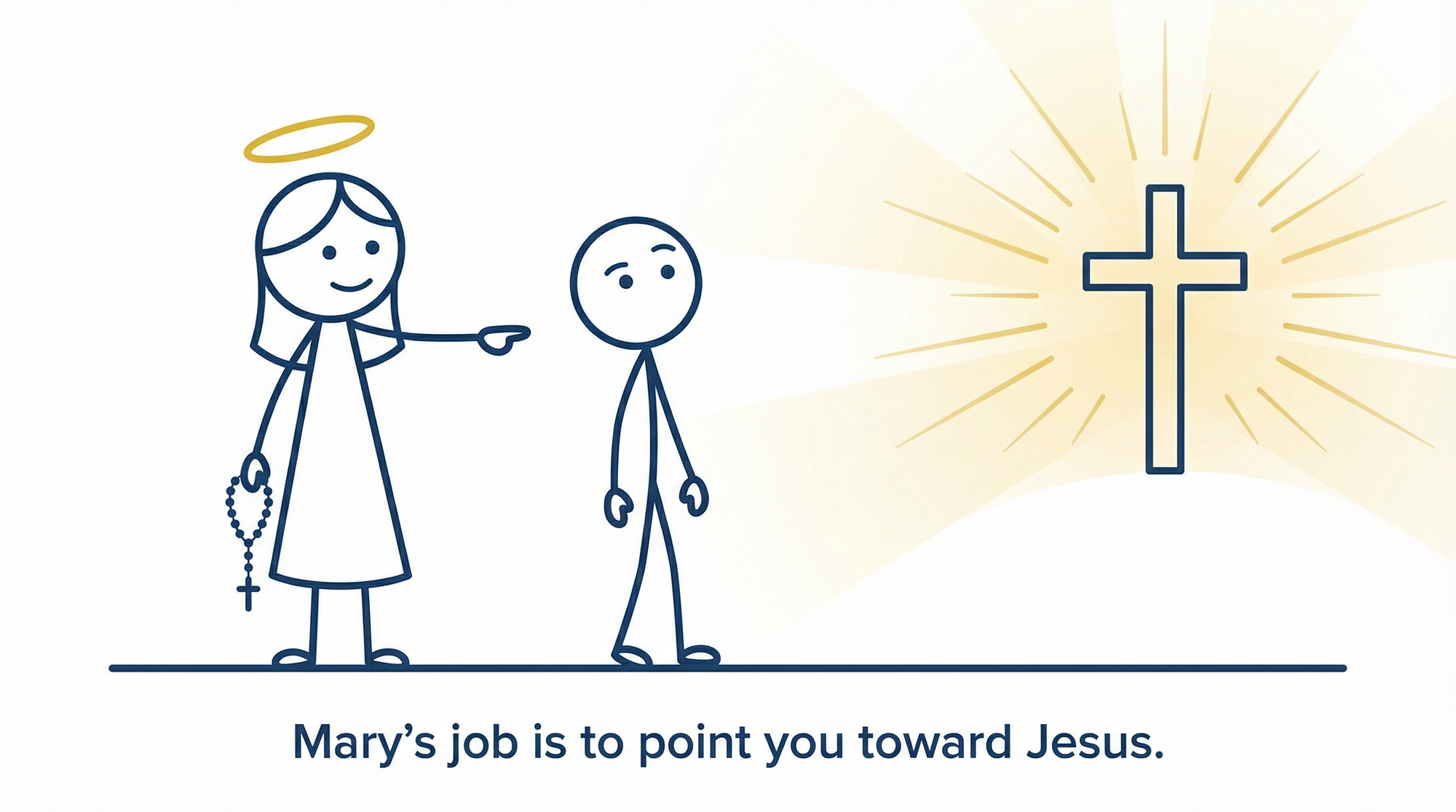
The prayers to Mary are not parallel tracks to prayers to Jesus. They are connected. They point toward him. When you pray the Rosary, you are meditating on the mysteries of Jesus' life, and asking Mary to pray with you for those intentions. The rosary beads themselves have a crucifix on them. Every decade ends with a Glory Be, which is a prayer to the Trinity. Mary is the vehicle, not the destination.
Think of it this way. If you have a friend whose mother is influential and wise, and you want to make a request, you might ask your friend to ask his mother to advocate for you. That is not insulting to the mother. That is recognizing the reality of relationships and influence. That is how intercession works.
What Catholics Actually Do With Mary
Let us talk about the concrete practices. Because understanding the theology is one thing. Seeing how it plays out in actual Catholic life is another.
The Rosary
The Rosary is probably the most famous Marian devotion. It is a string of beads used to count prayers. A person prays the Our Father, ten Hail Marys, a Glory Be, and an O My Jesus prayer ten times. That cycle repeats five times for a full Rosary.
But here is what people miss. The Rosary is not really about saying lots of prayers to Mary. It is about meditating on the mysteries of Jesus' life while Mary's name functions like a chorus.
You are holding the mysteries in your mind: the Annunciation, when Mary said yes to God's plan. The Visitation, when she traveled to see her cousin. The Nativity, when she gave birth to Jesus. The Finding of Jesus in the Temple, when she searched for him in distress. Each mystery is a moment in Jesus' story, and you are asking Mary to help you understand it, to pray with you about it.
The Hail Mary prayer itself reveals what is actually happening:
"Hail Mary, full of grace, the Lord is with you. Blessed are you among women, and blessed is the fruit of your womb, Jesus. Holy Mary, Mother of God, pray for us sinners, now and at the hour of our death. Amen."
Notice what you are actually asking. You are not asking her to forgive you. You are not asking her to save you. You are asking her to pray for you. The word "sinners" in that prayer is "us sinners," not you. You are confessing your own sinfulness while asking for her intercession.
Consecration to Mary
Another practice is consecration to Mary. A Catholic will say: "I consecrate myself to Mary" or even "I place myself under Mary's protection."
This sounds alarming if you think it means giving yourself over to Mary as a god. But it means something more like asking for her special protection and guidance, committing yourself to live out the virtues she lived out, and asking her to help you grow closer to Jesus.
It is similar to asking a mentor or spiritual director to guide you. Except Mary is not a mentor. She is the Mother of God, and Catholics believe that mothers protect their children, intercede for them, and want them to grow into the people they were meant to become.
Marian Apparitions
The Church also honors the various places where Mary is believed to have appeared. Fatima in Portugal. Lourdes in France. Guadalupe in Mexico. Each apparition has its own story, and the Church carefully investigates them to determine if they are real.
But again, notice what the Church actually teaches about these. At Fatima, Mary appeared to three children and gave them a message. The Church does not say that what Mary said at Fatima is new doctrine. It is not an addition to Scripture or the deposit of faith. The messages from apparitions always point back to Jesus, call people to prayer, call them to repentance, call them to live their faith more deeply.
The Historical Development of Marian Devotion
One objection many people raise is this: "If Marian devotion is biblical, why did not see it as prominently in the early Church?"
That is actually a fair question. The answer is that Marian devotion did develop over time. But so did our understanding of almost everything in Christianity.
The early Church believed Jesus was God, but it took them centuries to develop the precise language of the Trinity. The early Church believed in one God, but it took theological development to explain how Jesus could be God while also being the Son of God. These were not additions to the faith so much as deeper understandings of truths that were always there.
With Mary, the same thing happened. The earliest Christians recognized her as special, as the one who said yes when the angel asked. Over time, as they reflected on what it meant that she became the Mother of God, that she was asked to cooperate with God's plan, that she stood at the cross and loved Jesus through suffering, the Church's understanding of her role deepened.
By the time of the Council of Ephesus in 431, the Church formally declared that Mary was truly the Mother of God, not just the mother of Jesus's human nature, but the mother of Jesus himself. This was not new. It was the Church formalizing what had been believed all along.
The more recent Marian dogmas came even later. The Immaculate Conception was defined in 1854. The Assumption was defined in 1950. But the Church defines doctrines when it needs to defend them against heresy or when it needs to clarify what has been believed all along.
Why the Immaculate Conception? Because if Mary was going to be the Mother of God, if she was going to carry and give birth to God himself, then she could not have been stained by sin in the way you and I are. That is not adding something new. That is drawing out the logical implications of something the Church had always believed.
Why the Assumption? Because if Jesus rose from the dead and went to heaven, and if Mary was the one most closely united to Jesus, would Jesus have allowed his own mother to remain in the grave? Would the one who honored his mother from the cross have dishonored her in death? Again, it is not new doctrine. It is the Church saying out loud what has been believed quietly for centuries.
Mary and the Saints
It is important to understand that Marian devotion does not exist in isolation. The Church teaches about the veneration of all the saints. Mary is not alone.
The Bible speaks about the communion of saints, the understanding that the Church is not just made up of living people on earth. It is made up of all the faithful, living and dead, who are united in Christ. When you ask a saint to pray for you, you are recognizing that this person, now in heaven, still loves you, still cares about you, and can speak to God on your behalf.
The Catechism explains:
"It is not that we need any intermediary to approach God, since Christ is the one mediator. Rather we honor the saints and seek their prayers as a way of strengthening our own faith and drawing closer to Christ." (CCC 956)
That last part is key. The whole point of asking a saint to pray for you, of asking Mary to intercede for you, is to draw closer to Christ. If it did not do that, if it distracted you from Jesus, the Church would not encourage it.
Think of it like asking someone whose spiritual life you respect to pray with you. You are not replacing your own prayer to God. You are asking for help, for partnership in prayer, for the strength that comes from knowing others are standing with you.
What Catholics Do NOT Teach About Mary
Let us be crystal clear about what the Church does not teach.
The Church does not teach that Mary is a co-redemptrix in the sense that she saved anyone. Jesus is the sole redeemer. His sacrifice alone is sufficient.
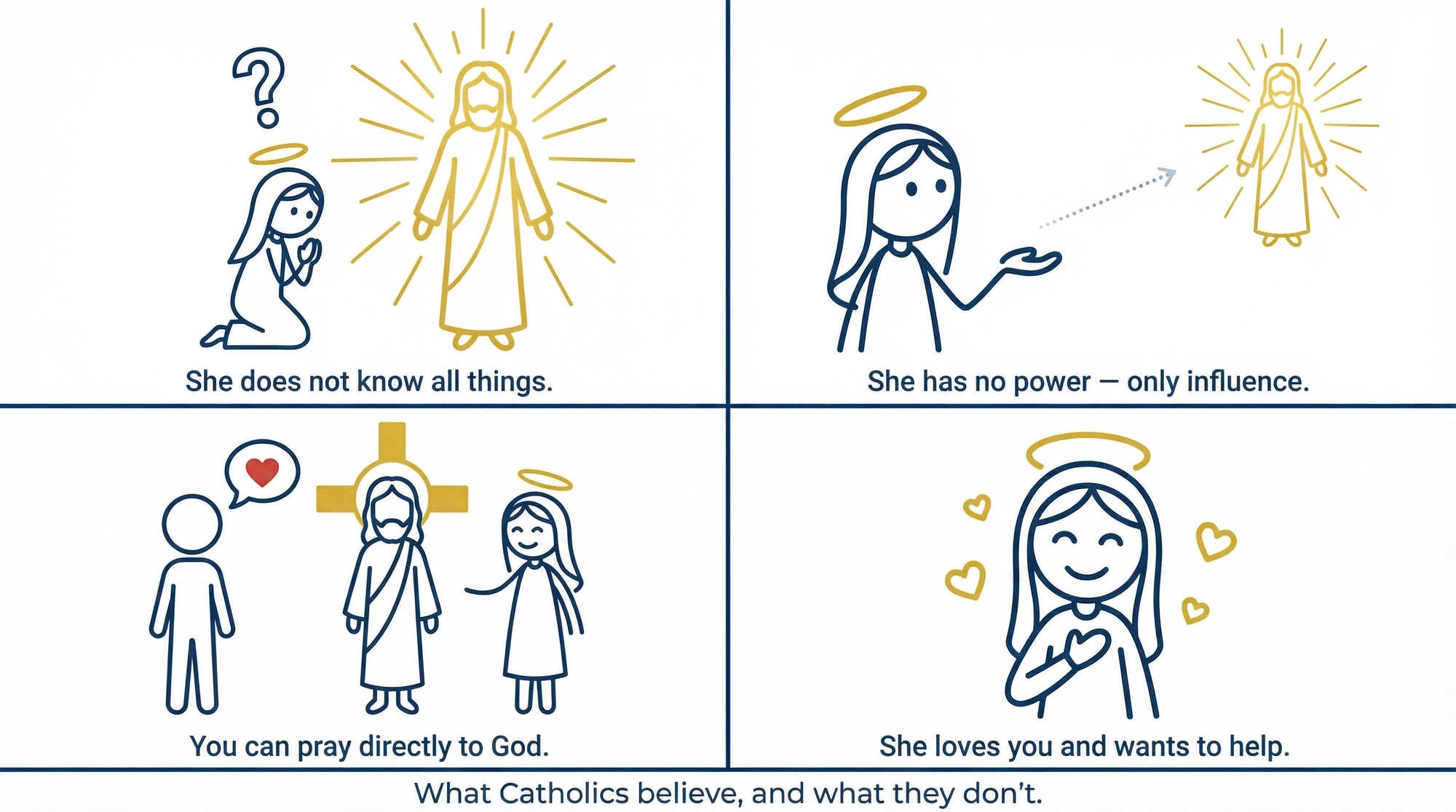
The Church does not teach that Mary answers prayers. God answers prayers. Mary can ask God to answer your prayers, but she does not have power over God or answers in herself.
The Church does not teach that Mary knows everything or is present everywhere. She is a creature, not divine. She is in heaven, but she is not omniscient or omnipresent.
The Church does not teach that you need Mary to reach God. Jesus said, "I am the way, the truth, and the life" (John 14:6). You can go directly to God. You can pray directly to Jesus. Nothing in Catholic theology says you must go through Mary.
What the Church does teach is that Mary, who loves you, who understands your struggles because she lived a human life, can ask her son to help you. And that recognizing this gift, asking for her intercession, honoring her unique role, is not idolatry. It is gratitude to the one who said yes so that the Incarnation could happen.
Do Catholics worship Mary? No.
But they honor her, deeply and genuinely.
They ask for her prayers the way you might ask a friend to pray for you. They recognize that she held a unique place in salvation history, that she said yes when it mattered most, that she understood suffering and faith in a way few humans ever have.
-
They do not believe she saved them. They know Jesus did.
-
They do not believe she answers prayers. They know God does.
-
They do not believe they need her to reach God. They know they can pray directly to Jesus.
But they do believe that she loves them, that she is still their mother, that her prayers matter, and that asking for her help points them back to her son.
If that is worship, then mothers everywhere are guilty, because mothers have always interceded for their children, and children have always asked their mothers to pray for them.
The language is different now. In the medieval world, when everyone had large families and knew the importance of a mother's protection and a mother's prayers, the theology made intuitive sense. Now, when we live in a more individualistic culture, it takes explanation.
But the reality is the same as it always has been. Mary is the Mother of God. She loves her son. She loves the children of her son. And she is waiting for you to ask her to pray for you.
It is not worship. It is not even required. But for those who understand it, it is one of the great gifts that the Church offers.