

TL;DR: Most Catholic-Protestant conversations crash and burn within 60 seconds because somebody leads with an argument instead of a question. These five conversation openers flip the script by using curiosity, shared love for Jesus, and a little psychology to keep the door open. Plus, we'll cover what to do when things get heated, borrowing some brilliant moves from Protestant apologist Greg Koukl's playbook.
Key Takeaways
- Lead with questions and curiosity, never with arguments and corrections
- The five openers (Curious Learner, Shared Foundation, Personal Testimony, Historical Wonder, Permission-Based) all work by lowering defenses before exploring differences
- Koukl's Columbo tactic ("What do you mean by that?" and "How did you come to that conclusion?") keeps you in the driver's seat without being aggressive
- Your goal is NOT to convert anyone in a single conversation. Your goal is to place one stone in one shoe
- When someone steamrolls you: stop them, name the behavior, and exit gracefully if needed
- "I don't know, let me look into that" is one of the strongest moves in apologetics
- Learn to spot self-defeating statements (claims that refute themselves when applied to themselves)
- The person across from you is a fellow Christian, not an opponent. Treat them accordingly
- St. Francis de Sales had it right: honey beats vinegar every single time
Why Do These Conversations Always Go Sideways?
Picture this. You're at a neighborhood cookout. Somebody mentions they just got back from a church retreat. You mention you're Catholic. And suddenly the temperature changes.
"Oh... so you guys worship Mary, right?"
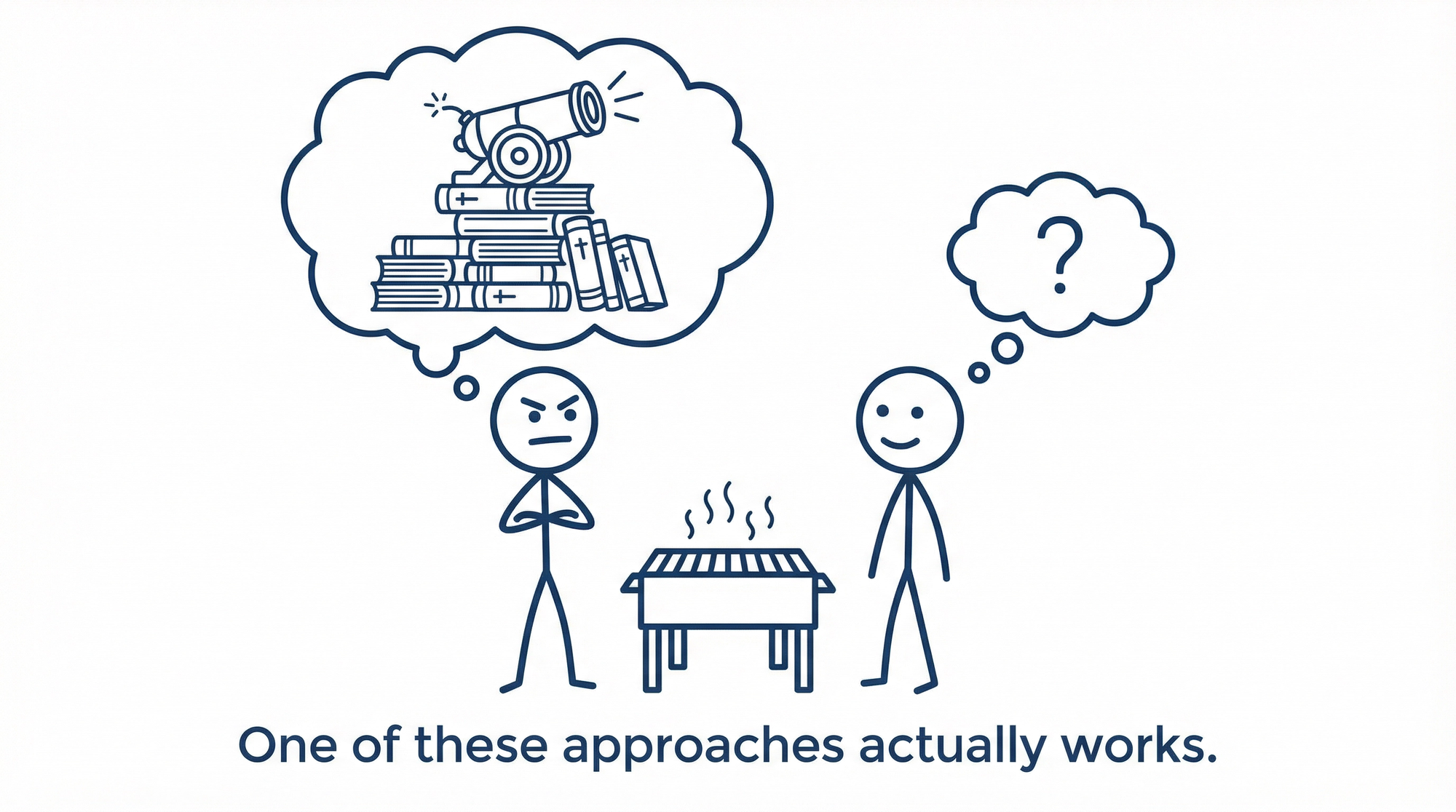
And just like that, you're on defense. Your brain starts loading up arguments like a Civil War cannon. You want to say, "Actually, we don't worship Mary, and let me explain the difference between latria and dulia and also here's what the Council of Trent said and..."
But their eyes are already glazing over.
Here's the thing most Catholics get wrong about these conversations: we treat them like debates when they should be dinner conversations. We come in armed with Aquinas when what the moment actually needs is a good question and a genuine smile.
I've been on both sides of this. I've been the guy loading the theological cannons. And I've been the guy who learned, sometimes the hard way, that winning the argument usually means losing the person.
So let me share five conversation openers that actually work, why they work, and what to do after the door swings open.
Opener #1: "What First Drew You to Your Church?"
This is the Curious Learner approach, and it's probably the most powerful one in the bunch.
Here's why it works: you're making them the expert. You're asking them to tell their story. And people absolutely love talking about their story. There's zero threat here because you're not making any claims. You're not even hinting that you think they're wrong about anything. You're just genuinely curious about their journey.
The psychology is simple. When someone feels heard, they become willing to listen. When someone feels interrogated, they build walls. This opener is all listening, zero interrogation.
What happens next: You actually listen. Not "waiting for your turn to talk" listening. Real listening. Ask follow-up questions about their journey. Show genuine interest. After they've shared their story, the natural reciprocal question almost always follows: "So what about you? What's your church like?" And now you have an invitation to share what drew you to Catholicism.
Notice what just happened. You didn't force the door open. They opened it for you.
The key here is to focus on what attracted you TO Catholicism, not what you think is wrong with their church. Talk about the beauty of the Eucharist. The depth of 2,000 years of intellectual tradition. The way the liturgy connects you to Christians across centuries. Let your love for the faith do the heavy lifting.

Opener #2: "We Both Love Jesus. How Did We End Up in Different Traditions?"
This is the Shared Foundation approach. And it's sneakily effective.
By leading with "we both love Jesus," you've just done something powerful. You've established common ground before any differences enter the conversation. You've said, in effect, "We're on the same team at the most fundamental level."
This matters more than you think. In conversation psychology, there's a concept called in-group identity. When people feel like they belong to the same tribe, they process disagreements differently. Instead of "that person is attacking my beliefs," it becomes "someone from my team sees things differently, and I'm curious about that."
What happens next: Build on the common ground first. Talk about your shared love of Scripture. Your prayer life. The ways you both try to serve your communities. Only after you've built real rapport do you gently explore differences with something like, "I'm curious how you understand [the Eucharist/apostolic succession/the role of tradition] differently than I do."
See the frame? You're not saying, "Here's why you're wrong about the Eucharist." You're saying, "I'm curious how you see it." One invites conversation. The other invites combat.
Opener #3: "Want to Hear Why I Became Catholic? No Sales Pitch, I Promise."
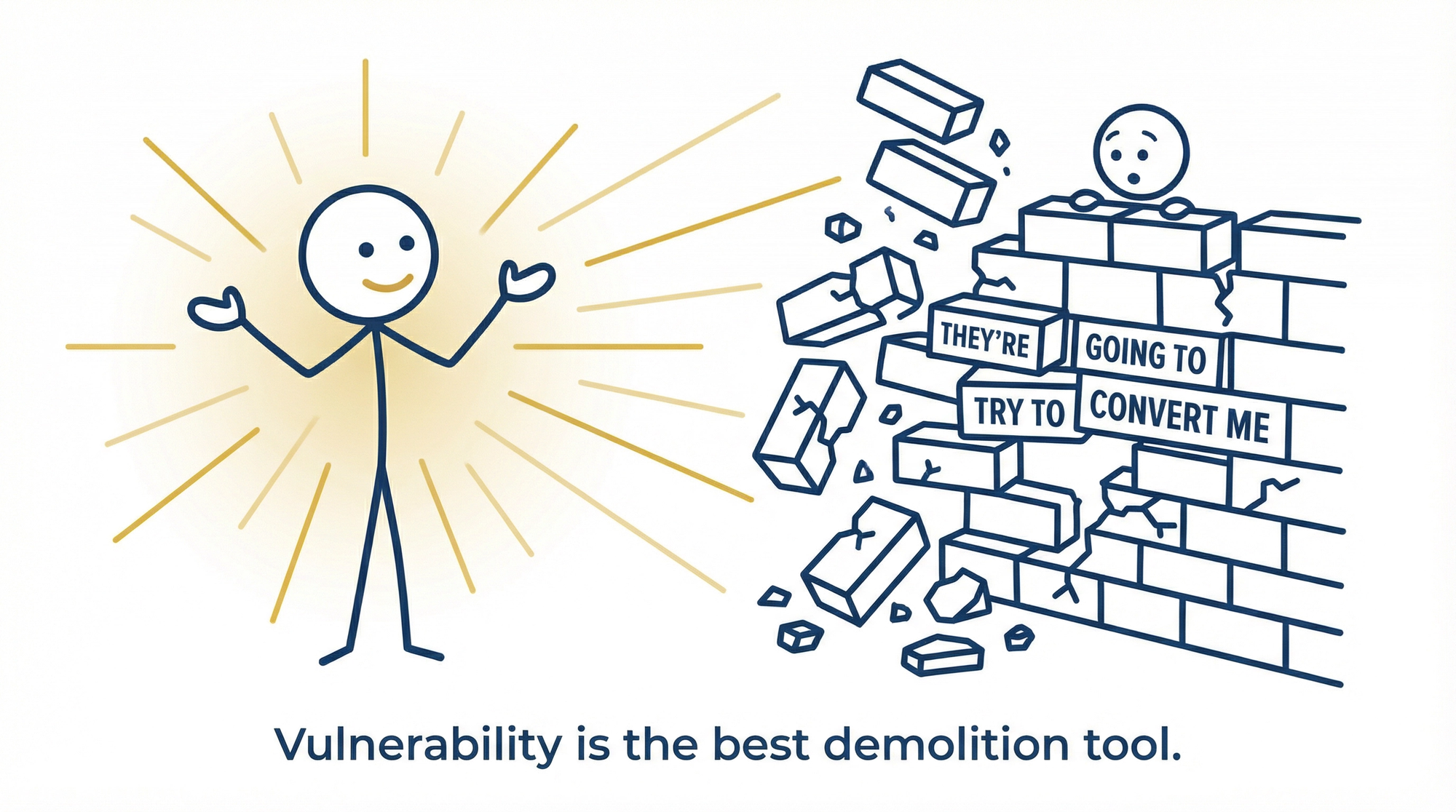
This is the Personal Testimony approach, and it works because of one powerful ingredient: vulnerability.
When you offer to share your story while explicitly promising you're not trying to convert anyone, you disarm the biggest fear in the room. Every Protestant who's ever talked to an enthusiastic Catholic has, at some point, felt like they were on the receiving end of a sales presentation. And nobody likes feeling sold to.
By naming that fear and taking it off the table, you create space for a real conversation.
What happens next: Share your conversion story or your journey deeper into Catholicism. Focus entirely on the positive attractions. What moved you. What surprised you. What you discovered that you didn't expect. End with an open question: "Does any of that resonate with you, or does it sound completely foreign?"
That last question is gold. It gives them permission to engage honestly without feeling like there's a right answer.
Opener #4: "What Do You Think Those First Christians Were Doing?"
This is the Historical Wonder approach, and it's the most intellectually potent of the five.
Here's why: it bypasses personal beliefs entirely and goes straight to shared curiosity about history. You're not asking what they believe. You're asking what they think the early Church looked like. And that's a fascinating question that most thoughtful Christians have wondered about.
The beauty of this opener is that the early Church is actually Catholic territory. The early Christians celebrated the Eucharist as the real Body and Blood of Christ. They had bishops. They had apostolic succession. They baptized infants. They prayed for the dead. They venerated Mary. But you don't need to point any of that out. You just need to explore the question together and let them discover the similarities on their own.
What happens next: Explore early Church practices together. Read some quotes from the Church Fathers. Let them encounter Ignatius of Antioch writing about the Eucharist around 107 AD. Let them read what Irenaeus said about apostolic succession around 180 AD. Let the Fathers do the talking. The question that naturally emerges is: "Which modern church looks most like that one?"
You don't even need to answer it. Just let it sit there.
Opener #5: "Would You Be Up for a No-Agenda Conversation About Our Traditions?"
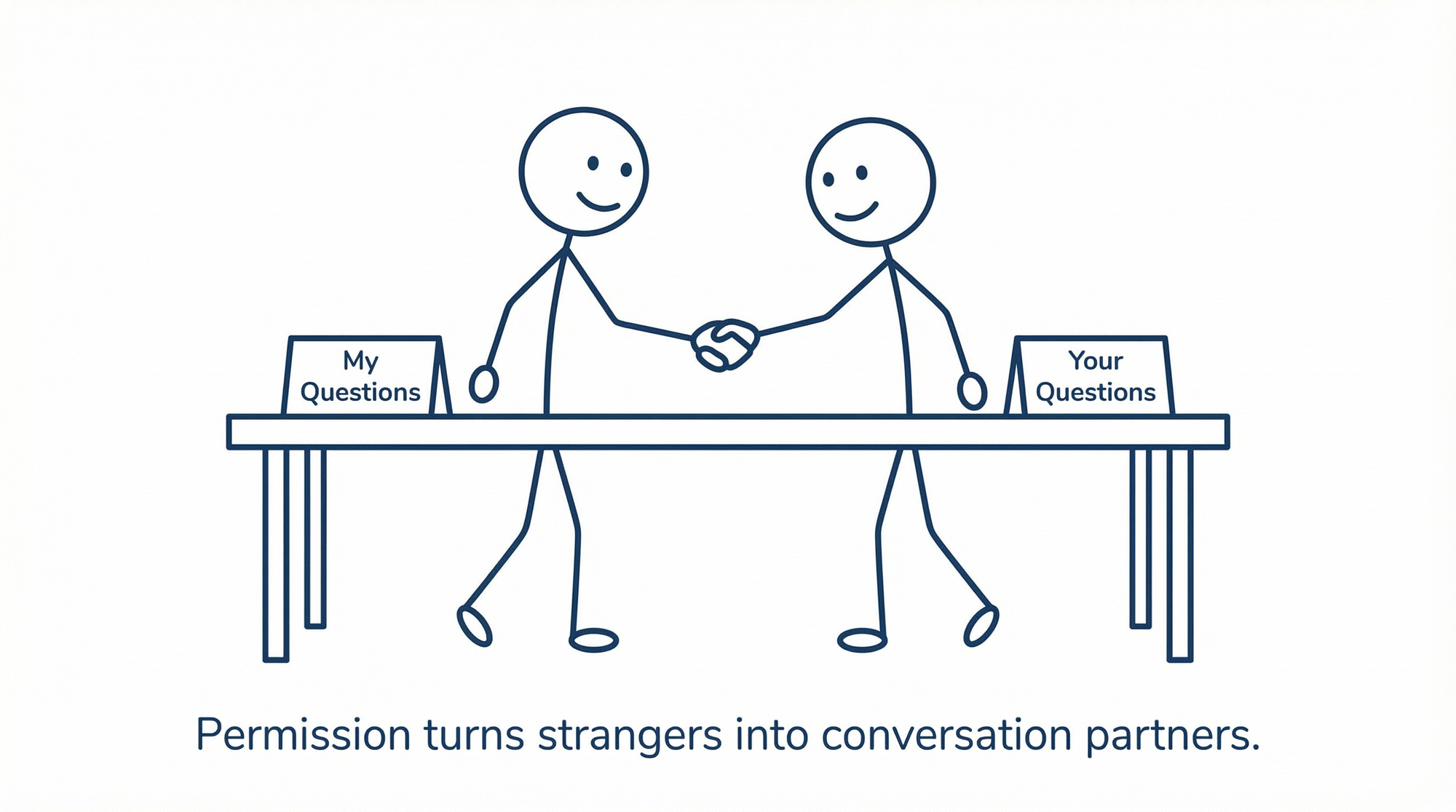
This is the Permission-Based approach, and it works because it respects autonomy so completely that it's almost impossible to say no to.
Think about it. You're explicitly framing this as mutual learning. You're not positioning yourself as the teacher and them as the student. You're not even hinting that you have an agenda. You're asking permission, which in a culture where religious conversations often feel like ambushes, is deeply refreshing.
What happens next: Take turns. Let them go first with their questions. Answer honestly, including when the honest answer is "I don't know, let me look into that." Build understanding before seeking to be understood. This approach is slower, but it builds the kind of trust that leads to the deepest conversations.
OK, the Door Is Open. Now What? The Gentle Art of Catholic Defense
So you've used one of these openers. The conversation is rolling. They're curious. You're sharing. And then they say something like:
"Yeah, but where is [insert Catholic doctrine] in the Bible?"
This is the moment where most Catholics either panic or go nuclear. Neither works.
Here's the move: instead of defending, redirect with a question.
This is where we borrow from Greg Koukl, a Protestant apologist who wrote the book (literally) on having better faith conversations. His framework, laid out in his book Tactics, is so good that Catholics should absolutely steal it.
The Columbo Tactic: Ask, Don't Tell
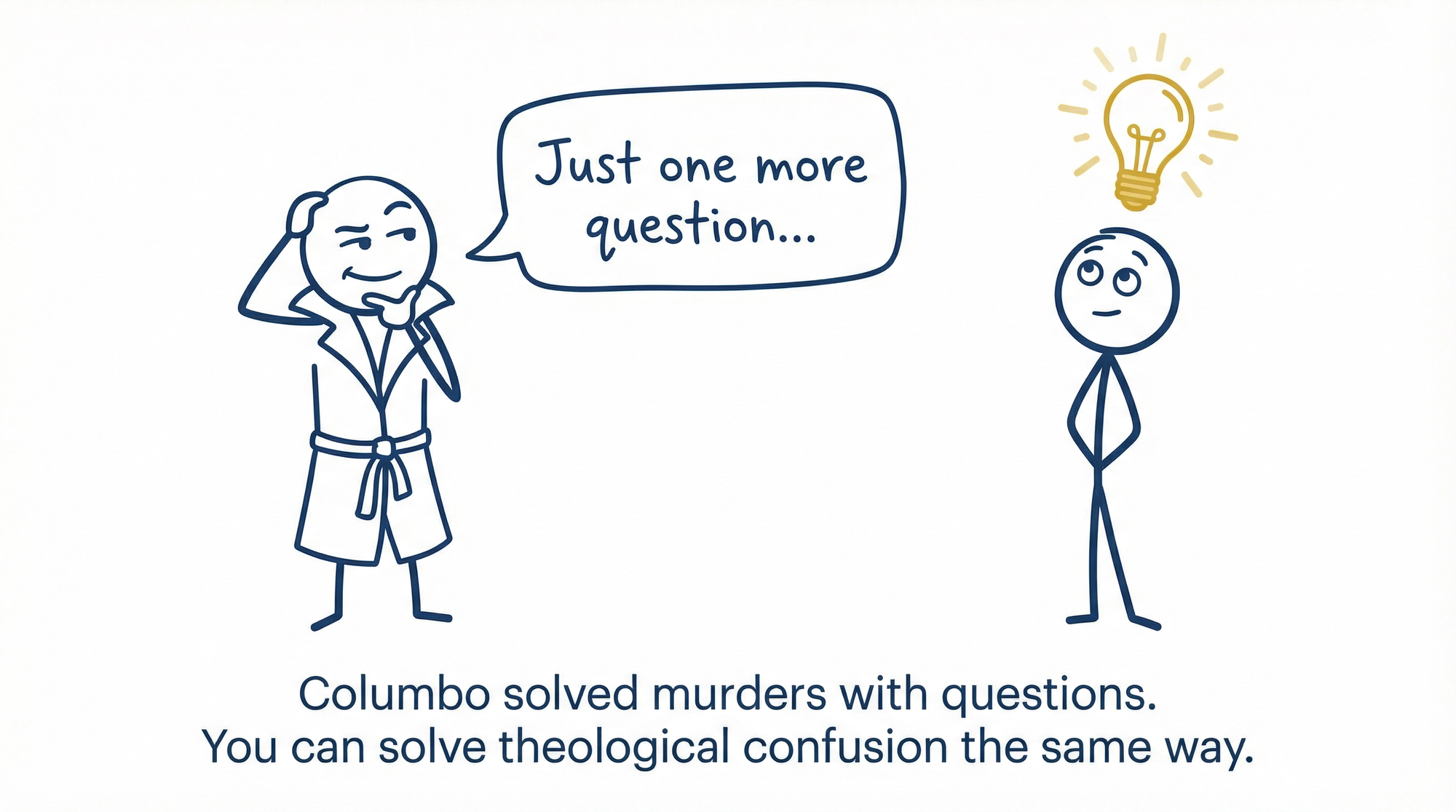
Koukl named this after the TV detective who solved every case by looking confused and asking one more question. The principle is simple: go on the offensive in an inoffensive way by using carefully selected questions to move the conversation forward.
The two core Columbo questions are:
"What do you mean by that?" This question is your best friend. When someone says "Catholics added books to the Bible" or "the Catholic Church corrupted the original faith," this question forces them to define their terms and actually think through what they're claiming. Half the time, people are repeating something they heard somewhere and haven't actually examined the claim themselves.
"How did you come to that conclusion?" This reverses the burden of proof. Instead of you scrambling to defend Catholic teaching, the person making the claim now has to support their own assertion. And here's what you'll discover: most people don't have an argument behind their claim. They have an impression. There's a massive difference.
These two questions keep you in the driver's seat without being aggressive. You're just curious. You're just asking. But the questions do real intellectual work.
Why Questions Beat Arguments
Here's what most of us don't realize: when you make a statement, the other person's brain goes into evaluation mode. "Is this true? Do I agree?" They're already looking for reasons to disagree.
But when you ask a question, their brain goes into a completely different mode. They start thinking. Searching. Processing. They're working through the problem themselves instead of defending against your conclusion.
Questions also do something sneaky: they expose weak foundations without you having to point them out. When someone says "the Bible is the only authority" and you ask "How did you come to that conclusion?" they have to grapple with the fact that the Bible itself never makes that claim. You didn't tell them that. They discovered it while trying to answer your question.
That's ten times more powerful than any argument you could make.
What Happens When It Gets Heated? Koukl's Playbook for Hard Moments
Even with the best openers and the gentlest approach, some conversations get adversarial. Maybe they had a bad experience with a Catholic priest. Maybe they've been told their whole life that Catholicism is a cult. Maybe they're just passionate and passionate people get loud.
Here's what to do.
The Stone in the Shoe Principle
Koukl's most liberating insight is this: your goal is NOT to convert anyone in a single conversation. Your goal is to place a stone in their shoe. Give them something worth thinking about. Something they can't quite shake. Something that keeps poking at them long after the conversation ends.
This completely changes the pressure dynamic. You don't need to "win." You don't need to address every objection. You don't need to have the last word. You just need to leave them with one good thought they didn't have before.
That might be: "Huh, I never thought about how we got the Bible in the first place."
Or: "I didn't realize the early Christians believed in the Real Presence."
Or even just: "That Catholic person was really kind and thoughtful. Maybe I was wrong about what they believe."
One stone. One shoe. Let God handle the rest.
Dealing with Steamrollers
Some people don't want a conversation. They want a firing range. Koukl calls these folks "steamrollers," and they show up as rapid-fire objections, interruptions, and a general refusal to let you finish a sentence.
Here's the three-step response:
Step One: Stop and ask for time. A simple "I'd love to answer that, but could I finish my last point first?" works. Most people will self-correct when they realize what they're doing.
Step Two: Name the pattern. If they keep rolling, calmly say, "I notice you've asked me three questions without letting me answer any of them. I'm happy to work through each one, but I need you to let me respond." This isn't confrontational. It's just honest.
Step Three: Gracefully exit. If they can't or won't stop steamrolling, it's OK to say, "I think we're both too fired up to have a productive conversation right now. Can we pick this up another time?" There's no dishonor in a strategic retreat. You can't plant a stone in a shoe that's kicking you.
When the Theology Gets Too Deep
Sometimes a conversation gets into territory where you're genuinely out of your depth. Maybe they bring up Second Temple Judaism's impact on soteriology. Maybe they're quoting the original Greek and you're not sure if they're right.
This is not a crisis. This is an opportunity.
The single best thing you can say is: "That's a great point. I honestly don't know enough about that to respond well. Can I look into it and get back to you?"
This does three things simultaneously. First, it shows intellectual honesty, which builds massive credibility. Second, it gives you time to actually research the question and come back with a solid answer. Third, it creates a reason for a follow-up conversation. You just guaranteed another meeting.
Never bluff. Never fake expertise you don't have. The fastest way to lose credibility (and hurt the Church's witness) is to confidently state something that turns out to be wrong.
The Self-Defeating Statement Detector
One more Koukl tactic worth knowing: learn to spot self-defeating statements. These are claims that, when applied to themselves, fall apart. Koukl calls this the "Suicide" tactic (because the argument defeats itself).
In Catholic-Protestant conversations, you'll hear these more often than you'd expect:
"No human authority can tell me what the Bible means." (But... who told you that? Some human authority, presumably.)
"We only follow what's in the Bible." (Where does the Bible say to only follow what's in the Bible?)
"Tradition is unreliable." (How do you know which books belong in your Bible? A tradition handed down by the early Church councils.)
You don't need to drop these like bombs. Just ask the question gently: "That's interesting. Does that rule also apply to itself?" Let the logic do the work. It's much more effective when they see the problem themselves than when you point it out.

The One Rule That Governs Everything Else
If you take nothing else from this article, take this: the person across from you is not an opponent. They are a fellow Christian who loves Jesus and is doing their best to follow Him faithfully. They deserve your respect, your patience, and your genuine interest in their story.
The Catechism itself (paragraph 818) acknowledges that many elements of truth and sanctification exist outside the visible boundaries of the Church. The Second Vatican Council's decree on ecumenism, Unitatis Redintegratio, explicitly calls Protestants "separated brethren" and recognizes the work of the Holy Spirit in their communities.
You're not talking to enemies. You're talking to family members you haven't fully reconciled with yet.
If you remember that, everything else flows naturally. The openers work because they come from a place of genuine love. The Columbo questions work because they come from real curiosity. The graceful exits work because you actually care more about the relationship than about scoring points.
St. Francis de Sales, one of the greatest evangelists in Church history, won back tens of thousands of Calvinists in 16th-century Geneva. His secret wasn't superior arguments (though he had those too). His secret was patience, charity, and genuine affection for the people he was talking to.
He once wrote that you catch more flies with a spoonful of honey than with a barrel of vinegar. Five centuries later, that's still the whole game.
Quick Reference: Your Conversation Cheat Sheet
Before the conversation:
Pick the opener that fits your personality and the relationship. The Curious Learner (#1) is the safest default. The Historical Wonder (#4) is strongest for intellectual types.
During the conversation:
Lead with questions, not statements. Use Koukl's Columbo questions ("What do you mean by that?" and "How did you come to that conclusion?") whenever you feel the urge to argue. Listen more than you speak, especially early on.
When things get tense:
Remember the stone in the shoe. You only need one good thought to land. Name steamroller behavior calmly if it happens. Never be afraid to say "I don't know, let me look into that."
After the conversation:
Follow up. If you promised to research something, actually do it. Send a text: "Hey, I really enjoyed our conversation. Here's what I found about that question you raised." This builds the kind of trust that leads to deeper dialogue over time.
FAQ
Do I need to be a theology expert to have these conversations?
Not even close. The five openers in this article work precisely because they don't require you to be an expert. You're leading with curiosity and questions, not lectures. That said, the more you learn about your own faith, the more confident you'll feel. Start with the Catechism and a good intro like Karl Keating's Catholicism and Fundamentalism. [EXTERNAL: Link to Karl Keating's book]
What if they bring up the sex abuse scandals?
Don't deflect, don't minimize, and don't change the subject. Acknowledge that real evil happened, that it was a profound betrayal, and that the Church has work to do. You can also gently note that the sins of individual members don't disprove the truth of Catholic teaching any more than Judas disproved Jesus. But lead with compassion here, not apologetics.
Is it OK to use Greg Koukl's tactics even though he's Protestant?
Absolutely. Truth is truth regardless of its source. Koukl's conversational principles are based on good logic and human psychology, not on any particular theology. Catholics have been borrowing good ideas from thoughtful Protestants (and vice versa) for centuries. Aquinas himself built extensively on the work of the Muslim philosopher Averroes. Use what works.
What if I genuinely can't answer their objection?
Say so. "I don't know, but I'll find out" is one of the most powerful sentences in apologetics. It shows intellectual honesty and creates a reason for continued conversation. Then actually do the research and follow up.
Should I give them Catholic books or resources?
Only if they ask, or if the relationship has developed to a point where it would feel natural. Unsolicited book-giving can feel pushy. A better move is to mention a book or resource casually: "I read this thing by Scott Hahn that really helped me understand that. I can send you the title if you're interested." Let them opt in.
What about online conversations? Do these openers work on social media?
The principles transfer, but the medium is harder. Online conversations lack tone of voice, facial expressions, and the natural pacing of in-person dialogue. Everything reads more aggressively in text. If you're going to engage online, double your kindness, halve your word count, and resist the urge to have the last word. The stone-in-the-shoe principle is even more important online because you almost never get to see the fruit.
How do I handle a family member who's anti-Catholic?
With extra patience and extra love. Family dynamics add layers of complexity that stranger conversations don't have. The Permission-Based opener (#5) often works best here because it explicitly removes any sense of agenda. And remember: you'll have many more conversations with a family member than with a stranger. You can afford to play the long game.
Your Move
Try one of these openers this week. Just one. Pick the one that fits your personality and the next opportunity God puts in front of you. You don't need to be ready for every possible objection. You just need one good question and a genuine willingness to listen.
And if you want to go deeper, grab a copy of Greg Koukl's Tactics and Karl Keating's Catholicism and Fundamentalism. One teaches you HOW to have the conversation. The other gives you the WHAT. Together, they'll make you the kind of Catholic that Protestants actually want to talk to.
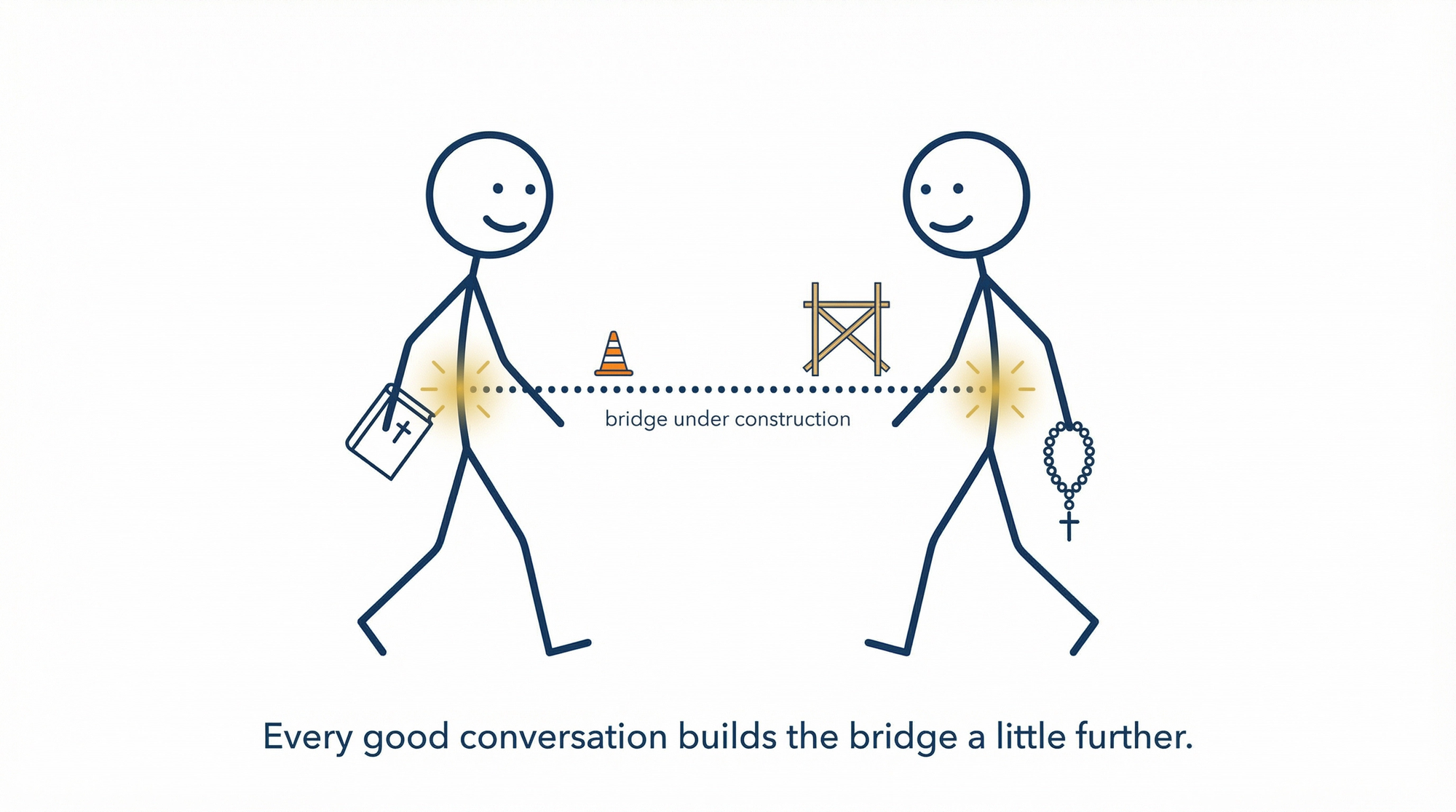
That's the goal. Not winning arguments. Building bridges.
Now go have a conversation.