

It is a fair question.
And if you have ever asked it, you are in good company, because Christians have been wrestling with it for two thousand years.
Ironically, it's one of the easiest objections to Catholicism we have. Scripture is very much on our side with this one. But because it is so stubbornly simple many just keep looking right past it.
Let's get into it...
The Thing Everyone Already Believes
Here is what is interesting. Almost nobody actually has a problem with confessing sins to another person. We do it all the time.
You tell your best friend what you did last weekend. You sit across from a therapist and unpack years of regret. You call your mom and admit you were wrong. You look your spouse in the eye and say the three hardest words in the English language: "I was wrong."
Nobody calls any of that weird. In fact, we call it healthy. We call it brave. We fill entire bookshelves with self-help books about the power of vulnerability and the freedom of radical honesty.
So the real question is not whether we should confess to another human being. We already do. ALOT! The real question is whether there is something different about confessing to a priest. Whether something happens in that little booth that does not happen in a therapist's office or over coffee with a friend.
The Church says yes.
And the reason is not what most people think.
What Is Actually Happening in That Booth
The most common misunderstanding about Confession is that you are telling your sins to a MAN and asking that MAN to forgive you.
That is not what is happening. Not even close.
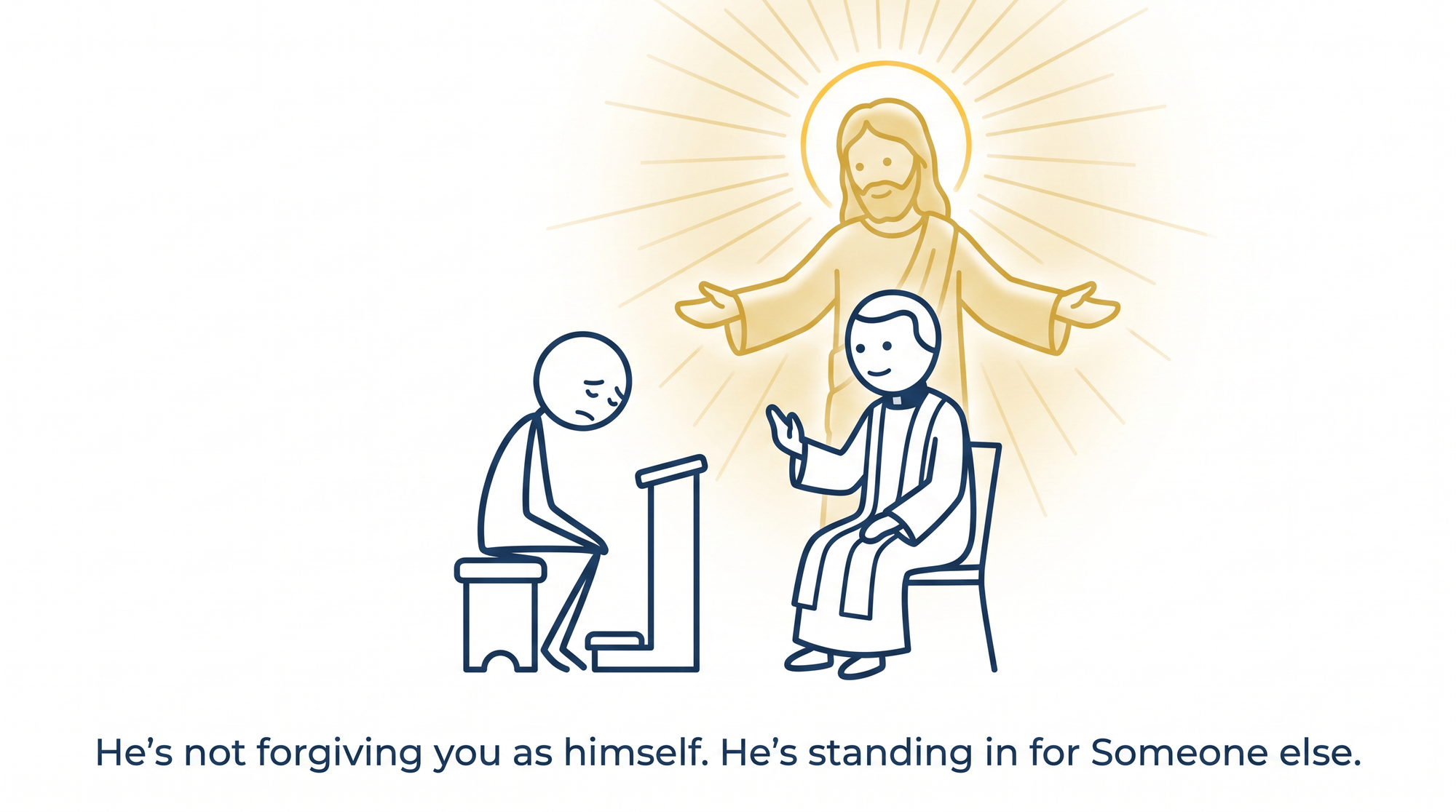
When a priest hears your confession, he is not acting as himself. He is not Joe from the parish who likes football and drinks his coffee black.
He is acting in persona Christi.
That's a Latin phrase that means "in the person of Christ." He is standing in for Jesus. Not symbolically. Not metaphorically. The Church teaches that Christ Himself is present in that sacrament, working through the priest the way a king works through an ambassador.
Ok so then we literally don't need the priest, we CAN just pray right to Jesus???
Hold on, hold on, let me finish. I'm about to show you the scripture that puts a nail in this argument...
The Catechism puts it plainly:
"In the ecclesial celebration of this sacrament, the faithful exercise the office of reconciliation by the intervention of the Church... the priest, who by virtue of the sacrament of Holy Orders has the power to forgive sins 'in the name of the Father, and of the Son, and of the Holy Spirit.'" (CCC 1448)
And St. Paul described it the same way two thousand years ago:
"All this is from God, who reconciled us to himself through Christ and gave us the ministry of reconciliation... We are therefore Christ's ambassadors, as though God were making his appeal through us." (2 Corinthians 5:18, 20)
An ambassador does not speak for himself. He speaks for the one who sent him. When the priest says "I absolve you," the "I" is Christ. The priest is the instrument. God is the musician.
Scripture Takes It Even Further
If you have spent any time in conversations about Confession, you have probably heard someone say, "Show me where that is in the Bible."
Fair enough.
Let us look.
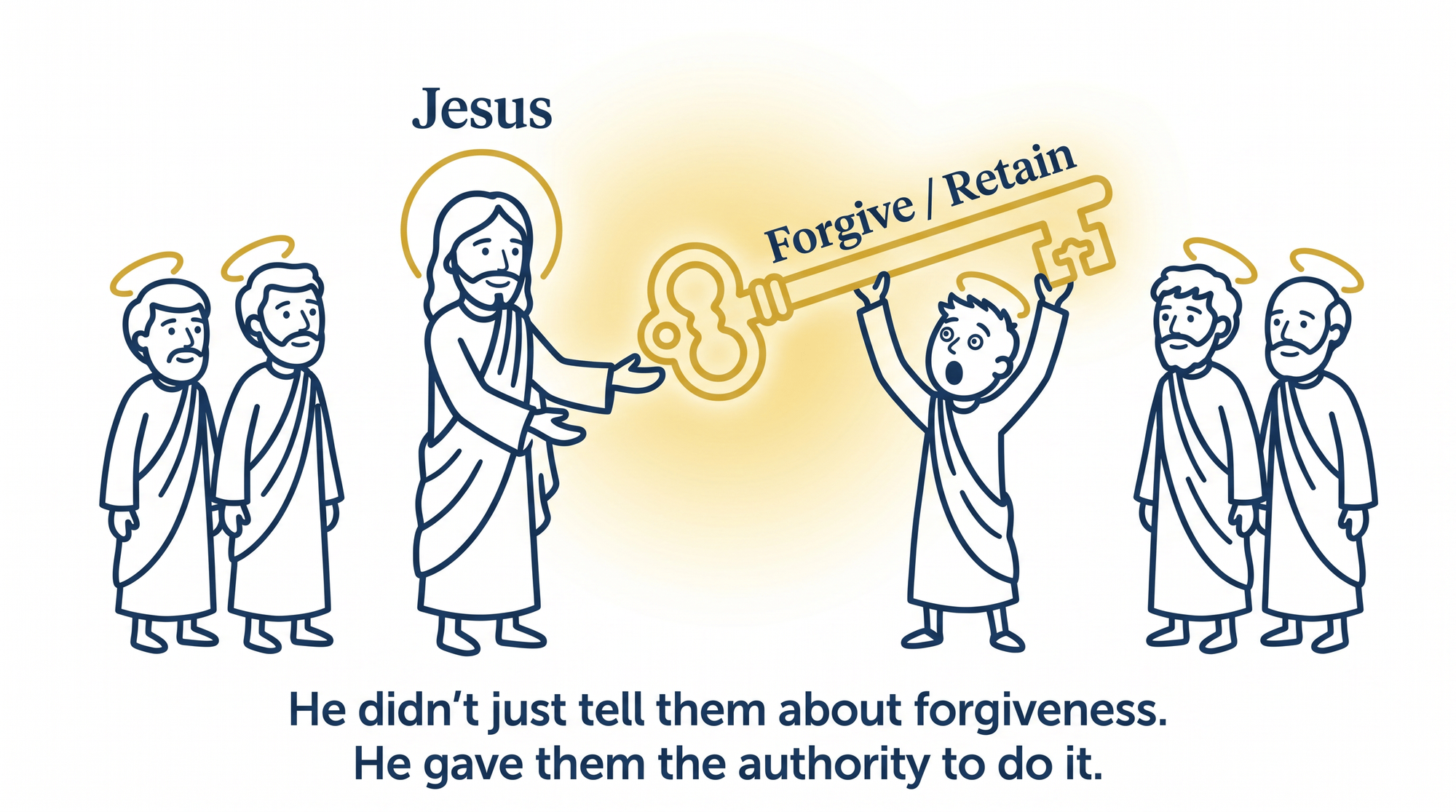
The evening of the Resurrection, Jesus appeared to His apostles in a locked room. He breathed on them and said something extraordinary:
"Peace be with you. As the Father has sent me, even so I am sending you." And when he had said this, he breathed on them and said to them, "Receive the Holy Spirit. If you forgive the sins of any, they are forgiven them; if you withhold forgiveness from any, it is withheld." (John 20:21-23)
Read that again slowly. Jesus did not say, "Tell people I forgive them." He said, "If you forgive sins, they are forgiven. If you retain them, they are retained."
So we already confess to our friends, our therapists, to judges. Confession to another human clearly isn't a problem. And scripture just said "If you forgive the sins of any, they are forgiven them; if you withhold forgiveness from any, it is withheld."
Jesus said "The father sent me." Then he says "I am sending you" to the apostles. (John 20:21) And the apostles choose their successors (Paul > Timothy).
All authority comes from God the Father, 100%.
However, the Father passes it to His Son, His Son passes it to the Apostles, and the Apostles pass it to their successors.
Ireneaus, an early Bishop, was a direct disciple of of John. Clement was chosen by Peter and Paul. There is a chain of apostolic succession where this authority to forgive sins is passed down generation after generation to your local Catholic bishop and priests today.
You can literally trace the lineage back with your own research.
Now here is the question that changes everything: How can the apostles forgive or retain sins if they never hear them?
Think about it. If a judge has the authority to acquit or convict, he has to hear the case first. You cannot render a verdict on evidence you have never seen. Jesus gave His apostles a real authority, an authority that requires real knowledge of what is being confessed. That is not a metaphor. That is a job description.
The Letter of James drives the point further:
"Therefore confess your sins to each other and pray for each other so that you may be healed. The prayer of a righteous person is powerful and effective." (James 5:16)
And in Matthew's Gospel, Jesus tells His apostles directly:
"Truly I tell you, whatever you bind on earth will be bound in heaven, and whatever you loose on earth will be loosed in heaven." (Matthew 18:18)
Binding and loosing. Forgiving and retaining. This is not vague spiritual language. It is the delegation of real authority from God to specific people for a specific purpose.
Even The Reformers Kept Confession
Here is a detail that surprises almost everyone, including most Protestants.
Martin Luther, the man who nailed 95 theses to a church door and launched the Reformation, did not throw out Confession.
Luther kept it. He valued it. He wrote about it with striking warmth.
In his Small Catechism, Luther taught:
"Confession has two parts. First, that we confess our sins, and second, that we receive absolution, that is, forgiveness, from the pastor as from God Himself, not doubting, but firmly believing that by it our sins are forgiven before God in heaven."
Read that last part again: "from the pastor as from God Himself."
Luther understood that something real was happening when a minister pronounced absolution. He did not want to abolish Confession. He wanted to reform the abuses around it.
In his explanation of the Office of the Keys, Luther wrote:
"When the called ministers of Christ deal with us by His divine command... this is just as valid and certain, even in heaven, as if Christ our dear Lord dealt with us Himself."
Luther defended private confession publicly as late as 1532, writing to the city of Frankfurt to urge them not to abandon the practice. The irony is thick. The man who is often credited with ending Confession actually fought to keep it.
So if someone says, "Confession is just a Catholic invention," you might gently point out that the founder of Protestantism disagreed.
Science Says Your Body Needs Confession
Set aside theology for a moment.
Set aside Scripture and tradition and Church authority. Look at it from a purely science angle.
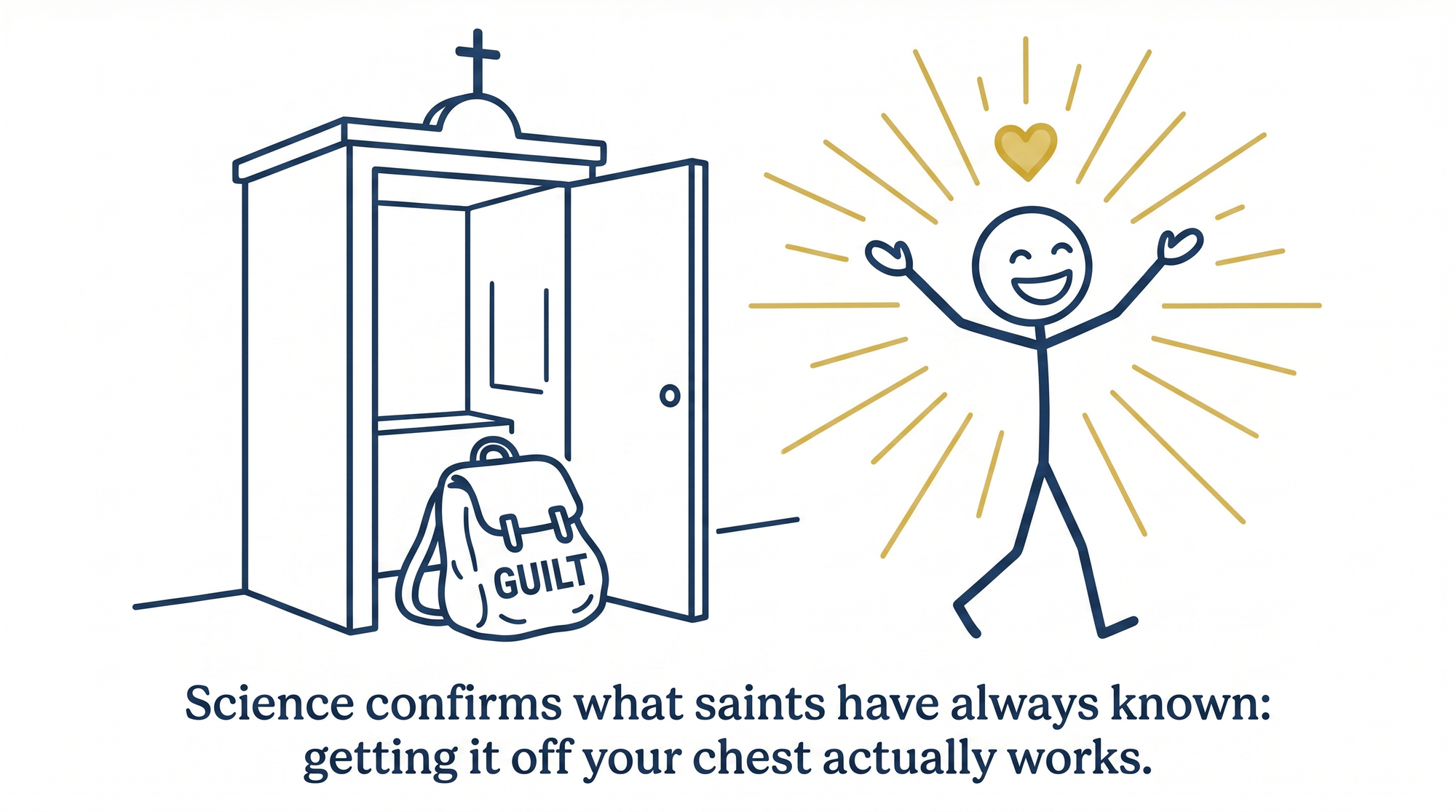
Confession is good for you. Your body knows this even if your theology has not caught up yet.
Dr. James Pennebaker at the University of Texas has spent decades studying what happens when people disclose painful secrets.
His research consistently shows that putting our burdens into words, out loud, to another person, produces measurable physical and psychological benefits: improved mood, reduced distress, fewer doctor visits, and even improved immune function.
Researchers at the University of Birmingham found similar results. Self-disclosure, the act of telling someone else what you have been carrying, leads to improved sleep, fewer physical symptoms, and better mental health.
And the opposite is also true. Keeping secrets creates chronic stress, forces the brain into constant rumination, and depletes cognitive resources. Your brain was not designed to carry the weight of hidden guilt indefinitely. It will eventually buckle under the load.
This is not some new discovery.
The Church has been prescribing this medicine for two thousand years. The sacrament of Confession is, among other things, a divinely designed exhale. It is God saying, "You were not built to carry this alone. Let Me take it from you. And I have arranged for you to feel it leave."
Every therapist in the world will tell you that talking about your problems helps.
The Catholic Church agrees.
It just adds one thing the therapist cannot: actual absolution. Not "I validate your feelings." Not "You should forgive yourself."
"Your sins are forgiven. Go in peace."
What Confession Looks Like in Real Life
So what does all of this actually look like for you, today, in your actual life?
If you are a parent, Confession models something powerful for your children. It teaches them that even adults make mistakes, that forgiveness is real and available, and that there is never a sin too big for God's mercy. Taking your kids to Confession normalizes the practice and gives them a spiritual habit that will serve them for the rest of their lives.
If you are a young adult consider this: every generation discovers that bottling up guilt does not work. Therapy helps. Journaling helps. But the sacrament offers something nothing else can, the actual words of absolution spoken by someone with the authority to say them. You do not have to wonder if God forgives you. You hear it, out loud, with your own ears.
If you have not been to Confession in years (or decades), know that you will not be the first person to walk in after a long absence. Priests hear it every week. "Father, it has been twenty years since my last Confession." And the priest does not gasp. He does not lecture. He sits there in the person of Christ and he listens. That is his whole job.
If you are in religious life or discerning a vocation, the saints are unanimous: frequent Confession is the fuel of the spiritual life. Not because priests and nuns sin more than everyone else, but because they understand that the closer you draw to the light, the more clearly you see the dust.
Where to Go From Here
If this article stirred something in you, here are a few next steps worth considering.
Go to Confession. Most parishes offer it on Saturdays, and many have additional times during the week. If it has been a while, you can say so. The priest will help you through it. You do not have to have your act together first. That is literally the point.
Read the Catechism on Reconciliation. Paragraphs 1422 through 1498 walk through the entire sacrament with clarity and beauty. It is not as dense as you might expect.
Pick up a book. Scott Hahn's Lord, Have Mercy is an accessible, deeply personal exploration of Confession from a former Protestant pastor who became Catholic. Fr. Mike Schmitz also has excellent short videos on Confession that are perfect for anyone who learns better by watching than reading.
Frequently Asked Questions
Why can't I just confess my sins directly to God?
You can, and the Church encourages a daily examination of conscience and personal prayer of repentance. But Christ established a sacrament with real authority to forgive sins through the apostles (John 20:21-23). In emergencies with no priest available, a perfect act of contrition with the intention to confess later is fully valid. The sacrament exists not to limit God's mercy but to give you certainty of it.
God see's your heart. If in your heart you're actually saying "I don't need any help" or "I don't accept what the scripture says" then are you really confessing? Are you truly repentant? Only god will know.
Do I have to confess every single sin to a priest?
The Church requires confession of all mortal sins (grave matter, full knowledge, deliberate consent) that you have not yet confessed. For my Protestant readers, mortal sins are sins where you have knowingly turned away from God. Yes, Jesus forgives all sins, but if you've knowingly turned away from God, then by your own free will you have left God not the other way around.
In love, please heed this warning, masturbation and fornication are grave matter. If you're doing them willingly while knowing God does not approve of these, you could be in mortal sin. Please be careful!
Venial sins (lies, anger, lustful thoughts) do not require sacramental confession and can be forgiven through the Confiteor at Mass, acts of charity, prayer, and reception of the Eucharist. However, many saints encouraged confessing venial sins regularly for spiritual growth.
What if I am too embarrassed to confess something?
Priests have heard everything. Even murders! They are bound by the Seal of Confession, which is the strictest form of secrecy in the Church. A priest cannot reveal what he hears in Confession under any circumstances, not to police, not to bishops, not to anyone. They will be excommunicated. The embarrassment lasts a moment. The freedom lasts for eternity.
Did early Christians actually confess to priests?
Yes. The practice of confessing sins to leaders in the community dates to the earliest centuries of Christianity. The Didache (circa 70 AD), one of the oldest Christian documents outside the New Testament, instructs believers to confess their sins before gathering for the Eucharist. The practice developed in form over the centuries, but the substance has been present from the beginning.
Didn't The Reformation abolish Confession?
No. Martin Luther kept private confession and valued it highly. In his Small Catechism, he taught that believers should receive absolution from the pastor "as from God Himself." He objected to certain abuses and to the requirement of enumerating every single sin, but he defended the practice of confession and absolution throughout his life, including in a 1532 letter to the city of Frankfurt.