

Ok, this is going to get a little nerdy.
But I promise this is going to fill you up with so much faith because it shows us Jesus wasn't playing around when He said He was building this Church on solid rock.
When I was first exploring Catholicism, the Pope was one of the biggest stumbling blocks for me. I came from a Protestant background where the idea of one man having authority over the entire Church sounded... suspicious.
Where was this in the Bible? Where was this in history? Did Jesus really set this up, or was it something humans invented later?
I needed to know real answers. Not just "the Church says so" answers. I needed to see the evidence. All of it. The stuff that supports the claim AND the stuff that challenges it.
So I did something a little unusual. I used a tool from probability theory called Bayesian analysis to evaluate the historical evidence. And what I found didn't just answer my question. It transformed how I see the entire story of the Church.

What Is Bayesian Analysis (and Why Should You Care)?
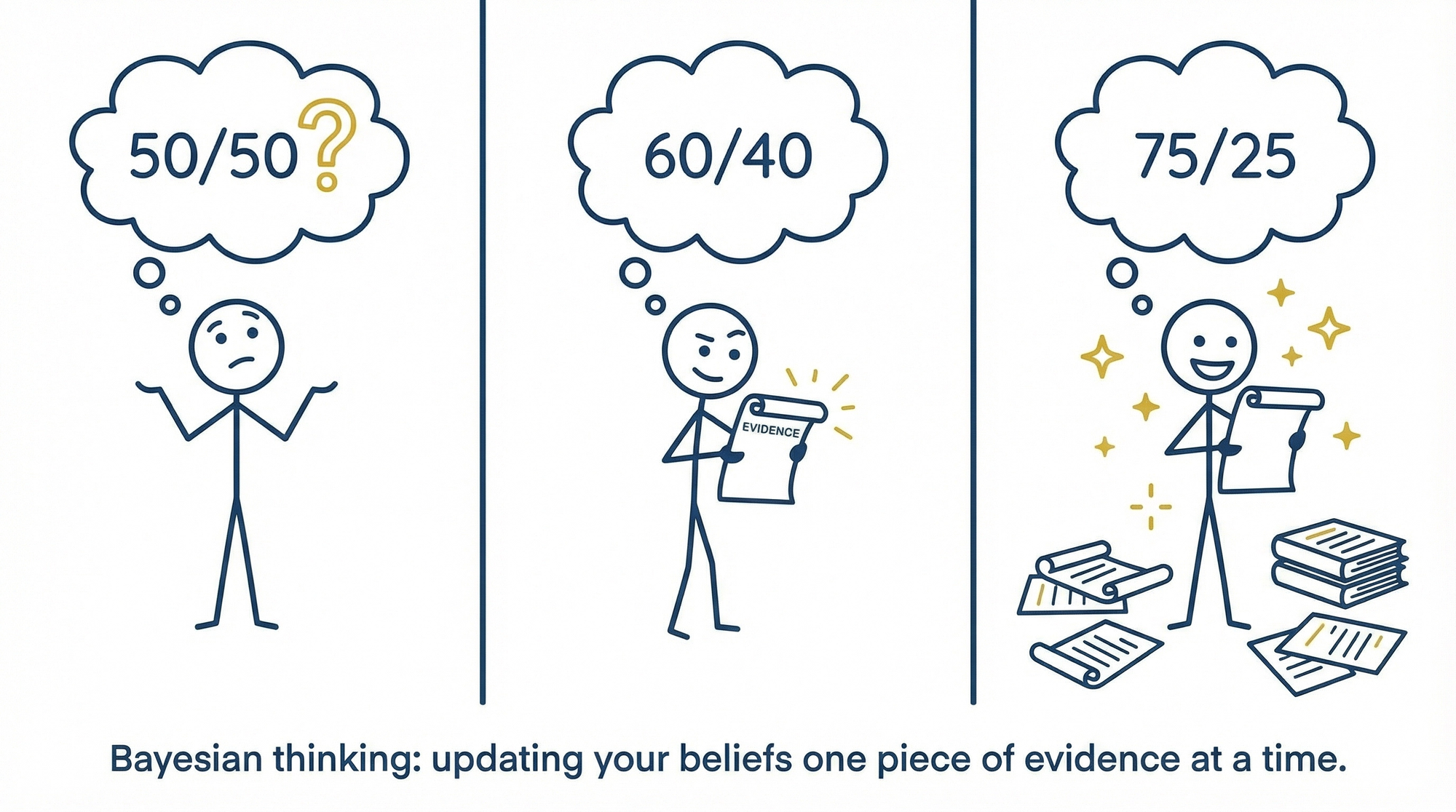
Here's the simple version. Bayesian analysis is a way of updating what you believe based on new evidence.
Imagine you hear a noise outside your house at 3 AM. Your first thought might be "it's a raccoon." That's your starting belief, what statisticians call a "prior." Now you look outside and see a person standing in your driveway. That's new evidence. So you update your belief. Now you think "maybe it's a neighbor." Then you see they're carrying a flashlight and walking toward your door. More evidence. You update again.
That's Bayesian reasoning. You start with a belief, encounter evidence, and adjust your confidence up or down based on what the evidence actually shows.
Scientists use it for medical research. Intelligence agencies use it for threat assessment. Detectives use it to solve cases.
I used it to figure out if the Pope is for real.
The basic idea is simple. You take a claim, like "The papacy has legitimate historical roots going back to Jesus and Peter." Then you look at each piece of historical evidence and ask: does this evidence make the claim MORE likely or LESS likely? By how much? When you add it all up, you get a probability. Not certainty. But a clear picture of where the evidence points.
The Evidence: Starting at the Very Beginning
Let's walk through the major evidence, starting where it all begins.
Jesus Gave Peter a Unique Role
This part is hard to argue with, no matter what tradition you come from. In the Gospels, Peter stands out. He is mentioned more than any other apostle. Jesus singled him out in ways He didn't single out anyone else.
The big one is Matthew 16:18-19:
"And I tell you, you are Peter, and on this rock I will build my church, and the gates of hell shall not prevail against it. I will give you the keys of the kingdom of heaven, and whatever you bind on earth shall be bound in heaven, and whatever you loose on earth shall be loosed in heaven." (Matthew 16:18-19)
Jesus changed Simon's name to Peter, which means "rock." He gave him the keys. He said He would build His Church on this rock. That's not something Jesus did for anyone else.
Then in John 21, after the Resurrection, Jesus told Peter three times to "feed my sheep."
"He said to him the third time, 'Simon, son of John, do you love me?' Peter was grieved because he said to him the third time, 'Do you love me?' and he said to him, 'Lord, you know everything; you know that I love you.' Jesus said to him, 'Feed my sheep.'" (John 21:17)
Three denials. Three restorations. Three commissions. Feed my lambs. Tend my sheep. Feed my sheep. Jesus was giving Peter a job. A specific, unique job: take care of my people.
Bayesian update: This is strong evidence. Even many Protestant scholars acknowledge that the most natural reading of Matthew 16 identifies Peter as the rock. Donald Hagner of Fuller Seminary, a Protestant institution, admits the "natural reading" is Peter as the rock. This evidence pushes our probability significantly toward the idea that Peter held a unique leadership role.
Within 30 Years of Peter's Death, Rome Was Already Acting Like It Was in Charge
Here's where it gets interesting.
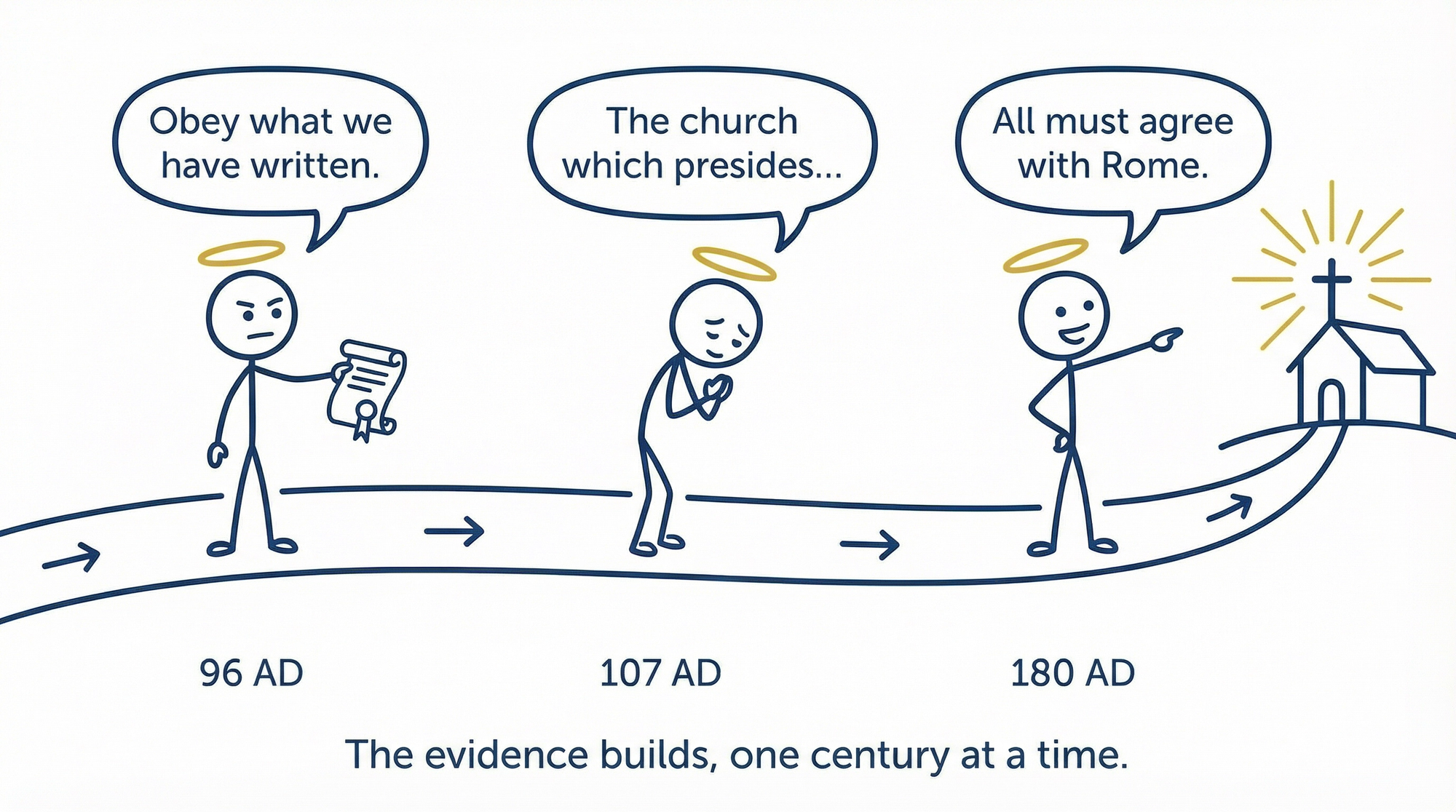
Around 96 AD, barely 30 years after Peter and Paul were martyred in Rome, the Church in Rome wrote a letter to the Church in Corinth. This letter, known as 1 Clement, did something remarkable. The Roman church stepped in to settle a dispute in a church hundreds of miles away. Without being asked. They sent the letter as though it was their duty to address the problem.
The letter says things like "accept our counsel" and warns those who disobey will "involve themselves in transgression and serious danger."
Now, was this a formal act of papal authority? Some scholars say no, it was more like fraternal concern. Fair enough. But here's what matters for our Bayesian analysis: a church in a distant city chose to intervene in another church's affairs as though it had responsibility to do so. And the Corinthians apparently accepted it.
That's not proof. But it's a data point. And it pushes the probability needle.
Bayesian update: Moderate evidence. Rome is already behaving like it has oversight responsibility for other churches, even if the precise nature of that authority is still taking shape.
Ignatius Called Rome "Presiding in Love" (107 AD)
About ten years after 1 Clement, Ignatius of Antioch was being transported to Rome for execution. On the way, he wrote letters to several churches. His letter to Rome is different from all the others. In every other letter, Ignatius gives instructions, names the local bishop, and speaks with authority. But to Rome? He's deferential. Almost reverent.
He calls the Roman church the one "presiding in love," a phrase that scholars have debated for centuries. Some say it means jurisdictional authority. Others say it just means Rome was generous and charitable. But notice what Ignatius does NOT do: he doesn't name a Roman bishop, and he doesn't boss them around.
Bayesian update: Weak to moderate evidence on its own. But it tells us something: Rome already had a special status that even a bishop from the other side of the empire recognized. The pattern is building.
Irenaeus Said Every Church Must "Agree With" Rome (180 AD)
By 180 AD, we get something much stronger. Irenaeus of Lyon, writing to combat false teachers, pointed to Rome as the touchstone of authentic Christian teaching:
"For it is a matter of necessity that every Church should agree with this Church, on account of its preeminent authority." (Irenaeus, Against Heresies, Book III)
Irenaeus wasn't writing a treatise on papal authority. He was fighting Gnostic heretics who claimed secret traditions from the apostles. His argument was simple: if you want to know what the apostles actually taught, look at the churches they founded. And Rome, founded by Peter and Paul, is the best example.
Was Irenaeus saying the Pope is infallible? No. But he was saying that Rome holds a unique position as the measuring stick for true teaching. That's significant.
Bayesian update: Moderate to strong evidence. By 180 AD, a bishop in France is pointing to Rome as the church every other church should align with. The probability continues to rise.
The Honest Part: Where the Evidence Gets Complicated
This is where I want to be really careful. Because if you look at the full picture, there are moments in early Church history that don't look great for the papal claim. And I think being honest about those moments actually makes the overall case stronger.
Early Rome Had a Team of Leaders, Not One Bishop
Here's a fact that even some Catholic scholars acknowledge: for the first 100 to 150 years, the Church in Rome was probably led by a group of elders rather than a single bishop. We call this "collegial governance." The lists of early popes that you see, Linus, Cletus, Clement, were compiled later. They may represent prominent leaders within the group rather than individual monarchs.
Does this disprove the papacy? No. And here's why.
Doctrines Develop Over Time. That's Normal.
Think about the Trinity. The word "Trinity" never appears in the Bible. The full doctrine wasn't formally defined until the Council of Nicaea in 325 AD, almost 300 years after Jesus. Does that mean the Trinity was invented in 325? Of course not. The reality of Father, Son, and Holy Spirit was there from the beginning. It just took time for the Church to find the precise language to express what was always true.
The same pattern applies to the understanding of Christ's nature (fully God AND fully human, defined at Chalcedon in 451 AD), to the canon of Scripture (not formally settled until the late 300s), and to dozens of other teachings.
Cardinal John Henry Newman, one of the greatest minds in Church history, showed that authentic doctrine develops like a living thing. The seed is planted at the beginning. It grows over centuries. The full flower looks different from the seed, but it's the same plant.
The papacy follows this exact pattern. Peter received a unique role from Jesus. Rome's special authority was recognized early. The precise language and structures took centuries to develop. But the seed was always there.
Bayesian update: The development of doctrine framework is critical. If you accept that doctrines legitimately develop (and most Christians do, since they accept the Trinity and the Biblical canon), then the gradual unfolding of papal authority fits a pattern we already trust.
Some Early Bishops Pushed Back Against Rome
Here's another complication. In the 200s, the bishop of Carthage, a man named Cyprian, who actually affirmed Peter's special role and called Rome "the principal church, whence episcopal unity has taken its rise," also pushed back hard when Rome tried to tell him how to handle a specific issue about baptism.
And the Eastern churches never accepted the full jurisdictional claims that Rome eventually made. This is, of course, what led to the Great Schism in 1054.
How do we handle this in our analysis?
Two ways. First, disagreeing about how authority is exercised is not the same as denying that authority exists. Cyprian affirmed Rome's primacy while disagreeing about a specific application. That's not unlike how Americans might disagree about what a president should do while still acknowledging the office is legitimate.
Second, the fact that these debates happened actually supports the idea that Rome was making authority claims early on. You don't resist something that doesn't exist. The pushback itself is evidence that Rome was already asserting a leadership role that others had to reckon with.
Bayesian update: This is honestly weak evidence against the full Catholic claim, maybe a 2:1 ratio against. But it's not devastating, because the resistance was to specific applications, not to Rome's special status itself. And the development principle accounts for the gradual clarification of how that authority works.
Pope Leo I: Where It All Came Together (440 AD)
If you want to see the moment where the early threads wove together into a clear picture, look at Pope Leo I. Around 440 AD, Leo articulated what had been developing for centuries: Peter lives and presides through his successors in Rome.
At the Council of Chalcedon in 451, after the bishops read Leo's teaching on Christ's nature, they declared: "Peter has spoken through Leo." This was a massive moment.
Bishops from across the Christian world, East and West, recognized that the Pope of Rome was speaking with Peter's authority.
Even scholars who don't accept the full Catholic claim acknowledge that Leo I represents a watershed moment. This is when what had been implicit became explicit. The seed planted by Jesus in Matthew 16 had grown into something the whole Church could see.
Bayesian update: Strong evidence. By the mid-400s, the Church is treating the Pope as Peter's successor with real authority. This isn't a medieval invention. It's a 5th-century recognition of something that had been growing for 400 years. [INTERNAL: Link to a Church Fathers or early Church article]
Running the Numbers: What Does the Evidence Actually Show?
Here's where the nerd in me gets excited.
When you lay out all the evidence and run a Bayesian analysis, the results depend on one crucial question: do you accept the principle that doctrines can legitimately develop over time?
If you do (and again, you probably already do if you believe in the Trinity), here's what the evidence shows:
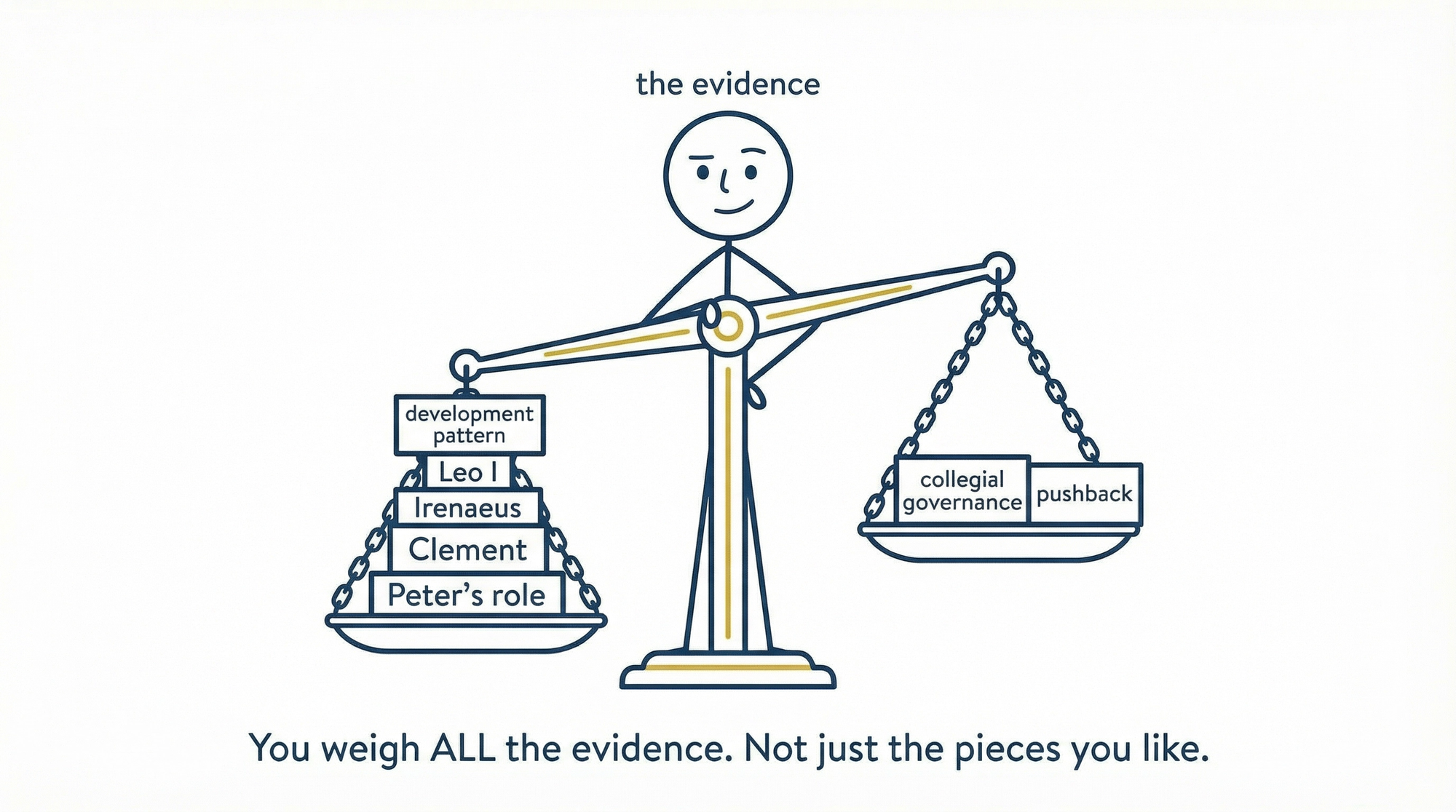
Peter's unique role in the Gospels: Very strong evidence for papal foundations. Almost everyone agrees Peter was special. (Probability push: strongly in favor.)
Rome's early behavior: From 96 AD onward, Rome acted like it had responsibility for other churches. By 180 AD, Irenaeus said every church should agree with Rome. (Probability push: moderately in favor.)
Development pattern: The gradual unfolding of papal authority matches how other core doctrines developed. Trinity, Christology, the Biblical canon, they all followed the same "seed to full flower" pattern. (Probability push: moderately in favor.)
Early resistance to jurisdictional claims: Some bishops pushed back on specific applications of Roman authority. (Probability push: mildly against.)
Collegial governance in early Rome: The first century or so didn't have a single bishop in Rome. (Probability push: mildly against, but explained by development.)
When you add it all up, the posterior probability lands somewhere between 55% and 75% in favor of the Catholic claim that the papacy has legitimate historical roots going back to Jesus and Peter.
That might not sound like a slam dunk. But here's what stopped me in my tracks: that's HIGHER than the probability threshold scientists use to publish research findings. And it's far higher than the alternative explanations.
The hypothesis that Rome just made it all up? The evidence doesn't support that. Rome's special status was recognized too early, too consistently, and by too many different sources for it to be a fabrication.
The hypothesis that Rome had honor but no real authority? That fits some of the evidence, but it can't explain why Rome kept intervening in other churches' affairs, why appeals kept flowing to Rome, and why the whole Church at Chalcedon said "Peter has spoken through Leo."

What This Means for You
You don't need to understand Bayesian analysis to take something away from this. Here's the simple version of what the evidence shows.
Jesus gave Peter a unique role. The early Church recognized Rome's special authority. That authority developed and clarified over centuries, the same way other core teachings developed. The evidence for the papal claim is stronger than the evidence against it. Not perfect. Not beyond all doubt. But stronger.
And that pattern of development? It's actually beautiful when you step back and see it. Jesus planted seeds. He trusted His Church, guided by the Holy Spirit, to cultivate those seeds over time. He didn't hand the apostles a fully written catechism. He gave them truth and trusted the process.
"I still have many things to say to you, but you cannot bear them now. When the Spirit of truth comes, he will guide you into all the truth." (John 16:12-13)
Jesus knew the full picture would take time. He designed it that way. And the story of the papacy, from Peter's commission to Leo's articulation to the Church today, is one of the most remarkable examples of that divine patience.
That's what filled me with faith. Not just that the Pope is legitimate. But that Jesus was so confident in His plan that He planted a seed in a fisherman named Simon and trusted it would grow into exactly what the Church would need, century after century, all the way to today.
He wasn't playing around when He said He was building this Church on solid rock.